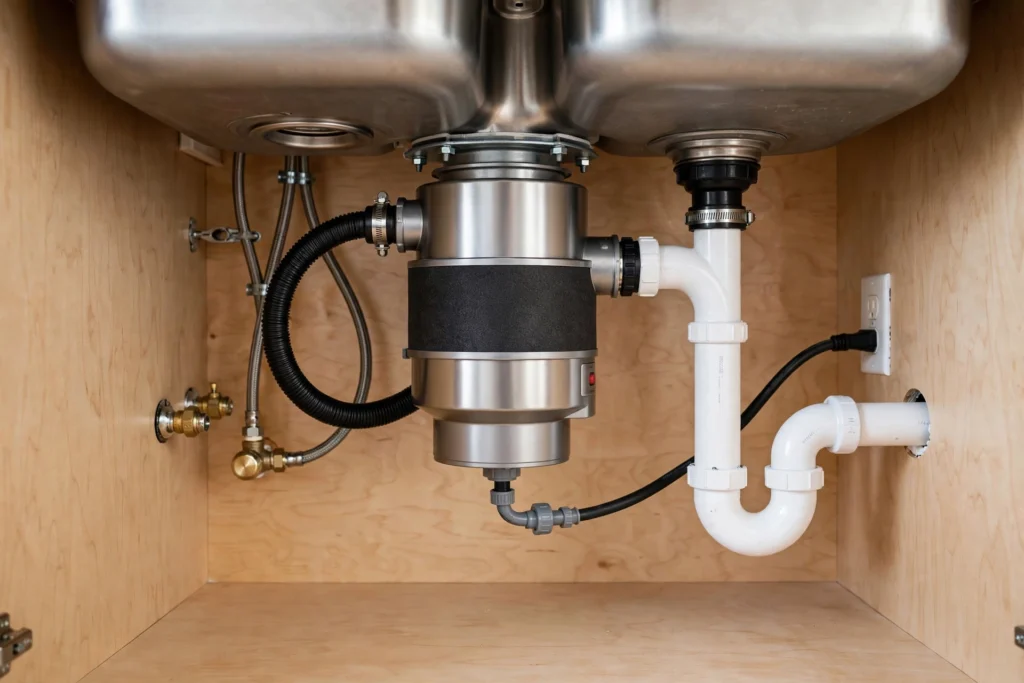
Updated October 2026. Replacing a garbage disposal is usually a small kitchen project, but the final bill can vary sharply depending on whether you are making a simple like-for-like swap or adding plumbing and electrical work. Current Angi data puts many professional replacements around $200 to $625, with an average near $550 and a broader reported range of roughly $150 to $950. A direct swap with an inexpensive unit can land below the average, while premium equipment, drain changes, sink-flange work, or electrical corrections can push the total higher.
That range is a planning benchmark, not a contractor quote. Current national consumer cost datasets put replacement in roughly the same band: HomeGuide reports about $200 to $550 for replacement with existing connections, while Angi reports professional replacement commonly around $200 to $625. Home Depot currently lists an average installation service cost of $189, with a $97 to $339 range, but that service assumes suitable existing plumbing and electrical connections and does not include new electrical boxes or components.
Garbage disposal replacement cost at a glance
| Project | Typical planning range |
|---|---|
| Basic unit only | $75–$150 |
| Midrange 1/2–3/4 HP unit | $100–$300 |
| Premium / quieter 1 HP unit | $175–$400+ |
| Replacement labor | $100–$250 |
| Typical replacement, unit + labor | $200–$625 |
| New installation where no disposal exists | Often $250–$650+, before unusual electrical/plumbing work |
These figures are national planning ranges assembled from current consumer cost guides and retailer installation pricing. Your local quote can be higher or lower because labor rates, access, code requirements, and the exact unit all matter.
What makes up the installed price?
The disposal itself is only part of the bill. For a normal replacement, you are paying for the new unit, removal of the old unit, installation labor, drain and dishwasher connections, electrical reconnection, leak testing, and cleanup. HomeGuide currently estimates a new disposal at about $100 to $300 and replacement labor at roughly $100 to $250.
A direct swap is cheapest when the new disposal fits the existing sink flange or mounting system, the drain alignment works, the dishwasher hose is already correctly connected, and the existing electrical supply is suitable. Costs rise when the installer has to rebuild part of the drain, replace a corroded flange, change the trap position, add a cord or receptacle, or correct old wiring.
Cost by motor size
Horsepower affects both purchase price and how comfortably the disposal handles regular use. Current market data commonly puts 1/3- to 1/2-HP units at the budget end, 3/4 HP in the middle, and 1 HP or larger at the premium end. Angi’s 2026 data places 1/3- to 1/2-HP units around $50 to $225, 5/8- to 3/4-HP models around $120 to $310, and 1- to 1-1/4-HP models around $200 to $400.
For many households, 1/2 or 3/4 HP is the practical middle ground. Paying for a larger motor can make sense for a household that cooks frequently, but horsepower is not the only feature worth comparing. Sound insulation, stainless grinding components, warranty length, anti-jam features, physical dimensions, and compatibility with your existing mount can matter just as much.
Replacement versus a first-time installation
A replacement is normally cheaper because the sink, drain and electrical supply are already set up for a disposal. Installing one under a sink that has never had a disposal can require a new sink flange, drain reconfiguration, a switch or air-switch arrangement, and electrical work. HomeGuide places a new retrofit around $250 to $650 before unusually difficult modifications.
This distinction is important when comparing quotes. A $200 labor quote for a direct replacement and a $500 quote for a first-time installation are not necessarily inconsistent; they may describe very different scopes of work.
Hidden costs that can change the quote
Electrical work. If the existing connection is damaged, unsuitable, or must be changed to meet applicable local requirements, an electrician may be needed. Do not assume a retailer’s basic installation fee includes this work. Home Depot explicitly states that its standard disposal installation service does not install new electrical boxes or components.
Drain changes. A new disposal may place the discharge outlet at a different height. If the existing trap or drain cannot line up correctly, the plumber may need to alter the under-sink piping. Corroded metal piping can also turn a quick swap into a larger repair.
Dishwasher connection. If your dishwasher drains through the disposal, the installer needs to reconnect the hose correctly. A first-time connection can require additional parts and setup.
Old-unit removal. Removal is often included in a replacement quote, but not always. HomeGuide estimates removal during replacement at roughly $25 to $50 when itemized. Ask whether haul-away is included.
Permits and code corrections. A simple appliance swap often does not trigger a permit, but rules vary by jurisdiction and scope. New wiring, a new circuit, or meaningful plumbing alterations may be treated differently. Your local building department—not a national cost guide—is the authority for permit requirements.
Repair or replace?
Not every humming, jammed, or leaking disposal needs replacement. A reset, cleared jam, loose connection, or replaceable seal may be inexpensive to correct. HomeGuide currently places typical disposal repair around $100 to $250, compared with roughly $200 to $550 for replacement.
Replacement becomes easier to justify when the motor has failed, the housing itself is leaking, corrosion is extensive, the unit has recurring problems, or a repair quote approaches a large share of the cost of a new installed unit. If the problem is actually a blocked kitchen drain rather than the disposal, replacing the appliance may not solve it. For broader plumbing pricing, see our 2026 drain cleaning cost guide and 2026 plumber cost guide.
DIY versus professional replacement
A mechanically experienced homeowner may be able to replace a like-for-like unit when the existing plumbing and electrical arrangement is already correct. The potential saving is mainly labor. But this is not a good project for improvising around electricity or forcing mismatched drain piping.
Before touching the unit, shut off the correct circuit and verify that power is off. Never put your hand into a disposal to clear an obstruction. If the job requires new wiring, a new receptacle, circuit changes, or corrections to an unsafe existing setup, use a qualified electrician as required locally. If drain alignment is poor, the sink flange is badly corroded, or you are uncertain about leak-free plumbing connections, a plumber is usually the safer choice.
For homeowners comparing the economics of professional work more broadly, our electrician cost guide explains service-call and hourly pricing patterns.
What if your home has a septic system?
This is one place where a disposal decision affects more than the kitchen. The U.S. Environmental Protection Agency advises homeowners with septic systems to limit garbage-disposal use because ground food adds solids to the septic tank. Those solids can increase sludge and scum accumulation and may increase pumping needs. A disposal marketed for septic use does not eliminate the basic issue that food solids are entering the septic system.
If you are on septic, reducing food waste sent down the drain can be more important than buying a more powerful disposal. Scrape food into trash or compost where appropriate and follow your septic professional’s maintenance schedule.
Three realistic homeowner scenarios
Scenario 1: simple apartment or small-home swap. The old 1/2-HP unit fails, the mount and drain are usable, and the electrical connection is already correct. A basic unit plus straightforward installation can reasonably land around the lower half of the national range.
Scenario 2: family kitchen upgrade. The homeowner chooses a quieter 3/4-HP model and hires a plumber to remove the old unit, install the new one, reconnect the dishwasher and test for leaks. A budget of roughly $300 to $500 is a sensible starting point, with the actual quote driven by local labor and the unit selected.
Scenario 3: first disposal in an older kitchen. The sink has never had a disposal and needs drain changes plus a suitable electrical supply. This is no longer a simple appliance swap. The combined plumbing and electrical scope can push the project beyond the normal replacement range.
How to compare contractor quotes
For a straightforward replacement, two or three itemized quotes are usually enough to reveal whether one contractor has included work the others have not. Ask each installer to identify the disposal model, labor, old-unit removal, minor plumbing parts, electrical work, permit fees if applicable, and warranty terms separately.
Also ask what would trigger a change order. Under-sink corrosion and poor drain alignment are common surprises. A quote that looks unusually cheap may simply exclude haul-away, new piping, a power cord, flange parts, or electrical corrections.
How much should you budget?
For most U.S. homeowners replacing an existing disposal in 2026, $200 to $625 is a useful professional-replacement planning range, with current Angi project data averaging about $550. A basic like-for-like swap can cost less, while premium quiet units, first-time installations, drain reconfiguration, or electrical corrections can push the project toward the broader $150 to $950 reported range.
If this is a first-time installation rather than a replacement, get a scope-specific quote before buying the appliance. The cheapest unit is not a bargain if its dimensions force drain changes or its installation exposes electrical work that was not included in the advertised installation price.
Five-step garbage disposal replacement plan
- Confirm the real failure. Check the reset button and rule out a simple jam or a clogged drain before paying for a replacement.
- Match the new unit to the sink and plumbing. Compare mounting system, physical height, discharge position, dishwasher connection, and motor size.
- Check the electrical scope. Make sure the existing connection is suitable and ask whether a cord, receptacle, switch, air switch, or circuit correction is included.
- Compare complete installed prices. Put the unit, labor, old-unit removal, flange parts, minor drain changes, electrical work, and warranty on the same comparison sheet.
- Test before final payment. Run water, operate the disposal, inspect the flange and drain joints for leaks, and confirm the dishwasher connection if one is present.
What to prepare before the installer arrives
- Clear the cabinet under the sink.
- Tell the installer whether a dishwasher drains through the disposal.
- Report any history of leaks, slow drains, tripped breakers, or a switch that does not work reliably.
- Know whether you are supplying the disposal or want the contractor to provide it.
- If you have a septic system, mention it and discuss whether frequent disposal use fits your maintenance plan.
What to verify after installation
- No water leaks around the sink flange, discharge tube, trap, or dishwasher connection.
- The disposal runs smoothly without excessive vibration.
- The switch or air switch operates correctly.
- The sink drains normally with the disposal off and on.
- The installer explains any new reset, cord, switch, or maintenance features.
- You receive the product and labor warranty promised in the quote.
Frequently asked questions
How much does garbage disposal replacement cost in 2026?
Many professional replacements fall around $200 to $625, with current Angi data averaging about $550. A very simple swap may cost less, while premium units and added plumbing or electrical work can cost more.
Is it cheaper to repair a garbage disposal?
Sometimes. A jam, loose connection, or minor seal problem may be worth repairing. Replacement becomes more attractive when the motor has failed, the housing leaks, corrosion is extensive, or repair cost approaches the installed price of a new unit.
Can a plumber install a garbage disposal?
Yes, a plumber commonly handles the disposal and drain connections. If new wiring, a receptacle, or circuit work is required, an electrician may also be needed depending on the local rules and existing setup.
Should I buy a larger horsepower model?
Not automatically. A larger motor can make sense for frequent cooking and larger households, but sound insulation, stainless grinding components, warranty, physical size, and compatibility with the existing drain can matter just as much.
Home Cost Desk compares current U.S. cost or technical references and checks safety, code, efficiency, incentive, or regulatory claims against authoritative sources when available. National figures are planning ranges, not local quotes.
Editorial review: Home Cost Desk Editorial Team · Read our research methodology · Detailed sources appear below.
Sources and methodology
Home Cost Desk treats national figures as planning ranges, not promises of local pricing. This guide cross-checks current 2026 consumer cost data from Angi, project-cost data from HomeGuide, current installation-service pricing and scope from The Home Depot, and septic-system guidance from the U.S. Environmental Protection Agency. Retail and contractor prices vary by location and can change; use local written quotes for an actual project budget.
Bottom line
A normal garbage disposal replacement is one of the more manageable kitchen repairs: plan on roughly $200 to $625 installed, with many standard projects clustering around $300 to $450. The biggest price jumps come from premium equipment, plumbing changes, electrical corrections, and converting a sink that never had a disposal. Compare the full scope—not just the headline labor fee—and treat any electrical or leak risk as a reason to bring in the appropriate professional.