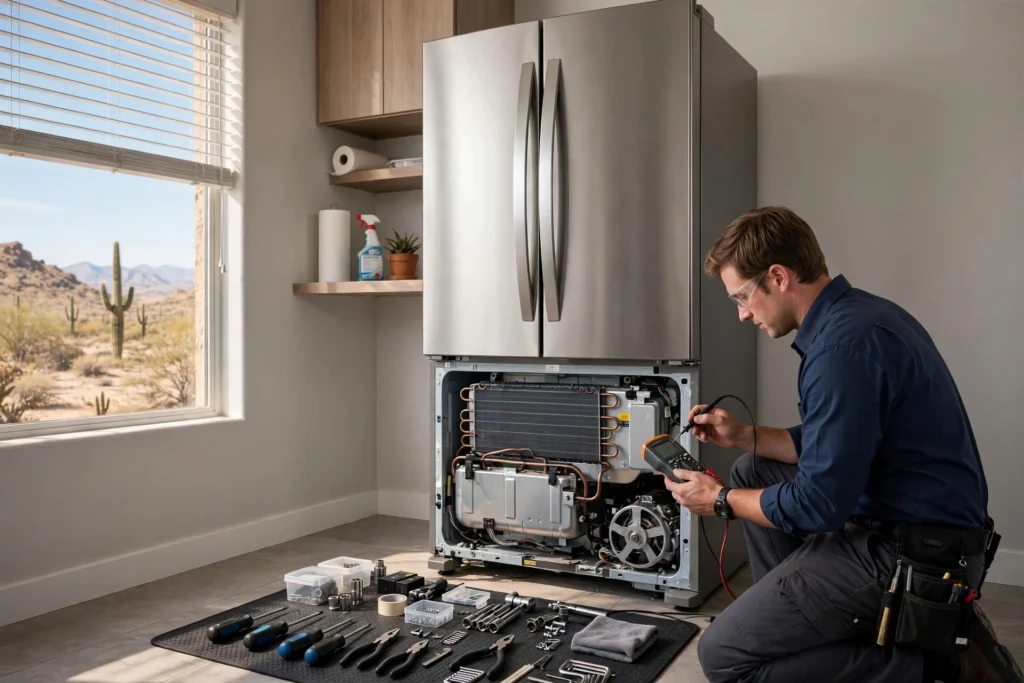
2026 cost snapshot
| Item | Planning range / amount | Basis |
|---|---|---|
| Phoenix refrigerator repair | $175-$675 typical local range | Recommended.app Phoenix guide (May 2026); excludes parts unless noted |
| Typical local repair | Around $375 | Recommended.app Phoenix guide (May 2026); excludes parts unless noted |
| Diagnostic / service call | $75-$165 | Recommended.app Phoenix guide (May 2026); excludes parts unless noted |
| National refrigerator repair | $150-$400 typical | Angi 2026 |
| Major compressor / control repair | $500-$800+ possible | Home Cost Desk planning estimate, not a sourced local average |
Quick answer
Phoenix refrigerator repair in 2026 commonly costs about $175 to $675, with one Phoenix market guide (Recommended.app, May 2026) listing a typical repair near $375 and diagnostic calls around $75 to $165. That guide states its prices exclude parts and materials unless noted, so treat these as planning figures; a repair that needs a costly part can land higher. National Angi data is somewhat lower at roughly $150 to $400 for many repairs. The local difference is less about a special Phoenix labor rate than the mix of urgent no-cooling calls, premium appliances and units operating in demanding hot environments.
The final bill depends on the failed component, brand, part availability and whether the sealed refrigerant system must be opened. A condenser fan or start relay can be a modest repair. A compressor, inverter board or refrigerant leak can push the job toward the top of the local range or beyond.
Phoenix heat changes the operating environment
A refrigerator rejects heat through its condenser. When surrounding air temperature rises, the compressor and condenser must work harder to keep food compartments cold. Indoor kitchen units are usually protected by air conditioning, but garage refrigerators may see ambient temperatures far above normal residential test conditions.
Before authorizing an expensive repair on a garage unit, check the manufacturer’s approved ambient operating range. A technically successful component replacement may not solve poor cooling if the appliance is being operated outside the conditions it was designed to handle.
Diagnostic fee and first visit
Many Phoenix appliance companies charge a service-call or diagnostic fee in the $75 to $165 range. A company may credit some or all of that amount toward an approved repair, but the policy should be confirmed before the appointment.
Ask whether the fee includes a written diagnosis, whether a second trip for an ordered part adds another charge and whether evening or weekend appointments cost more. A low diagnostic fee can be offset by higher labor or part markups.
Common no-cooling causes
A warm refrigerator can result from a failed condenser fan, evaporator fan, start device, defrost system, thermostat, thermistor, control board, sealed-system leak or compressor. Dirty condenser surfaces and blocked airflow can also reduce capacity.
A technician should identify the actual failed component rather than selling a compressor because the cabinet is warm. Ask what voltage, current, temperature or pressure readings support the diagnosis.
Dust and condenser airflow
Phoenix dust, pet hair and kitchen debris can accumulate around accessible condenser coils and air passages. Restricted airflow raises compressor temperature and can lengthen run time, especially during summer.
Homeowners can often clean accessible coils according to the appliance manual, but should unplug the unit and avoid bending tubing or damaging fan wiring. If the condenser is enclosed or difficult to reach, leave disassembly to a technician.
Compressor replacement
A compressor is one of the most expensive refrigerator repairs because the technician is replacing a major mechanical component and opening the sealed refrigerant circuit. Proper work includes refrigerant recovery, replacement of required drier or related components, evacuation, leak checking and correct recharging.
On an older basic refrigerator, a compressor quote can exceed the economic value of the unit. On a premium built-in refrigerator, repair may still make sense because replacement cost and cabinet fit can be much more expensive.
EPA refrigerant rules
Federal EPA Section 608 rules require certification for technicians who maintain, service or repair refrigeration equipment when the work can reasonably be expected to release refrigerant. That includes many sealed-system refrigerator repairs.
Intentional venting of regulated refrigerants and substitutes is prohibited. A professional technician should use appropriate recovery equipment rather than treating refrigerant as a disposable gas.
Fans, relays and other lower-cost repairs
Evaporator and condenser fans, start relays, door switches and some sensors are often less expensive than compressors. Their failure can still produce dramatic symptoms such as warm food, frost buildup or clicking at startup.
These repairs are usually worth completing when the appliance is otherwise in good condition. Ask whether the new part carries a separate part warranty in addition to the labor warranty.
Control boards and inverter electronics
Modern refrigerators use electronic boards, thermistors, inverter modules, dampers and multiple fans. An error code can guide diagnosis, but it should not be treated as proof that the board itself has failed.
Brand-specific electronics can be expensive and occasionally backordered. Ask whether the quoted part is new OEM, authorized aftermarket, refurbished or used and how that choice affects warranty.
Ice makers, valves and water leaks
Ice-maker and dispenser problems often involve water inlet valves, fill tubes, sensors, frozen lines or control modules. They tend to cost less than sealed-system cooling work but can cause significant cabinet or flooring damage if leaks continue.
Turn off the refrigerator water supply if a valve or line is actively leaking. Fixing a $200 appliance component is much cheaper than repairing swollen cabinets or flooring.
Door gaskets and hot-kitchen performance
A damaged gasket allows warm air to enter, increasing run time and frost load. A paper test around the door can reveal weak areas, but hinge alignment, cabinet level and food packages preventing full closure should also be checked.
After any repair, verify actual compartment temperatures over several hours rather than assuming a quiet compressor means the refrigerator is fixed.
Food-safety urgency
A no-cooling refrigerator is also a food-safety problem. Use a refrigerator thermometer and current food-safety guidance instead of smell or appearance alone. Repeatedly opening a warm refrigerator only accelerates temperature rise.
If repair cannot happen quickly, move still-safe perishable food to another working refrigerator or a properly iced cooler. The cost of discarded food can become part of the real failure cost.
Repair versus replace in Phoenix
Repair is usually reasonable when the refrigerator is relatively young, the failed component is replaceable and the quote is comfortably below the cost of a comparable replacement. Replacement becomes more attractive when an older basic unit needs a compressor plus electronics or when repeated failures have already occurred.
Use the Appliance Repair or Replace 2026 guide for a broader decision framework. In Phoenix, also ask whether garage heat or poor ventilation will continue stressing the replacement or repaired unit.
Three Phoenix scenarios
Scenario 1 – condenser fan failure: the refrigerator is warm and the compressor runs hot. Diagnostics confirm the fan has failed, keeping repair in the lower-to-middle local range.
Scenario 2 – control problem: temperatures fluctuate and testing confirms a sensor or board fault. Brand and part availability determine whether the job approaches $500.
Scenario 3 – compressor failure on an older garage refrigerator: the repair is expensive and the unit will continue operating in extreme heat. Replacement is often the stronger long-term decision.
What a written estimate should include
The estimate should identify the diagnosed failed part, labor, part description, diagnostic-fee credit, refrigerant work if applicable, return-trip policy, warranty and taxes. “Sealed system” or “electronics” alone is not a useful diagnosis.
Ask whether the technician will verify compartment temperatures and proper cycling after repair. An appliance that powers on is not necessarily repaired if it cannot hold food-safe temperatures.
DIY limits
Cleaning accessible coils, checking gaskets, confirming power, resetting controls and clearing simple drain debris can be reasonable homeowner tasks. Opening the sealed refrigerant system, replacing compressors or working on line-voltage electronics should be left to qualified technicians.
Do not puncture refrigerant tubing or substitute an unapproved flammable refrigerant in an attempt to revive an older unit.
Permits and ordinary appliance repair
Routine appliance component replacement usually does not resemble a building remodel, but new or altered electrical, plumbing or structural work can trigger separate requirements. Most refrigerator service therefore centers on technician competence, appliance safety and EPA refrigerant compliance rather than a building permit.
If a replacement refrigerator requires a new water line, new receptacle or cabinet alteration, those additions should be scoped separately rather than hidden inside the appliance repair.
Garage refrigerator decision guide
If a refrigerator lives in an unconditioned Phoenix garage, compare the appliance’s ambient-temperature specification with actual summer conditions. A model that is not designed for extreme heat may run nearly continuously, lose freezer performance or shorten compressor life even after a correct repair.
When replacing a garage unit, consider a model designed for broader ambient conditions or relocate the appliance to a conditioned space. Paying repeatedly to repair an unsuitable unit can cost more than solving the operating-environment problem.
Warranty and sealed-system coverage
Many manufacturers provide longer warranty coverage on sealed-system components than on ordinary electronics or labor. Before approving a compressor or evaporator repair, check the model’s original warranty terms and purchase date.
A service company should also state its own part and labor warranty. Ask whether a refrigerant leak repair is warranted against leakage at the repaired joint and whether a second visit is covered if the system loses charge again.
Questions to ask before authorizing a major repair
Ask the refrigerator’s age, estimated replacement value, exact failed component, part availability, total installed repair price, warranty and expected remaining life. If the technician cannot identify the cause of failure, be cautious about approving a high-cost part on speculation.
For a sealed-system repair, ask what evidence identified the leak or compressor fault, what refrigerant the appliance uses and whether the technician is EPA-certified for the work.
After-repair temperature verification
A refrigerator can require many hours to stabilize after a sealed-system or major airflow repair. Follow the technician’s instructions and verify refrigerator and freezer temperatures with an independent thermometer.
If temperatures remain unsafe, contact the service company before loading the unit with expensive groceries. A successful repair should be measured by stable temperature performance, not simply by the compressor running.
Homeowner records and final QA
Keep the signed proposal, approved change orders, product specifications, permit or inspection records where applicable, warranty and completion photographs.
Before final payment, compare the completed work with the written scope and document any remaining punch-list items.
Built-in and premium refrigerators
Built-in refrigerators can justify repairs that would be uneconomical on a freestanding unit because replacement equipment, delivery and cabinetry changes may cost thousands of dollars. They can also require more labor just to reach compressors, boards and valves.
For a premium unit, obtain a brand-experienced technician and compare the repair against the true installed replacement cost, not the price of a basic freestanding refrigerator.
Repeated icing and defrost problems
Frost covering the evaporator can restrict airflow and make the fresh-food section warm even while the compressor runs. The cause may be a heater, sensor, control, door-seal or airflow problem rather than low refrigerant.
A technician should identify why the frost formed before replacing parts. Simply melting ice may restore cooling temporarily without repairing the defect.
Preventive maintenance after repair
Keep ventilation openings clear, clean accessible condenser areas, check door gaskets and avoid packing food against internal air returns. These basic steps are especially useful during Phoenix summer when the cooling system already faces a high heat-rejection load.
Record the repair date, part and warranty. If the same symptom returns, the service history can help distinguish a warranty issue from a new failure.
For national repair-cost ranges by failed component, see our national refrigerator repair cost guide.
Bottom line
Phoenix refrigerator repair in 2026 commonly falls around $175 to $675, with a typical local repair near $375. Extreme heat makes airflow, garage location and condenser condition especially important to diagnosis.
Diagnose before replacing expensive parts, verify EPA-qualified refrigerant service when the sealed system is opened and compare major repairs against the appliance’s age, value and future operating environment.
Frequently asked questions
How much does refrigerator repair cost in Phoenix in 2026?
A useful local range is about $175 to $675, with diagnostic calls commonly around $75 to $165.
Why do garage refrigerators struggle in Phoenix?
Garage temperatures can exceed the appliance’s designed ambient range, making the condenser and compressor work harder.
Do refrigerator technicians need EPA certification?
Technicians who open or service the refrigerant circuit generally need EPA Section 608 certification.
Is a compressor worth replacing?
It depends on age, brand, replacement value and total repair cost. Premium built-ins justify expensive repairs more often than older basic units.
Can dirty coils cause cooling problems?
Yes. Restricted condenser airflow raises operating temperatures and run time.
When should I replace instead of repair?
Replacement becomes more attractive when an older appliance needs a high-cost compressor or control repair approaching a large share of replacement cost.