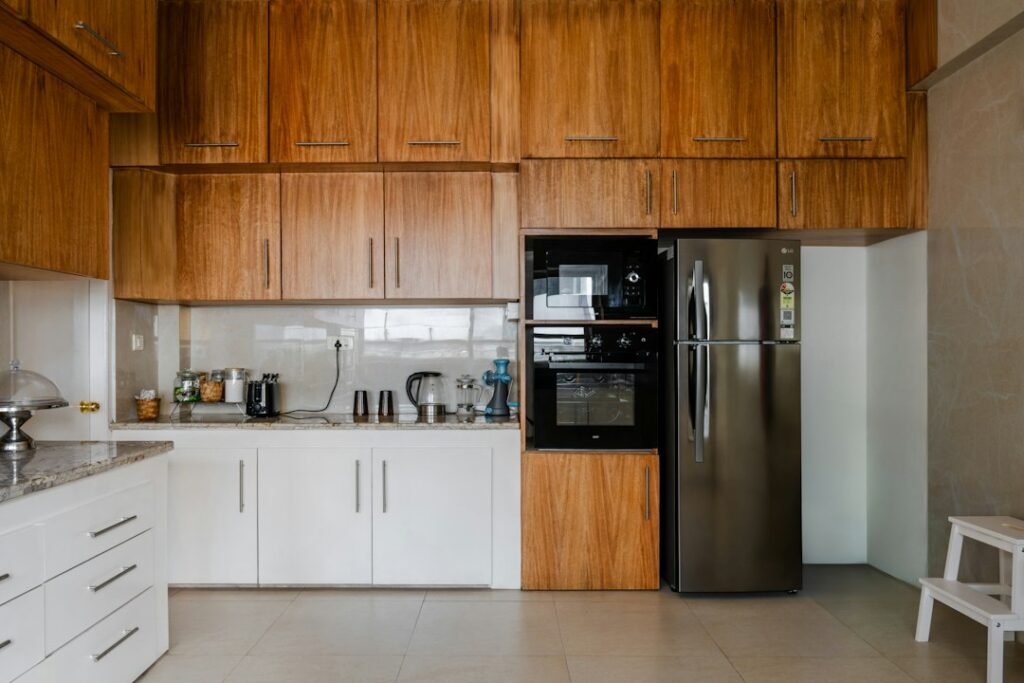
A refrigerator that is running but not cooling creates two separate problems at once: an appliance problem and a food-safety problem. The smartest response is to protect the food first, then troubleshoot from the simplest causes to the more expensive ones.
This 2026 guide is written for U.S. homeowners who notice that the refrigerator compartment feels warm, food is spoiling faster, milk is not staying cold, or the freezer seems normal while the fresh-food section is getting warmer. It explains what you can safely check yourself, what symptoms point toward a service call, and when replacement may make more sense than another repair.
Quick Answer: What to Do First
- Check the actual temperature. Do not judge by touch alone. Use an appliance thermometer if you have one.
- Protect perishable food. A refrigerator should hold food at 40°F or below. If temperatures have risen above safe limits, follow current FDA and USDA food-safety guidance rather than relying on smell or appearance.
- Confirm power and settings. Check that the unit has power, the controls were not accidentally changed, and a showroom or demo mode was not enabled.
- Check airflow. Make sure interior vents are not blocked by food and that the refrigerator has the clearances required by its manufacturer.
- Inspect the doors and gaskets. A door that does not close fully can overwhelm the cooling system.
- Listen and observe. Note whether fans and the compressor appear to run, whether there is heavy frost, and whether the freezer is cold while the refrigerator is warm.
- Stop before unsafe disassembly. Electrical testing, refrigerant work, compressor work, sealed-system repairs, and diagnosis around energized components belong to qualified technicians.
Food Safety Comes Before Appliance Diagnosis
The U.S. Food and Drug Administration recommends keeping refrigerators at 40°F or below and freezers at 0°F. A refrigerator thermometer is far more useful than guessing from how cold a shelf feels.
During a power outage, the FDA says an unopened refrigerator will generally keep food cold for about four hours. After that, the correct decision depends on food temperature and how long perishable items have been above safe refrigeration temperature. USDA guidance is especially conservative: perishable foods held above 40°F for more than two hours should not be consumed.
Do not use smell, taste, or appearance as a food-safety test. Some unsafe food can look and smell normal. When the cooling failure is uncertain, protecting your household is more important than saving a questionable carton of food.
Official references:
- FDA: Are You Storing Food Safely?
- FDA: Power Outages and Food Safety
- USDA FSIS: Refrigeration and Food Safety
Step 1: Measure the Temperature Before You Change Anything
Place an appliance thermometer in the refrigerator compartment and give it time to stabilize. If the unit has a built-in display, use that as useful information but not as the only evidence when food clearly feels too warm. A separate thermometer can help confirm what the compartment is actually doing.
Also compare the refrigerator and freezer:
| Symptom | What it can suggest |
|---|---|
| Both refrigerator and freezer are warm | Power, control, compressor, condenser, refrigerant, or major airflow problem |
| Freezer cold but refrigerator warm | Airflow, evaporator fan, damper, frost/defrost, or blocked-vent issue |
| Refrigerator overcooling or freezing food | Control, sensor, damper, or airflow issue |
| Cooling comes and goes | Door sealing, icing, controls, fan, compressor-start, or intermittent component problem |
This symptom pattern is not a final diagnosis. It simply helps you avoid replacing the wrong part.
Step 2: Check Power, Controls, and Operating Mode
Start with the easy failures because they are common and cost nothing to check.
- Confirm the refrigerator is plugged in securely.
- Check whether the interior lights or control panel have power.
- Confirm the temperature setting was not changed accidentally.
- Look for a vacation, cooling-off, showroom, or demo mode if your model has one.
- If a breaker has tripped, reset it only if there is no evidence of burning, arcing, water intrusion, damaged wiring, or another electrical fault.
If a breaker trips again, stop resetting it. Repeated tripping is a fault signal, not an inconvenience to override.
Step 3: Make Sure Interior Air Vents Are Not Blocked
Many refrigerators move cold air between compartments through dedicated vents. A tightly packed shelf, food containers pushed against the rear wall, or items placed directly in front of an air outlet can create warm zones even when the cooling system is operating.
Rearrange food so air can circulate. Do not assume fuller is always better. A reasonably stocked refrigerator can hold temperature well, but packing it so tightly that air cannot move can work against the cooling system.
If the freezer is cold but the refrigerator is warm, blocked airflow deserves particular attention.
Step 4: Inspect the Door Seal and Door Alignment
A refrigerator cannot maintain temperature efficiently if warm room air is entering constantly. Check the gasket around the full perimeter of each door.
Look for:
- Torn, folded, hardened, or visibly damaged gasket sections
- Food packages preventing the door from closing
- Drawers or shelves sitting out of position
- Condensation or frost concentrated near a door edge
- A door that rebounds open instead of staying shut
- A refrigerator that is badly out of level according to the manufacturer’s installation requirements
Clean dirty gaskets with the method recommended by the manufacturer. Do not use aggressive solvents that can damage the gasket material.
Step 5: Look for Dust and Ventilation Problems Around the Condenser
Refrigerators must reject heat into the room. Depending on the design, condenser components may be underneath, behind, beside, or integrated into the cabinet. Some modern models have areas that are not intended for homeowner access.
If your owner’s manual identifies homeowner-cleanable condenser coils or grilles, unplug the refrigerator before cleaning and follow the manufacturer’s instructions. Remove dust with an appropriate vacuum attachment or coil-cleaning brush without bending tubing or damaging wiring.
Also make sure the refrigerator has the installation clearances specified by the manufacturer. Pushing a unit too tightly into a cabinet opening can restrict heat rejection on designs that depend on surrounding airflow.
Step 6: Listen for Fans and Compressor Operation
You do not need to disassemble the refrigerator to collect useful clues. Stand near the unit and listen during a cooling cycle.
Depending on the model, you may hear a condenser fan, an evaporator fan, and the compressor. A completely silent refrigerator that should be cooling points in a different direction from a unit with fans running continuously but poor temperature performance.
Useful observations include:
- Does the compressor seem to start and then stop quickly?
- Is there repeated clicking?
- Is the freezer fan audible when the door switch logic allows it?
- Is one compartment cold while the other is warm?
- Is the unit running nearly all the time without reaching temperature?
Do not bypass door switches or safety interlocks to force components to run. If diagnosis requires energized testing, stop at the homeowner-observation stage.
Step 7: Heavy Frost Can Point to an Airflow or Defrost Problem
A sheet of frost or ice on the freezer’s interior rear panel can be an important clue on many frost-free refrigerators. Ice can restrict airflow across the evaporator and reduce cooling in the fresh-food compartment.
The underlying cause may involve a defrost heater, sensor, thermostat, control board, drain issue, fan problem, or another component. The exact architecture varies by model.
Do not attack ice with a knife, screwdriver, or other sharp object. Puncturing an evaporator or refrigerant line can turn a manageable repair into a major sealed-system failure.
A manual defrost may temporarily restore airflow on some models, but if the frost returns, the underlying defect still needs diagnosis.
Step 8: Check for Water, Ice Maker, and Drain Clues
Water under a refrigerator does not automatically mean the sealed refrigeration system has failed. It may come from a defrost drain, drain pan, water-supply line, filter housing, ice-maker connection, condensation, or another source.
If the refrigerator has a water line, inspect visible connections without pulling or stressing tubing. Shut off the household water supply to the appliance if you find an active leak that cannot be controlled safely.
Water near electrical components is a reason to stop troubleshooting and disconnect power if it can be done safely.
Common Causes of a Refrigerator That Is Not Cooling
| Possible cause | Typical clue | DIY level |
|---|---|---|
| Incorrect setting or cooling-off mode | Controls changed; no normal cooling request | Easy |
| Blocked interior vents | Cold and warm zones; packed shelves | Easy |
| Door not sealing | Condensation, frost near edge, door gap | Easy to moderate |
| Dirty accessible condenser area | Long run times, poor heat rejection | Model-dependent |
| Evaporator fan problem | Freezer may cool unevenly; poor fresh-food airflow | Technician often appropriate |
| Condenser fan problem | Poor heat rejection on fan-cooled designs | Technician often appropriate |
| Defrost-system fault | Heavy recurring frost; airflow falls over time | Technician |
| Damper or sensor problem | Freezer cold, refrigerator warm or unstable | Technician |
| Compressor/start-device problem | Clicking, failed starts, no effective cooling | Technician |
| Sealed-system/refrigerant problem | Runs but cannot achieve normal temperature | Qualified refrigeration technician |
When the Freezer Works but the Refrigerator Is Warm
This is one of the most useful symptom combinations because it tells you the system is producing at least some cold.
Start by checking whether food blocks the air passages between compartments. Then look for heavy frost in the freezer, unusual fan noise, or an air damper that is visibly stuck if your owner’s manual identifies it as user-accessible.
If airflow checks do not reveal an obvious problem, the likely diagnosis may require access to the evaporator fan, defrost components, sensors, dampers, or control electronics. At that point, a service call is more efficient than buying parts by guesswork.
When to Unplug the Refrigerator and Stop Troubleshooting
Stop homeowner troubleshooting and disconnect power if it is safe to do so when you notice:
- Burning odor or visible smoke
- Scorched plug, receptacle, cord, or wiring
- Repeated breaker trips
- Water contacting electrical components
- Evidence of arcing
- A damaged power cord
- A compressor or wiring area that appears overheated or damaged
Do not use an extension cord as a permanent refrigerator power solution unless the manufacturer explicitly allows a specific setup. Large appliances should be installed according to their electrical requirements and local code.
Repair or Replace?
If the diagnosis is a gasket, accessible fan, thermostat, sensor, or another limited component, repair can be sensible. If the appliance is older and the failure involves a compressor, sealed system, major control electronics, or repeated service calls, replacement deserves a serious comparison.
Use three numbers:
- The complete repair estimate, including diagnostic fee, labor, parts, and warranty
- The cost of an appropriate replacement refrigerator, including delivery, installation, haul-away, water-line work, and any cabinet-fit issues
- The realistic remaining life and repair history of the existing refrigerator
Our 2026 refrigerator repair cost guide covers current repair-cost categories, while our appliance repair-or-replace guide provides a broader decision framework.
If this refrigerator is part of a larger set of aging household equipment, the major home systems lifespan guide can help you prioritize replacement reserves instead of treating every breakdown as an isolated emergency.
Repair or replace: a faster decision
Repair leans stronger when
- The refrigerator is relatively young and has not needed repeated service.
- The fault is limited to a gasket, fan, sensor, thermostat, start device, or another contained component.
- The repair carries a useful parts-and-labor warranty.
- The cabinet, doors, shelves, water system, and controls are otherwise in good condition.
Replacement leans stronger when
- The appliance is older and has already needed several meaningful repairs.
- The diagnosis involves the compressor, sealed system, multiple control boards, or another high-cost core component.
- Parts are obsolete, delayed, or unusually expensive.
- The refrigerator no longer fits household needs or has additional unresolved problems beyond the current failure.
Before deciding, compare the complete repair price with delivery, installation, haul-away, water-line work, cabinet-fit changes, and warranty on a replacement—not just the sticker price of a new refrigerator.
Questions to Ask an Appliance Technician
- What failed, and how was it tested?
- Is the problem electrical, airflow-related, control-related, or part of the sealed refrigeration system?
- Does the quoted repair include the diagnostic fee?
- Are parts new OEM, aftermarket, rebuilt, or used?
- What labor and parts warranty comes with the repair?
- Is there evidence that another major component is also near failure?
- Does the model have a manufacturer warranty, extended sealed-system warranty, service bulletin, or recall that may apply?
- If the repair is expensive, what would make replacement the better decision?
Ask for the model and serial number to be included on the work order. Those numbers matter for parts compatibility, warranty research, and manufacturer service information.
What Not to Do
- Do not taste questionable food to decide whether it is safe.
- Do not repeatedly reset a breaker that continues to trip.
- Do not puncture ice with knives or screwdrivers.
- Do not open sealed refrigerant lines.
- Do not replace expensive boards or compressors based on a guess.
- Do not block air vents by packing food tightly against them.
- Do not ignore a door that is not closing fully.
- Do not assume that the compressor is running means the refrigerator is cooling correctly.
A Practical 15-Minute Homeowner Check
If there is no smoke, burning smell, electrical damage, or water hazard, this is a reasonable first pass:
- Move perishable food to safe refrigeration if needed.
- Measure refrigerator and freezer temperatures.
- Confirm power, controls, and operating mode.
- Check that doors close and gaskets are not obstructed.
- Move food away from interior vents.
- Look for obvious heavy frost or ice buildup.
- Listen for unusual clicking, fan noise, or complete silence.
- Inspect only the homeowner-accessible ventilation or condenser areas identified in the manual.
- Write down the model number, symptoms, temperatures, and when the problem started.
That information gives a technician a much better starting point and reduces the chance that you spend money replacing parts without a diagnosis.
Bottom Line
A refrigerator that is not cooling should be treated first as a food-safety event and second as an appliance repair. Confirm actual temperature, protect perishable food, check settings, doors, airflow, visible frost, and manufacturer-approved maintenance points before assuming the compressor has failed.
If the refrigerator and freezer are both warm, the unit runs constantly without reaching temperature, heavy frost keeps returning, electrical symptoms appear, or diagnosis requires refrigerant or energized electrical work, move to professional service.
The goal is not to perform every possible repair yourself. It is to make the safe, inexpensive checks first, preserve useful evidence, protect your food, and arrive at the repair-versus-replace decision with better information.
Home Cost Desk compares current U.S. cost or technical references and checks safety, code, efficiency, incentive, or regulatory claims against authoritative sources when available. National figures are planning ranges, not local quotes.
Editorial review: Home Cost Desk Editorial Team · Read our research methodology · Detailed sources appear below.
Sources and Methodology
This guide separates food-safety guidance from appliance troubleshooting. Food-temperature recommendations were checked against current U.S. Food and Drug Administration and USDA Food Safety and Inspection Service guidance. Appliance troubleshooting is intentionally limited to homeowner-observable symptoms and manufacturer-approved maintenance; model-specific disassembly, refrigerant work, and energized electrical diagnosis are left to qualified technicians.
- U.S. FDA: Are You Storing Food Safely?
- U.S. FDA: Power Outages — Key Tips for Consumers About Food Safety
- USDA FSIS: Refrigeration and Food Safety
Featured photo: Sanju Pandita via Unsplash.