2026 cost snapshot
| Item | Planning range / amount | Basis |
|---|---|---|
| Typical Baltimore sewer replacement | $1,544–$4,640 | Angi local 2026 |
| Baltimore average | About $2,951 | Angi local 2026 |
| Typical pipe + installation | About $60–$220/linear ft. | Angi local 2026 |
| PVC in Baltimore | About $60–$120/linear ft. | Angi local 2026 |
| Professional labor | About $80–$95/hour | Angi local 2026 |
Quick answer
Baltimore sewer line replacement in 2026 commonly falls around $1,544 to $4,640 for many residential projects, with a local Angi average near $2,951. That range can climb quickly when the failed lateral is long, deep, under a sidewalk or driveway, blocked by roots, collapsed near the public connection, or requires significant excavation and restoration.
Angi’s Baltimore-specific cost data also places many installed sewer materials around $60 to $220 per linear foot, with PVC commonly around $60 to $120 per linear foot installed. Those figures are useful planning bands, not universal quotes. A 20-foot yard repair and a 70-foot lateral crossing hardscape are fundamentally different projects.
Baltimore adds an important ownership and permit issue: the City maintains sewer infrastructure in the public system, while property owners are responsible for private-side portions of sewer laterals. Before approving a repair, determine where the defect sits relative to the property line and public right-of-way.
Understanding the Baltimore sewer lateral boundary
Baltimore’s own public-works materials distinguish the public and private portions of a sewer lateral. City documents state that the City may repair lateral portions from the property line toward the sewer main, while the portion inside the private property line is the property owner’s responsibility to maintain.
That boundary matters because a contractor’s camera may identify a defect close to the sidewalk or street. Homeowners should not automatically authorize excavation in the public right-of-way before confirming whether the defect falls on the City side, private side, or at a connection point that requires coordination.
Ask the plumber to mark the property line, cleanout, connection direction, defect distance from the camera access, and estimated depth on a sketch. A few feet of location uncertainty can change who should investigate next.
2026 Baltimore cost range by project type
A short accessible replacement in a front yard may remain near the lower end of Baltimore’s local range. A deeper line under mature landscaping, steps, retaining walls, concrete, or a rowhouse areaway can cost much more because excavation and restoration become the dominant expense.
Angi’s local data gives a broad installed pipe range of $60 to $220 per linear foot and a normal project range of $1,544 to $4,640. It also notes labor around $80 to $95 per hour and local permit costs that can add to the project.
Do not multiply a per-foot price by the estimated length and assume that is the final budget. Mobilization, camera inspection, utility locating, excavation, disposal, bedding, cleanouts, permits, street or sidewalk work, and restoration can all add fixed costs.
Camera inspection before replacement
A sewer camera inspection is one of the most valuable pre-contract steps. It can distinguish root intrusion, offset joints, bellies, cracks, broken clay or cast iron, grease buildup, and a complete collapse. It also helps locate the defect so the contractor does not excavate a larger area than necessary.
Ask for the video file or at least clear still images with distance markers. The contractor should explain whether the camera traveled all the way to the public main, whether standing water prevented full inspection, and how the line was located above ground.
If the line is merely clogged and structurally sound, cleaning may be the correct first step. Compare with the Drain Cleaning Cost 2026 guide before approving replacement solely because a backup occurred.
Baltimore plumbing permits and licensed contractors
Baltimore City plumbing regulations generally require a permit before plumbing work begins unless a specific exception applies. The permit application must identify the insured, licensed master plumber responsible for the work. City code also says plumbing services must be performed by or under the direct supervision of the appropriately licensed professional.
This means the homeowner should not accept a proposal that shifts permit responsibility vaguely back to the customer. The contractor should state who pulls the permit, which inspection is expected, and whether the fee is included.
Emergency work can begin before permit issuance in defined hazardous situations, but City rules require prompt notification and a subsequent permit. Emergency status is not a blanket exemption from code compliance.
Pipe materials in older Baltimore housing
Baltimore housing stock includes older rowhouses and detached homes that may have vitrified clay, cast iron, Orangeburg-type materials, or later PVC replacements. The existing material influences failure mode and repair method.
Clay lines can crack, separate at joints, and admit roots. Cast iron can corrode internally or develop scale. Older fiber pipe can deform. PVC is widely used for replacement because it is smooth and root-resistant when installed correctly with proper bedding and slope.
Ask whether the contractor is replacing only the failed segment or the full private lateral. Segment repair can be rational when the remaining line is sound. A full replacement is more defensible when the camera shows repeated defects along the entire run.
Traditional excavation
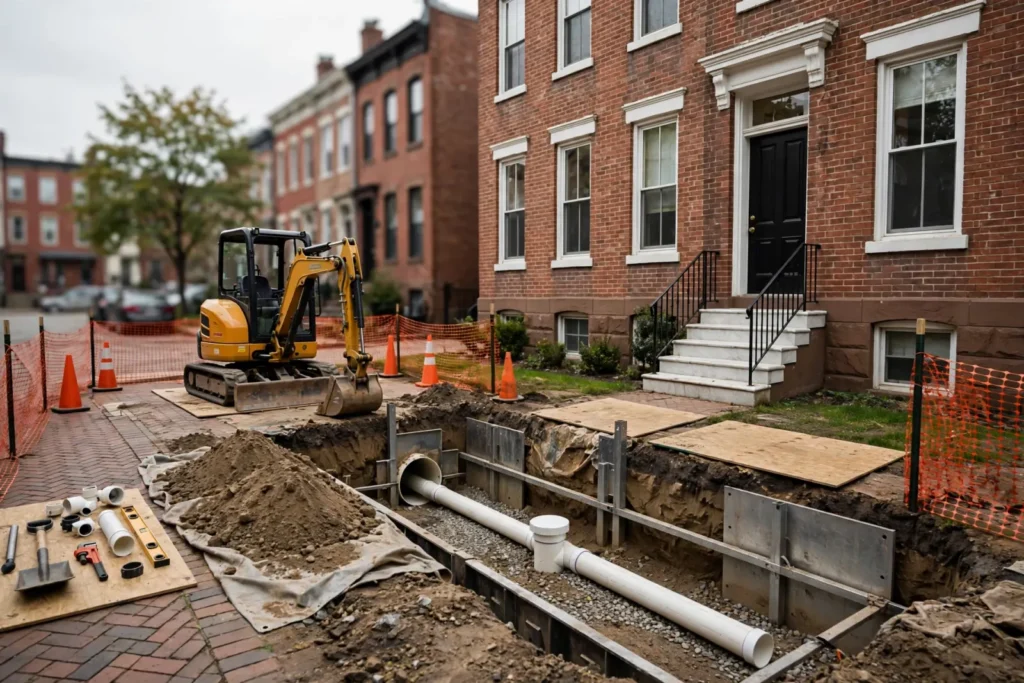
Open excavation gives the contractor direct access to the pipe and makes it easier to correct slope, replace bedding, install cleanouts, and address a fully collapsed line. It is often the most straightforward method when the sewer runs through open yard space.
The cost rises when the trench crosses concrete, brick walkways, stoops, fences, retaining walls, or mature trees. The sewer depth also matters because deeper trenches require more excavation and stronger safety controls.
Ask who restores the yard, concrete, pavers, or sidewalk. Some plumbers backfill the trench but exclude final hardscape or landscaping. A low sewer quote can become expensive after separate restoration work.
Trenchless lining and pipe bursting
Trenchless methods can reduce surface disruption in the right conditions. Cured-in-place pipe lining creates a new liner inside an existing host pipe, while pipe bursting pulls a new pipe through the path of the old line as the existing pipe is broken outward.
Lining is not suitable for every defect. A fully collapsed pipe, severe belly, badly misaligned line, or insufficient diameter may require excavation or another method. Pipe bursting usually needs launch and receiving pits and may not be practical near certain utilities or connections.
Ask the contractor to explain why the chosen method fits the camera evidence. A trenchless premium is worthwhile when it avoids expensive hardscape restoration, but not when it is being sold simply because it sounds modern.
Right-of-way, sidewalks and street work
When a repair extends beyond private property, the project can involve additional City coordination and right-of-way requirements. Do not let a contractor excavate into a sidewalk or street based only on a verbal assumption that the homeowner will “sort out the permit later.”
Public work can require traffic control, pavement restoration, utility clearances, and inspection standards that are different from a backyard repair. The location of the defect should therefore be confirmed before the final contract is signed.
If the suspected problem sits near the property line, contact the appropriate City or DPW channel and preserve the camera evidence. The objective is to avoid paying privately for work that belongs on the public side, or delaying a private repair because ownership was never established.
Utility locating and trench safety
Maryland 811 utility locating should be part of excavation planning, but a public utility locate does not necessarily identify every private line on the property. Irrigation, landscape lighting, private electric feeds, and other owner-installed utilities may need separate locating.
Sewer trenches can be deep enough to create collapse hazards. Homeowners should not enter an open trench or encourage unprotected access for inspection photographs. Trench safety is the contractor’s responsibility.
Keep children and pets away from the work zone. A clean project plan should also address spoil piles, equipment access, and how the contractor will protect adjacent foundations and sidewalks.
Tree roots and recurring backups
Tree roots often enter through existing cracks or joints rather than breaking a perfectly sealed modern pipe from the outside. Root cutting can restore flow temporarily, but recurring intrusion usually signals a structural defect that allows roots back in.
If roots are the only camera finding and the pipe remains aligned, a contractor may recommend cleaning plus monitoring. If roots are entering at multiple broken joints or a crushed section, replacement becomes more logical.
Do not remove a mature tree solely because roots were found in the sewer. The sewer condition, tree health, replacement method, and property layout should be evaluated together.
Three Baltimore project scenarios
Scenario 1 — short front-yard repair: a camera locates a cracked clay segment 15 feet from the house in an open lawn. The contractor excavates, installs PVC with proper bedding and slope, adds a cleanout, and restores rough grade. This can stay near the local average.
Scenario 2 — rowhouse lateral under hardscape: the line runs beneath a front walk or areaway and the defect is deeper. Demolition and restoration add meaningful cost even if the pipe length is short.
Scenario 3 — uncertain defect near the public connection: the camera shows trouble close to the property line. Before signing a private excavation contract, the homeowner documents the location and confirms responsibility with the City or DPW.
Repair versus full replacement
A single broken joint in an otherwise sound line may justify spot repair. Repeated offsets, extensive cracking, severe corrosion, multiple root-entry points, a long belly, or a deteriorated material throughout the run can justify full replacement.
Ask the contractor to show where the remaining pipe is healthy. A recommendation for complete replacement should be based on video evidence, material age, defect frequency, access cost, and the likelihood of another excavation soon.
Use the Sewer Line Replacement Cost 2026 guide for national cost context, and the Plumber Cost in 2026 guide when comparing labor and diagnostic charges.
How to compare Baltimore sewer quotes
A detailed proposal should identify pipe material, diameter, replacement length, average depth, excavation method, cleanout work, bedding, connection points, permit responsibility, camera work, haul-away, backfill, compaction, and restoration exclusions.
Require a post-installation camera if practical. This can confirm that joints are aligned, the pipe is clear, and the repair connects correctly.
Compare at least two or three proposals when the project is not an emergency. Sewer work is difficult to price from the surface, so differences in scope often explain large price differences.
Baltimore sewer replacement action checklist
Before authorizing excavation or trenchless work, use this sequence:
- Locate the defect. Obtain camera footage or clear stills with distance markers and a sketch showing the cleanout, property line, suspected failure, and route toward the public main.
- Confirm responsibility. Determine whether the failed section is on the private lateral, near the property line, or within an area that requires City or DPW coordination before paying for private work.
- Verify the contractor and permit path. Confirm the licensed master plumber responsible for the job, who pulls the permit, and which inspections are expected.
- Compare repair methods. Ask why spot repair, full excavation, lining, or pipe bursting fits the actual camera evidence, depth, slope, pipe material, and access conditions.
- Price restoration separately. Identify sidewalk, driveway, paver, landscaping, retaining-wall, or rough-grade restoration that is excluded from the plumbing quote.
- Plan utility locating and site safety. Make sure public utility locating is arranged and ask how private utilities, trench protection, spoil piles, and access will be handled.
- Document change orders. Require written approval for added length, deeper excavation, unexpected connections, or additional hardscape work before costs expand.
- Close out the project. Keep the permit and inspection approval, pipe material and length, final camera evidence when available, warranty, paid invoice, and before-and-after site photographs.
Use the national sewer line replacement cost guide to separate Baltimore permits, access and trenchless conditions from the underlying project cost. For broader service-call and plumbing labor context, see the 2026 plumber cost guide.
Bottom line
Baltimore sewer line replacement in 2026 commonly falls around $1,544 to $4,640, with an average near $2,951, but length, depth, hardscape, trenchless methods, and public-right-of-way issues can move the project far beyond that range.
The most important Baltimore-specific step is locating the defect relative to the private/public lateral boundary. Confirm responsibility first, then compare repair methods and complete restoration scope rather than choosing a bid from price per foot alone.
Frequently asked questions
How much does sewer line replacement cost in Baltimore in 2026?
Angi’s Baltimore data shows a typical range around $1,544 to $4,640 and an average near $2,951. Long, deep, trenchless, or hardscape-heavy projects can cost much more.
Who is responsible for the sewer lateral in Baltimore?
City materials distinguish public-side and private-side responsibility. The property owner is generally responsible for the lateral portion on private property; confirm the exact defect location before authorizing work.
Does Baltimore require a plumbing permit for sewer replacement?
Yes, plumbing work generally requires a permit, and the permit is tied to a licensed master plumber or other appropriately licensed contractor.
Is trenchless sewer replacement always better?
No. It can reduce surface damage, but collapsed pipe, severe bellies, connection problems, or unsuitable geometry can make excavation the better solution.
Should I replace the whole sewer line if roots are present?
Not automatically. Roots indicate an entry path. The camera inspection should show whether there is one repairable joint or widespread structural deterioration.
What should a Baltimore sewer quote include?
Length, depth, material, excavation/trenchless method, connections, cleanouts, permit responsibility, backfill, haul-away, restoration, and camera verification.