Quick answer
Los Angeles sewer line replacement in 2026 commonly costs more than the national average because labor, access, concrete restoration, mature landscaping, permit work, and public-right-of-way requirements can be significant. Angi’s Los Angeles-specific 2026 data reports a typical replacement range of about $1,551 to $6,631, averaging around $4,091. The same source reports approximately $150 to $300 per linear foot for many Los Angeles replacement projects, while a separate local installation guide gives a much broader $75 to $400 per linear foot range depending on trenching, material, and site conditions.
Trenchless work has its own local range. Angi’s Los Angeles 2026 guide places trenchless sewer replacement around $2,158 to $6,816 for many projects, with an average near $3,294 and per-foot costs that can reach $90 to $400 depending on method and conditions. These ranges overlap because a short difficult repair can cost more per foot than a long accessible line.
Los Angeles also has a critical permitting distinction. The Bureau of Engineering says an S-Permit is required for constructing, connecting, altering, or repairing a house connection sewer, and work in the public right-of-way requires a Bonded Sewer Contractor. The homeowner should know exactly where the damaged pipe is and which side of the property line the work reaches before comparing bids.
2026 Los Angeles sewer cost snapshot
For a private lateral replacement, use the local $1,551 to $6,631 range as a first screening band, not as a ceiling. A straightforward 20-foot repair in accessible soil may stay near the lower end. A long line beneath a driveway, patio, retaining wall, mature trees, or a steep hillside can rise well beyond it.
Angi’s separate Los Angeles new-sewer installation guide reports an average around $4,540, a broad $3,000 to $14,000 range, and roughly $75 to $400 per linear foot. This wider data is useful when the project involves a new route, major excavation, or connection work rather than a simple replacement in the existing trench.
For national context, compare the local proposal with the Home Cost Desk Sewer Line Replacement Cost 2026 guide. The national guide helps identify whether a quote is high because of Los Angeles conditions or because it includes more work.
Start with a camera inspection
A sewer replacement decision should begin with evidence. A video inspection can show roots, cracks, offsets, bellies, collapsed sections, corrosion, separated joints, or repeated blockage. It also helps locate the problem relative to the house, property line, sidewalk, and street.
Ask for a copy of the video or still images and a written location estimate. If the contractor says the entire line needs replacement, ask what portions are damaged and whether the camera reached the municipal connection.
A camera does not solve every diagnostic question. Standing water can hide defects, and some pipe conditions need cleaning before inspection. But replacing a sewer without documented condition is a much larger gamble.
Who is responsible for the lateral?
The City of Los Angeles Bureau of Engineering states that the property owner is responsible for repairing and maintaining the house-connection lateral from the property line to the connection with the mainline sewer, including root-related obstruction. This is a major local budgeting issue because part of the homeowner’s responsibility can extend into the public right-of-way.
Do not assume that the city repairs the line simply because the defect is under the sidewalk or street. Ask the contractor to identify the private-house-sewer portion, the house-connection lateral, the public right-of-way segment, and the main sewer.
Responsibility can be complex at multifamily properties, shared laterals, easements, and unusual parcels. When boundaries are unclear, verify with the city before authorizing excavation.
The Los Angeles S-Permit
Fee check: Ask for a written, itemized city fee estimate. The official fee schedule distinguishes permit and inspection charges from special bonded-sewer charges that apply only to qualifying connections; a fee tied to lot frontage should not be assumed to apply to every replacement or calculated from the footage of pipe being repaired.
Los Angeles requires an S-Permit for specified sewer connection work. The Bureau of Engineering permit manual says the permit applies to new house connections, connections to an existing lateral at the property line, and repair of a damaged house-connection lateral.
If work occurs in the public right-of-way, a Bonded Sewer Contractor must obtain the permit and carry the required licenses, insurance, and bonds. City inspection also applies to construction in the right-of-way.
This means a homeowner comparing two bids should ask whether each contractor is qualified to complete the entire permitted scope. A plumber who can replace pipe inside the property may not be the same contractor authorized for bonded right-of-way work.
Traditional trench replacement
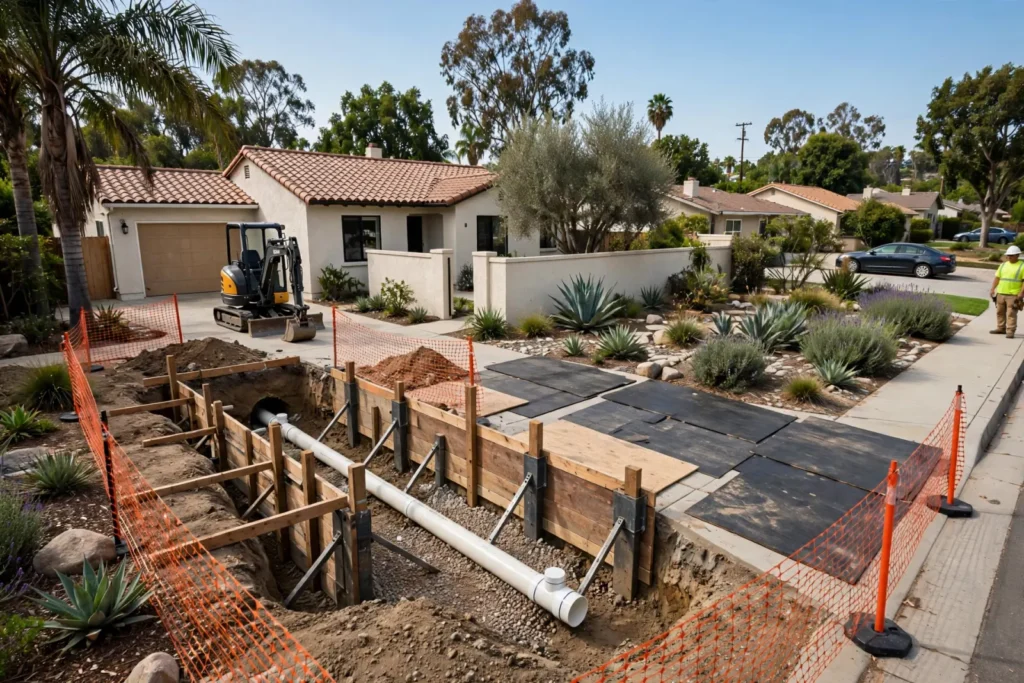
Traditional replacement excavates the old line, removes or abandons the damaged pipe, installs new pipe, beds and backfills the trench, and restores the surface. It is often the clearest method when the line has severe collapse, poor slope, major offsets, or a route that needs correction.
The cost problem in Los Angeles is surface restoration. A trench across lawn is one thing; a trench through concrete driveway, decorative paving, mature landscaping, retaining walls, or a finished courtyard is another. Ask the contractor to separate sewer work from concrete, pavers, landscaping, and irrigation restoration.
Before excavation, ask the contractor to confirm the utility-locate process and explain how privately maintained sewer laterals will be identified. Keep the utility-locate reference and marked route with the project records.
Pipe bursting
Pipe bursting is a trenchless replacement method that pulls a new pipe through the path of the old pipe while breaking the old pipe outward. It usually needs launch and receiving pits but can avoid a full-length trench.
Bursting can be attractive under driveways and landscaping, but it is not appropriate for every line. Existing utility conflicts, severe changes in direction, certain pipe conditions, or insufficient space for pits can make it impractical.
Ask whether the proposed method changes pipe diameter and how the new slope will be verified. “Trenchless” should not be treated as a guarantee of zero excavation.
City of LA right-of-way check: For pipe bursting of a house-connection lateral in the public right-of-way, the Bureau of Engineering’s S-Permit requirements call for an approved Bonded Sewer Contractor and camera inspection both before and after construction. Ask who schedules the required inspections, supplies the recordings, and includes any applicable street-damage-restoration fees in the written bid. These specific City rules should not be assumed to govern a parcel outside City of Los Angeles jurisdiction.
Cured-in-place pipe lining
CIPP lining installs a resin-saturated liner inside an existing pipe and cures it into a new interior pipe. It can avoid excavation when the host pipe retains enough structural shape and slope.
Lining does not correct every problem. A major belly, collapsed pipe, incorrect slope, or badly offset joint may remain unsuitable. Ask the contractor to explain why the host pipe is a good candidate and what preparation—cleaning, descaling, root cutting, or spot repair—is needed first.
A lined pipe also slightly reduces internal diameter. That may be acceptable, but the contractor should state the finished size and warranty. For City of Los Angeles house-connection lateral lining under the S-Permit process, ask who arranges the required before-and-after camera inspections, whether the city inspector must attend, and how you will receive the recordings and approval. Check the city’s published S-Permit processing procedures rather than assuming that a trenchless method is exempt.
Los Angeles roots, older neighborhoods, and mature trees
Tree roots are a common reason older sewer laterals fail or repeatedly clog. Roots usually enter through existing joints or cracks rather than puncturing sound modern pipe from scratch. Repeated root cutting can restore flow temporarily but does not repair the opening that lets roots return.
If camera footage shows one isolated joint, a spot repair may be rational. If roots enter through many joints along an old clay line, replacement or lining can be more durable than annual cleaning.
Do not remove valuable trees automatically. A trenchless method or carefully planned route may preserve landscaping, though an arborist may be needed where excavation affects major roots.
Soil, earthquakes, and movement
Los Angeles has varied soils and seismic conditions. A sewer line can be affected by settlement, hillside movement, poor bedding, or ground displacement. Flexible modern piping can be appropriate, but material alone cannot compensate for bad slope or unstable soil.
If the camera shows recurring offsets or the property has known movement, ask whether the sewer failure is a symptom of a broader site or foundation issue. Replacing pipe in the same unstable condition can lead to another failure.
Hillside properties also increase access and shoring complexity. A sewer contractor should not price a steep site from a generic per-foot schedule without visiting the property.
Pipe materials
PVC and ABS are common modern residential sewer materials where code allows, while older Los Angeles homes may have clay, cast iron, Orangeburg, or other legacy materials. The correct replacement depends on location, code, connection detail, and method.
Ask the contractor to specify pipe type, diameter, fittings, cleanouts, bedding, and connection to the existing system. A proposal that only says “replace sewer” is not detailed enough.
If interior cast-iron drainage is also failing, keep that scope separate from the exterior lateral. The Plumber Cost in 2026 guide can help compare labor for interior plumbing work.
Cleanouts and future maintenance
A sewer replacement is a good time to confirm that accessible cleanouts exist where required or useful. Proper cleanouts make future camera inspection and maintenance less disruptive.
Ask the contractor whether new cleanouts are part of the permit scope and where they will be located. A cleanout hidden behind landscaping or hardscape may be difficult to use later.
Keep the final video, permit, inspection record, and route sketch. Future plumbers can save time if they know exactly where the line runs.
Restoration can rival the pipe cost
Concrete, pavers, retaining walls, landscaping, irrigation, fencing, and interior flooring can all be damaged by access. A sewer bid should state which surfaces are restored and to what standard.
“Backfill included” does not mean “driveway restored.” Ask for separate line items for concrete thickness, reinforcement, paver replacement, sod, planting, and irrigation repair. If a third-party contractor will do restoration, identify that before excavation begins.
Trenchless work can reduce restoration cost, but launch pits still require repair. Compare the total site cost, not the sewer line alone.
Repair versus full replacement
A localized crack, root intrusion, or failed joint may justify a spot repair when the rest of the pipe is sound. Repeated backups, multiple offsets, extensive root entry, corrosion, belly sections, or widespread deterioration can make full replacement more sensible.
Ask the contractor to mark each defect on the video and explain how the proposed method addresses it. If a line is being replaced only because it is old, get a second opinion. Age alone is not a diagnostic test.
For emergency blockages, first restore safe flow and diagnose the cause. Do not authorize a five-figure replacement solely because a drain-cleaning visit occurred after hours.
Three Los Angeles scenarios
Scenario 1: short accessible private-yard replacement
A 15- to 25-foot damaged section is under soil in an accessible side yard. Camera inspection confirms the rest of the line is sound and no right-of-way work is needed. A targeted excavation can stay near the lower end of local ranges.
Scenario 2: old clay lateral under driveway
Roots enter through multiple joints and the line passes under a large concrete driveway. Pipe bursting or lining may reduce restoration compared with a full trench. The project price depends on whether the host pipe is suitable and where pits can be placed.
Scenario 3: repair reaches public right-of-way
Damage extends beyond the property line. The project requires an S-Permit, a Bonded Sewer Contractor for right-of-way work, inspection, traffic or street considerations, and surface restoration. This scope can exceed the typical private-lateral average substantially.
Before you approve a sewer replacement: six Los Angeles checks
- Locate the failure, not just the backup. Request a dated camera recording with distance marks, the entry point, and a marked location at the surface. Ask whether the camera passed the damaged section and reached the downstream connection. If the line could not be inspected fully, make that uncertainty explicit in the quote.
- Confirm the actual permitting jurisdiction. A Los Angeles mailing address does not prove the property is inside the City of Los Angeles. Ask the contractor to identify the city or county authority for the parcel before applying the City of LA S-Permit rules. For a City of LA house-connection lateral, check the Bureau of Engineering S-Permit guidance.
- Separate the damaged segment from the proposed replacement length. A camera may show one broken joint on a longer otherwise serviceable line. Request the measured length for a spot repair and, if recommended, the measured length for full replacement. Ask why either scope addresses the recorded defects.
- Get the method and restoration in writing. A trench, pipe burst, and cured-in-place liner require different access, cleaning, excavation pits, and surface repairs. For each option, identify who restores concrete, landscaping, irrigation, and any sidewalk or street surface.
- Verify the permitted contractor and inspection sequence. Where City of LA public-right-of-way sewer work is involved, confirm that the right-of-way scope will be handled by a currently approved Bonded Sewer Contractor and that required city inspections are included. Do not let backfill or paving conceal work before required inspections.
- Make the final payment conditions measurable. Request the final inspection approval where applicable, post-work camera footage showing the completed run, a map or measurements of cleanouts, a written warranty, and a list of restoration punch-list items.
Compare the total project, not a misleading per-foot price
The Los Angeles replacement figures above describe different sets of jobs; they are not interchangeable quotes. As a simple illustration only, 40 feet multiplied by the published $150–$300-per-foot range equals $6,000–$12,000 for the footage-based component. That arithmetic does not establish a local bid or prove that permits, deep excavation, right-of-way requirements, concrete restoration, or a camera inspection are included. Do not add this illustration to Angi’s $4,091 average: those are alternative ways of viewing costs, not separate line items.
| Bid item | What the written proposal should say | Common comparison trap |
|---|---|---|
| Diagnosis and footage | Video evidence, start/end points, pipe diameter, measured replacement length | One quote prices a 12-foot repair; another replaces 50 feet |
| Replacement method | Open trench, bursting, or lining; pit locations; cleaning and testing | “Trenchless” hides access pits or host-pipe preparation |
| Permits and jurisdiction | Permit type, issuing authority, applicant, inspections, right-of-way scope | A City of LA rule is assumed for an unincorporated or different-city address |
| Buried conditions | Utility locating, depth assumptions, shoring where needed, unforeseen-obstruction procedure | Low base bid excludes difficult excavation and safe trench support |
| Surface restoration | Specific concrete, paving, landscaping, irrigation, and street repair responsibilities | “Backfill” is mistaken for complete driveway restoration |
| Completion and warranty | Required approvals, final video, cleanout access, written warranty and exclusions | Final payment is due before proof of completion |
Example: One contractor quotes a shorter open-trench repair that includes driveway replacement; another quotes pipe bursting across a longer run but excludes pit restoration and permit handling. Neither price is automatically better. Ask both contractors to price the same diagnosed length and provide a separate allowance or written change-order procedure for unknown buried conditions.
If a backup is active, avoid using affected fixtures and keep people and pets away from wastewater. Have a qualified professional stabilize the situation and identify the cause before agreeing to major replacement. For cleaning-only options and their limitations, see our 2026 drain cleaning cost guide.
How to compare Los Angeles sewer bids
Require camera evidence, measured or estimated length, pipe diameter, existing material, proposed method, permit responsibility, right-of-way scope, cleanouts, excavation limits, trench safety, new pipe material, bedding, testing, inspection, disposal, restoration, warranty, and exclusions.
Ask these questions:
- Where exactly is the defect relative to the property line?
- Is an S-Permit required?
- Is a Bonded Sewer Contractor required for any part of the work?
- Is the line suitable for lining or bursting, and why?
- What surface restoration is included?
- What happens if a second defect is discovered during excavation?
- Does the warranty cover settlement, roots, lining defects, or only workmanship?
- Will I receive post-work camera footage?
Verify the contractor before paying a deposit. Look up the company’s current California contractor license and appropriate classification through the Contractors State License Board. If the work enters the City of Los Angeles public right-of-way, separately confirm that the company performing that portion has current City approval as a Bonded Sewer Contractor. A state license by itself does not establish City right-of-way authorization. The written bid should identify the permit applicant, any subcontractors, who schedules inspections, and who pays for sidewalk or street restoration.
Get the cash price before evaluating financing. Emergency sewer work is stressful, but large replacement decisions still deserve at least one competing opinion when sewage can be safely controlled.
Choose the repair scope from the camera findings
Use the recorded defect locations to test the contractor’s recommendation rather than choosing a method by its name:
- One damaged joint, otherwise intact line: Ask for a priced spot-repair option and a post-repair camera inspection. Compare the cost of opening and restoring that exact location with any proposed full-line replacement.
- Roots at several joints, but a continuous pipe with usable slope: Request a written explanation of whether lining, bursting, or open-trench replacement is technically feasible. For lining, ask how the pipe will be cleaned and how its finished diameter and condition will be documented.
- Collapse, major sag, or repeated offset: Ask which method will actually correct the grade or failed segment. A liner that follows a sag does not fix the slope; access excavation or rerouting may be necessary.
- Defect near the sidewalk or street: Before signing, obtain a marked route and written confirmation of the permitting authority, right-of-way responsibilities, approved contractor, and who pays for pavement restoration.
Before final sign-off: Compare the finished camera video with the original defect map; verify that all agreed cleanouts are accessible; obtain the required inspection record; photograph restored surfaces; and list unfinished work in writing. If the final video still shows an unexplained obstruction or standing water, ask for an explanation before treating the project as complete.
Insurance and home-sale considerations
Homeowners insurance may cover some sudden accidental damage but often excludes wear, roots, gradual deterioration, or service-line failures unless specific coverage applies. Read the policy rather than assuming either full coverage or no coverage.
Service-line endorsements can change the picture. If a claim may apply, document the failure before destructive work and ask the insurer what evidence is required.
For resale, keep permits, camera videos, invoices, and warranties. A documented new lateral can be valuable information for a buyer of an older Los Angeles home.
Frequently asked questions
How much does sewer line replacement cost in Los Angeles in 2026?
Angi’s local data reports many replacement projects between about $1,551 and $6,631, averaging around $4,091. Complex excavation, long runs, concrete, hillside access, trenchless methods, or right-of-way work can push the total much higher.
How much does Los Angeles sewer replacement cost per foot?
Local Angi data reports roughly $150 to $300 per linear foot for many replacements, while broader installation and trenchless data can range from about $75 to $400 per foot. Site conditions matter more than a single per-foot number.
Who repairs the sewer under the street in Los Angeles?
The city’s Bureau of Engineering says property owners are responsible for the house-connection lateral from the property line to the mainline connection. Work in the public right-of-way has specific permit and contractor requirements.
What is an S-Permit?
It is a Los Angeles sewer connection permit used for specified house-connection construction, connection, alteration, and repair. The Bureau of Engineering administers the process.
Is trenchless sewer replacement always better?
No. It can reduce excavation but is unsuitable for some collapsed, badly offset, or incorrectly sloped pipes. The camera and site conditions should determine the method.
Should I line or replace an old clay sewer?
It depends on structural condition, slope, joint offsets, diameter, and access. Lining can work well when the host pipe is structurally suitable; pipe bursting or excavation may be better when the pipe has major defects.
Does a Los Angeles mailing address always mean City of LA permits apply?
No. Confirm the property’s actual jurisdiction before assuming which sewer permit is required. The contractor should identify the relevant permitting office and include approvals in the written proposal.
Will an 811 utility-locate ticket mark my private sewer lateral?
Not necessarily. The Southern California utility-notification service coordinates markings for participating utility owners, but private and some non-pressurized sewer lines may not be marked. Ask the contractor how the lateral will be traced using appropriate professional locating methods before excavation. A clear utility response is not proof that the route contains no buried lines.
Use the national sewer line replacement cost guide to separate Los Angeles trenchless, permit and access factors from the underlying project cost. For broader service-call and plumbing labor context, see the 2026 plumber cost guide.
Bottom line
Los Angeles sewer line replacement cost in 2026 is driven as much by location and permit boundary as by pipe length. A private-yard repair may fit within the local $1,551 to $6,631 range, while right-of-way work, trenchless methods, concrete restoration, hillside access, and long lines can push well above it.
Get the camera evidence first. Then compare methods, permit responsibility, and restoration scope. The cheapest per-foot quote is not a bargain if it ignores the S-Permit, public-right-of-way work, or the surfaces that must be rebuilt afterward.