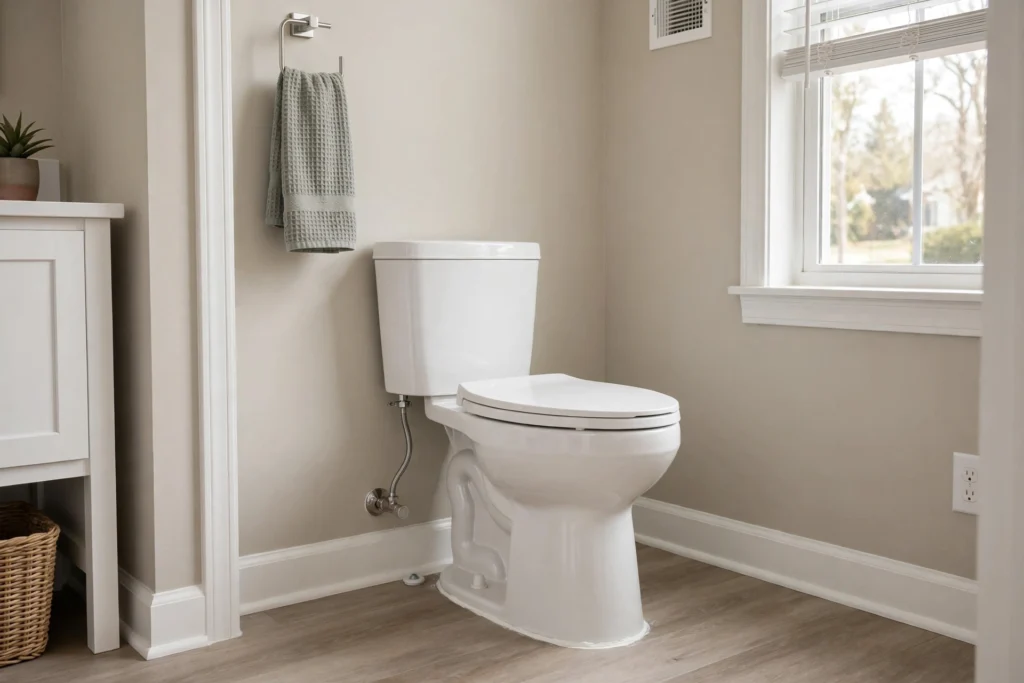
Replacing a toilet is usually a modest bathroom project, but the final bill can rise quickly when the job involves a premium fixture, damaged flooring, a failed flange, an awkward drain connection, or plumbing that needs correction. For U.S. homeowners planning a 2026 replacement, a useful starting point is about $225 to $535 for professional installation labor and a standard replacement job, before major repairs or an expensive toilet are added. Angi‘s 2026 data puts the typical professional installation around $374, with most projects falling between about $224 and $533.
That is a national planning benchmark, not a contractor quote. The toilet itself, local plumber rates, removal, floor condition, access, permits, and unexpected drain or flange work can all change the actual price.
Toilet replacement cost at a glance
| Cost item | 2026 planning range |
|---|---|
| Professional installation | About $224–$533 |
| Typical installation average | About $374 |
| Old toilet removal | About $50–$200 |
| Basic toilet fixture | Often $100–$300 |
| Midrange / specialty fixture | Often $300–$800+ |
| Floor repair if leak damage exists | Potentially $8–$24 per sq. ft. |
These ranges are budgeting tools. A straightforward same-location swap can stay near the lower end, while hidden water damage, a broken flange, drain changes, wall-hung models, bidet features, or premium finishes can push the project much higher.
What is included in a normal toilet replacement?
A standard professional replacement generally means shutting off the water, disconnecting and removing the old toilet, inspecting the mounting area, installing a new seal, setting and securing the new fixture, reconnecting the supply line, and testing for leaks and proper flushing. Disposal may or may not be included.
Ask the plumber to state whether the quote includes the toilet, wax or wax-free seal, supply line, bolts, removal, haul-away, minor flange work, cleanup, and tax. Two quotes that look similar can cover very different scopes.
The toilet itself can change the price dramatically
Basic two-piece gravity toilets are usually the least expensive option. One-piece models often cost more but can be easier to clean. Comfort-height bowls, elongated bowls, dual-flush models, pressure-assisted systems, concealed-tank toilets, wall-hung fixtures, integrated bidet seats, and smart toilets can all increase material and installation costs.
Before buying, measure the rough-in—the distance from the finished wall to the center of the closet bolts. Twelve inches is common, but older homes may differ. Also check bowl projection, door clearance, nearby cabinetry, shutoff-valve location, and whether an elongated bowl will fit comfortably.
WaterSense toilets: what the label actually means
The U.S. Environmental Protection Agency says WaterSense-labeled toilets use 1.28 gallons per flush or less, at least 20% less than the current federal standard of 1.6 gallons per flush. The label also requires independent certification for efficiency and flush performance.
EPA estimates that replacing older inefficient toilets with WaterSense-labeled models can reduce toilet water use by 20% to 60% for an average family, saving nearly 13,000 gallons annually. Actual household savings depend on the toilet being replaced, household size, flushing frequency, local water rates, and the new model.
Some utilities offer rebates or vouchers for qualifying toilets. Do not assume a rebate is available nationally: check your local water utility’s current program and eligibility requirements before purchasing.
Hidden costs homeowners should plan for
Damaged toilet flange
The flange anchors the toilet and connects it to the drain. Corrosion, cracking, poor previous repairs, or an incorrect height can require additional work after the old toilet is removed. A flange problem is difficult to price accurately until the fixture is lifted.
Rotten or damaged subfloor
A toilet that has leaked slowly can damage flooring and subfloor around the base. Angi notes that flooring repairs after leaks can run roughly $8 to $24 per square foot depending on the material and damage. Extensive structural damage is a separate repair project and should not be hidden inside a simple installation allowance.
Shutoff valve and supply line
An old valve may not close fully, and an aging supply connector may be worth replacing during the job. These are relatively small components, but correcting them while the toilet is disconnected can reduce the chance of a future leak.
Drain or rough-in problems
If the toilet has chronic drainage problems, replacing the fixture may not solve the underlying issue. A blocked branch drain, venting problem, damaged pipe, or incorrect rough-in needs separate diagnosis. Homeowners with recurring backups may want to review our 2026 drain cleaning cost guide before assuming the toilet itself is the cause.
Repair or replace?
A running toilet does not automatically need replacement. Common serviceable parts include the flapper, fill valve, flush valve, handle, supply line, and seal. If the porcelain is sound and the fixture performs well, a modest repair can be the economical choice.
Replacement becomes more compelling when the bowl or tank is cracked, the toilet rocks because of persistent mounting problems, repairs keep recurring, the fixture uses substantially more water than modern models, or the homeowner wants a different height, bowl shape, or accessibility feature.
If the problem is primarily plumbing labor rather than the fixture itself, compare the likely repair with the rates and service-call structure discussed in our plumber cost guide.
DIY vs. professional installation
A like-for-like toilet swap is within reach of an experienced DIY homeowner. The basic process is not mechanically complex, but toilets are heavy and fragile, the seal must be correct, and over-tightening can crack porcelain. A poorly seated toilet can leak into the floor without immediately producing an obvious puddle.
DIY makes the most sense when the shutoff works, the flange is sound, the floor is level, the rough-in matches, the drain has no known problem, and the homeowner can safely lift and position the fixture. Professional installation is preferable when there is visible water damage, a broken or corroded flange, an unusual toilet system, drain relocation, a wall-hung model, accessibility concerns, or uncertainty about the plumbing.
Do you need a permit?
Permit requirements are local. A simple fixture replacement in the same location often receives different treatment from moving a drain, altering water piping, opening walls, or changing the bathroom layout. Check the local building department when the scope goes beyond a straightforward replacement, and ask a contractor who is responsible for any required permit.
How to compare plumber quotes
For a standard replacement, ask each plumber to price the same scope. The written estimate should identify whether the toilet is owner-supplied or contractor-supplied, removal and disposal, new seal and supply connector, flange repair allowance, shutoff-valve work, floor repairs, permit responsibility, warranty, and cleanup.
Also ask how unexpected damage is handled. A useful quote explains the hourly rate or unit price for extra work and requires approval before substantial additions are performed. That is more informative than choosing the lowest headline installation price.
Three realistic homeowner scenarios
Simple same-location swap: The old toilet comes out cleanly, the flange and floor are sound, and a standard two-piece model fits the existing rough-in. This is the scenario most likely to stay near the typical national installation range.
Older bathroom with leak damage: The fixture has rocked or leaked for months. Once removed, the installer finds a deteriorated flange and damaged flooring. The toilet itself may be inexpensive, but repair work becomes the dominant cost.
Premium upgrade: The homeowner chooses a one-piece, bidet-equipped, wall-hung, or smart model. Electrical requirements, concealed carriers, nonstandard plumbing, and specialized labor can make the project several times more expensive than a basic replacement.
How to avoid unnecessary costs
Measure the rough-in before buying. Confirm what accessories come with the fixture. Do not automatically replace a sound toilet for a cheap internal part. If replacement is justified, address any known floor or drainage issue at the same time rather than paying for repeated removal and resetting.
For water efficiency, compare models carrying the WaterSense label rather than relying only on marketing language. If a rebate matters to the economics, verify the exact qualifying model and program rules with the utility before purchase.
Five-step toilet replacement plan
- Measure before buying. Confirm rough-in, bowl projection, door swing, cabinet clearance and shutoff-valve location.
- Choose the fixture for the household. Compare bowl height, shape, flush performance, water use and any bidet or accessibility needs.
- Inspect the floor and flange. Budget separately for flange repair or water-damaged flooring instead of hiding uncertainty inside the toilet price.
- Compare complete installation quotes. Make removal, disposal, seal, supply line, shutoff work, permit responsibility and warranty explicit.
- Test before final payment. Flush repeatedly, inspect the base and supply connection for leaks, verify the toilet is stable and confirm the shutoff works.
Questions to ask the plumber
- Is the toilet included or owner-supplied?
- Are removal and haul-away included?
- Will the supply line and seal be replaced?
- What does flange repair cost if damage is found?
- How is subfloor damage handled?
- Will any drain problem be diagnosed before a new toilet is installed?
- What labor warranty applies to leaks and resetting?
Frequently asked questions
How much does toilet installation cost in 2026?
Angi’s 2026 data places professional installation around $224 to $533, with an average near $374. HomeGuide‘s broader fixture-plus-labor range is roughly $350 to $800 for many standard projects.
How much does old-toilet removal cost?
Removal and disposal commonly adds about $50 to $200 when it is not included in the installation price.
Should I repair a running toilet or replace it?
Repair is usually sensible when the porcelain is sound and the problem is a flapper, fill valve, handle or other inexpensive part. Replacement makes more sense when the fixture is cracked, inefficient, repeatedly troublesome or no longer meets household needs.
What is the biggest hidden cost?
Water-damaged flooring or a failed flange can turn a routine swap into a larger repair. That condition may not be visible until the old toilet is removed.
Related Home Cost Desk guides
Bottom line
For a straightforward 2026 U.S. toilet replacement, a reasonable professional-installation planning range is roughly $224 to $533, with Angi reporting an average near $374. The complete project total depends on the fixture and whether removal, disposal, flange work, supply components, flooring, or plumbing repairs are required.
The cheapest toilet is not necessarily the lowest-cost long-term choice. A correctly sized, properly installed WaterSense-labeled model can combine reliable performance with lower water use. The most important budgeting step is to separate the known replacement cost from uncertain repair work that may only become visible after the old fixture is removed.
Home Cost Desk compares current U.S. cost or technical references and checks safety, code, efficiency, incentive, or regulatory claims against authoritative sources when available. National figures are planning ranges, not local quotes.
Editorial review: Home Cost Desk Editorial Team · Read our research methodology · Detailed sources appear below.
Sources and methodology
Home Cost Desk treats published national figures as planning benchmarks rather than guaranteed local prices. Cost figures were cross-checked against Angi’s 2026 toilet-installation data. Water-efficiency and performance claims were checked against current U.S. EPA WaterSense guidance and specifications. Actual contractor pricing varies by market, fixture, site condition, permits, and scope.