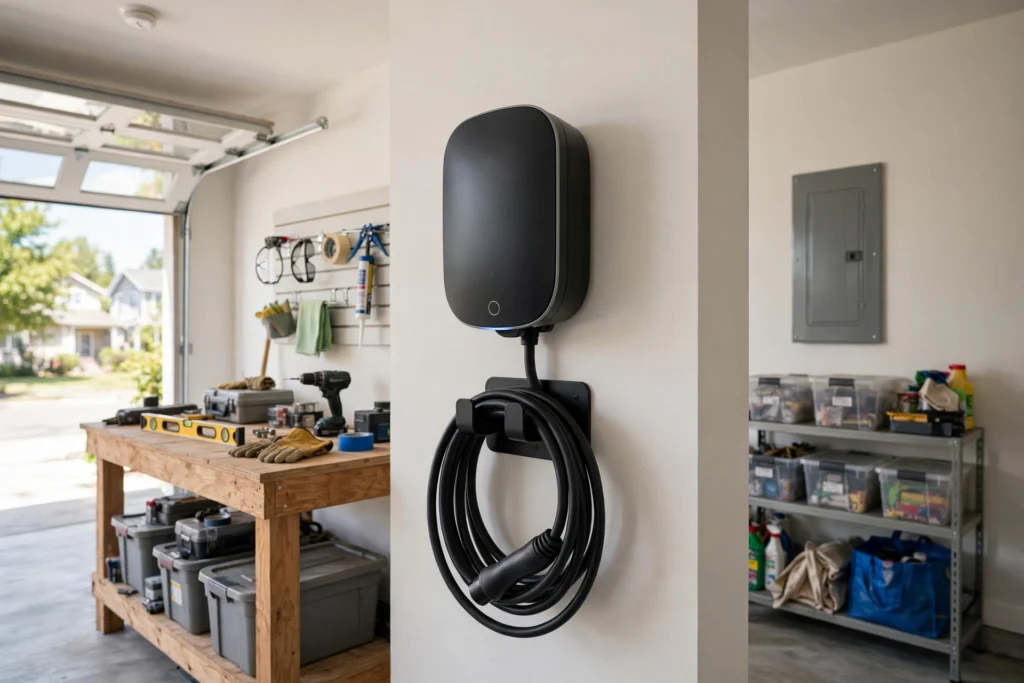
Updated October 2026. Installing a Level 2 EV charger at home can be a modest electrical project or a multi-thousand-dollar upgrade, depending on what the house already has. Current national data separates the budget into two useful numbers: Angi reports professional EV-charger installation averaging about $967, with many projects around $554 to $1,380, while HomeGuide puts a typical complete Level 2 project—including charger and installation—around $1,200 to $3,000.
A short run from a modern panel can stay near the low end. A long conduit route, outdoor pedestal, detached garage, trenching, electrical-panel work or service-capacity upgrade can push the project to $3,000 to $6,000 or more. That is why the most useful homeowner question is not simply “What does EV charger installation cost?” but “What electrical work does my house need before the charger can operate at the charging rate I actually want?”
Do not compare a labor-only number with an all-in project total. Charger hardware, permits, wiring length, breaker size, panel capacity and restoration work may be included in one quote and excluded from another.
EV charger installation cost at a glance
| Project | 2026 planning range |
|---|---|
| Use an existing suitable Level 1 outlet | Often $0 additional installation cost |
| Level 2 charger hardware | About $300–$1,000+ for many residential units |
| Professional EV charger installation | About $554–$1,380 for many projects |
| Typical complete Level 2 project | About $1,200–$3,000 including charger and installation |
| Dedicated circuit or new wiring | Often several hundred dollars to $1,500+, depending on distance and access |
| Permit allowance | Often about $100–$200 where required |
| Electrical panel upgrade, if truly needed | Often about $800–$2,000 in current EV-installation cost data, with larger service work potentially higher |
| Detached garage, trenching, long run or major service work | Often $3,000–$6,000+ |
These are national planning figures, not contractor bids. Angi’s September 2026 data separates professional installation from equipment, while HomeGuide reports all-in Level 2 projects. Permit fees, conductor length, charger output, panel capacity, trenching and utility work can materially change a real quote.
Do you actually need Level 2 charging?
The U.S. Department of Energy’s Alternative Fuels Data Center says many EV drivers charge overnight at home. Level 1 uses 120-volt power; if a suitable dedicated branch circuit is already available near the parking space, some drivers can meet their daily needs without paying for a new charging installation. Level 2 uses 240-volt equipment and is the common choice when faster overnight charging is needed.
Before spending money, start with your driving pattern. Someone who drives 20 or 30 miles most days and parks for 10 hours overnight may have very different needs from a two-EV household with a long commute. Buying the highest-output charger available does not automatically produce the best value, because the vehicle’s onboard charger and the home’s electrical capacity also limit what you can use.
What changes the installation price?
1. Distance from the electrical panel
A charger mounted a few feet from an adequately sized garage panel is usually the inexpensive case. Put the main panel on the opposite side of a finished house and the electrician may need substantially more cable, conduit, wall access and labor. Detached garages can add trenching and restoration work. Ask every bidder to state the assumed wire-run length so you can compare quotes on the same basis.
2. Available electrical capacity
This is the variable most likely to turn a modest project into an expensive one. EV charging is treated as a continuous electrical load, and the Department of Energy notes that EV charging installations must comply with applicable electrical codes and local requirements. An electrician should evaluate the service and perform the appropriate load calculation rather than simply looking for an empty breaker space.
If the panel cannot support the proposed charger, do not assume a full service upgrade is the only answer. Depending on the home and local code, a lower charger setting, load-management equipment or other electrical design may solve the problem. If an upgrade really is required, see our electrical panel upgrade cost guide before approving the extra work.
3. Charger output
Residential Level 2 equipment spans a wide output range. The Department of Energy notes that Level 2 equipment can range from about 2.9 kW to 19.2 kW. Higher output can require a larger branch circuit and heavier conductors. The right question is not “What is the biggest charger?” but “What charging rate will my vehicle accept, and what rate do I need to replace my normal daily mileage overnight?”
4. Plug-in versus hardwired
Some Level 2 units plug into a 240-volt receptacle; others are hardwired. A plug-in unit can be easier to replace or take with you, while a hardwired installation can be a clean permanent solution and may be preferable or required for some higher-output configurations. The quote should specify the charger model, circuit rating, receptacle if any, breaker, conductor and whether the installation is hardwired.
5. Indoor versus outdoor location
The Department of Energy says outdoor home charging is possible, including in rain, when equipment is appropriately rated for outdoor use. Outdoor placement can nevertheless increase project cost if it requires weather-rated hardware, exterior conduit, trenching or a pedestal. Do not substitute an indoor-only device because it is cheaper.
6. Permit and inspection requirements
Local and state rules vary. The Department of Energy specifically notes that appropriate permits may be required by local building and permitting authorities. Ask whether the electrician is pulling the permit and whether the permit and final inspection are included in the quoted total.
Hidden costs that can change an EV charger quote
- Long wire runs: More copper, conduit and labor can move a simple installation into a much higher price tier.
- Finished-wall access: Routing behind drywall, ceilings or finished basements can add labor and repair work.
- Detached garages: Underground conduit, trenching, a feeder or subpanel and surface restoration can become a separate project.
- Outdoor mounting: Weather-rated equipment, exterior conduit, bollards or a pedestal may be required.
- Panel or service work: An empty breaker space does not prove the home has electrical capacity. A load calculation should support any upgrade recommendation.
- Utility involvement: Large service upgrades may require meter or utility coordination beyond the charger installer’s base price.
- Drywall, concrete and landscaping restoration: These are frequently excluded from the electrician’s quoted electrical scope.
- Owner-supplied charger issues: A bargain charger can become expensive if it lacks the required listing, outdoor rating, cable length or compatible connector.
Before accepting a bid, ask the contractor to mark every one of these items as included, excluded or not applicable. That makes quote comparison much more reliable than comparing only the final total.
Three realistic 2026 EV charger budgets
Scenario 1 — Attached garage, modern panel: The charger is mounted close to a panel that already has capacity. A $400–$800 charger plus a short conventional circuit run could put the complete project around $900–$1,800. This is the cleanest case and the one most likely to resemble national-average installation data.
Scenario 2 — Long run through a finished home: The panel has capacity, but the parking space is 50 or 60 feet away and routing requires more conductor, conduit and wall access. The charger may still cost $500, but the complete project can move toward roughly $1,800–$3,500 depending on access, circuit size and finish repair.
Scenario 3 — Older service and detached garage: The home needs trenching or a garage feeder and the electrician documents inadequate service capacity for the desired charging rate. Once panel or service work is added, a project can reach roughly $3,000–$6,000+. Get the load calculation and garage-feed scope in writing before buying the charger. If service work is proposed, compare it with our electrical panel upgrade cost guide and consider a second electrical opinion.
These are planning examples, not bids. They show why charger hardware is often not the dominant cost once distance, trenching or service capacity becomes part of the job.
DIY vs. professional installation
There is useful work a homeowner can do: choose the parking location, measure the approximate panel-to-charger route, check the vehicle’s charging specifications, photograph the panel label and ask the utility about time-of-use rates or charger rebates.
Installing a new high-current 240-volt branch circuit is different. The Department of Energy says a qualified electrician can add circuits for Level 2 charging and emphasizes code compliance for EV charging equipment. Unless you are legally qualified to perform this work in your jurisdiction, treat the circuit, breaker, load calculation and hardwired connection as professional electrical work. Our electrician cost guide explains how service-call and labor pricing can affect smaller electrical projects.
Important 2026 tax-credit update: the federal home-charger credit has ended
This is one area where older articles can now mislead homeowners. The IRS states that the Section 30C Alternative Fuel Vehicle Refueling Property Credit applied to qualifying property placed in service through June 30, 2026. Under the prior rules, eligible personal-use installations at a principal residence could receive 30% of qualifying cost, up to $1,000 per charging port, subject to location and other requirements.
Because it is now October 2026, a new home charger placed in service today does not qualify for that federal credit. The IRS states that property placed in service after June 30, 2026 cannot claim Section 30C. Do not subtract $1,000 from a contractor quote based on an outdated incentive page. State, local and utility rebates may still exist, so check your utility and state programs before purchasing equipment.
How to compare EV charger quotes
Get at least two or three itemized proposals when the project involves more than a short, obvious circuit run. Each quote should answer the same questions:
- What charger model and maximum output are being installed?
- Is the charger included in the price or owner-supplied?
- What circuit and breaker size is proposed?
- How many feet of wiring or conduit are included?
- Is the installation plug-in or hardwired?
- Was a load calculation performed?
- Are permit and inspection fees included?
- Is drywall repair, trenching or concrete work excluded?
- If a panel upgrade is recommended, why is it necessary?
- Does the utility need to approve or modify anything?
Be cautious with a quote that gives only one lump-sum number. A $900 quote and a $1,500 quote may not actually compete if one excludes the charger, permit or a long conduit run. Likewise, a contractor proposing a service upgrade should be able to explain the electrical basis for it.
Can load management save you from a panel upgrade?
Sometimes. ENERGY STAR specifically advises homeowners to ask electricians about optimizing existing panel capacity and notes that there may be ways to avoid increasing electric service capacity. For an EV project, the practical options can include reducing the charger’s configured output or using approved load-management equipment, depending on the installation and local code.
That does not mean every older home can avoid an upgrade. It means a $2,000-plus upgrade should be justified by a load calculation and the actual charging requirement, not treated as an automatic add-on.
Safety and code points homeowners should not skip
Use charging equipment listed or certified for its intended application, follow the manufacturer’s installation instructions, and use outdoor-rated equipment outdoors. Do not run an improvised extension cord as a substitute for a properly designed permanent charging circuit. The Department of Energy notes that EV charging equipment is a continuous load under the National Electrical Code and that installations must comply with state and local rules.
If a receptacle, plug or charger becomes unusually hot, shows discoloration, smells burned or repeatedly trips a breaker, stop using it and have the installation inspected. A high-current circuit that operates for hours at a time is not a good place to ignore signs of a poor connection.
Five-step home EV charger plan
- Start with daily mileage. Estimate how many miles you normally need to replace overnight instead of automatically choosing the highest-output charger.
- Match the charger to the vehicle. Check the vehicle’s maximum AC charging rate, connector requirements and recommended home-charging setup.
- Have the electrical capacity checked. Ask for a load calculation when capacity is uncertain. An empty breaker space alone is not enough evidence that a larger charging circuit is appropriate.
- Compare complete installed scopes. Put charger hardware, breaker, conductors, conduit, permit, inspection, wall repair, trenching and panel work on the same comparison sheet.
- Check local incentives before purchase. The federal 30C home-charger credit has ended for property placed in service after June 30, 2026, but utility, state or local rebates may still reduce the project cost.
Common EV charger budgeting mistakes
- Buying the charger before confirming the vehicle, circuit and connector requirements.
- Assuming the fastest charger is automatically the best value.
- Comparing a labor-only quote with an all-in quote.
- Accepting a panel upgrade without asking for the load calculation behind it.
- Ignoring the cost of a long wire run, trenching or detached-garage electrical work.
- Forgetting permits, inspections, drywall repair or landscape restoration.
- Using an indoor-only charger in an outdoor location.
- Budgeting for an expired federal tax credit.
Before you sign the contract
A good EV-charger proposal should make three things obvious: how fast the proposed setup will charge your vehicle, why your electrical system can support it, and exactly what the installed price includes. If those answers are vague, get another quote before authorizing the work.
Final quote checklist
- Exact charger make and model
- Maximum configured charging output
- Hardwired or receptacle connection
- Breaker and branch-circuit size
- Estimated wire/conduit length
- Load calculation where capacity is a concern
- Permit and inspection responsibility
- Panel, service or load-management work
- Trenching, wall repair and restoration exclusions
- Equipment and labor warranties
For many homes, the best-value installation is not the fastest possible charger. It is a properly sized Level 2 circuit that replenishes normal daily driving overnight without forcing unnecessary electrical upgrades.
What to verify after installation
- The charger is mounted securely and the cable reaches the normal parking position without strain.
- The electrician explains the configured amperage and expected charging rate.
- The circuit, breaker and charger are labeled clearly where required.
- The charger completes a test session without overheating, fault codes or repeated breaker trips.
- You receive permit or inspection records where applicable.
- You keep the charger model, serial number, warranty information and electrician invoice.
- If a utility rebate or managed-charging program applies, you know what documentation must be submitted.
What to send an electrician before requesting a quote
You can make quotes more accurate before anyone arrives. Send the same information to each electrician:
- a photo of the main electrical panel and its label;
- the existing service amperage, if known;
- the EV make, model and maximum AC charging rate;
- the charger make and model if you have already chosen one;
- the approximate distance from the panel to the parking location;
- whether the route is through finished space, outdoors or underground;
- whether the garage is attached or detached;
- photos of the proposed charger location and route;
- any major electric loads already in the home, such as a heat pump, electric range, dryer or water heater.
Then ask each bidder for the same four outputs: the proposed charging amperage, the load-calculation conclusion, the complete installed price, and a written list of exclusions. That gives you a like-for-like comparison instead of three unrelated lump-sum quotes.
Home Cost Desk compares current U.S. cost or technical references and checks safety, code, efficiency, incentive, or regulatory claims against authoritative sources when available. National figures are planning ranges, not local quotes.
Editorial review: Home Cost Desk Editorial Team · Read our research methodology · Detailed sources appear below.
Sources and methodology
Current installation pricing was cross-checked against Angi’s September 23, 2026 EV-charger cost data, which reports a national professional-installation average around $967 and a common range around $554–$1,380, and HomeGuide’s current Level 2 all-in planning range of about $1,200–$3,000. Electrical and charging guidance was checked against the U.S. Department of Energy Alternative Fuels Data Center pages on charging EVs at home and EV charging equipment. Electrical-capacity guidance was cross-checked against ENERGY STAR electric-ready guidance. The federal tax-credit status was checked against the IRS Section 30C guidance and Form 8911 instructions, which state that qualifying property had to be placed in service by June 30, 2026. Cost figures are national planning ranges; contractor bids vary by location, electrical capacity and site conditions.