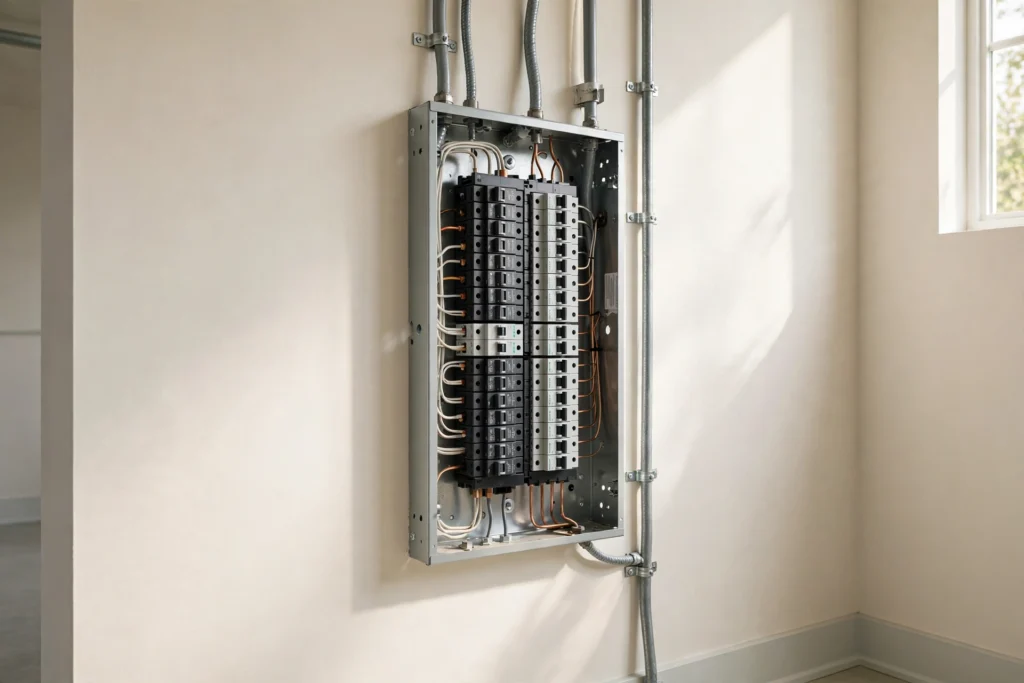
Updated October 2026. Quick answer: A straightforward professional electrical-panel upgrade commonly lands around $1,200 to $2,000 in current 2026 pricing. A new 200-amp panel often falls around $1,300 to $2,500, while a true service upgrade can move above that once the project also needs a meter base, service-entrance conductors, utility coordination, grounding corrections, relocation, or wiring repairs. Complex projects can reach $4,000 to $10,000+ when substantial service or building work is involved.
The first budgeting rule is to separate a panel swap from a service upgrade. They are not the same job. A quote should spell out the panel, breakers, meter work, service conductors, grounding and bonding, permits, inspection, utility work, and any wall or exterior repairs instead of hiding them inside one number.
An electrical panel quote can be confusing because two homeowners may both say they are “replacing the breaker box” while one is getting a simple like-for-like swap and the other is rebuilding much of the home’s electrical service. That scope difference matters more than the price of the metal box itself.
Electrical panel upgrade cost at a glance
| Project | Typical planning range | What changes the price |
|---|---|---|
| 100A panel replacement / upgrade | About $800–$1,500 | Breaker count, access, grounding/bonding corrections |
| 150A panel | About $1,300–$1,600 | Equipment, breakers, local labor and code work |
| 200A panel installation | About $1,300–$2,500 | Panel, breaker count, service condition and whether new service equipment is required |
| 300A service / panel | About $1,800–$3,500 | Larger equipment and service conductors |
| 400A service / panel | About $2,000–$4,000+ | Larger service equipment, meter configuration and utility scope |
| Complex service upgrade or relocation | About $4,000–$10,000+ | Meter base, mast, trenching, relocation, major wiring or finish repairs |
These are budgeting ranges, not bids. Current 2026 consumer pricing varies because some estimates cover the panel and installation only, while others include a true service upgrade. Angi reports many professional panel upgrades around $1,200–$2,000, while HomeGuide places many 200-amp projects around $1,300–$2,500 depending on whether new service equipment is required. The number becomes much less useful once relocation, utility-side work, major grounding corrections, trenching, or extensive rewiring enters the scope.
Panel replacement vs. service upgrade: know what you are buying
A panel replacement can mean removing the existing panel and installing a new one at roughly the same capacity. A service upgrade may also require larger service-entrance conductors, a meter base, grounding changes and coordination with the electric utility. That is why a $1,800 quote and a $4,000 quote are not necessarily bids for the same job.
If you are moving from 100 amps to 200 amps because you are adding a heat pump, induction range, electric water heater or EV charger, ask the electrician to perform or document the required load calculation rather than assuming a larger panel is automatically necessary.
100A vs. 200A vs. 400A: how much capacity do you actually need?
Amp rating is not a quality score. It is the amount of electrical service the home can safely accommodate under the applicable design and load calculation. A smaller home with gas heat and modest electrical demand may function well on 100 amps, while a home adding multiple large electric loads may justify 200 amps. Very large homes, multiple EV chargers, workshops, major electric heating loads, accessory dwelling units, or unusually heavy equipment can push some projects toward 300- or 400-amp service.
| Service size | Where it may fit | What to verify |
|---|---|---|
| 100 amps | Smaller or lower-demand homes | Existing and planned electric loads |
| 200 amps | Common modern whole-home capacity target | Heat pump, EV, electric cooking, water heating and future circuits |
| 300–400 amps | Large or unusually high-load properties | Utility availability, meter setup, service conductors and actual calculated demand |
Do not pay for a 400-amp project simply because it sounds more future-proof. Ask what calculated load requires it, what new equipment you plan to add, and whether load-management equipment or a smaller service with better circuit planning would meet the same goal.
Could a subpanel solve the space problem without a full service upgrade?
Sometimes a homeowner says “I need a bigger panel” when the real problem is simply that the existing panel has no usable breaker spaces. If the service capacity is still adequate, an electrician may recommend a properly sized subpanel instead of replacing the main service solely for more circuit spaces.
A subpanel does not increase the total electrical service available to the house. It redistributes circuits and provides additional breaker spaces. That distinction matters: if the home is already near its service limit, adding a subpanel alone does not solve the load-capacity problem.
What drives the cost?
1. Amperage and available capacity
A simple same-size replacement generally costs less than increasing service capacity. Larger services require more expensive equipment and may trigger work beyond the panel itself.
2. Meter and service-entrance work
This is one of the biggest quote separators. Ask whether the meter base, mast, weatherhead, service cable or utility connection must change. A low quote that excludes those items may become expensive once work begins.
3. Breaker requirements
The number and type of breakers matter. Modern code requirements can mean that some circuits need more sophisticated protection than the old panel provided. Ask the contractor to identify any code-driven breaker upgrades in the proposal.
4. Grounding, bonding and old wiring
Older homes can reveal undersized conductors, deteriorated insulation, improper bonding or other defects once the panel is opened. A panel project does not automatically mean whole-house rewiring, but required corrections can add substantially to the bill. If you already suspect broader wiring problems, compare our 2026 electrician cost guide and 2026 house rewiring cost guide.
5. Location and access
A panel in an accessible garage is usually easier to work on than one in a cramped or noncompliant location. Relocating a panel can add wiring, conduit, wall repair and additional labor.
6. Permits, inspection and utility coordination
Main-panel work normally involves local permitting and inspection, and a service upgrade may require the utility to disconnect and reconnect power. Before comparing bids, make sure each contractor has included the same administrative and utility scope.
When does a panel actually need replacement?
Age alone is not enough to diagnose a panel. Replacement becomes more compelling when the equipment is damaged, capacity is demonstrably inadequate, parts are obsolete or unavailable, or an electrician finds unsafe conditions.
Repeated breaker trips should not simply be ignored or “fixed” by repeatedly resetting the breaker. The U.S. Consumer Product Safety Commission advises homeowners to investigate why a breaker trips and to consult a qualified electrician when in doubt.
Other reasons to schedule an evaluation include scorch marks, unusual heat, buzzing or crackling, corrosion or water intrusion, a burning odor, damaged equipment, or plans for major new electrical loads. If you smell burning, see smoke or arcing, or suspect an active electrical fire, treat it as an emergency rather than a budgeting project.
A note about older Federal Pacific panels
You may see sweeping online claims about Federal Pacific Electric Stab-Lok panels. The history deserves more precision. CPSC testing found that certain breakers failed UL calibration requirements, but the Commission closed its investigation without making a determination that the breakers posed a serious risk of injury. Homeowners with older equipment should have its condition and suitability evaluated by a qualified electrician rather than relying on a brand name alone.
Can you repair the panel instead of replacing it?
Sometimes. A bad individual breaker, a clearly repairable connection, or another isolated fault may not justify replacing the entire panel. But repair becomes less attractive when the enclosure or bus is damaged, the equipment is obsolete, capacity is inadequate, multiple problems are present, or replacement parts cannot be safely sourced.
Ask the electrician for two numbers when repair is genuinely possible: the cost of the immediate repair and the cost of replacement. Then ask what each option solves and what it leaves unresolved. This prevents a cheap repair from becoming expensive if replacement is already likely in the near future.
Is an electrical panel upgrade a DIY project?
No—not as a homeowner cost-saving project. Main-service equipment involves potentially lethal electrical hazards and work that commonly requires permits, inspection and utility coordination. This is an appropriate job for a properly licensed electrician working under local requirements.
DIY savings are better pursued around the project: clear access to the work area, plan wall repairs separately if allowed, gather your future electrical-load plans before bids, and compare complete scopes from qualified contractors.
Could rebates lower the cost in 2026?
Possibly, but separate rebates from the old federal tax credit. The U.S. Department of Energy still lists income-qualified Home Energy Rebates that may provide up to $4,000 for an eligible electric-panel upgrade. Availability, income rules and project eligibility are state- and program-specific, so do not subtract the maximum amount from your budget until you confirm that your state program is active and that your project qualifies.
The former federal Energy Efficient Home Improvement Credit under Section 25C is different. Current IRS guidance says the credit is not allowed for property placed in service after December 31, 2025. That means a new 2026 panel project should not be budgeted using the old federal 25C credit, even though state, local or utility rebates may still exist.
This distinction matters when a panel upgrade is connected to electrification work such as a heat pump. If that is your project, our 2026 heat pump cost guide explains the larger installation budget.
Three realistic 2026 budget scenarios
Scenario 1: Like-for-like panel replacement
An accessible panel is being replaced at roughly the same service capacity. The meter and service conductors remain usable, no relocation is required, and only routine grounding or breaker corrections are needed. A project like this may stay near the lower end of the current $1,200–$2,000 professional-upgrade range.
Scenario 2: 100A to 200A service upgrade
The homeowner is adding larger electric loads and the load calculation supports a 200-amp service. The project includes a new panel, service equipment, permit, inspection and utility coordination. A practical budget often moves into roughly the $1,800–$4,000 range once the complete service scope is included, even if the panel itself is inexpensive.
Scenario 3: Older home with meter, service and wiring corrections
The existing panel location is problematic, the meter base or service entrance needs replacement, grounding must be corrected, and several circuits need repair. This is no longer a simple breaker-box swap. A project like this can move into the $4,000–$10,000+ If the concern is the wiring itself rather than the panel, compare the two projects in our guide to panel upgrade vs. whole-house rewiring. range depending on local labor, utility requirements and how much finish repair or rewiring is involved.
A five-step plan before you approve an upgrade
- List your future loads. Include planned heat pumps, EV chargers, induction cooking, electric water heating, hot tubs, workshops or additions.
- Ask for a documented load calculation. Do not assume 200 or 400 amps is necessary simply because the old panel is crowded.
- Separate panel work from service work. Identify whether the meter base, mast, service conductors, grounding or utility connection must change.
- Get comparable written quotes. Each proposal should include the same permit, breaker, meter, grounding, cleanup and utility scope.
- Verify incentives before signing. Check current state, local and utility programs; do not budget an expired federal credit.
What to prepare before the electrician arrives
- A photo of the existing panel exterior and label, without removing the cover.
- A list of major electric appliances already in the home.
- Your planned future loads for the next several years.
- Any history of breaker trips, flickering lights, overheating, buzzing or burning odors.
- Whether you plan an EV charger, heat pump, electric range or electric water heater.
- Any previous electrical inspection reports or known permit issues.
Do not remove the dead front, touch service conductors or attempt to inspect energized components yourself. If you are concerned about warning signs, use our home electrical safety checklist as a homeowner-level reference and leave panel diagnosis to a qualified electrician.
How to compare electrician quotes
Do not compare only the bottom-line number. Ask each contractor to put the following in writing:
- existing and proposed service amperage;
- panel manufacturer, size and number of spaces;
- which breakers are included;
- whether the meter base or service entrance is included;
- grounding and bonding work;
- permit and inspection fees;
- utility disconnect/reconnect responsibilities and fees;
- any drywall, siding or finish repairs that are excluded;
- warranty on labor and equipment;
- what conditions could trigger a change order.
For a large job, two or three comparable written bids are useful. A dramatically cheaper bid deserves scrutiny: it may simply exclude work the other contractors included.
A realistic homeowner example
Suppose an older home has 100-amp service and the owner plans to install a heat pump and an EV charger. One electrician quotes $2,100 for a new panel. Another quotes $3,500. The second bid may look excessive until the scopes are compared: perhaps it includes a new meter base, service conductors, permit, grounding work and utility coordination while the first is only a panel swap.
The right question is therefore not “Which electrician is cheaper?” It is “What complete electrical system will I have when each contractor is finished?”
After the upgrade: a final homeowner verification checklist
- Confirm the permit has been closed and the required inspection passed.
- Keep the final invoice, permit record, panel model information and warranty documents together.
- Make sure the new circuit directory is legible and accurately identifies the major circuits.
- Ask which breakers or circuits received AFCI or GFCI protection and why.
- Confirm any utility disconnect/reconnect or meter work is complete.
- Ask the electrician to explain any remaining wiring limitations or recommended future repairs in writing.
- If the upgrade was installed for a future heat pump, EV charger or other major load, confirm the planned equipment remains within the load calculation used for the project.
Before final payment, compare the finished work with the written scope. If a meter base, grounding correction, surge protection, new breakers or service conductors were included in the proposal, verify that those items were actually completed rather than assuming the new panel cover means the entire service upgrade is finished.
Local electrical-panel planning examples
National panel-upgrade ranges are a starting point, but local permitting and utility requirements can change the project scope. Compare our Austin electrical panel upgrade cost guide for Texas permitting and service-coordination considerations and our New York City panel upgrade guide for apartment-building access, local permit processes and Con Edison coordination. These examples are not interchangeable with a quote in another city.
Bottom line
For 2026 planning, a straightforward professional panel upgrade commonly lands around $1,200–$2,000, while many 200-amp projects fall around $1,300–$2,500 before major service complications. Budget more when the project also needs a new meter base, larger service conductors, grounding corrections, relocation, extensive wiring work or difficult utility coordination.
The safest way to control cost is to define the scope before comparing bids. Have a licensed electrician evaluate the existing service and future loads, insist on a written load-based recommendation, and make every quote spell out what is—and is not—included.
Home Cost Desk compares current U.S. cost or technical references and checks safety, code, efficiency, incentive, or regulatory claims against authoritative sources when available. National figures are planning ranges, not local quotes.
Editorial review: Home Cost Desk Editorial Team · Read our research methodology · Detailed sources appear below.
Sources and methodology
- Angi — Electrical Panel Upgrade Cost, updated August 3, 2026
- HomeGuide — Electrical Panel Replacement and Upgrade Cost
- NerdWallet — Electrical Panel Replacement Cost, updated March 13, 2026
- U.S. Department of Energy — Home Upgrades and Rebate Information
- IRS — Current Home Energy Credit Termination Dates
- U.S. CPSC — Federal Pacific Breaker Investigation and Safety Information
National cost figures are planning estimates, not contractor quotes. Local labor, utility requirements, service condition, permits, breaker types, wiring condition and installation scope can materially change the final price.