Quick answer
Professional gutter guard installation in 2026 has an unusually wide published cost range because products and sales models vary dramatically. Angi’s current verified-project data places the national average around $1,521, with most professional projects between about $653 and $2,458. Angi also reports roughly $6 to $13 per linear foot for installed guards. HomeGuide reports a much higher professional range of about $15 to $45 per linear foot, or roughly $3,000 to $9,000 for 200 linear feet, reflecting higher-end systems, warranties, and dealer-installed products.
Those numbers should not be averaged into one “correct” price. A basic screen installed on accessible one-story gutters is not the same product as a premium micro-mesh or surface-tension system installed on a steep two-story roof with gutter repairs, custom corners, and a long warranty. The homeowner’s job is to identify the guard type, linear footage, gutter condition, roof access, and warranty before comparing totals.
2026 gutter guard cost snapshot
Angi’s $653 to $2,458 range is a useful baseline for ordinary professional projects. Its per-foot data of about $6 to $13 translates to roughly $1,200 to $2,600 for 200 linear feet. HomeGuide’s 2026 range is substantially higher at $15 to $45 per linear foot, or $3,000 to $9,000 for 200 linear feet. The difference is not necessarily bad data; it reflects different product mixes and installation channels.
Material-only DIY products can cost much less. Screens, foam inserts, brush guards, and basic metal mesh can be bought for a fraction of premium dealer-installed systems. However, the cheapest material is not automatically the lowest lifetime cost if it clogs, collapses, interferes with the roof, or requires frequent removal for cleaning.
If the gutters themselves need replacement, compare the guard quote with the existing Gutter Installation Cost 2026 guide. Guards should not be installed over failing gutters just because the guard salesperson offers a package price.
What gutter guards actually do
Gutter guards reduce the amount of leaves, twigs, seeds, pine needles, and other debris that enters a gutter. They do not make a gutter maintenance-free. Fine roof granules, pollen, dust, shingle grit, small seeds, and organic residue can still collect on top of or inside a guard system.
A good guard reduces the frequency and difficulty of gutter cleaning while preserving enough water flow during heavy rain. A bad guard can move the maintenance problem from inside the gutter to the top of the cover, where wet debris forms a mat and water overshoots the edge.
Set expectations correctly. The goal is fewer clogs and safer maintenance, not a promise that nobody will ever inspect the gutters again.
Micro-mesh guards
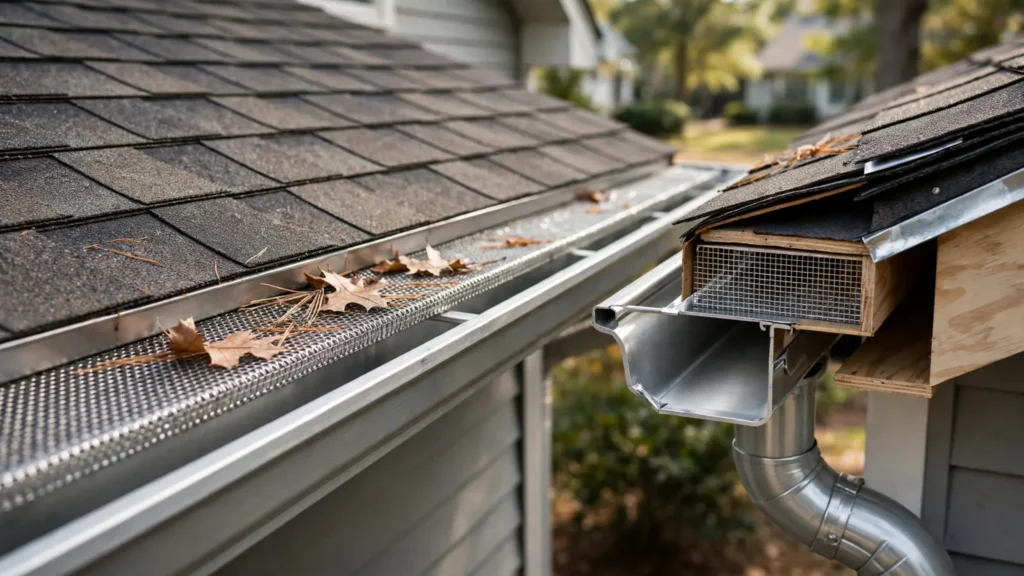
Micro-mesh systems use a fine stainless or coated mesh supported by a frame. They are effective at blocking small debris such as pine needles and shingle granules while allowing water through when the surface is clean.
They usually cost more than simple screens because the materials and attachment system are more substantial. In areas with heavy tree coverage, micro-mesh can be a strong choice, but it still needs occasional surface cleaning. Pollen or organic films can reduce flow if ignored.
Ask how the mesh is supported. A flimsy mesh that bows under wet leaves can trap debris even if the screen material itself is high quality.
Perforated metal and expanded-mesh screens
Metal screens are one of the simpler professional options. They block larger leaves and debris and can be relatively inexpensive. They are less effective against fine seeds, pine needles, and roof grit than true micro-mesh.
They can be a good value where the main problem is broad leaves rather than fine debris. Compare the hole size, metal thickness, coating, fasteners, and how corners and valleys are handled.
Do not assume that a heavier screen is automatically better. The system must remain stable without restricting water or damaging the gutter lip.
Surface-tension and reverse-curve covers
Surface-tension guards use a curved cover intended to direct water around an edge into the gutter while debris falls away. They can work well when installed with correct slope and spacing, but they are sensitive to roof geometry, heavy rainfall, and installation detail.
Ask the installer to demonstrate how the system handles roof valleys, steep slopes, and high-volume runoff. A straight gutter run may perform well while a valley concentrates more water than the cover can accept.
These systems are commonly sold through proprietary dealers, so price can include a long warranty and specialized installation. Compare the actual product specification and warranty rather than the discount percentage shown in a sales presentation.
Foam and brush inserts
Foam inserts and brush guards are inexpensive and easy to install, which makes them attractive for DIY use. They can block larger debris but may collect organic material, seeds, and roof grit over time.
They are not maintenance-free. In some climates they can hold moisture or become difficult to clean. Treat them as a lower-cost management option rather than as an equivalent substitute for every premium system.
If a homeowner is comfortable with safe ground-access maintenance, inexpensive guards may be rational on a one-story home. They are less attractive when every cleaning requires risky ladder work.
Start with the existing gutters
Before installing guards, the gutters should be securely attached, correctly pitched, free of active leaks, and adequately sized for the roof. Angi’s 2026 guide suggests budgeting for cleaning and possible repairs before guard installation. Installing guards over sagging or leaking gutters only hides the underlying problem.
Check downspouts too. A guard cannot fix a downspout that is undersized, crushed, disconnected, or draining beside the foundation. Water must have a complete path from the roof to a safe discharge point.
The Gutter Repair vs. Replacement 2026 guide can help decide whether the existing system is worth upgrading.
Linear footage matters, but roof complexity matters too
Contractors often price gutter guards by linear foot, but two 200-foot houses can have very different labor. A simple one-story ranch with long straight runs is easier than a two-story house with multiple rooflines, dormers, inside corners, and difficult access.
Ask the contractor to measure actual gutter footage rather than estimating from home square footage. Also request separate pricing for second-story sections, steep roof access, custom miters, valleys, or detached structures.
If a quote is far above the published per-foot range, the installer should be able to explain whether the premium comes from product, access, gutter repair, warranty, or dealer overhead.
Trees and debris type should determine the product
The best guard depends on what falls on the roof. Large maple or oak leaves are easier to block than pine needles, small seed pods, roof granules, or fine organic debris.
Walk the property before choosing a system. Identify the trees that overhang each roof plane and where valleys concentrate debris. A micro-mesh system may be justified on one elevation while a simpler screen could work elsewhere.
Avoid buying a premium product based solely on a demonstration with artificial leaves and a garden hose. Real roof debris is wet, irregular, and mixed with dust.
Heavy rain and roof valleys
A guard has to admit runoff quickly enough during real storms. Water overshoot can occur where steep roof slopes, large roof areas, or valleys concentrate flow into a short gutter section.
Ask how the installer handles high-flow zones. Some systems use diverters, larger gutters, extra downspouts, or modified guard details. Do not accept a guard that simply shifts water over the gutter and onto landscaping or the foundation.
After installation, inspect the system during the first heavy rain if it is safe to do so from the ground. Look for overflow, overshoot, leaks at corners, and slow downspouts.
Gutter guards and roof warranties
Some guard systems tuck under the first course of shingles or fasten near the roof edge. Poor installation can lift shingles, disturb drip edge, or create warranty questions.
Ask the installer to explain exactly how the guard attaches and whether it requires disturbing the roofing. Compare the method with the roof manufacturer’s installation requirements. On a newer roof, preserving the roofing warranty may be more important than selecting the cheapest guard.
If the roof is already near replacement age, consider waiting and coordinating guards with the reroof instead of paying twice for removal and reinstallation.
Cleaning does not disappear
Angi’s current guidance notes that guard systems reduce gutter-cleaning frequency but do not eliminate it. The correct interval depends on trees, roof pitch, guard type, and local conditions.
A maintenance plan should include checking the top surface, valleys, downspout outlets, and any sections hidden from easy view. Fine debris that passes through guards can settle in the gutter over time and may eventually need flushing or manual removal.
Ask whether the installer’s warranty requires professional maintenance or documentation. A “lifetime” product warranty can be less valuable if clogging, labor, or service visits are excluded.
DIY versus professional installation
Simple snap-in screens on a one-story home can be a manageable DIY project for someone who can work safely. The main risk is not technical complexity; it is ladder and roof-edge exposure.
Two-story work, steep roofs, long runs, and systems that require precise fastening are better left to professionals. A fall can cost far more than the labor saved.
If you do any DIY work, avoid leaning a ladder against unstable gutter sections and follow ladder safety practices. Do not step onto a wet, steep, or fragile roof to save an installation fee.
Do guards save money?
The financial case depends on what you currently spend on cleaning and repairs. If professional gutter cleaning costs a few hundred dollars once or twice a year, a moderately priced guard system can reduce recurring expense. A $6,000 to $9,000 premium system may take many years to recover its cost through cleaning savings alone.
That does not make premium guards a bad purchase. The value may come from reduced ladder exposure, fewer emergency clogs, less overflow near foundations, and easier maintenance for an older homeowner. Just do not accept a simple payback claim without checking the numbers.
Calculate the installed guard price, expected maintenance cost with guards, expected maintenance cost without guards, and realistic ownership period. Then add the nonfinancial value of safer access and reduced clog risk.
Three project scenarios
Scenario 1: one-story home with broad leaves
The gutters are in good condition and the main debris is large leaves. A quality metal screen may solve the problem without premium micro-mesh pricing. The project can remain near Angi’s lower-to-middle range.
Scenario 2: pine needles and fine debris
The roof sits under conifers, and small needles repeatedly pack the gutters. A well-supported micro-mesh system is more likely to justify its higher cost. The homeowner should still plan periodic surface cleaning.
Scenario 3: two-story complex roof with failing gutters
The contractor finds loose hangers, poor pitch, corroded seams, and several high-flow valleys. The correct project may be gutter repair or replacement plus guards, larger downspouts, and access labor. Comparing the guard price alone would be misleading.
Match the guard to the actual problem before requesting bids
- Map the trouble spots. Note which gutter runs clog, which valleys dump heavy runoff, and whether the debris is broad leaves, needles, seeds, or roof grit. Photograph overflow from the ground during rain; do not climb onto a wet roof.
- Check the drainage system first. Have the installer inspect pitch, hangers, seams, outlets, and downspout discharge. If water backs up because a downspout is blocked or the gutter is too small, a finer screen is not the cure.
- Choose a product category, not just a brand. Ask for the aperture or opening design, frame support, gutter-size compatibility, attachment method, and how the product is cleaned or removed for repairs.
- Request equivalent written bids. Give bidders the same measured footage and the same repair and cleaning requirements. Ask each to separate optional upgrades from work needed for the system to function.
- Plan the first-storm check. Agree in writing who will correct overshooting water, loose sections, or a blocked outlet found after installation, and how warranty service is requested.
Side-by-side gutter guard bid comparison
A quote that looks cheaper can exclude the work that makes a guard useful. Ask contractors to complete the same scope table rather than comparing promotional discounts.
| Bid item | What should be written down | Why it changes the decision |
|---|---|---|
| Measured coverage | Linear feet by elevation; sections intentionally left uncovered | Prevents a whole-house price from masking partial coverage. |
| Guard specification | Screen, micro-mesh, or reverse-curve; material, frame, gutter-size fit | Products with different debris performance should not be treated as identical. |
| Preparation and repairs | Cleaning, flushing, re-pitching, hangers, seams, and downspouts as separate line items | Guards cannot correct an existing drainage failure. |
| Roof and high-flow details | Fastening method, shingle or drip-edge contact, valleys, corners, and steep sections | Installation details affect runoff and the risk of roof-edge damage. |
| Access and cleanup | Two-story or difficult-access charges, removal of old guards, disposal, site protection | These costs may be omitted from an attractive per-foot rate. |
| Service terms | Labor and material coverage, clogging exclusions, maintenance duties, transfer terms | A long warranty is not the same as free future cleaning or repairs. |
If the roof may be replaced soon, coordinate timing with the Roof Replacement Cost 2026 guide. Ask whether guard removal and reinstallation will be charged separately during reroofing.
Worked example: will the guards pay for themselves?
Consider a hypothetical house with 200 linear feet of gutters. Assume the owner currently pays $200 per cleaning, twice a year ($400 annually). With guards, assume one $150 professional inspection or cleaning per year remains necessary. The estimated annual cash saving is then $400 minus $150, or $250.
- At a hypothetical $2,000 installed price, simple payback is $2,000 divided by $250 = 8 years.
- At a hypothetical $6,000 installed price, simple payback is $6,000 divided by $250 = 24 years.
These are arithmetic examples, not contractor quotes or predictions. They exclude financing, future price changes, repairs, replacement, and the time value of money. If cleaning is needed just as often after installation, the assumed savings disappear. If the home has dangerous high gutters, reduced ladder exposure may matter even when the cash payback is long.
What to check before approving the finished job
- From the ground, confirm all agreed gutter runs are covered and visible joints and corners are secure.
- Request photos of inaccessible sections, valley transitions, and any roof-edge attachment details.
- Ask for proof that gutters and downspouts were cleared before the guards went on, plus a record of any repairs.
- Observe runoff from a safe ground-level position during the next substantial rainfall. Watch for overshoot, corner leaks, and water discharging beside the foundation; report problems promptly.
- Keep the written warranty, maintenance instructions, final invoice, and service contact together. Do not climb onto the roof to investigate a suspected failure.
How to compare gutter guard quotes
Ask each installer to state measured linear footage, exact guard type and material, attachment method, gutter repairs, cleaning, downspout work, valley details, second-story charges, removal of old guards, warranty, maintenance requirements, and total cash price.
Do not sign based on a same-day discount. Gutter guards are a competitive product category with large dealer markups. Take the written specification, compare at least two other systems, and look at the final installed price per foot.
Use this checklist:
- What guard type is being installed?
- What is the actual installed price per linear foot?
- Is gutter cleaning included before installation?
- Are repairs or re-pitching included?
- How are roof valleys and high-flow areas handled?
- Does installation disturb shingles or drip edge?
- What maintenance is required to keep the warranty valid?
- Does the warranty cover labor, clogging, material failure, or only the product?
- Can another contractor service or replace sections later?
Frequently asked questions
How much do gutter guards cost in 2026?
Angi reports a national average near $1,521 and a typical range of about $653 to $2,458, while HomeGuide reports much higher premium professional ranges. The correct number depends heavily on product class and installation model.
How much do gutter guards cost per linear foot?
Angi reports roughly $6 to $13 per linear foot for many professional projects. HomeGuide reports about $15 to $45 per linear foot for higher-end professional installations. Ask which product and warranty explain the difference.
Do gutter guards eliminate cleaning?
No. They reduce debris entering the gutter, but the top of the guard and the gutter itself still require periodic inspection and cleaning.
Are micro-mesh guards worth the money?
They can be valuable where fine debris such as pine needles, seeds, and roof granules are a persistent problem. They are less necessary where the main debris is occasional large leaves and access is easy.
Should I replace old gutters before installing guards?
Yes if the gutters are leaking, sagging, undersized, badly corroded, or incorrectly pitched. A guard should not be used to conceal a failing drainage system.
Can gutter guards cause roof leaks?
The guard itself should not cause a leak when installed correctly, but attachment methods that disturb shingles, flashing, or drip edge can create problems. Ask exactly how the system attaches.
What if water runs over the guards during heavy rain?
Check whether the overshoot occurs only at a roof valley or along the entire run. A concentrated valley discharge may need a different guard detail or gutter/downspout capacity assessment; overflow along the run can also indicate clogged outlets or incorrect gutter pitch. Ask the installer to diagnose the water path rather than simply adding another screen. Observe storms from the ground, not from a ladder.
Can I install guards now if the roof will be replaced soon?
Ask the roofer and guard installer whether the chosen attachment will need to be removed during reroofing, who pays for that work, and whether removal affects the guard warranty. If roof replacement is imminent, coordinating both projects may avoid duplicated labor.
Bottom line
Gutter guard installation cost in 2026 ranges from a few hundred dollars for simple systems to several thousand dollars for premium dealer-installed products. Published sources differ because they cover very different product tiers. The best comparison is price per linear foot for the same guard type, on the same gutter condition, with the same warranty and access assumptions.
Buy guards to solve a real debris and maintenance problem. Do not buy them because a salesperson promises that gutters will never need attention again.