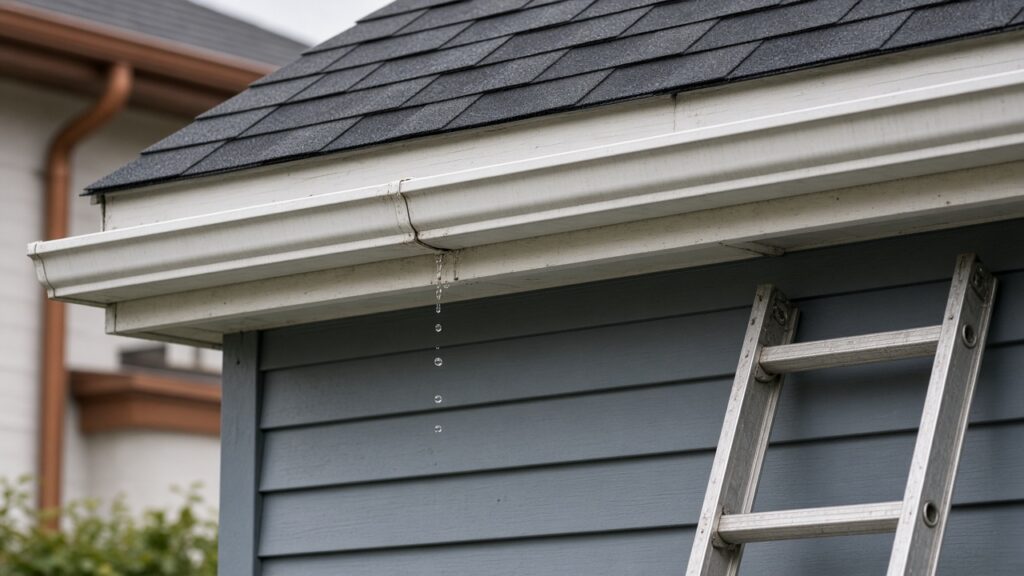
Quick answer: Repair your gutters when the problem is isolated—a leaking seam, a few loose hangers, a short dented section, a clogged outlet, or a run that has lost its slope—and the fascia behind it is solid. Replace the system when damage is widespread, the gutters are near the end of their service life, rust or corrosion shows up in several places, the fascia has rotted along long stretches, or you are already replacing the roof. A practical rule of thumb from Angi: if a repair quote climbs past roughly 50% of what a full replacement would cost, replacement usually makes more financial sense.
For 2026 planning, Angi puts the national average for professional gutter repair at about $390, with most homeowners paying $240 to $480 and a broader range of roughly $120 to $900. This Old House reports a similar $195 to $625 repair range (about $385 on average) and estimates a full gutter replacement around a house at $1,700 to $3,100. These are national planning benchmarks, not quotes; your home’s height, roofline, gutter material, and fascia condition will move the real number.
Gutter Repair vs. Replacement: 2026 Cost Snapshot
| Job | Typical 2026 planning range | Source |
|---|---|---|
| Sealing a leaking seam or joint | $80–$140 | Angi |
| Correcting improper slope | $80–$250 | Angi |
| Fixing sagging gutters | $80–$600 | Angi |
| Clearing clogged or blocked gutters | $160–$400 | Angi |
| Repairing physical (storm or impact) damage | $240–$550 | Angi |
| Simple repairs priced by length | $2–$7 per linear foot | Angi |
| Complex repairs or section replacement | $5–$18 per linear foot | Angi |
| Downspout replacement | About $8 per linear foot | This Old House |
| Full gutter replacement around a house | $1,700–$3,100 | This Old House |
| New gutter installation (project range) | $629–$1,736 (average about $1,182) | Angi |
The two replacement figures above come from different publishers and describe different typical scopes, so treat them as a band rather than a contradiction. Our gutter installation cost guide breaks down new-system pricing by material and linear foot in more detail.
Signs Your Gutters Need Attention
Gutters fail quietly. Most homeowners notice the symptoms on the ground or on the walls before they see anything wrong up at the roof edge. This Old House lists these common warning signs:
- Cracks, gaps, or drips at seams and corners
- Sections that have pulled apart or disconnected
- Sagging runs or gutters pulling away from the fascia
- Rust spots or peeling paint on the gutters
- Streaks or stains running down the siding
- Standing water or saturated soil along the foundation
- Mold, moss, or mildew near the roofline
- Water damage to fascia, soffits, or other roof-edge trim
The fastest way to diagnose a problem is to watch the system during a steady rain. Note where water sheets over the front edge, drips through a joint, or pours out short of a downspout. Mark those spots so a contractor can see exactly what you saw.
When Gutter Repair Usually Makes More Sense
Repair is the stronger choice when the failure is local and the rest of the system is in good shape. Angi recommends repair when there is only minor damage—leaks, cracks, or loose hangers—when the damage can be fixed fully and quickly, or when your budget only allows a smaller project. Typical repair-friendly situations include:
- A leaking seam or end cap. Cleaning the joint and resealing it is one of the least expensive gutter fixes.
- Loose or failed hangers. Re-fastening or adding hangers can stop a minor sag, provided the wood behind them is sound.
- Lost slope. Resetting brackets so water flows toward the outlet can cure standing water and overflow.
- One damaged section. A branch strike or ladder dent on a sectional system can often be fixed by swapping one piece.
- A clogged outlet or downspout. This Old House notes the drop where the gutter meets the downspout is a frequent clog point that may only need cleaning and resealing.
When Full Gutter Replacement Is Usually the Better Call
Angi recommends replacing gutters entirely when there is major damage such as widespread sagging, ice damage, or corrosion; when the gutters are past a normal lifespan of around 20 years; when you want to upgrade and have the budget; or when you are replacing the roof. Replacement also tends to win when:
- The fascia is rotted along long runs. Angi notes that sagging caused by water-damaged fascia is a common reason to replace rather than patch. New gutters cannot hold on soft wood.
- Repairs keep recurring. Paying for the same seam or the same sag every season is a sign the system, not the spot, is failing.
- The system is undersized. If gutters overflow in heavy rain even when clean, a larger gutter or more downspouts may be needed—something a repair cannot fix.
- You are re-roofing. Gutters usually have to come off for roof-edge work anyway, which makes it a logical time to replace an aging system. See our roof replacement cost guide for that budget.
How Long Do Gutters Last?
Age is one of the clearest repair-or-replace signals, but published lifespans vary by source and material. Use the ranges below as context, not as an expiration date.
| Material | Angi lifespan estimate | This Old House lifespan estimate |
|---|---|---|
| Vinyl / PVC | 10–15 years | 10–20 years |
| Aluminum | Around 25 years | Up to 20 years (metal gutters) |
| Galvanized steel | 15–20 years | Up to 20 years (metal gutters) |
| Copper and zinc | 50–100 years | 50 years or more |
Maintenance matters as much as material. This Old House notes that clogged gutters wear out faster because trapped debris adds weight and stress to sealant and connectors. Our home systems lifespan guide covers how to think about age across the rest of the house.
What Drives Gutter Repair and Replacement Costs
Type and extent of damage
Angi identifies the type of damage as the primary cost driver. A resealed seam is a short visit; a storm-crushed run with bent hangers and a torn downspout is a section replacement.
Gutter material
Repairs should normally match the existing material. Angi’s 2026 repair ranges by material are roughly $100–$350 for vinyl, $150–$400 for aluminum, $230–$600 for steel, and $300–$1,000 for copper. Premium metals such as copper and zinc cost more because they require more specialized tools and skills.
Gutter style and seamless vs. sectional
This Old House reports average repair costs of about $12 per linear foot for K-style gutters, $13 for half-round, and $35 for box or fascia gutters, which may require construction work to reach. Seamless gutters often need partial replacement rather than a spot repair because each run is a single piece; This Old House puts seamless repairs at $125–$250 versus $100–$225 for sectional systems. Angi likewise notes that a damaged sectional gutter can often be fixed by replacing one section.
Home height, roof pitch, and access
This Old House reports that two-story homes typically see repair costs about twice those of single-story homes. Steep roofs, landscaping that blocks ladder placement, and jobs that require a lift instead of a ladder all add labor.
Gutter size and climate
Wider 6- and 7-inch systems cost more to repair and replace than 5-inch gutters; This Old House estimates 20%–30% more. For full replacement, Angi notes homeowners in areas with frequent or intense rainfall may spend up to 50% more because they need larger gutters and more downspouts.
Labor rates
Angi lists professional gutter repair labor at about $50 to $100 per hour and installation labor at about $75 per hour. A full replacement on an average-size home typically takes one to two days, longer if fascia repairs are needed first.
Hidden Costs That Change the Decision
The gutter itself is often the cheapest part of the bill. These are the add-ons most likely to surprise you:
- Fascia and soffit repair. Rot usually appears only after the old gutter comes off. Angi’s fascia repair table runs from about $300–$1,000 for 50 linear feet up to $1,800–$6,000 for 300 feet, and full fascia board replacement averages about $2,500 nationally.
- Downspouts and extensions. Each downspout that needs replacing adds cost; This Old House cites about $8 per linear foot, more for two-story runs.
- Small parts. Brackets, hangers, elbows, end caps, flashing, and splash blocks are often billed separately.
- Color matching and finishing. Angi notes that color-matching or painting can add 30% or more to a repair.
- Removal and disposal. Confirm whether tear-off and haul-away are included in a replacement quote.
- Service fees and surcharges. This Old House notes extra charges for long material carries, debris disposal, or remote locations.
- Water damage elsewhere. Long-term overflow can damage siding, paint, and foundations. If you see staining, peeling, or cracks near downspouts, read our guides to peeling paint and foundation cracks.
Repair vs. Replace Decision Table
| Situation | Usually repair | Usually replace |
|---|---|---|
| One leaking seam, corner, or end cap | Yes | No |
| A few loose hangers, fascia solid | Yes | No |
| Water pooling from lost slope | Yes, reset brackets | Only if hangers and fascia are failing too |
| One dented or storm-damaged section | Yes, especially on sectional systems | Consider it if the run is seamless and old |
| Rust or corrosion in several places | Rarely | Yes |
| Sagging along long runs with soft fascia | Fascia repair is required either way | Often, after fascia is fixed |
| System about 20 years old with repeat repairs | Short-term only | Yes |
| Overflow in heavy rain even when clean | Adding a downspout may help | Yes, if gutters are undersized |
| Roof replacement scheduled | Rarely worth patching first | Yes, coordinate with the roofer |
| Repair quote above about 50% of replacement | No | Yes (Angi’s rule of thumb) |
Practical Scenarios
The examples below are illustrative planning exercises built from the published ranges cited in this guide. They are not quotes, and your local prices may differ.
Scenario 1: A 10-year-old aluminum system with one dripping corner
The rest of the system drains well, and the fascia is firm. Sealing a leak falls in Angi’s $80–$140 range. This is a clear repair, and it is worth asking the contractor to check hangers and outlets while they are on the ladder.
Scenario 2: A 30-foot sagging run over the back porch
The contractor finds soft fascia behind the sag. Angi’s sagging-gutter range is $80–$600, and its fascia repair table starts at about $300–$1,000 for 50 linear feet. The fascia must be fixed first. Whether you rehang the old gutter or replace just that run depends on its condition, but the rest of the house may not need new gutters.
Scenario 3: A 22-year-old steel system with rust at several seams
Using This Old House’s $1,700–$3,100 full-replacement range, Angi’s 50% rule puts the tipping point at roughly $850–$1,550 in repairs. Multiple rust failures on an older system are likely to approach that number over time, and the system is past Angi’s roughly 20-year mark. Replacement is the more durable choice.
Scenario 4: Gutters are 15 years old and a new roof is planned
Angi lists a roof replacement as one of the times to replace gutters entirely. Ask the roofer whether existing gutters will be removed and reinstalled, and compare that labor against a new system installed after the roof. Coordinating the two avoids paying twice for access and roof-edge work.
DIY vs. Hiring a Pro
This Old House says homeowners who have the right equipment and are comfortable on a ladder can handle minor fixes such as small cracks, broken seals, and loose hangers. It recommends a professional for disconnected sections, rotten fascia, broken downspouts, collapsed sections, and premium materials such as copper. Angi recommends hiring a pro for most repairs because mistakes can lead to water damage and because working at height is risky.
If you do any gutter work yourself, follow basic ladder safety guidance from OSHA:
- Inspect the ladder before use and look for overhead power lines; avoid metal ladders near electrical lines.
- Set an extension ladder so its base is about one-quarter of its working length away from the wall.
- Keep three points of contact while climbing and face the ladder.
- When using a ladder to reach a roof, extend it at least 3 feet above the landing or secure the top.
- Never stand on the top three rungs of an extension ladder, and do not lean out beyond the side rails.
Two-story work, steep roofs, wet conditions, or anything near the electrical service drop is a job for a professional.
Permits, Drainage, and Safety Considerations
Simple gutter repairs usually do not require a permit, but rules vary. Angi notes that fascia replacement may need a permit in some areas, with permit fees it cites at roughly $50–$300. Check with your local building department, and if you hire a contractor, confirm in writing who pulls any required permit. Homeowners associations may also have rules on gutter color, style, or material.
Where the water goes matters as much as the gutter. EPA guidance recommends directing downspout water to a lawn, garden, or rain barrel and discharging at least five feet from the foundation. EPA also encourages disconnecting downspouts from sewer standpipes where appropriate, but some cities regulate these connections, so check with your local utility first. If you already have basement water problems, read our basement waterproofing cost guide and sump pump replacement guide.
Contractor Quote Checklist
Get at least two or three written quotes, as This Old House recommends, and make sure each one answers the same questions:
- What exactly is failing, and why? Ask for photos of the problem areas.
- Is the quote for a repair, a section replacement, or a full replacement?
- How many linear feet of gutter and downspout are included?
- What material, gauge, size (5-, 6-, or 7-inch), and style will be used? Seamless or sectional?
- Are hangers, brackets, elbows, end caps, flashing, and splash blocks included?
- How will the contractor handle fascia rot found during the job, and at what price per foot?
- Are tear-off, disposal, and cleanup included?
- Where will each downspout discharge?
- What workmanship and materials warranties apply? Angi notes workmanship warranties typically run one to three years and materials warranties one to 15 years.
- Is the company licensed where required, and does it carry liability and workers’ compensation insurance?
- Who pulls any required permit?
Our guide to hiring a home contractor covers red flags and contract terms in more depth.
How to Extend the Life of Your Gutters
- Clean at least twice a year. Angi and This Old House both recommend spring and fall cleaning, with more frequent checks under heavy tree cover.
- Flush and inspect. Run water through the system to confirm flow and check that hangers are tight.
- Fix small problems early. A resealed seam is far cheaper than rotted fascia.
- Consider gutter guards. This Old House notes guards can reduce clogs and cleaning frequency but do not eliminate maintenance, and professional installation can cost several thousand dollars.
- Keep discharge clear. Make sure extensions and splash blocks stay in place after mowing and storms.
Add gutter checks to your seasonal home maintenance checklist and your annual maintenance budget.
Frequently Asked Questions
How much does gutter repair cost in 2026?
Angi reports a national average of about $390, with most homeowners paying $240–$480. This Old House reports $195–$625, with an average of about $385.
How much does it cost to replace all the gutters on a house?
This Old House estimates $1,700–$3,100 for full replacement around a house. Angi’s installation guide reports a typical project range of $629–$1,736, with an average of about $1,182. Size, height, material, and fascia work drive the final number.
Can you replace just one section of gutter?
Yes, especially on sectional systems, where pieces are joined with couplings. On seamless gutters, damage often means replacing the whole run between corners.
Can sagging gutters be fixed?
Often, yes. Re-fastening or adding hangers can fix a sag if the fascia is sound. If the fascia is rotted, it must be repaired first; widespread sagging is a common reason to replace.
Should I replace gutters when I replace my roof?
Angi lists a roof replacement as a good time to replace gutters, especially if they are older. If yours are newer and in good shape, ask the roofer about removing and reinstalling them instead.
Does homeowners insurance cover gutter repair?
Coverage depends on your policy and the cause of damage. Sudden damage, such as a fallen tree, is treated differently from wear, rust, or neglect. Check your policy and talk to your insurer before you file a claim.
The Bottom Line
Repair isolated leaks, loose hangers, slope problems, and single damaged sections, especially on younger systems with solid fascia. Replace when corrosion or sagging is widespread, the system is around 20 years old and needs repeat repairs, the gutters are undersized, or the roof is being replaced. Before you sign, compare written quotes that spell out footage, materials, fascia allowances, downspout routing, and warranties. For related exterior decisions, see our guides to siding repair vs. replacement and roof repair costs.
Sources
- Angi: How Much Does Gutter Repair Cost? [2026 Data] (updated October 1, 2026)
- Angi: How Much Does Gutter Installation Cost? [2026 Data] (updated July 9, 2026)
- Angi: How Much Does Soffit and Fascia Repair Cost? [2026 Data]
- Angi: How Much Does Fascia Board Replacement Cost? [2026 Data]
- Angi: Seamless Gutters vs. Regular Gutters
- This Old House: How Much Does Gutter Repair Cost in 2026? (updated June 12, 2026; cost data sourced from HomeAdvisor)
- U.S. EPA: Soak Up the Rain — Disconnect / Redirect Downspouts
- U.S. EPA Nonpoint Source Toolbox: Downspout Redirection Guide (PDF)
- OSHA: Portable Ladder Safety QuickCard (PDF)
- OSHA: Safe Use of Extension Ladders Fact Sheet (PDF)
Cost figures are national planning estimates from the sources above and were current as of October 2026. Local prices vary. Always get written quotes from licensed, insured contractors in your area.