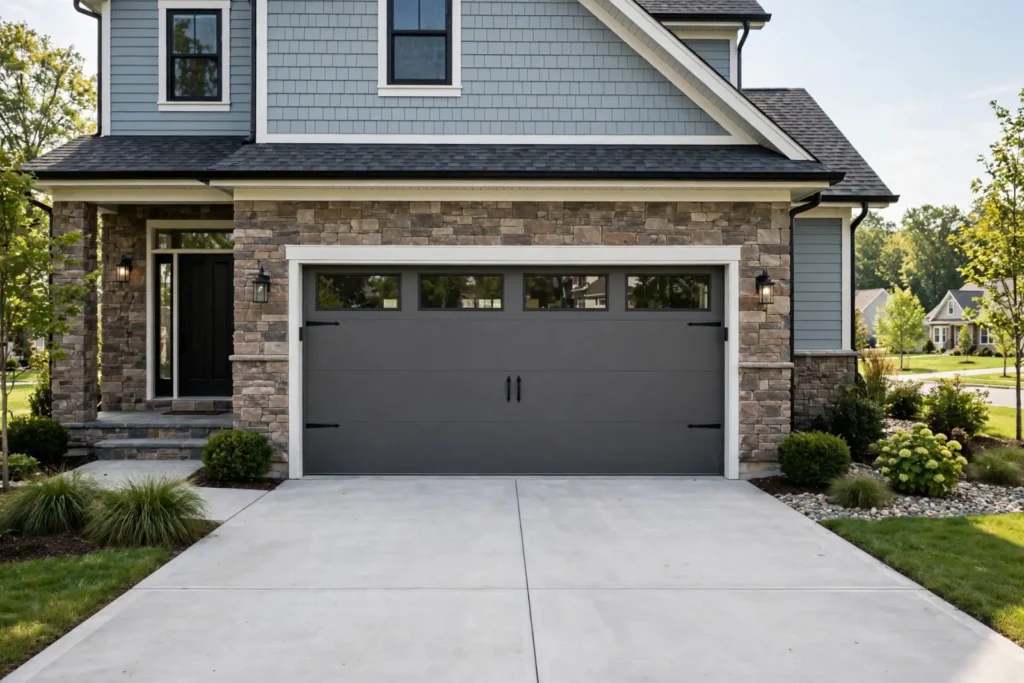
Replacing a garage door is usually a mid-sized exterior project rather than a simple hardware swap. For U.S. homeowners planning a 2026 replacement, a realistic national budgeting range for a standard professionally installed door is about $700 to $3,500. Many projects cluster closer to $1,200 to $1,700, while custom wood doors, glass designs, oversized openings, multiple doors, wind-rated systems, structural repairs, and opener upgrades can push the total much higher.
That range is for planning only. The quote you receive will depend on door size, material, insulation, local labor, track and spring condition, removal of the old door, opener work, electrical needs, permit requirements, and whether the opening itself needs repair. If only the opener is failing, compare garage door opener repair cost before replacing the door.
Garage door replacement cost at a glance
| Project | 2026 planning range |
|---|---|
| Typical replacement, installed | $700–$3,500 |
| Common national average from major cost datasets | About $1,200–$1,500 |
| Single-car door | About $700–$2,700 |
| Double garage door | About $1,000–$3,500 |
| Professional labor when itemized separately | About $200–$500 |
| Garage door opener upgrade or addition | Often $200–$1,300 extra |
| Premium/custom configurations | $4,000–$8,000+ in some cases |
Angi’s September 2026 data puts the national average garage door replacement around $1,231, with most reported projects between $754 and $1,707. HomeGuide uses a wider installed range of roughly $700 to $3,500, including about $700 to $2,700 for a single door and $1,000 to $3,500 for a double door. HomeAdvisor also shows a broad spread depending on size and product level.
The safest way to use these numbers is to treat them as a budget envelope, then compare local written quotes for the same scope.
What changes the price most?
1. Door size and configuration
A single 8- to 10-foot-wide door is usually less expensive than one large double door or two separate single doors. Multi-car garages cost more because you are buying more door area, more hardware, and often more labor.
Angi’s 2026 data shows one-car configurations starting near the lower end of the market, while two- and three-car setups can rise into several thousand dollars depending on material and design.
2. Material
Steel is often the value choice because it combines relatively low cost, durability, and broad availability. Aluminum can be light and corrosion-resistant. Fiberglass and composite products offer different maintenance and appearance tradeoffs. Wood and full-view glass doors usually cost substantially more, especially when custom-built.
The material price is only part of the total. Heavier doors may require different springs, stronger tracks, a more capable opener, or additional framing work.
3. Insulation
Insulated garage doors generally cost more than basic single-layer doors. They can make more sense when the garage is attached to the house, conditioned, used as a workshop, or located in a climate with large temperature swings.
Do not buy on R-value alone. Ask how the door is constructed, whether thermal breaks are used, how well the perimeter seals, and whether the existing garage itself is insulated. A high-R-value door cannot compensate for major air leaks around the frame or an uninsulated garage ceiling.
4. Style, windows, and finish
Decorative hardware, custom colors, wood-look finishes, windows, carriage-house styling, and made-to-order sizes all increase cost. Glass also changes the weight, security, privacy, and wind-resistance considerations.
5. Tracks, springs, rollers, and hardware
A replacement quote may include new tracks and hardware, or it may reuse some existing components if they are compatible and in good condition. This distinction matters because high-tension spring systems are a major safety component and should not be treated as a casual add-on.
6. Opener replacement
A door replacement does not automatically require a new opener. If the existing opener is compatible, correctly sized, and in good condition, it may be reused. If you want quieter operation, battery backup, smart controls, or the old opener is nearing the end of its useful life, replacing both at once can be convenient.
Angi estimates that moving from a manual setup to an automatic door can add roughly $200 to $1,300, depending on opener type and features.
7. Electrical work
Most opener replacements use an existing receptacle, but new wiring, a relocated outlet, or other electrical corrections can add cost. If electrical work is needed, see our 2026 electrician cost guide for service-call and labor benchmarks.
Single vs. double garage door costs
A single-car door typically costs less in both materials and installation. A double door costs more because it is wider, heavier, and may require stronger hardware.
HomeGuide’s current national ranges are roughly:
- Single garage door: $700–$2,700 installed
- Double garage door: $1,000–$3,500 installed
- Three-car configuration: about $1,700–$6,200 depending on layout
Two separate single doors can cost more than one double door because each opening has its own tracks, springs, hardware, and installation work. The tradeoff is that separate doors can offer more flexibility and limit the size of an opening exposed when only one vehicle is moving.
Repair or replace?
Replacement is not always the best answer. A door with a failed spring, worn rollers, a damaged cable, or a minor opener problem may be economically repairable.
Angi’s 2026 garage door repair data puts many repairs around $155 to $379, with an average near $265. That means a several-hundred-dollar repair can still make sense when the door itself is structurally sound and visually acceptable.
Replacement becomes more reasonable when:
- multiple panels are damaged or badly corroded;
- the door is sagging or no longer seals properly;
- tracks and hardware are also failing;
- the door is poorly matched to a newer opener;
- you want significantly better insulation or wind resistance;
- repeated repairs are approaching a meaningful share of replacement cost;
- the existing door has major cosmetic damage and curb appeal matters.
If the problem is only one damaged panel, ask whether a matching panel is still available before replacing the whole door.
Garage door opener safety matters
Automatic residential garage door operators sold in the United States are subject to the federal safety standard in 16 CFR Part 1211. The U.S. Consumer Product Safety Commission explains that residential automatic operators must include entrapment-protection measures.
For homeowners, the practical takeaway is simple: do not disable photo-eye sensors or other reversing systems, and test the opener’s safety features according to the manufacturer’s instructions. Older openers that do not meet modern safety expectations are strong candidates for replacement.
Why DIY garage door replacement is usually a poor trade
Painting a wall or replacing a faucet can be reasonable DIY work for many homeowners. Replacing a garage door is different because the door is heavy and the spring system stores substantial mechanical energy.
Professional installation is usually worth the labor charge because the installer must correctly size and tension springs, align tracks, balance the door, set travel limits, verify opener force and reversal, and confirm that the door stays in place throughout its travel.
Homeowners can safely handle low-risk tasks such as cleaning tracks, visually inspecting weather seals, or lubricating components when the manufacturer recommends it. Spring adjustment, cable replacement, and major structural work should be left to trained technicians.
Permits, wind ratings, and hurricane-prone areas
A simple like-for-like garage door replacement may not require a permit in every jurisdiction, but local rules vary. Some cities and counties require permits for exterior door replacement, structural changes, or wind-rated products.
High-wind and hurricane-prone regions deserve special attention. FEMA notes that garage doors are large openings that can be vulnerable to wind pressure and that doors in wind-prone areas should be capable of resisting site-specific design loads. Newer building codes may also require product labeling showing pressure ratings and test standards.
If you live in coastal Florida, the Gulf Coast, or another high-wind area, ask the installer for the door’s approved wind-pressure rating and confirm that it is acceptable for your exact location. Do not assume that a door marketed as “hurricane rated” automatically meets your local code.
Hidden costs to include in the budget
Old door removal and disposal
Many quotes include removal, but some charge separately. Confirm whether haul-away is included.
Framing or opening repairs
Rotten jambs, damaged headers, cracked masonry, or an out-of-square opening can add labor before the new door can be installed correctly.
Weatherstripping
Bottom seals and perimeter weatherstripping may be included or itemized. Replacing them at the same time can improve air sealing and water resistance.
Opener brackets or reinforcement
Some doors need reinforcement at the opener attachment point. This is especially important on insulated or lightweight sectional doors.
Electrical corrections
A missing or poorly located outlet, damaged wiring, or code corrections can create an additional electrician charge.
Permit and inspection fees
Where required, permit fees can range from modest administrative charges to a more meaningful line item.
Wind-rated upgrades
Stronger tracks, reinforcement, impact-resistant glazing, and approved wind-rated assemblies can raise the project cost in coastal or storm-prone areas.
How to compare contractor quotes
Get at least two or three written estimates for a full replacement. Compare the scope, not just the bottom-line price.
A useful garage door quote should identify:
- door manufacturer and model;
- exact size;
- material and construction;
- insulation level;
- window or glass specification;
- wind rating where relevant;
- tracks, springs, rollers, and hardware included;
- opener included or excluded;
- removal and disposal of the old door;
- framing or trim work included;
- permit responsibility;
- labor warranty and product warranty;
- total installed price.
A cheaper quote may be excluding tracks, disposal, opener setup, or trim work. Ask contractors to clarify exclusions in writing.
Should you replace the opener at the same time?
Replace the opener at the same time if the existing unit is unreliable, incompatible with the new door, lacks modern safety features, or you specifically want quieter operation, battery backup, or app controls.
Keep the existing opener if it is relatively new, properly sized, and the installer confirms compatibility. There is no financial benefit in replacing a good opener simply because the door itself is being changed.
Exterior appearance and related projects
A garage door occupies a large portion of the front elevation on many homes, so replacement can have a strong visual effect. If you are also planning broader exterior work, coordinate colors and timing with our exterior house painting cost guide.
If deteriorated windows are also part of the project, our window replacement cost guide provides separate whole-house and per-window planning ranges.
Five-step garage door replacement plan
- Measure and define the opening. Confirm width, height, headroom, side room and whether the current framing is sound before choosing a door.
- Choose performance before style. Decide whether insulation, wind resistance, windows, corrosion resistance or quiet operation matters most at your home.
- Get comparable installed quotes. Require each bid to state the exact door model, tracks, springs, hardware, disposal, opener work, trim and permits.
- Verify safety and code details. Confirm opener compatibility, entrapment protection, wind rating where applicable and any required inspection.
- Test the completed system. Before final payment, operate the door several times, test balance and reversal features, inspect seals and receive warranty documents.
Questions to ask before ordering
- Is this quote for one complete installed door or equipment only?
- Are new tracks, springs, rollers and perimeter seals included?
- Will the existing opener be reused, adjusted or replaced?
- Does the door meet local wind-load requirements if those apply?
- Who removes and disposes of the old door?
- What structural repairs would trigger a change order?
- What are the labor and manufacturer warranties?
Frequently asked questions
How much is a typical garage door replacement in 2026?
Angi’s September 2026 project data centers many replacements around $754 to $1,707 per door, with a national average near $1,231. Premium or highly customized projects can cost far more.
Is it cheaper to replace one double door or two single doors?
One double door is often cheaper than two separate single doors because it uses one opening and one primary hardware system, but the existing garage structure and design goals can change the economics.
Should the opener be replaced with the door?
Only when the old opener is unreliable, incompatible, undersized or missing desired safety and convenience features. A sound compatible opener can often remain in service.
Can I replace only a damaged panel?
Sometimes. Panel replacement can make sense if the matching section is still available and the tracks, springs and remaining panels are in good condition.
Bottom line
For 2026, a reasonable national planning range for a professionally installed garage door replacement is about $700 to $3,500, with many standard projects landing around $1,200 to $1,700. A single basic steel door can stay near the lower end, while large, insulated, custom, glass, wood, wind-rated, or multi-door projects can reach several thousand dollars more.
The most important comparison is not simply “door price.” Compare the full installed scope: door, tracks, springs, opener compatibility, removal, trim, structural repairs, permits, wind requirements, and warranty. That is the only way to know whether two contractor quotes are truly comparable.
Home Cost Desk compares current U.S. cost or technical references and checks safety, code, efficiency, incentive, or regulatory claims against authoritative sources when available. National figures are planning ranges, not local quotes.
Editorial review: Home Cost Desk Editorial Team · Read our research methodology · Detailed sources appear below.
Sources and methodology
Home Cost Desk uses current national consumer cost datasets as planning references and checks safety or regulatory claims against official U.S. sources. Actual contractor pricing varies by location, house configuration, product selection, and job conditions.