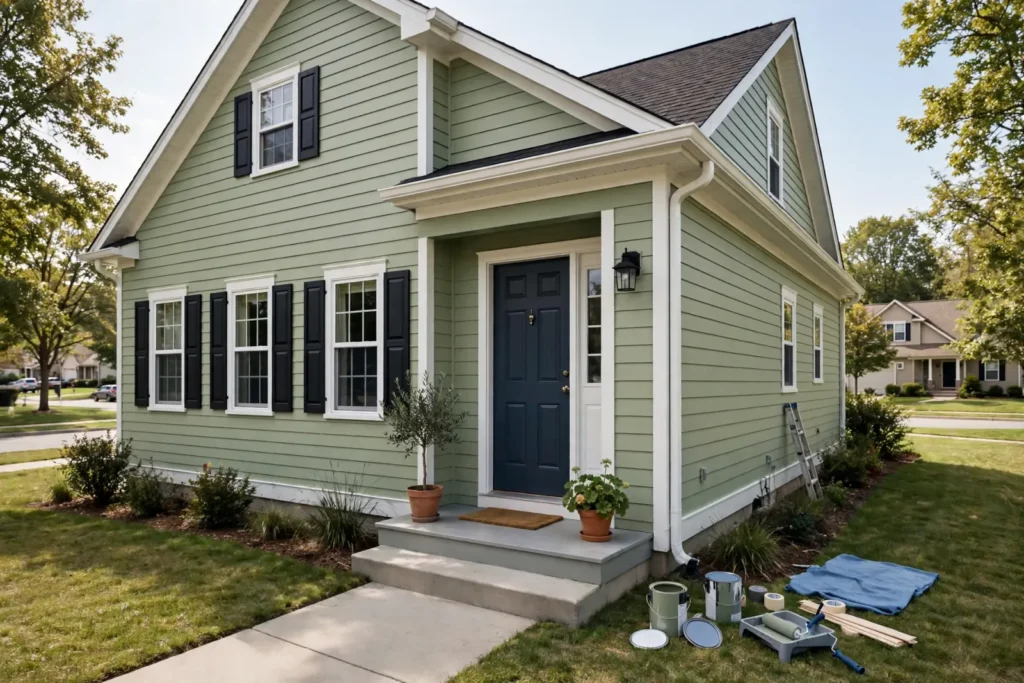
Exterior house painting is one of those projects where two similar-looking homes can receive very different quotes. For U.S. homeowners planning a 2026 repaint, a practical national planning range is about $1.50 to $5.00 per paintable square foot. Many standard professional projects land somewhere around $1,800 to $5,000, while larger, taller, highly detailed, or prep-heavy homes can reach $6,000 to $12,000 or more.
Those figures are budgeting guides, not promises. Your actual quote depends on the amount of paintable exterior surface, siding material, number of stories, surface condition, access, local labor rates, number of coats, and how much repair or scraping is needed before the first finish coat goes on.
Exterior house painting cost at a glance
| Project or pricing method | 2026 planning range |
|---|---|
| Professional exterior painting | About $1.50–$5.00 per paintable sq. ft. |
| Common whole-house project | Roughly $1,800–$5,000 |
| 2,000-sq.-ft. home, depending on paintable area and complexity | Often about $3,000–$10,000 |
| Professional painter labor | Often about $25–$75+ per hour per painter |
| Paint stripping where needed | About $0.50–$2.00 per sq. ft. |
| Premium / difficult / extensive-prep projects | $6,000–$12,000+ |
Angi’s 2026 exterior-painting data reports an average project around $3,178, with a typical range of roughly $1,819 to $4,551 and about $1.50 to $4.00 per square foot. HomeGuide gives a broader planning range of about $1.50 to $5.00 per square foot and roughly $3,000 to $10,000 for a 2,000-square-foot home. HomeAdvisor’s 2026 update is close to Angi’s national average. The spread between these figures is a good reminder that surface condition and project scope matter as much as house size.
Do not confuse floor area with paintable exterior area
A 2,000-square-foot house does not automatically have 2,000 square feet of exterior wall to paint. Contractors may estimate from wall dimensions, subtract major openings, account for gables and architectural details, and then add trim, soffits, fascia, doors, shutters, railings, or other surfaces separately.
That is why a per-square-foot price is most useful when you know exactly what the contractor is measuring. When comparing quotes, ask whether the square-foot number refers to paintable wall area, floor area, or simply an internal estimating method.
What drives the final exterior painting price?
1. House size and number of stories
Larger homes need more paint and more labor. Height adds another layer of cost because crews may need taller ladders, scaffolding, lifts, fall-protection equipment, or additional setup time. A simple one-story ranch is usually less expensive to paint than a two- or three-story house with dormers, steep rooflines, and difficult access.
2. Siding material
Exterior materials do not all prep or accept coatings the same way. HomeGuide’s current data puts common professional ranges at roughly $1.50 to $5.00 per square foot for wood, $1.50 to $4.50 for vinyl, $2.00 to $5.00 for stucco, $2.50 to $5.00 for brick, and $2.00 to $4.50 for aluminum.
Those figures are broad national ranges. The correct coating system depends on the actual substrate, its condition, previous coatings, moisture exposure, and manufacturer requirements.
3. Surface preparation
Prep is often the difference between a cheap-looking estimate and a durable paint job. A crew may need to wash the exterior, scrape loose paint, sand rough transitions, repair cracks, replace failed caulk, spot-prime bare areas, treat stains, or repair damaged siding before painting.
Angi reports paint stripping at roughly $0.50 to $2.00 per square foot where removal is necessary. More serious lead-paint abatement is a separate specialty scope and can cost far more than normal scraping or prep.
4. Paint quality and number of coats
Higher-grade exterior coatings cost more, but material price is only part of the decision. Coverage, durability, color change, porosity, primer requirements, and the number of finish coats affect both labor and total material usage.
A dramatic color change, badly faded siding, repaired areas, or porous masonry may require extra primer or additional finish coats.
5. Trim and architectural details
Window trim, fascia, soffits, shutters, porch columns, railings, doors, decorative brackets, exposed foundations, and other details can add significant labor even when they occupy relatively little square footage.
6. Access and landscaping
Tight side yards, steep grades, roof sections that block wall access, dense landscaping, pools, decks, power lines, or neighboring structures can slow down setup and painting. A difficult-access wall may cost more than a much larger open wall.
7. Local labor market
National averages are useful for budgeting, but labor prices vary substantially by region and metro area. A homeowner should treat online cost ranges as a planning tool and use local written estimates for the real decision.
Typical project scenarios
Scenario 1: one-story home in good condition
The siding is sound, the existing coating is mostly intact, and the home only needs washing, minor scraping, spot priming, caulking, and two finish coats. This type of job is most likely to stay near the middle or lower part of the national range.
Scenario 2: two-story home with peeling paint
The crew must spend substantial time scraping, sanding, repairing trim, priming exposed wood, and setting up for high walls. Labor can become the dominant cost, and the quote may be several thousand dollars higher than a similar-size house in good condition.
Scenario 3: stucco home with cracks
Hairline cracks and failed patches may need repair before coating. The contractor may also recommend a coating system suited to the stucco’s condition and local climate. The homeowner should make sure crack repair is specifically included in the quote rather than assuming “paint exterior” covers it.
Scenario 4: pre-1978 home
Older painted surfaces require extra caution because disturbing lead-based paint can create hazardous dust and chips. This can change the contractor, work practices, containment, cleanup, and sometimes the project cost.
Lead paint rules for pre-1978 homes
The U.S. Environmental Protection Agency warns that homes built before 1978 are more likely to contain lead-based paint. Under the federal Renovation, Repair and Painting rule, paid contractors who disturb painted surfaces in covered pre-1978 housing generally must use certified firms and trained renovators who follow lead-safe work practices.
For exterior work, the rule generally has a minor-repair threshold of 20 square feet or less of disturbed painted surface. A normal full-house repaint involving scraping or other paint disturbance can easily exceed that threshold.
Homeowners doing work on their own owner-occupied pre-1978 home are generally not covered by the RRP rule in the same way as paid contractors, but the EPA still recommends lead-safe DIY practices. If your home is older and prep will disturb existing coatings, ask contractors directly about lead-safe certification and how they will contain and clean up debris.
DIY vs. professional exterior painting
DIY can reduce labor cost, especially on a small one-story home in good condition. But exterior painting is more demanding than painting an interior room. You may need pressure washing or careful cleaning, scraping, repairs, caulking, priming, ladders, extension equipment, masking, weather planning, and multiple coats.
Professional painting is usually the stronger choice when:
- the home is two or more stories;
- there is extensive peeling, cracking, or wood damage;
- lead-based paint may be present;
- stucco, masonry, or specialty siding needs repair;
- access requires scaffolding or lifts;
- you need a large project completed quickly;
- you are not comfortable working at height.
If you are also budgeting interior work, see our Interior Painting Cost in 2026 guide for a separate set of labor and pricing benchmarks.
Hidden costs homeowners should ask about
Wood or siding repair
Rotten trim, cracked boards, damaged siding, or deteriorated sheathing may not be visible until prep begins. Painting over failed material is not a durable fix.
Caulking and sealant replacement
Some contractors include normal caulking in prep; others charge for extensive joint repair. The quote should say what is included.
Pressure washing or specialty cleaning
Cleaning may be included, itemized, or excluded. Mildew, heavy chalking, oxidation, or unusual contamination can add labor.
Scaffolding or lift rental
High walls, chimneys, steep sites, and awkward elevations can require access equipment that is not part of a basic estimate.
Lead-safe work
Containment, specialized cleanup, testing, or abatement can materially increase cost on older homes. Do not compare a standard repaint quote with a lead-safe or abatement quote as if they cover the same work.
Trim, doors, shutters, and detached structures
A quote for “house exterior” may exclude garage doors, front doors, shutters, porch ceilings, fences, sheds, decks, and detached garages. Ask for each surface to be listed. If you are planning larger curb-appeal work, our Fence Installation Cost in 2026 guide can help you budget a separate fence project.
Do you need a permit to paint a house exterior?
A straightforward repaint often does not require a building permit, but local rules vary. Historic districts, homeowners associations, planned communities, and some municipalities may regulate exterior colors, visible changes, scaffolding in public areas, or related repair work.
If the painting project includes structural repairs, siding replacement, electrical work, or other construction, those parts of the job may trigger separate approvals. Check your city or county and any HOA before work starts rather than relying on a national rule of thumb.
How to compare contractor quotes
Get at least two or three written estimates for a substantial exterior project, and compare scope rather than just total price. A useful quote should identify:
- which elevations and surfaces are included;
- cleaning and prep steps;
- repairs included or excluded;
- primer requirements;
- paint manufacturer and product line;
- number of coats;
- trim, doors, shutters, gutters, and soffits;
- lead-safe procedures where applicable;
- access equipment;
- cleanup and debris removal;
- labor and material warranty;
- payment schedule.
A $3,500 quote that includes washing, scraping, repairs, primer, two finish coats, and trim may be better value than a $2,800 quote that excludes most prep and only includes one coat.
When should you repaint instead of just touching up?
Touch-ups can make sense when the coating is generally sound and damage is isolated. A full repaint becomes more reasonable when fading is widespread, multiple walls are peeling, exposed substrate is appearing, caulk is failing across the home, or repairs are scattered over many elevations.
If windows themselves are failing rather than just their trim paint, painting should not hide the underlying problem. Our Window Replacement Cost in 2026 guide can help separate cosmetic work from a replacement project.
How to keep the project from becoming unnecessarily expensive
- Ask contractors to separate essential prep from optional cosmetic work.
- Compare quotes with the same number of coats and similar paint quality.
- Schedule repairs before the painting crew arrives when practical.
- Trim shrubs and move outdoor furniture to improve access.
- Avoid choosing a contractor from price alone if the estimate is vague about prep.
- Follow the coating manufacturer’s weather and temperature instructions.
- Address small paint failures before moisture damage turns them into carpentry repairs.
Five-step exterior painting plan
- Inspect before pricing paint. Walk every elevation and note peeling, chalking, failed caulk, cracked stucco, rotten trim, damaged siding, and moisture staining.
- Define the exact scope. Decide whether the quote includes walls only or also trim, fascia, soffits, shutters, doors, porch ceilings, railings, and detached structures.
- Standardize prep and coating requirements. Ask each contractor to describe cleaning, scraping, sanding, repairs, primer, paint product, and number of finish coats.
- Resolve safety and lead issues. For pre-1978 painted surfaces, discuss lead-safe requirements before work starts. For high or difficult areas, use professionals with appropriate access equipment rather than improvising unsafe ladder setups.
- Inspect before final payment. Walk the house in daylight, check coverage and repairs, and document touch-ups while the crew and equipment are still on site.
What to prepare before painters arrive
- Trim shrubs and move furniture, grills, planters, and decorations away from walls.
- Point out known leaks, rotten wood, recurring peeling, and areas where water collects.
- Confirm paint colors, sheen, product line, and which surfaces receive which coating.
- Ask who removes and reinstalls shutters, downspouts, fixtures, address numbers, or other wall-mounted items.
- Clarify responsibility for window protection, landscaping protection, daily cleanup, and final debris removal.
- If the home predates 1978, tell bidders so lead-safe work can be addressed in the proposal.
What to verify after painting
- Coverage is even with no obvious missed areas, thin spots, runs, or lap marks.
- Bare wood or repaired areas received the specified primer and finish system.
- Caulked joints are smooth and complete where the scope required sealing.
- Windows, doors, vents, lights, and hardware operate normally and are not painted shut.
- Overspray or drips are removed from roofing, glass, hardscape, and landscaping.
- Remaining paint is labeled if the contractor leaves touch-up material.
- You receive the written labor and product warranty promised in the contract.
Frequently asked questions
How much does exterior house painting cost in 2026?
Angi’s July 2026 data puts the national average around $3,178, with many projects between about $1,819 and $4,551. A practical pricing benchmark is roughly $1.50 to $4 per paintable square foot, while prep-heavy or highly detailed projects can run higher.
Why do exterior painting quotes vary so much?
Prep, house height, siding condition, trim detail, access, number of coats, paint quality, and repair work can create larger differences than the paint itself.
Is pressure washing always included?
No. Some contractors include normal washing in prep and others price it separately. Ask each bidder to describe the cleaning method and whether special treatment for mildew, chalking, or stains is extra.
Can I paint over peeling paint?
Loose or failing coating should be properly prepared rather than simply covered. If peeling is caused by moisture, the moisture source should also be addressed or the new coating may fail again. Our peeling paint diagnosis guide explains how to separate moisture, adhesion, and lead-paint issues before repainting.
For a local high-cost market comparison, see our San Francisco Exterior House Painting Cost 2026 guide.
Bottom line
For 2026 budgeting, a useful national planning range for professional exterior house painting is about $1.50 to $5.00 per paintable square foot. Many ordinary projects fall around $1,800 to $5,000, while larger or difficult homes can reach $6,000 to $12,000+.
The biggest mistake is comparing prices without comparing prep. House height, siding condition, repairs, paint system, number of coats, trim, access, and lead-safe requirements can matter more than the advertised cost per square foot. Use national figures to establish a budget, then make the final decision from detailed local quotes that describe exactly what the contractor will do.
Home Cost Desk compares current U.S. cost or technical references and checks safety, code, efficiency, incentive, or regulatory claims against authoritative sources when available. National figures are planning ranges, not local quotes.
Editorial review: Home Cost Desk Editorial Team · Read our research methodology · Detailed sources appear below.
Sources and methodology
Home Cost Desk uses national cost data as a planning reference rather than a substitute for a local contractor quote. For this guide, 2026 pricing was compared across Angi and HomeAdvisor, with broader square-foot and siding benchmarks from HomeGuide. Lead-safe requirements and homeowner guidance were checked against the U.S. Environmental Protection Agency’s current Renovation, Repair and Painting resources, including materials updated in 2026.