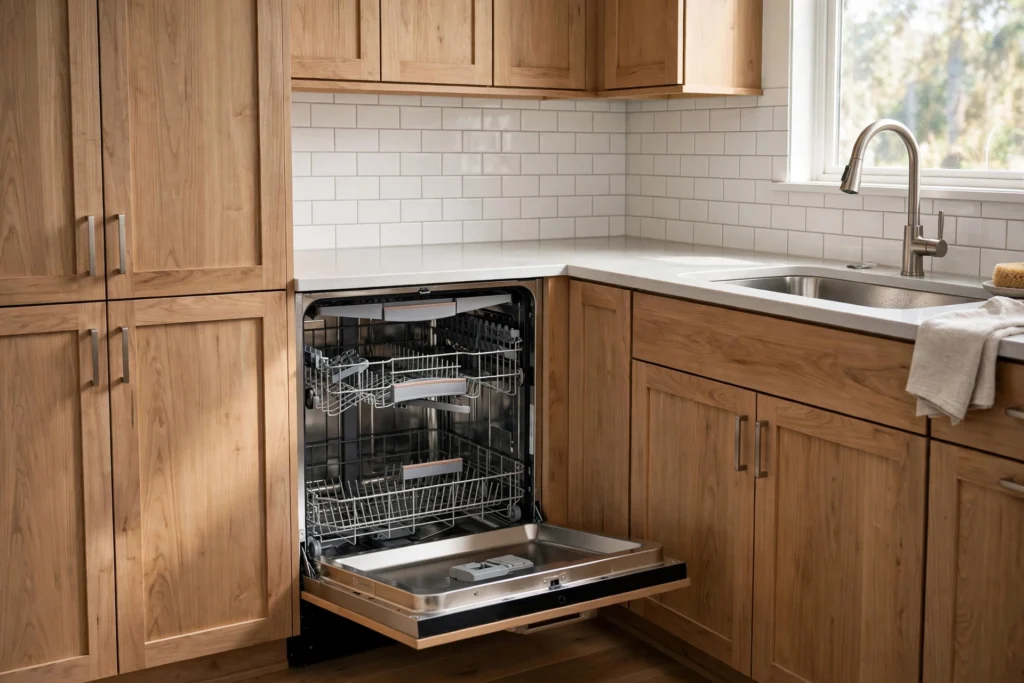
Replacing an existing dishwasher can be a fairly simple appliance job—or it can turn into a plumbing, electrical, and cabinetry project if the kitchen was never set up for one. For U.S. homeowners planning a 2026 project, a straightforward dishwasher replacement commonly costs about $200 to $500 in installation labor when usable water, drain, and electrical connections are already in place. A first-time installation with new hookups can run roughly $300 to $1,300 in labor, and the total project cost rises further once the appliance, delivery, haul-away, permits, or kitchen modifications are included.
Open the kitchen remodel calculator
Those figures are planning ranges, not guaranteed local quotes. The final price depends heavily on whether you are swapping one built-in dishwasher for another or creating a new installation from scratch.
For a straightforward dishwasher replacement where the water, drain, power and cabinet opening are already usable, plan roughly $200–$500 for installation labor. If you are asking for the average cost of a new dishwasher and installation together, a typical replacement using a $400–$1,200 appliance works out to about $600–$1,700 before optional haul-away. A first-time installation with new hookups can be much higher because plumbing, electrical work or cabinet changes are added separately. Before comparing quotes, identify whether your job is a simple replacement or a new installation.
Dishwasher installation cost at a glance
| Project | Typical 2026 planning range |
|---|---|
| Replacement labor with existing hookups | About $200–$500 |
| New installation labor with new connections | About $300–$1,300 |
| Typical new dishwasher | About $400–$1,200 |
| High-end dishwasher | Up to about $3,000+ |
| Old dishwasher removal / haul-away | Often about $50–$150 |
| Replacement project including appliance | Often about $600–$1,700 |
Interactive estimator
Dishwasher Installation Cost Estimator
Choose whether this is a simple replacement or a first-time installation, then add the appliance and haul-away only if you want them included.
This is a planning estimate, not a contractor quote. The calculator adds only ranges stated in this article. New circuits, plumbing changes, cabinet work, permits, delivery and moisture repair are listed separately because this guide does not assign one universal dollar amount to them.
HomeGuide’s current cost data places replacement labor at roughly $200 to $500 when the existing connections can be reused, and labor for a new location at about $300 to $1,300. It also puts a typical new dishwasher at roughly $400 to $1,200. Angi’s 2026 data shows that more involved professional installations can run around $1,000 to $1,500, which illustrates why homeowners need to compare the scope behind the number rather than assume every “installation” quote includes the same work.
The biggest question: replacement or first-time installation?
Replacing a dishwasher in the same location
This is usually the least expensive scenario. The installer removes the old unit, disconnects it, connects the new dishwasher to the existing water supply, drain, and electrical source, levels the appliance, secures it, and tests for leaks and operation.
The job stays near the lower end when:
- the new unit fits the existing opening;
- the water shutoff valve works properly;
- the drain connection is usable;
- the electrical connection is compatible;
- the flooring and cabinets do not need alteration;
- the old unit comes out without damage or access problems.
Installing a dishwasher where there was none
A first-time installation is more complex because the installer may need to create water, drain, and electrical connections, modify cabinetry, confirm the opening size, and possibly repair flooring or trim. In some kitchens, a plumber and electrician may both be involved.
This is why a project that sounds like “install one dishwasher” can cost several times more than a straightforward replacement.
Cost to add a dishwasher to existing cabinets
Converting a base cabinet into a dishwasher opening is really four small trades in one job. HomeGuide’s installation guide (page titled 2026; byline dated January 19, 2024) lists these typical line items:
| Line item | Published range | Needed when |
|---|---|---|
| Remove a base cabinet to create the opening | $150–$400 | No existing 24-inch opening |
| New water supply and drain rough-in | $400–$600 minimum | No dishwasher connections at the sink |
| New outlet | $150–$350 | A circuit exists but no receptacle or junction point |
| New dedicated circuit | $250–$900 | No suitable circuit; depends on panel location and capacity |
| Permit (where required) | $25–$100 | New electrical or water lines in many jurisdictions |
These are examples of work a first-time installation may involve, not a checklist of fees to add on top of the $300–$1,300 first-time labor planning range already shown on this page. Some of the items may be included in an all-in installation price, and complex electrical, cabinet or plumbing work may push a particular quote above that broad range. Not every kitchen needs each item; a newly installed circuit may already include the required outlet, for example. Ask contractors to identify the included scope, avoid charging both an all-in fee and the same work again as line items, and separately identify any cabinet-face, countertop or flooring repair.
Electrical work should be priced by a licensed electrician; see our electrician cost guide.
What is included in a basic installation?
A standard replacement quote often includes labor to remove or disconnect the old unit, set the new dishwasher in place, connect it to existing utilities, level and secure it, and test the appliance. But every installer defines “basic installation” differently.
Before booking, ask whether the quoted amount includes:
- disconnecting the old dishwasher;
- removing and hauling away the old unit;
- new supply hose or installation kit;
- drain-hose connection;
- electrical connection;
- mounting brackets;
- leveling and testing;
- minor cabinet adjustments;
- delivery;
- taxes and permit fees.
A low advertised installation price can increase quickly if several of those items are excluded.
Seven factors that change dishwasher installation cost
1. Existing plumbing
If the dishwasher is replacing another unit and the shutoff valve, supply line, and drain setup are in good condition, plumbing work may be minimal. A corroded valve, leaking fitting, missing shutoff, or poorly configured drain can add labor and materials.
If additional plumbing is required, compare the added charge with typical local plumbing rates. Our 2026 plumber cost guide provides a broader benchmark for service-call and labor pricing.
2. Electrical setup
Dishwashers need a safe, code-compliant power connection appropriate for the appliance and local requirements. A simple like-for-like replacement may reuse an acceptable existing setup, while a new location may require an electrician to add or modify a circuit, receptacle, wiring method, or disconnect arrangement.
Local electrical requirements vary, so do not assume a connection that worked for an old appliance is automatically correct for a new one. If electrical work is required, our electrician cost guide can help you evaluate the additional quote.
3. Cabinet opening and fit
Most standard built-in dishwashers are designed for a common under-counter opening, but small dimensional differences still matter. Flooring height, countertop thickness, cabinet trim, toe kicks, side panels, and previous remodeling can make removal or installation harder than expected.
If the opening must be widened, trimmed, rebuilt, or finished, you are no longer paying only for appliance installation.
4. Floor height
A common hidden problem appears when flooring was installed after the old dishwasher. New tile, hardwood, or other finished flooring can trap an older unit beneath the countertop or reduce the usable opening height. Removing the old machine or fitting the replacement may require extra work.
5. Drain configuration
The dishwasher drain must be connected correctly to prevent wastewater from flowing back toward the appliance. The exact configuration depends on the kitchen setup and local requirements. If the sink, garbage disposal, or drain piping is being changed at the same time, installation can become more involved.
6. Old-unit removal
HomeGuide reports roughly $50 to $150 for removal and disposal in many projects. Retailers sometimes bundle haul-away into a package, while others charge separately. Confirm this before comparing prices.
7. Delivery, permits, and local labor
Delivery fees, permit requirements, trade rates, and service minimums vary by market. A national average is useful for planning, but your final contractor or retailer quote should clearly identify each extra charge.
How much does the dishwasher itself cost?
For a typical built-in model, current market data places many dishwashers around $400 to $1,200. Premium models with quieter operation, stainless interiors, advanced racks, specialty wash zones, smart features, or luxury finishes can reach $1,200 to $3,000 or more.
The appliance price and installation price should be evaluated separately. A heavily discounted dishwasher is not necessarily a bargain if it requires costly cabinet, plumbing, or electrical changes.
ENERGY STAR efficiency: what the current criteria mean
If you are replacing an older unit, operating efficiency can matter over the appliance’s life. Under the current ENERGY STAR residential dishwasher criteria, a standard-size qualified dishwasher must use no more than 240 kWh per year and no more than 3.2 gallons of water per cycle. Compact qualified models have lower limits.
ENERGY STAR also notes that the federal EnergyGuide label shows estimated yearly electricity use and estimated yearly energy cost. When comparing models, those labels are more useful than marketing claims because they provide standardized efficiency information.
Efficiency should not be the only purchase criterion, but it is worth considering if your old dishwasher is inefficient, frequently used, or nearing the end of its service life.
Hidden costs that catch homeowners by surprise
New shutoff valve
An old valve may leak or fail when disturbed. Replacing it adds a small amount of material but can increase labor if access is poor.
New electrical work
A first-time dishwasher installation may require a new circuit or other electrical changes. This is one of the main reasons a simple-looking appliance job can move well beyond basic installation pricing.
Cabinet modification
Removing a cabinet section, modifying an opening, adding side panels, rebuilding trim, or finishing exposed surfaces can turn the job into light carpentry.
Garbage disposal changes
If the dishwasher drains through a garbage disposal, a replacement disposal or improper existing setup can add another task. If the disposal itself is failing, it may be more efficient to address both projects together rather than paying for separate service visits.
Flooring repair
Water damage, missing flooring under the old dishwasher, or height differences can require repair before the new unit is installed correctly.
Leak or water-damage repair
When an old dishwasher has been leaking slowly, cabinet bases, flooring, or subflooring may be damaged. Appliance installation should not cover over an active moisture problem.
DIY vs. professional installation
A mechanically experienced homeowner may be able to replace a dishwasher when the new unit fits the same opening and all existing connections are suitable. The work still involves water, drainage, electricity, leveling, and secure mounting, so small mistakes can cause leaks, electrical hazards, or cabinet and floor damage.
Professional installation is the better choice when:
- the dishwasher is going into a new location;
- new plumbing is required;
- new electrical work is required;
- the old shutoff valve is damaged or corroded;
- the cabinet opening needs modification;
- the old dishwasher leaked;
- you are uncertain about local code requirements;
- the manufacturer or retailer warranty requires specific installation conditions.
Do not treat appliance installation as a place to improvise with unfamiliar electrical or plumbing work. The cost of repairing water damage can exceed the price of professional installation many times over.
Repair or replace the dishwasher?
Installation cost matters most when the old dishwasher is still repairable. If the machine needs only a modest repair and is otherwise reliable, replacing the entire appliance may not be economical.
Replacement becomes more reasonable when:
- repairs are becoming frequent;
- the machine is leaking from a major component;
- the racks, controls, pump, or tub have multiple problems;
- repair cost is a large share of the price of a suitable new model;
- the dishwasher performs poorly and uses noticeably more water or energy than a modern unit;
- parts are difficult to obtain.
The decision is not simply “repair bill versus appliance price.” Include delivery, installation, haul-away, and any hookup upgrades in the replacement side of the comparison.
Example homeowner scenarios
Scenario 1: straightforward replacement
A ten-year-old built-in dishwasher fails. The new model fits the same opening, and the existing plumbing and electrical connections are usable. This is the type of project most likely to remain near the lower installation range, plus the appliance and any haul-away fee.
Scenario 2: first dishwasher in an older kitchen
The homeowner wants to remove a base cabinet and add a dishwasher next to the sink. The project may now involve cabinetry, water supply, drainage, electrical work, finishing, and possibly permits. The installation cost can easily exceed the price of an entry-level dishwasher.
Scenario 3: new dishwasher does not fit cleanly
The appliance dimensions look correct on paper, but newer flooring has reduced the opening height. The installer must solve the clearance issue before the machine can be leveled and secured. Extra labor is justified because the project is no longer a simple slide-in replacement.
Scenario 4: replacing during a kitchen remodel
If cabinets, countertops, flooring, or plumbing are already being changed, dishwasher installation should be coordinated with the larger project. Our Kitchen Remodel Cost in 2026 guide can help put the appliance work in context.
What to ask before accepting an installation quote
Ask the installer or retailer:
- Is this price for labor only or labor plus materials?
- Is delivery included?
- Is old-unit removal included?
- Are new hoses or installation kits included?
- What happens if the shutoff valve must be replaced?
- Does the quote assume the existing electrical connection can be reused?
- Are cabinet modifications extra?
- Who handles any required permits?
- Will the installer test for leaks and proper drainage?
- What warranty applies to the installation work?
Comparing quotes on the same scope prevents a low initial price from becoming the most expensive option after add-ons.
Five-step dishwasher installation plan
- Confirm the opening before ordering. Measure width, height, and depth at more than one point, and check whether finished flooring reduces the usable height.
- Inspect the existing hookups. Verify that the shutoff valve works, the drain path is suitable, and the electrical connection matches the new appliance and local requirements.
- Separate appliance cost from installation cost. Ask for delivery, haul-away, installation kit, plumbing, electrical work, permits, and cabinet changes as separate line items.
- Resolve moisture damage first. If the old unit leaked, repair wet cabinet, flooring, or subfloor materials before hiding the problem behind a new appliance.
- Test before final payment. Run a cycle, inspect the supply and drain connections for leaks, confirm the unit is level and secure, and verify the door clears surrounding cabinets.
What to prepare before the installer arrives
- Clear the sink cabinet and the area in front of the dishwasher.
- Know where the dishwasher shutoff and electrical disconnect are located.
- Confirm whether the installer is removing the old appliance.
- Have the new dishwasher model number and installation instructions available.
- Tell the installer about any previous leak, damaged shutoff valve, or breaker problem.
- If this is a first-time installation, confirm in advance who handles cabinet cutting, plumbing, and electrical work.
What to verify after installation
- The dishwasher is level and firmly secured so it does not tip when racks are extended.
- The door opens and closes without rubbing the countertop, cabinets, or flooring.
- The water supply connection remains dry during and after a test cycle.
- The drain hose is routed and connected correctly for the kitchen configuration.
- The unit fills, washes, drains, and shuts off without error codes.
- No water appears under the sink, beneath the dishwasher, or at the front toe kick.
- You receive any installation warranty, permit record, and haul-away documentation promised in the quote.
Frequently asked questions
How much does dishwasher installation cost in 2026?
A straightforward replacement with usable existing hookups often costs about $200 to $500 in labor. First-time installations with new plumbing, electrical work, or cabinet changes can cost much more. Current Angi data shows more involved professional installation projects commonly reaching about $1,000 to $1,500.
Does installation include the dishwasher?
Not necessarily. Retailer and contractor quotes vary. Always ask whether the number includes the appliance, delivery, installation kit, labor, haul-away, and any required plumbing or electrical work.
Can a plumber install a dishwasher?
A plumber can handle water and drain work, but electrical or cabinet changes may require another qualified trade depending on local rules and the existing kitchen setup.
Should I replace the shutoff valve during installation?
Not automatically. But if the valve leaks, will not close fully, is badly corroded, or is difficult to operate, replacing it while the dishwasher is already disconnected can prevent a later service call.
Explore related cost guides
- Plumber Cost 2026
- Kitchen Remodel Cost 2026
- Electrician Cost 2026
- Appliance Repair or Replace Guide 2026
Bottom line
For 2026 planning, budget about $200 to $500 in labor for many straightforward dishwasher replacements with usable existing hookups. A new-location installation can run roughly $300 to $1,300 in labor, while the appliance itself commonly costs about $400 to $1,200. More complex professional installations can reach well beyond those figures once electrical work, plumbing, cabinets, delivery, permits, or repairs are involved.
The most useful question to ask is not simply “How much does dishwasher installation cost?” It is “Which parts of my kitchen are already ready for the new dishwasher, and which parts must be changed?” That distinction determines whether the project stays simple or becomes a small renovation.
Home Cost Desk compares current U.S. cost or technical references and checks safety, code, efficiency, incentive, or regulatory claims against authoritative sources when available. National figures are planning ranges, not local quotes.
Editorial review: Home Cost Desk Editorial Team · Read our research methodology · Detailed sources appear below.
Sources and methodology
Home Cost Desk treats national cost data as planning guidance, not a universal contractor price. For this 2026 guide, installation and appliance ranges were compared across current Angi data and HomeGuide’s installation and appliance cost datasets. Efficiency information was checked against the current U.S. ENERGY STAR dishwasher criteria. Local labor, code requirements, delivery policies, appliance pricing, and project conditions can materially change an actual quote.