Quick Answer
Professional bathroom sink installation typically costs about $250 to $650 in 2026, according to Angi, with plumbers commonly charging $50 to $200 per hour. A straightforward like-for-like replacement usually stays toward the lower end, while changes to the sink size or mounting style, faucet and drain replacement, corroded shutoff valves, countertop modifications, or plumbing changes can push the final cost higher.
Home Cost Desk uses national cost data as planning guidance rather than a substitute for a local written bid. Actual prices vary with city, labor market, product availability, building age, access, code requirements and concealed damage.
2026 Cost Snapshot
| Scope | 2026 planning benchmark | Basis |
|---|---|---|
| Professional bathroom sink installation | About $250–$650 | Angi |
| Plumber labor | About $50–$200 per hour | Angi |
| New or modified piping when required | About $150–$800 | Angi |
| Faucet installation, if included | About $90–$600 | Angi |
How to Read the Price Range
Angi’s $250–$650 range covers most straightforward swaps where the new sink fits the existing countertop or vanity and the drain and supply lines line up. Bills rise when the countertop needs a new cutout, the drain has to move for a different sink depth, shutoff valves or supply lines are corroded, or the faucet is replaced at the same visit. Plumber minimum charges also mean a very small job may cost more per hour than a larger one.
What Drives the Cost
The largest cost drivers for this project include drop-in, undermount, vessel or pedestal sink style, sink and faucet material, countertop cutout changes, drain alignment and P-trap condition, shutoff valve and supply-line condition, faucet replacement, cabinet or vanity access, and local plumber minimum-service charges.
Hidden Costs to Budget For
Build a contingency for conditions that cannot be fully confirmed until work begins. Common examples include new shutoff valves or supply lines, countertop cutting or repair, drain relocation for a different sink depth, faucet and pop-up drain hardware, old sink disposal, and water damage inside the vanity.
Safety, Permits and Quality Control
The main risk is a slow leak that is not obvious at first. After installation, dry every connection, run hot and cold water, fill and drain the basin, then recheck the trap, supply valves and faucet base. If old valves will not shut off reliably, stop and repair them before continuing.
If the faucet is being replaced too, WaterSense-labeled bathroom faucets use no more than 1.5 gallons per minute, which EPA says can cut sink water flow by 30 percent or more from the standard 2.2 gallons per minute without sacrificing performance (EPA WaterSense bathroom faucets).
Permit rules vary by jurisdiction. The contractor should state whether a permit is required and who will obtain it. For work involving structure, plumbing, electrical systems, combustion equipment, waterproofing or the weather envelope, quality control belongs in the scope from the beginning.
Three Real-World Planning Scenarios
Scenario 1: Like-for-like drop-in replacement
Using the same opening and drain location is the most predictable scope.
Scenario 2: Undermount sink with stone top
Removal and mounting can be more delicate; the countertop may need professional handling.
Scenario 3: Pedestal sink replacing a vanity
The wall, supply lines and drain become visible, so plumbing alignment and wall finish can add work.
How to Compare Contractor Quotes
Sink bids differ mainly in what is reused. Confirm whether the faucet, drain assembly, P-trap and shutoff valves are new or reused, whether the countertop needs a new cutout, and who supplies the sink. An undermount sink in an existing stone top is a different job from swapping a drop-in basin.
DIY vs. Professional Work
DIY can make sense when the task is genuinely low-risk, the homeowner understands the assembly, and a mistake will be obvious and easy to correct. Professional help becomes more valuable when the work can cause water damage, fire, structural movement, gas or electrical hazards, roof leaks, failed waterproofing, expensive finish damage or warranty problems.
Include tool rental, disposal, material waste, time and the cost of correcting an error in the DIY decision. The cheapest-looking path is not always the lowest total-cost path.
How to Save Money Without Creating a False Economy
The safest way to control bathroom sink replacement cost is to keep the new sink compatible with the existing countertop opening and plumbing whenever that still meets your goals. Confirm sink style, dimensions, faucet configuration, drain position and countertop work before buying fixtures. Ask the installer to price valve, supply-line, P-trap and cutout changes separately so a simple fixture swap does not become an unclear remodeling allowance.
Pre-Quote Homeowner Inspection
- Note the sink type (drop-in, undermount, pedestal or vessel) and whether the countertop stays.
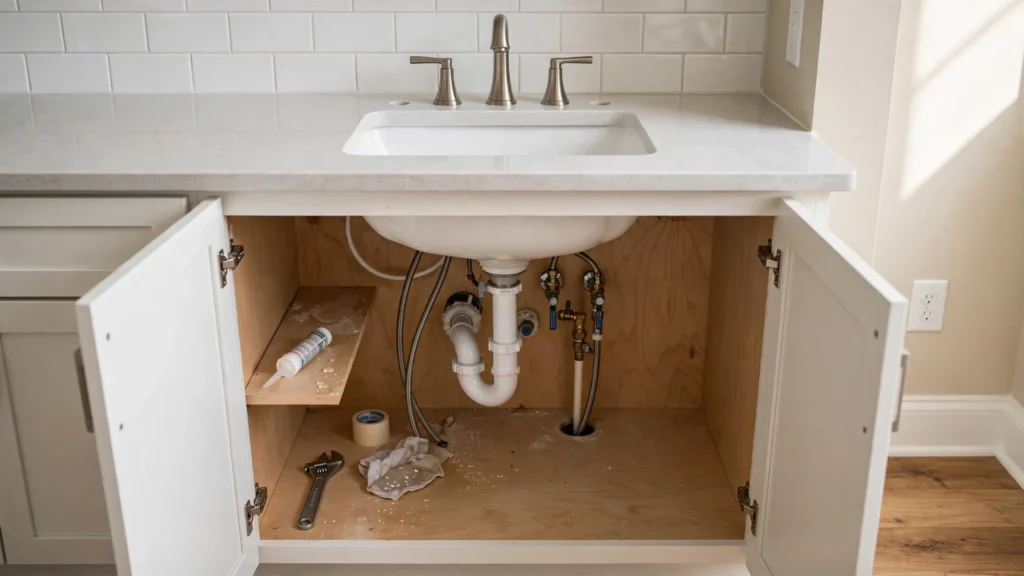
- Check the shutoff valves under the sink; stiff or corroded valves often need replacement.
- Look for water stains or soft wood in the vanity base.
- Measure the faucet hole spacing so a new faucet fits the sink and top.
- Photograph the existing sink, faucet, countertop opening, drain alignment, shutoff valves and the inside of the vanity before buying the replacement.
- Ask whether the existing shutoff valves, supply lines and drain can be reused safely or should be replaced as part of the installation.
Red Flags in a Quote
- Reusing corroded shutoff valves without mentioning them.
- No plan for resealing or supporting an undermount sink.
- An all-in price that does not say who supplies the faucet.
- No plan for likely concealed conditions such as new shutoff valves or supply lines, countertop cutting or repair, drain relocation for a different sink depth, faucet and pop-up drain hardware.
Planning the Work From Start to Finish
Shut off water at the fixture valves before work and test them; if they do not hold, the plumber may need to shut off the main. After installation, run the sink and check the drain and supply connections for drips over the next few days.
Quote Checklist
- Sink and faucet models and who supplies them.
- New or reused shutoff valves, supply lines, drain and P-trap.
- Countertop cutout or reinforcement work.
- Caulking or sealing details.
- Disposal of the old fixture.
- Demolition, removal and disposal.
Related Home Cost Desk Guides
Frequently Asked Questions
Can I replace a bathroom sink without replacing the faucet?
Yes, if the faucet is in good condition and fits the new sink or countertop hole pattern. Replacing both at once can still make sense because access is already open and old supply lines or drain hardware may be easier to address during the same visit.
Is an undermount sink more expensive to replace?
It can be. The old sink may be bonded or clipped beneath a stone top, and the replacement must match the cutout and mounting method. Countertop damage or fabrication changes can add cost quickly.
What plumbing parts commonly need replacement?
Supply lines, shutoff valves, the P-trap, pop-up drain assembly and short drain extensions are common items. A different sink depth or drain position can require more piping changes.
Can a new sink reveal water damage?
Yes. Slow leaks may damage the vanity floor, cabinet sides, wall or countertop substrate. Ask the installer to document damage before covering it with the new fixture.
Is a pedestal sink a simple swap for a vanity sink?
Not always. A pedestal exposes the wall and plumbing, so drain and supply locations, wall finish and floor finish may need more work than a like-for-like vanity replacement.
When should I call a plumber instead of doing it myself?
Call a plumber when shutoff valves do not close reliably, piping must move, corrosion is significant, leaks continue after reassembly, or the new sink changes the drain arrangement enough to require more than a straightforward trap connection.
Before You Buy the New Sink
- Measure the existing cutout, cabinet width and available depth before choosing a replacement.
- Confirm whether the new sink uses the same mounting style—drop-in, undermount, vessel or pedestal—as the old one.
- Check the drain centerline, P-trap alignment and shutoff valves so plumbing changes are identified before installation day.
- Decide whether the faucet and pop-up drain are being reused or replaced and include them in the quote.
- For stone countertops, confirm who is responsible for cutting, polishing and supporting the sink opening.
A like-for-like sink swap can stay simple. Changing mounting style, sink depth, countertop opening or visible plumbing can turn it into a small remodeling project, so those choices should be made before comparing bids.
What to Do Next
Bottom Line
Professional bathroom sink installation typically costs about $250 to $650 in 2026, with the final price depending heavily on sink style, plumbing condition, countertop work and whether the faucet or drain is also replaced. A straightforward bathroom replacement can still climb when the new sink changes size or mounting style, the faucet and drain are replaced, shutoff valves are corroded, or the countertop and plumbing need modification. The strongest decision is based on the real project scope, a normalized written quote and clear responsibility for preparation, hidden conditions and finish work.
Sources & Methodology
Home Cost Desk reviewed the following sources for national planning ranges and technical guidance. Cost data is not a substitute for local bids. Where safety, energy, moisture or building-envelope issues are involved, authoritative agency guidance should take priority over marketing claims.