Quick answer
Charlotte homeowners replacing a water heater in 2026 should expect a standard tank replacement to commonly land in the low-to-mid four figures, while tankless and heat-pump systems can cost more. HomeGuide’s national 2026 data lists about $600 to $3,100 installed for a standard tank, $1,400 to $5,600 for tankless, and $2,000 to $4,600 for a hybrid heat-pump water heater.
For local context, CostRange’s 2026 Charlotte model estimates about $1,150 to $4,400, presented as a model estimate rather than a survey of local bids. The CostRange page could not be re-accessed when we last checked it on October 28, 2026, so treat this range as unverified and lean on itemized local quotes. A Charlotte contractor, SAFE Water Heater, also publishes installed examples of about $1,199 plus tax for a standard 40-gallon electric replacement, $1,349 plus tax for a 50-gallon electric unit, and gas replacements starting around $1,449 plus tax, with code corrections and nonstandard work extra. Those contractor prices are examples, not market averages, but they provide a useful reality check.
2026 Charlotte cost snapshot
These are alternative installed-cost benchmarks, not line items to add together. The first three rows are national ranges by equipment type; the Charlotte row is a separate model-based estimate across replacement jobs.
| Replacement type or benchmark | 2026 installed range | How to use it |
|---|---|---|
| Standard storage tank (national) | $600–$3,100 | Starting point for a same-fuel, same-location tank replacement; confirm fittings, disposal, and permit scope. |
| Tankless (national) | $1,400–$5,600 | Ask for separate gas-line, vent, condensate, or electrical upgrades before comparing with a tank quote. |
| Hybrid heat-pump tank (national) | $2,000–$4,600 | Check location, air space, condensate drainage, noise, and any fuel conversion. |
| Charlotte localized model (all types) | $1,150–$4,400 (modeled; not re-verified Oct 2026) | Use as a regional planning estimate, not a survey of accepted Charlotte contractor bids. |
National equipment-type ranges above are from HomeGuide (January 2026); the Charlotte figure is CostRange’s localized model. A published Charlotte installer’s promotional package is a fourth, narrower reference for qualifying standard swaps, not a citywide average. None of these figures is a guaranteed quote, and the ranges should not be summed.
A straightforward same-location tank swap may stay near the lower or middle part of those ranges. Fuel conversion, venting, electrical upgrades, expansion control, difficult access, attic installation, relocation, tankless conversion, leak damage, or code corrections can push the total higher.
For the national baseline, see Water Heater Replacement Cost 2026.
Mecklenburg County permitting is part of the job
Mecklenburg County Code Enforcement’s Trade Internet Permitting system specifically addresses equipment change-outs. It states that contractors can obtain permits for qualifying change-outs and that the plumbing contractor is the primary contractor for electric water-heater change-outs. The same system allows inspections to be requested after the work is completed.
County electrical guidance also contains a narrow exception for the electrical connection of a replacement electric water heater when the new unit is in the same location, has the same or lower capacity and electrical rating, the work is performed by a licensed person, and the installation meets current code. That exception does not mean the plumbing side of the project is automatically permit-free.
The practical takeaway: ask the installer which trade permits apply to your exact scope, who will obtain them, and what inspection is required. Do not rely on a generic statement that “water heaters don’t need permits.”
Standard tank replacement
A conventional 40- or 50-gallon tank is usually the simplest replacement when the new unit uses the same fuel, location, venting method, and connections as the old one. The appliance is only part of the price.
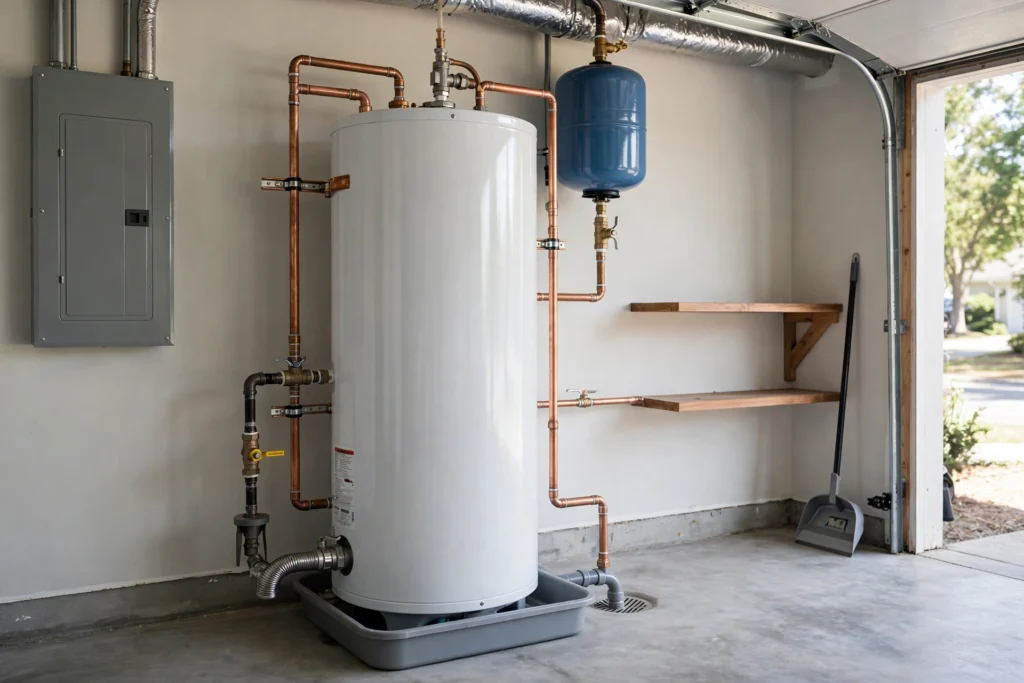
A complete quote should identify delivery, removal of the old tank, connectors, shutoff work, temperature-and-pressure relief discharge, drain pan where required, venting or electrical connection, expansion control, startup, cleanup, permit handling, and warranty registration.
If the existing installation has code deficiencies, a “same-size tank” can still require additional work. A low quote that ignores visible problems may grow after the old unit is drained.
Gas water heaters
Gas replacements can become more expensive when venting, combustion air, gas piping, chimney condition, or flue sizing need correction. A contractor should inspect the vent path before promising that every gas replacement will match a base package price.
Do not allow a damaged or improperly sized vent to be reused simply to keep the quote low. Carbon-monoxide risk makes venting one of the highest-consequence parts of the installation.
Ask whether the quote includes a new gas connector, shutoff work, sediment trap where required, vent connector, draft considerations, and any chimney or sidewall-vent changes.
Electric water heaters
Electric tank replacements may be straightforward when the existing circuit, conductors, disconnect, and location are suitable. A larger tank or a different equipment type can change electrical requirements.
Mecklenburg County’s permitting guidance specifically recognizes electric water-heater change-outs. If electrical work beyond the qualifying exception is needed, ask who will perform it and under which permit.
Do not assume that a plumbing contractor will perform electrical work outside the contractor’s licensing scope. If one bid includes an electrical correction and another does not, compare the scope before comparing the totals.
Tankless systems
Tankless water heaters can save floor space and provide long-duration hot water, but they are not a simple drop-in replacement for every house. HomeGuide’s 2026 data puts installed tankless systems around $1,400 to $5,600, with gas systems often at the higher end.
Gas tankless units may need a larger gas line, new venting, condensate management, or combustion-air provisions. Electric tankless units can require substantial electrical service capacity and multiple high-amperage circuits.
A conversion quote should list those upgrades separately. The unit price is often less than half of the total project when major infrastructure changes are needed.
Heat-pump water heaters
Hybrid heat-pump water heaters use electricity but move heat from surrounding air into the tank. HomeGuide lists about $2,000 to $4,600 installed. These systems can reduce operating energy but need adequate air volume, condensate drainage, electrical compatibility, and a location where cooler exhaust air and fan noise are acceptable.
A garage, basement, or large utility room can be a better location than a small sealed closet. If the existing tank is gas, conversion can also require electrical work and safe gas disconnection.
Ask for the manufacturer’s room-volume and clearance requirements, condensate plan, operating modes, and recovery performance before approving the equipment.
Expansion tanks and system pressure
Many replacement projects reveal a missing or failed thermal expansion tank. In a closed plumbing system, heated water expands and can increase pressure. An appropriately sized expansion tank may be needed depending on the system and applicable code.
A contractor should measure house pressure and understand whether a pressure-reducing valve, backflow device, or other condition creates a closed system. The tank should be selected for the water-heater size and pressure rather than installed as a one-size-fits-all accessory.
If one Charlotte quote includes expansion control and another does not, ask why before assuming the first is overpriced.
Drain pans, T&P discharge, and leak protection
A water heater located where leakage could damage finished areas may need a drain pan and an approved drain route. The temperature-and-pressure relief valve also needs a safe, code-compliant discharge path.
Smart leak sensors and automatic shutoff valves can add protection, especially in finished spaces or upper floors, but they do not replace correct plumbing and drainage.
For attic or tight-closet installations, access can be a major labor factor. Ask how the old tank will be removed, how the new unit will be brought in, and whether ceiling or finish repair is excluded.
Venting and chimney condition
Some older gas water heaters vent into masonry chimneys. A new heater can change flue-gas temperature or draft conditions. If the chimney or shared vent is deteriorated, the replacement may reveal a separate venting problem.
If chimney repair is part of the scope, use Chimney Repair Cost 2026 to budget that work separately. Do not bury significant chimney work in an unexplained water-heater allowance.
A qualified installer should determine whether the existing vent remains suitable for the new appliance.
Three Charlotte project scenarios
Scenario 1: straightforward 50-gallon electric swap
The existing circuit is suitable, access is easy, the drain pan and T&P discharge are compliant, and no plumbing corrections are needed. This is the type of project most likely to resemble the published local package examples.
Scenario 2: gas tank plus vent corrections
The replacement tank fits, but the vent connector, gas shutoff, expansion control, or relief discharge needs updating. The quote rises because the scope is no longer equipment-only.
Scenario 3: tank-to-tankless conversion
New venting, gas piping, condensate drainage, and possibly electrical controls are needed. The project can move toward the upper end of the national tankless range.
Repair or replace?
Before accepting a Charlotte replacement quote, ask for a written comparison of a same-fuel, same-location replacement and any proposed upgrade. Have the installer identify which added costs are required by the actual installation conditions, and who will arrange applicable permits and inspections.
A leaking tank body usually means replacement. Burner, thermostat, heating element, valve, igniter, thermocouple, or control failures may be repairable when the tank itself is sound.
Age matters, but condition and repair economics matter more. If an older tank needs an expensive repair plus a code or venting correction, replacement can make more sense. A younger unit with a contained component failure may be worth repairing.
For service pricing, the national Plumber Cost in 2026 guide can help you understand labor and service-call structure.
Sizing the new tank
Replacing a 50-gallon tank with another 50-gallon unit is common, but the best size depends on household demand and the equipment’s first-hour rating, not just the old label.
A household with back-to-back showers, a large soaking tub, or simultaneous hot-water use may need greater recovery or capacity. A smaller household may be able to downsize if the chosen unit’s performance is adequate.
Ask the contractor to explain the sizing basis, especially when recommending a significant change in tank capacity or a tankless conversion.
How to compare Charlotte quotes
Ask each installer to list:
- Exact model, capacity, fuel type, efficiency, and warranty.
- Removal and disposal of the old unit.
- Permit and inspection responsibility.
- Expansion tank or pressure-control work.
- Drain pan and T&P discharge.
- Gas venting or electrical work.
- Access or attic charges.
- Code corrections.
- Startup, cleanup, and warranty registration.
A quote that says only “replace 50-gallon water heater” is not detailed enough for a fair comparison.
Local package pricing: use it carefully
Published Charlotte package pricing can be useful because it shows that a basic installed replacement is not the same as buying a tank at a retail store. But package prices usually assume a standard swap with suitable existing connections and may exclude attic work, leak damage, relocation, vent corrections, gas-line changes, or code upgrades.
Use local package pricing as a screening reference, not as proof that every contractor should charge the same amount. Compare the assumptions behind the advertised package with the actual conditions in your home.
Emergency replacement planning
Water heaters often fail suddenly. Before an emergency, record the model, capacity, fuel type, age, and access conditions. Know the main water shutoff and keep the area around the tank clear.
If the tank begins leaking, shut off water and energy only if you can do so safely. Avoid working on gas piping or energized electrical components.
Emergency timing can reduce your ability to compare quotes, so advance planning becomes valuable once the existing unit is in the later part of its expected service life.
Five steps to compare Charlotte bids fairly
- Step 1: Request the exact water-heater model and installed price for a suitable like-for-like replacement.
- Step 2: Ask each installer to identify any additional venting, electrical, pressure-control, or drainage work and explain why it is necessary.
- Step 3: Confirm which trade permits and inspections apply to the proposed work and who will handle them.
- Step 4: Compare removal, disposal, taxes, access charges, startup testing, and warranty coverage on the same basis.
- Step 5: After installation, retain the model information, invoice, warranty terms, and any required inspection record.
Homeowner pre-quote checklist
- Photograph the existing tank label and installation.
- Measure available height and width.
- Note whether the unit is gas, electric, tankless, or heat pump.
- Identify the vent type if it is gas-fired.
- Ask whether the house has a pressure-reducing valve or closed plumbing system.
- Verify permit and inspection responsibility.
- Get at least two written quotes for a planned replacement.
- Keep permit, inspection, model, warranty, and invoice records after the work.
Frequently asked questions
How much does a water heater replacement cost in Charlotte in 2026?
A reasonable planning framework is roughly $1,150 to $4,400 based on a Charlotte localized model, with straightforward standard-tank replacements often lower than tankless or heat-pump conversions. National HomeGuide data ranges from $600 to $3,100 for standard tanks and $1,400 to $5,600 for tankless.
Does a Charlotte water heater replacement need a permit?
Mecklenburg County has a trade-permitting process for qualifying equipment change-outs and specifically addresses electric water-heater change-outs. The exact permit path depends on the scope and trades involved.
Is tankless always cheaper to operate?
It can reduce standby losses and provide long-duration hot water, but first cost and required gas or electrical upgrades can be substantial. Compare total installed cost and household demand.
Should I add a heat-pump water heater?
It can be a strong efficiency option when the location has enough air volume, drainage, electrical capacity, and acceptable noise conditions.
Why can two Charlotte quotes for the same 50-gallon tank differ?
One may include removal, permit handling, expansion control, a drain pan, relief discharge, and startup testing while another assumes those items are already compliant. Compare the equipment model and each required correction, not just the total.
Does the electrical permit exception mean my replacement is permit-free?
No. Mecklenburg County describes a narrow exception for certain electrical connections when a qualifying electric heater is replaced in the same location. It does not automatically waive plumbing permits or inspections. Ask the installer to confirm the permit path for your exact work.
Bottom line
For Charlotte in 2026, use national water-heater ranges plus local permit and installation conditions rather than a single magic number. A standard tank replacement often lands in the low-to-mid four figures, while tankless, heat-pump, difficult-access, venting, electrical, or code-correction work can move higher.
HomeGuide’s national ranges, Charlotte’s localized planning estimates, Mecklenburg County’s real permit framework, and published local package examples together create a practical budget. The final quote should make permits, venting, electrical work, expansion control, and every code correction visible before the job starts.
Sources & methodology
Our price references serve different purposes: HomeGuide provides national installed ranges by water-heater type; CostRange provides a model-based Charlotte estimate; and one local installer publishes example package prices for qualifying jobs. These are not interchangeable market averages. We use Mecklenburg County guidance for permitting context, but the applicable permits and inspections depend on the actual property and work. Homeowners should request itemized local quotes rather than treat any published range as a guaranteed price.
- HomeGuide — Water Heater Installation or Replacement Cost (2026)
- Mecklenburg County — Trade Internet Permitting (TIP)
- Mecklenburg County — Electrical Information for Homeowners
- CostRange — Water Heater Replacement Cost in Charlotte, NC (2026)
- SAFE Water Heater Charlotte — Published Installed Pricing