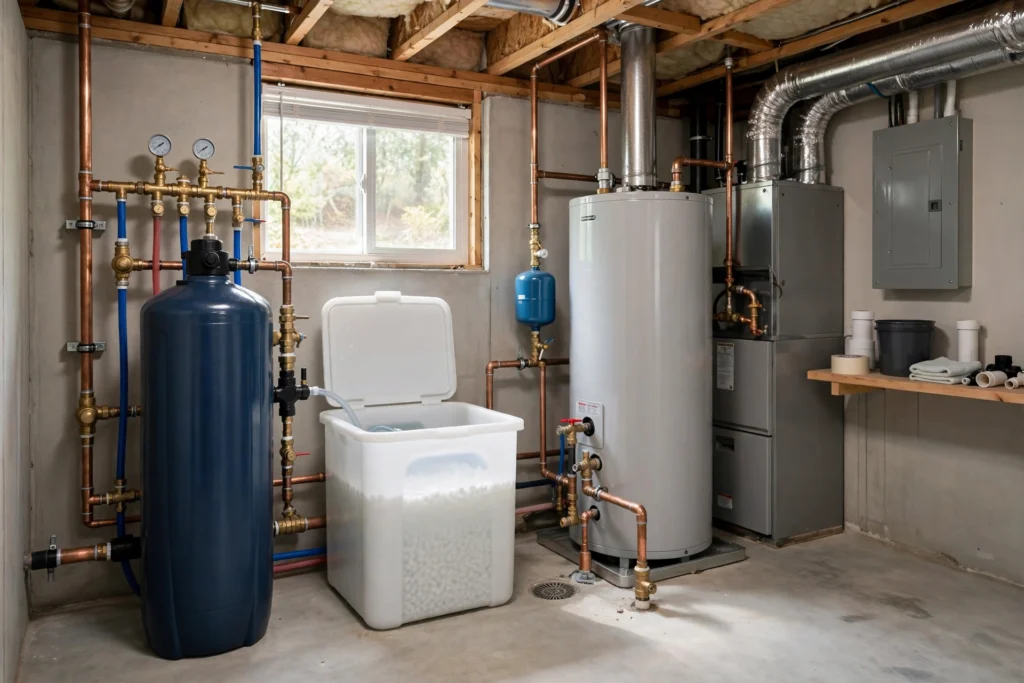
Quick answer: Water softener installation costs about $1,500 on average in Angi’s 2026 data, with a broad installed range around $200 to $6,000 depending on system type, capacity and plumbing work. HomeGuide’s 2026 planning range is narrower for a conventional whole-house system: about $1,200 to $3,800 including equipment and installation labor. Salt-free conditioning systems are often listed separately and can cost roughly $1,500 to $4,500, but they do not work the same way as ion-exchange softeners.
2026 cost snapshot
| Planning item | 2026 range | Notes |
|---|---|---|
| Typical whole-house softener + installation | $1,200-$3,800 | HomeGuide average range |
| Angi broad professional installation range | $200-$6,000 | Average about $1,500; scope varies widely |
| Salt-free conditioning system | $1,500-$4,500 | HomeGuide; different performance from ion exchange |
| Plumbing modifications | Project-specific | Main-line routing, loop, drain and bypass can change labor |
| Ongoing salt / regeneration water | Ongoing operating cost | Depends on hardness, capacity and programming |
Start by confirming that hardness is the problem you want to treat
A water softener is not a generic “better water” machine. CDC explains that water softeners primarily remove hardness minerals such as calcium and magnesium. They do not disinfect water and are not a substitute for treatment designed to remove bacteria, viruses or parasites. That distinction matters because a homeowner can spend thousands of dollars on the wrong equipment if the water problem was never tested.
EPA’s 2026 WaterSense guide notes that water above about 120 milligrams per liter of hardness (roughly 7 grains per gallon) is generally considered hard, and softening is often recommended when hardness exceeds about 180 mg/L or 10 grains per gallon. Local water quality varies, so start with a water report or test rather than choosing capacity from a salesperson’s rule of thumb. For a city-level example, see the San Antonio water softener installation cost guide.
If the problem is scale on fixtures, poor soap lather, mineral buildup in a water heater or hardness confirmed by testing, a softener can make sense. If the concern is lead, microbes, arsenic or another contaminant, use a treatment system specifically certified for that contaminant instead of assuming softening solves it.
Angi’s August 2026 article reports an average around $1,500 and says professional installation commonly spans roughly $200 to $6,000, with unusually complex or specialty systems going higher. HomeGuide gives a more focused $1,200 to $3,800 average range for a softener plus installation labor. Use the narrower range for a typical whole-home ion-exchange planning budget and the broader range when the home needs major plumbing changes, premium equipment or specialized treatment.
Equipment type changes both price and performance
The most common household softener is a cation-exchange system. EPA explains that these systems remove calcium and magnesium ions by exchanging them with sodium or potassium ions. The resin eventually needs regeneration, which uses water and salt. That ongoing process is why efficiency and correct sizing matter—not just the purchase price.
So-called salt-free systems are often marketed as water conditioners. HomeGuide lists them around $1,500 to $4,500 installed, but also notes that they are not as effective as conventional softeners for extremely hard water. Do not compare a salt-free conditioner and an ion-exchange softener only by price; ask what measurable water change each system is designed to produce.
Dual-tank or higher-capacity systems can cost more but may be useful where water demand is high or uninterrupted soft water is important. Whole-home filtration, iron removal, carbon treatment or reverse osmosis are separate functions and should be separately priced. Bundled systems can be convenient, but bundling can also make it harder to see whether you are paying for treatment you actually need.
Sizing the system correctly
System capacity should be based on water hardness and household water use, not simply the number of bedrooms. A contractor may use hardness measured in grains per gallon, estimate daily water consumption and then select a resin capacity and regeneration schedule. Oversizing can add unnecessary equipment cost; undersizing can force frequent regeneration and increase salt and water use.
EPA’s WaterSense materials emphasize efficient regeneration. Ask whether the control valve uses demand-initiated regeneration rather than regenerating on a fixed calendar regardless of actual use. Ask how the installer will program the hardness setting and what salt dose the system uses. Those questions affect lifetime operating cost even if two units have similar purchase prices.
Plumbing location and installation labor
A softener normally treats water near the point where the home’s main supply enters, before the water is distributed to most fixtures. The site needs enough room for the treatment tank and brine tank, access for adding salt, a suitable drain for regeneration discharge, and—in many systems—nearby electrical power. The exact location depends on climate and plumbing layout.
If the house already has a plumbing loop for a softener, installation can be straightforward. If the main line must be cut and rerouted, the job costs more. Finished basements, cramped utility rooms, difficult crawl spaces and large-diameter service piping can all increase labor. Use Plumber Cost in 2026 to understand how local service and labor charges can affect the installation beyond equipment price.
Older homes may reveal corroded or incompatible piping once the installer begins. That does not mean every softener project needs repiping, but if the house already has widespread supply-pipe problems, compare the treatment work with Whole-House Repiping Cost 2026 instead of paying for repeated small modifications around failing pipe.
Drain, bypass and outdoor-water decisions
The regeneration cycle creates discharge that needs an approved drain connection. Local plumbing and wastewater rules determine how that connection must be made. A quote should say whether the drain line, air gap or other required components are included rather than assuming the homeowner has a suitable drain nearby.
A bypass valve is important for service and maintenance. Ask whether the unit includes an integrated bypass and how to isolate it if a problem occurs. Also discuss whether outdoor hose bibs or irrigation should receive softened water. Many homeowners choose to leave some exterior water untreated to avoid unnecessary salt and regeneration demand, but the right layout depends on the existing plumbing and local water conditions.
How soft water affects the water heater and appliances
Hardness minerals can form scale inside water heaters and on heating surfaces. EPA notes that hard-water scale can reduce flow and interfere with heat transfer. Reducing hardness may therefore help manage scale, but it does not restore a water heater that is already leaking or near the end of its service life.
If the softener project is being triggered by heavy scale in an aging tank, compare the treatment budget with Water Heater Replacement Cost 2026. Replacing a failed heater without addressing very hard water may allow the same scale conditions to continue; installing a softener does not make an old corroded tank new.
Ongoing salt, water and maintenance costs
The purchase price is only the first cost. Cation-exchange systems use salt or potassium and water for regeneration. How much depends on hardness, household demand, resin capacity and programming. EPA specifically warns that inefficient softeners can consume significant water and salt, so ask about the unit’s efficiency ratings and regeneration controls.
Resin and control components also require maintenance over time. The brine tank may need cleaning, salt bridges can occur, prefilters may need replacement and valves can eventually need service. Ask the installer for a written maintenance schedule and the price of common service calls before choosing equipment.
Add the softener to your Home Maintenance Checklist 2026, including periodic checks for leaks, salt level and unusual regeneration behavior. A small leak around a bypass or drain line can create a much larger water-damage problem if it goes unnoticed.
Water quality and health boundaries
CDC’s treatment guidance is useful because it separates softening from purification. Softeners remove hardness minerals; they do not remove parasites, bacteria or viruses. Some products may carry additional contaminant-reduction claims, but those claims should be verified on the product certification rather than assumed from the word “softener.”
EPA also notes that sodium-based ion exchange adds sodium to treated water. The amount depends on incoming hardness and system operation. Home Cost Desk does not give medical advice about sodium intake. If a household member has a medically restricted diet or other health concern, discuss drinking-water choices with the appropriate clinician and ask the installer about plumbing options for an untreated drinking-water tap or alternative regeneration media.
Before you approve installation: a six-step homeowner checklist
- Record the actual water problem. Obtain a recent hardness result in grains per gallon (or mg/L as calcium carbonate). For a private well, discuss appropriate additional testing with a qualified water professional; a hardness test alone does not establish that well water is safe to drink.
- Check the proposed sizing calculation. Give each bidder the same hardness result and an estimate of daily household water use. Ask for the unit’s usable treatment capacity at the proposed salt dose, not only the advertised maximum grain rating, and the expected regeneration frequency.
- Walk the plumbing route. Identify the main shutoff, proposed softener position, bypass, drain discharge point, electrical outlet and lines that will remain unsoftened. Have the installer identify any necessary air gap, backflow protection or permit under local requirements.
- Request an itemized installed price. Separate equipment, connections, drain work, electrical work if needed, removal of an old unit, permits, testing and startup. Ask how unexpected piping repairs would be priced before authorizing extras.
- Compare operation and support. Request the manufacturer’s regeneration-water and salt-use specifications at the proposed settings, the warranty terms, service availability and prices for consumables or replacement parts.
- Verify the handover. Have the installer demonstrate bypass operation, explain how to add the specified salt, document the programmed hardness and regeneration settings, and test the treated water for hardness. Keep the test result and equipment manual.
Practical decision example: Two quotes may specify the same advertised grain capacity but cover different jobs. If one includes a new drain route, bypass and startup testing while the other assumes an existing loop and excludes those tasks, the totals are not comparable. Request a revised scope before choosing the lower figure. Neither quote should be treated as a drinking-water safety certification.
How to compare water softener quotes
Ask each bidder to use the same water test results. Compare system type, resin volume or rated capacity, control valve, regeneration method, salt efficiency, warranty, drain connection, bypass, electrical needs and which plumbing lines will be softened. A quote that only says “48,000-grain softener installed” is not enough to compare lifetime operating cost.
Confirm whether startup includes testing the finished hardness level and programming the control valve. Ask who handles permits or plumbing-code requirements, whether old equipment is removed, and what happens if the existing plumbing loop leaks or needs replacement.
For a larger project, use the written-scope discipline in How to Hire a Home Contractor 2026. Avoid a sales presentation that jumps straight from a quick strip test to a high-priced bundled system without explaining what each stage treats.
Frequently asked questions
How much is a typical whole-house water softener in 2026?
HomeGuide’s common installed range is about $1,200 to $3,800. Angi reports an average near $1,500 and a wider range because it includes more system types and installation conditions.
Is a salt-free conditioner the same as a water softener?
No. Different technologies change water in different ways. Conventional ion exchange actually removes calcium and magnesium ions; salt-free products are often conditioners and may not perform the same way in very hard water.
Do water softeners remove bacteria?
CDC says no. A softener is not a disinfection system.
Do I need a plumber to install one?
Many installations involve cutting and reconnecting the home’s main water line, drain requirements and code rules. A qualified plumbing or water-treatment professional is the safer route for a whole-house system.
Will a softener stop all spots and scale?
It can significantly reduce hardness-related scale when correctly sized and operated, but water chemistry and other dissolved solids can still affect appearance.
Budget scenarios: how the same $1,500 average can become different projects
A simple installation scenario is a home that already has a softener loop, floor drain and nearby receptacle. The water hardness is known, the family needs a conventional ion-exchange unit, and no other treatment is required. In that case, most of the budget is equipment, connection labor and startup. This is the kind of project most likely to cluster near the common national range.
A second home may have no loop and a finished utility room. The installer has to reroute the main water line, create a code-compliant drain connection, protect finished surfaces and decide which exterior hose bibs remain unsoftened. Even with the same softener model, labor can rise materially. Ask for a drawing or clear description of the plumbing route before comparing that proposal with a simpler “swap-in” installation elsewhere.
A third household may have very hard well water plus iron, sediment or another measured water-quality issue. Now a salesperson may propose a softener, sediment filter, iron treatment, carbon filter and reverse-osmosis drinking system. Some of that may be justified, but each stage should be tied to a test result and a treatment goal. The total can quickly move far beyond the price of a softener alone. Request itemized equipment and ask what happens if one component is removed from the package.
Total ownership cost matters because a cheaper unit that regenerates inefficiently can use more salt and water over many years. Ask for the manufacturer’s rated efficiency, typical salt setting for your hardness, expected regeneration frequency, control-valve warranty and the price of common replacement parts. The best value is the system that produces the required water quality with reasonable operating cost, not necessarily the unit with the biggest grain-capacity number on the sales sheet.
Common budgeting mistakes to avoid
Do not buy capacity from household size alone without measuring hardness. Do not assume every water-treatment tank in a sales package is necessary, and do not treat a softener as a purifier for microbes or every dissolved contaminant. Compare operating cost as well as purchase price, and ask what plumbing, drain and electrical work is excluded. A low equipment price can become an expensive installation when the home has no treatment loop or suitable drain.
Bottom line
For 2026 planning, a conventional whole-house softener often lands around $1,200 to $3,800 installed, with about $1,500 a useful national midpoint from Angi. The best purchase starts with a real hardness test, separates softening from filtration or disinfection, and compares quotes on capacity, regeneration efficiency, plumbing scope and lifetime maintenance—not tank size alone.
Sources used for this article
- HomeGuide — How Much Does a Water Softener Cost? (2026): https://homeguide.com/costs/water-softener-cost
- Angi — Water Softener System Installation Cost [2026 Data], updated August 3, 2026: https://www.angi.com/articles/how-much-does-water-softener-installation-cost.htm
- U.S. EPA WaterSense — Cation Exchange Water Softeners: https://www.epa.gov/watersense/cation-exchange-water-softeners
- U.S. EPA WaterSense — Soften Water Without Wasting It (2026 guide): https://www.epa.gov/system/files/documents/2026-05/ws-products-water-softener-guide.pdf
- CDC — About Home Water Treatment Systems: https://www.cdc.gov/drinking-water/about/about-home-water-treatment-systems.html