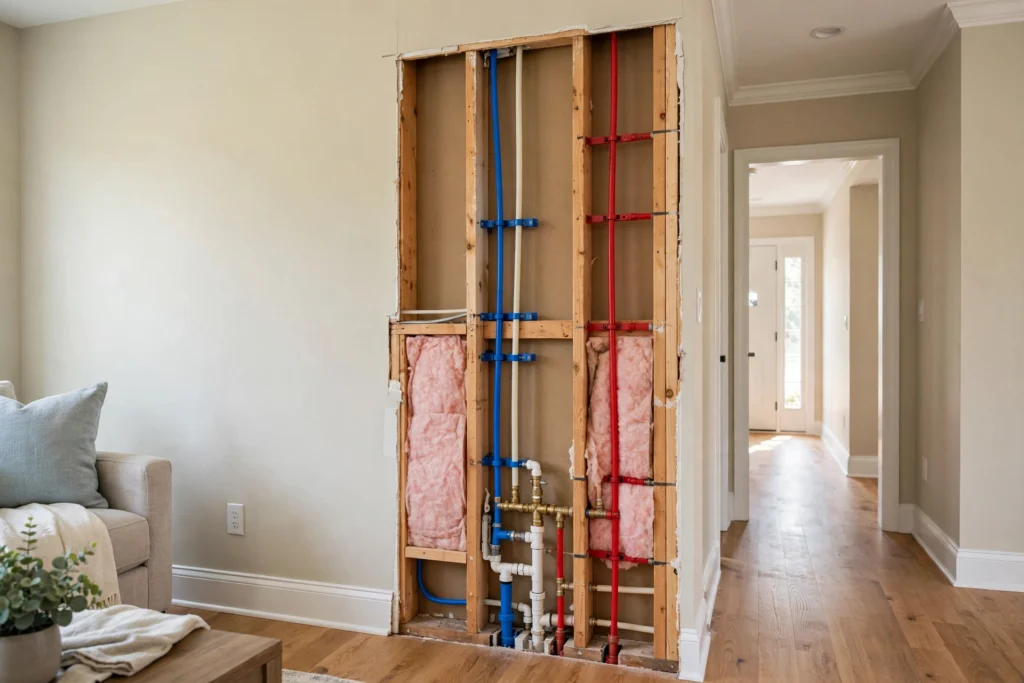
The average cost to repipe a house in 2026 depends heavily on size, access, and pipe material. For many typical U.S. projects, a practical planning range is about $3,900 to $7,500. Angi reports a much broader professional range of roughly $1,250 to $22,000, which shows why a small accessible PEX repipe and a multi-story copper retrofit should never be compared as the same job.
Open the maintenance budget calculator
These figures are budgeting references, not contractor quotes. A one-story house with open crawlspace access is fundamentally different from a multi-story finished home with many fixtures and difficult wall access.
Whole-house repiping cost at a glance
| Cost item | 2026 planning range |
|---|---|
| Typical whole-house repipe | About $3,900–$7,500 |
| Broad professional range reported by Angi | About $1,250–$22,000 |
| PEX material | About $0.40–$2 per linear foot |
| CPVC material | About $0.50–$1 per linear foot |
| Copper material | About $2–$8 per linear foot |
| Plumbing inspection | About $85–$300 |
Material prices alone do not determine installed cost. Angi estimates labor can account for roughly 70% of the project bill. Opening walls, routing pipe between floors, permits, testing, cleanup, and finish repair can matter more than the raw pipe price.
Interactive estimator
Whole-House Repipe Estimator
Answer five questions to see which part of this guide’s 2026 ranges your project most likely falls into. The tool only places your home within the published ranges; it does not invent local prices.
How it works: each answer that usually adds labor or material (two or more stories, harder access, more bathrooms, copper) adds 1 or 2 points, and every factor is listed with your result. 0–1 points shows the lower part of Angi’s broad range ($1,250–$3,900), 2–3 points shows the typical range ($3,900–$7,500), and 4 or more shows the upper part ($7,500–$22,000). The points only pick a band. No regional multipliers are applied, and drywall, texture and paint are usually priced separately.
PEX vs. copper: which costs less?
PEX
Cross-linked polyethylene, or PEX, is generally the lower-cost option. It is flexible, which can reduce fittings and make routing through existing framing easier. Angi’s current 2026 data puts PEX material around $0.40 to $2 per linear foot. In retrofit work, flexibility may also reduce demolition.
The lowest material price does not automatically produce the lowest final quote. Manifold design, connection system, pipe sizing, local code, installer preference, and access still affect labor.
Full-house copper repiping: why it usually costs more than PEX
For a full-house copper repipe, the material itself is usually more expensive and the rigid pipe can require more fittings and access work in an existing home. Angi lists copper pipe around $2 to $8 per linear foot before installation. Because copper is rigid, existing-home retrofits may require more fittings and wall or ceiling openings than flexible PEX layouts.
Local water chemistry matters. Copper is not automatically best for every home, and PEX is not automatically best in every jurisdiction. Ask why the proposed material suits local water, code requirements, routing, and service conditions.
CPVC
CPVC can be another lower-material-cost option, with Angi reporting roughly $0.50 to $1 per linear foot. Availability, local practice, temperature exposure, installation method, and code acceptance should all be considered. Compare complete installed systems rather than choosing solely from a material price chart.
What about PVC?
Standard PVC is not a general substitute for PEX, CPVC or copper in a whole-house repipe. PVC is widely used for drain, waste and vent lines. Some PVC pipe is certified for cold drinking water, but standard PVC is not suitable for hot-water lines because it loses strength at sustained higher temperatures. For hot- and cold-water distribution inside the home, plumbers use materials made and certified for that service. CPVC made to ASTM D2846/D2846M covers hot- and cold-water distribution systems up to 180°F (82°C). PEX and copper are the other common choices. A low per-foot price does not make PVC the cheapest or the right choice for a supply repipe. Your local plumbing code decides which materials are allowed, so ask each contractor which approved material they propose for the hot and cold lines.
What drives the final repiping price?
Fixture count: Kitchens, bathrooms, laundry connections, hose bibs, wet bars, and other fixtures add branches, valves, and labor. House size: Larger homes usually need more pipe, although fixture count and routing can matter more than square footage. Stories: Moving new lines between floors can increase wall openings and labor.
Access: Open basements and crawlspaces simplify work. Finished ceilings, tiled walls, cabinetry, tight chases, and slab foundations make routing harder. Material: Copper generally costs more than PEX. Local labor: Rates vary substantially by metro. Permits: Requirements and fees are local. Wall repair: Many plumbing bids exclude final drywall texture and paint.
Repiping is different from replacing a service line
A whole-house repipe usually refers to water-distribution piping inside the home. The service line connects the house to the public water main. These are separate scopes and should be priced separately.
This distinction matters when lead is a concern. EPA says lead service lines are often the most significant source of lead in drinking water where they are present. Replacing interior plumbing while leaving a lead service line may not remove the primary source. Ask the water utility what the service line is made from and whether a replacement or assistance program is available.
Older plumbing and lead
EPA and CDC identify lead pipes, faucets, fixtures, solder, and some galvanized plumbing as possible sources of lead in drinking water. Plumbing installed before 1986 deserves particular attention because older materials may contain more lead.
Do not assume pipe age proves the water contains lead. EPA says dissolved lead cannot reliably be identified by sight, taste, or smell; testing is the way to determine whether lead is present. EPA’s Protect Your Tap guidance says certified-laboratory testing commonly costs about $15 to $100, and some utilities or states may provide testing or replacement assistance.
If lead is suspected, CDC advises contacting the local water authority, identifying possible sources, and testing. Official guidance includes using cold water for drinking and cooking and, where appropriate, a filter certified for lead removal. Boiling water does not remove lead.
When does a whole-house repipe make sense?
A single leaking fitting does not justify replacing every supply line. Targeted repair may be economical when the rest of the system is in good condition.
A full repipe becomes more reasonable when leaks recur in multiple locations, pipes show widespread corrosion, flow is poor because of aging supply piping, the existing material has a history of failures, or renovations already expose much of the plumbing. It can also make sense when repeated repairs keep damaging finished walls and ceilings.
Ask the plumber to document why a full repipe is recommended. If the recommendation follows one isolated leak, a second opinion is particularly valuable.
Hidden costs to budget for
Drywall, texture, and paint
Plumbers may cut access openings but exclude final wall and ceiling restoration. Confirm who patches, textures, primes, and paints after inspection.
Tile and cabinet access
Bathrooms and kitchens can be expensive places to open finished surfaces. A routing plan that avoids decorative tile or custom cabinetry may save meaningful restoration cost.
Valves and fixture connections
A repipe may reveal old fixture stops, supply connectors, hose bibs, or main shutoff components worth replacing while the system is open. Confirm which valves and connections are included.
Water heater connections
New distribution piping must integrate with the existing water heater. A repipe does not automatically mean the heater needs replacement, so treat a new heater as a separate decision unless there is a specific defect or compatibility issue.
Permits and inspections
Whole-house plumbing replacement commonly falls under local building and plumbing rules. Permit responsibility, inspection scheduling, and fees should be stated in the proposal.
Lead service line work
If the service line is lead or galvanized requiring replacement, utility-side and homeowner-side responsibilities can differ. EPA notes that water systems must maintain service-line inventories and federal rules require replacement of lead and certain galvanized service lines under specified conditions. Check the utility before paying privately for work that may qualify for a program.
How long does a repipe take?
Many straightforward repipes can be completed in several working days, but there is no reliable national duration for every house. Size, fixture count, access, inspection timing, material, and wall restoration all matter. Ask for two schedules: plumbing work and the full timeline through patching and cleanup.
Also ask how long water will be unavailable each day. A well-planned project may restore water between work periods even while finish repairs continue.
DIY vs. professional repiping
A whole-house repipe is generally a professional project. It involves pipe sizing, routing, approved materials, supports, pressure testing, fixture connections, and local plumbing rules. Mistakes can create concealed leaks and costly water damage.
A capable homeowner may handle limited finish work after inspection where local rules allow, but a licensed plumbing contractor provides clearer responsibility for code compliance, testing, and warranty coverage.
Estimating a repipe by fixture count
Because labor makes up most of a repipe (Angi estimates about 70%), it helps to think about which fixtures need new supply lines. Angi reports an average of roughly $1,200 per fixture and publishes these per-fixture ranges. Angi does not explain how the per-fixture figures were calculated or what they include.
| Fixture | Angi range per fixture |
|---|---|
| Sink | $350–$800 |
| Dishwasher | $400–$800 |
| Washing machine | $350–$1,500 |
| Shower | $600–$1,600 |
| Water heater | $700–$1,800 |
Important: adding up per-fixture ranges is not a reliable way to price a whole-house repipe. In a real repipe, fixtures share main and branch supply lines, one crew and one set of wall and floor openings, so routing, access and labor costs overlap from fixture to fixture. A per-fixture figure may also include work that would be done only once for the whole house. Use the numbers below to understand where costs come from, not as a project price.
Worked example: two-bathroom, single-story home
Illustrative arithmetic only. Assume a kitchen sink, two bathroom sinks, two showers or tub-showers, a dishwasher, a washing machine and a water heater connection.
- 3 sinks: 3 × $350–$800 = $1,050–$2,400
- 2 showers: 2 × $600–$1,600 = $1,200–$3,200
- Dishwasher: $400–$800
- Washing machine: $350–$1,500
- Water heater connection: $700–$1,800
- Illustrative subtotal for the listed fixtures: about $3,700–$9,700
This subtotal is not a validated project price. Angi’s whole-house figures (about $1,500–$15,000, with many homeowners around $7,500) describe complete projects. They use a different scope and method than per-fixture figures, and Angi does not publish how the two relate. That is why a fixture sum cannot confirm or replace a whole-house quote. The subtotal also leaves out items Angi does not price per fixture: toilets, hose bibs, the refrigerator line, permits (Angi: $50–$500) and drywall repair (Angi: about $300 to $900 or more). Two-story routing or pipes under a slab can change the picture further. Rely on itemized quotes from licensed plumbers for the actual price.
Paying for a repipe
Arrangements homeowners sometimes use for larger plumbing projects include:
- Paying from savings, often with a deposit and progress payments tied to completed stages
- Financing offered through the contractor, usually provided by a third-party lender
- A home equity loan or line of credit
- A personal loan or credit card
Availability, approval and terms depend on the provider and your circumstances. This list is not a recommendation to borrow. If you consider any of these options, review the full written terms and total cost, and keep financing separate from the repiping contract so you can compare quotes on price and scope first.
How to compare repiping quotes
Get at least two or three itemized proposals. Each should identify pipe material and product system, fixture count, main and branch sizing, included valves, routing approach, demolition, disposal, permits, pressure testing, drywall exclusions, warranty, and total price.
Ask whether the bid includes both hot and cold distribution lines, exterior hose connections, refrigerator and dishwasher supplies, washing-machine connections, water-heater connections, and any recirculation piping. A lower quote may simply cover less work.
For PEX proposals, ask what connection system and layout will be used. For copper, ask what portion will be copper and whether access restoration is included. Do not compare only cost per foot.
Three practical homeowner scenarios
One-story home with crawlspace access: This can be a straightforward layout because long runs may be accessible without extensive wall demolition. PEX often produces a competitive quote.
Two-story finished home: Vertical routing, bathroom groups, and ceiling access can make labor and restoration a larger share of the project than pipe material.
Older home with possible lead sources: Start with the utility’s service-line information and certified water testing rather than assuming an interior repipe solves the entire issue. Service-line and interior plumbing should be evaluated separately.
Ways to control project cost
Have contractors bid the same written scope. Separate plumbing from optional finish upgrades. Ask whether access holes can be concentrated in closets or less-visible areas. Coordinate a repipe with a planned kitchen or bathroom renovation when walls will already be open. Confirm wall-repair scope before signing, because an inexpensive plumbing bid can become costly after separate finish work is added.
If recurring leaks are driving the project, keep records of repair locations. That history helps a second plumber assess whether failures are systemic or isolated.
Five-step whole-house repipe plan
- Confirm that the problem is systemic. Map recent leaks, low-flow fixtures, corrosion and pipe materials before committing to a full repipe.
- Define the exact scope. List bathrooms, kitchen, laundry, hose bibs, refrigerator line, water-heater connections and any recirculation piping.
- Compare PEX and copper as complete systems. Ask each plumber to explain routing, pipe sizing, fittings, manifolds, shutoffs and why the proposed material suits your home.
- Price restoration separately. Make drywall, texture, paint, tile and cabinet-access assumptions explicit so a cheap plumbing bid does not become an expensive finish project.
- Verify the finished system. Require pressure testing, inspection where applicable, leak checks at every fixture and written warranty information before final payment.
What to have ready before getting quotes
- Approximate home size and number of stories
- Number of bathrooms and other water fixtures
- Known pipe material and approximate age
- Locations of recent leaks or corrosion
- Whether a crawlspace, basement or attic provides access
- Photos of the main shutoff, water heater and exposed piping
- Utility information about the service-line material if lead is a concern
Frequently asked questions
How much does it cost to repipe a house in 2026?
Current national data spans a very wide range—roughly $1,250 to $22,000—because a small accessible home and a large finished multi-story home are fundamentally different projects. Many typical projects still cluster in the mid-four-figure range.
Is PEX cheaper than copper?
Usually. PEX material and installation are generally less expensive, especially in retrofit work where flexible tubing can reduce fittings and wall openings. The final choice should still account for local code, water conditions and installer experience.
Does a repipe include drywall repair?
Not automatically. Many plumbers create access openings and leave final texture and paint to another trade. The contract should state this clearly.
Will repiping fix lead in drinking water?
Not necessarily. Interior plumbing is only one possible source. If a lead or galvanized service line is present, replacing interior pipes alone may not remove the primary source.
Related Home Cost Desk guides
For a complete plumbing-cost comparison, also review our sewer line replacement cost guide, water heater replacement cost guide, and drain cleaning cost guide. These cover separate plumbing scopes that homeowners sometimes confuse with a whole-house repipe.
Bottom line
For 2026 planning, many whole-house repiping projects fall around $3,900 to $7,500, but current national data shows the possible professional range can extend from roughly $1,250 to $22,000. PEX generally has the lower material cost, while copper carries a significant premium. Labor, access, fixture count, wall restoration, and house layout often matter more than pipe price alone.
Compare itemized scopes rather than headline totals. If lead is part of the reason for repiping, identify the service-line material and test the water first; replacing interior piping is not necessarily the same as replacing the source of lead exposure.
Home Cost Desk compares current U.S. cost or technical references and checks safety, code, efficiency, incentive, or regulatory claims against authoritative sources when available. National figures are planning ranges, not local quotes.
Editorial review: Home Cost Desk Editorial Team · Read our research methodology · Detailed sources appear below.
Sources and methodology
Home Cost Desk treats national cost datasets as planning benchmarks, not guaranteed local prices. Current 2026 cost ranges were cross-checked against Angi and HomeGuide. Lead and drinking-water guidance was checked against the U.S. Environmental Protection Agency and Centers for Disease Control and Prevention. Actual prices depend on location, access, materials, permits, fixture count, and contractor scope.
- Angi — Cost to Repipe a House, updated August 2026
- HomeGuide — Plumbing and Whole-House Repiping Costs
- ASTM International — D2846/D2846M-24, CPVC Plastic Hot- and Cold-Water Distribution Systems
- Teknor Apex — Potable Water Certified: When to Use CPVC Compounds (materials supplier; PVC vs. CPVC temperature limits)
- U.S. EPA — Lead in Drinking Water
- U.S. EPA — Protect Your Tap
- CDC — About Lead in Drinking Water