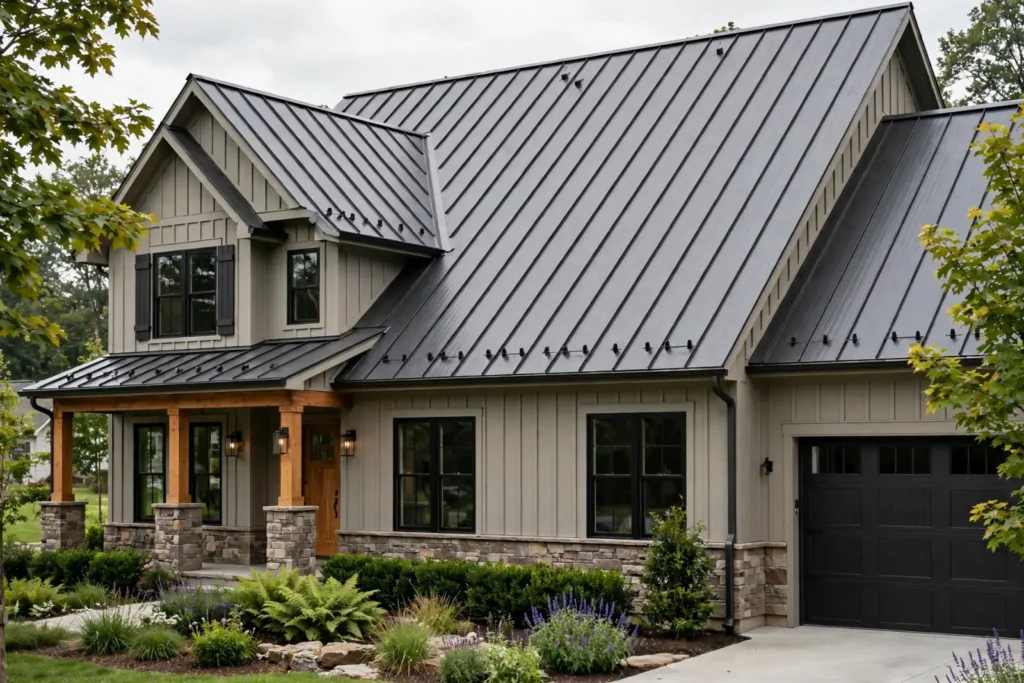
A metal roof can cost substantially more upfront than basic asphalt shingles, but homeowners often consider it for durability, lower maintenance, fire resistance, distinctive appearance, and the possibility of a long service life. For U.S. homeowners budgeting a 2026 replacement, a practical installed range is about $5 to $16 per square foot for many common metal systems, while premium standing-seam, copper, zinc, complex roofs, and difficult tear-offs can move far beyond that.
Recent national data illustrates the spread. Angi’s September 2026 metal-roof dataset reports an average project cost of about $11,766, with most homeowners paying roughly $6,045 to $18,340. HomeGuide reports about $7,500 to $40,000 for a 1,500- to 2,500-square-foot metal roof, depending on material and system. These figures are planning benchmarks, not substitutes for a roof-specific estimate.
Metal roof cost at a glance
| Project or material | 2026 planning range |
|---|---|
| Typical metal roof | $5–$16 per sq. ft. installed |
| Angi national project range | $6,045–$18,340 |
| Angi national average | About $11,766 |
| Corrugated metal | About $5–$12 per sq. ft. installed |
| Metal shingles | About $6–$14 per sq. ft. installed |
| Standing seam | About $9–$16 per sq. ft. in common HomeGuide data; some premium systems run higher |
| Steel roofing | About $6–$16 per sq. ft. in Angi’s 2026 steel data |
| Old-roof removal | About $1,000–$5,000 |
| Roof decking repair | About $2–$5 per sq. ft. |
| Roofing permit | Often about $250–$500 |
The number that matters most is not the home’s interior floor area. Roofers price the actual roofing area, which can be much larger because of roof pitch, overhangs, dormers, valleys, and waste.
How much does a metal roof cost by type?
Corrugated or exposed-fastener metal
Corrugated and other exposed-fastener systems are generally among the least expensive metal options. HomeGuide places corrugated sheet-metal roofing around $5 to $12 per square foot installed. Angi’s September 2026 data gives a broad range of roughly $3.50 to $15 per square foot depending on system and project conditions.
These roofs use visible fasteners through the panels. They can be economical, but the fasteners and washers become maintenance points over time because repeated expansion and contraction can loosen components or deteriorate seals.
Metal shingles
Metal shingles provide a more traditional appearance than large vertical panels. HomeGuide reports roughly $6 to $14 per square foot installed, while Angi’s 2026 comparison data shows a broader range for some products and markets.
They can work well for homeowners who want the durability of metal without the distinctly modern appearance of standing-seam panels.
Standing-seam metal
Standing seam is one of the most recognizable premium metal-roof systems. The vertical seams are raised above the panel surface and typically conceal the fasteners. HomeGuide reports about $9 to $16 per square foot installed, while Angi’s May 2026 dataset gives a much broader $4 to $30 per square foot range when different metals and high-end systems are included.
For a 2,000-square-foot standing-seam roof, Angi estimates roughly $18,000 to $32,000 in common 2026 projects. Complex geometry, copper or zinc, thick panels, and premium finishes can push the project much higher. To compare metal with other materials for your own roof size, try the Roof Replacement Cost Calculator.
Steel
Steel is the most common metal-roof material in many residential markets. Angi’s July 2026 steel-roof data reports an average of about $19,000, with many projects between $16,000 and $28,000. On a square-foot basis, its dataset shows about $6 to $16.
Galvanized, galvalume, painted, stamped, and stainless products do not all cost the same. Coating quality, gauge, panel profile, and warranty can matter as much as the underlying metal.
Aluminum, copper, and zinc
Aluminum is often considered in coastal environments because of corrosion resistance. Copper and zinc are premium materials that can cost far more than common steel systems. They may make sense for architectural projects, but they can quickly move a roof into a much higher budget category and require installers experienced with the specific material.
Why the same-size roof can have very different bids
Roof pitch
Steeper roofs take more time and require more fall-protection setup. Angi’s September 2026 data suggests steep pitch can add roughly 15% to 35% compared with easier roof geometry.
Complex roof design
Valleys, hips, dormers, chimneys, skylights, wall intersections, and multiple roof levels add cutting, flashing, waste, and labor. Angi estimates complex roof designs can cost roughly 15% to 25% more than a simple gable layout.
Metal gauge
Gauge refers to metal thickness, and the numbering can be counterintuitive: lower gauge numbers are generally thicker. Angi’s 2026 data shows large price differences between thin and heavy-gauge products. Do not choose gauge solely on price; wind exposure, panel profile, structural design, and manufacturer requirements all matter.
Fastener system
Exposed-fastener systems usually cost less than concealed-fastener standing seam. Angi estimates exposed-fastener configurations can be roughly 30% to 50% less than hidden-fastener systems in some comparisons.
Old roof removal and hidden decking damage
Removal of the existing roof can add roughly $1,000 to $5,000, according to Angi’s September 2026 data. The exact number depends on the roof size, number of existing layers, material, disposal fees, access, and local labor.
Tear-off can also reveal damaged plywood or oriented-strand board. Angi estimates roof-deck replacement around $2 to $5 per square foot in many cases. Water intrusion near valleys, chimneys, skylights, roof edges, and wall intersections can create repairs that were impossible to price from the ground.
Ask the contractor to state how decking repairs will be charged before work begins. A unit price per sheet or per square foot can reduce surprises.
Underlayment, flashing, and ventilation
Metal panels are only one part of the roof assembly. A quality replacement also depends on underlayment, flashing, ventilation, closures, sealants, fasteners, and details at penetrations.
Angi’s 2026 metal-roof guide shows common underlayment allowances around $1 to $1.30 per square foot, depending on the product. High-temperature underlayments may be specified beneath some metal roofs because roof-surface temperatures can become high in direct sun.
If your attic has moisture, condensation, or ventilation problems, address them as part of the roof design rather than assuming new metal panels will solve them. Our attic insulation cost guide covers another part of the roof-and-attic performance system.
Can a metal roof go over existing shingles?
In some jurisdictions and roof conditions, certain metal systems can be installed over an existing roof layer. That does not mean it is always the best approach.
The contractor must consider local code, manufacturer instructions, roof-deck condition, existing layers, flatness, moisture, weight, ventilation, and how flashings will be detailed. Installing over old shingles can reduce tear-off cost, but it can also make hidden decking damage harder to identify.
Ask for two written options when both methods are permitted: full tear-off and approved overlay. Compare warranty terms as well as price.
Metal roof vs. asphalt shingles
Metal typically costs more upfront than standard asphalt shingles. The decision is therefore not simply “which roof is cheaper today?” It is also about expected service life, maintenance, climate exposure, appearance, insurance considerations, and how long you expect to own the property.
If your existing roof may only need localized work, compare the full replacement price with our roof repair cost guide. For broader replacement benchmarks across roofing materials, see our roof replacement cost guide.
Energy efficiency and cool-roof performance
Metal is not automatically a “cool roof.” Surface color and coating matter. ENERGY STAR explains that cool roofs reduce heat gain by combining higher solar reflectance with higher thermal emittance. Reflective roof products can stay significantly cooler than dark, highly absorptive surfaces under strong sun.
ENERGY STAR notes that cool roofs tend to provide the greatest energy benefit in hot, sunny climates, particularly on buildings with lower roof insulation. Metal is one of several roofing materials that can be manufactured with high-reflectance surfaces.
When energy performance matters, ask for the specific product’s rated solar-reflectance and thermal-emittance data rather than assuming every light-colored or metal roof performs the same way.
Permits and local wind requirements
Angi’s 2026 data uses roughly $250 to $500 as a common permit allowance, but permit fees and requirements vary considerably by jurisdiction.
Wind-prone areas can require specific panel systems, fastener patterns, edge details, deck attachment, and approved products. Coastal projects may also have corrosion considerations. Ask the roofer to identify the applicable local design requirements and the exact product approval or installation instructions being followed.
DIY metal roofing vs. professional installation
Metal roofing is not a forgiving beginner project. Large panels are awkward to handle, roof work carries serious fall risk, and mistakes at seams or flashing points can create leaks that remain hidden until interior damage appears.
Professional installation is especially important for standing-seam systems, steep roofs, multiple valleys, skylights, dormers, chimneys, or roofs exposed to high winds. Manufacturer warranties may also depend on approved installation methods.
For most homeowners, cost savings are better found by comparing well-scoped contractor bids than by taking on the installation personally.
Hidden costs homeowners often miss
- Old-roof removal: commonly $1,000–$5,000.
- Decking repair: often $2–$5 per square foot where damaged.
- Underlayment: roughly $1–$1.30 per square foot for common products in Angi’s data.
- Permits: often around $250–$500.
- Chimney, skylight, and wall flashing: complex details increase labor.
- Snow guards or rails: Angi lists roughly $1,000–$4,000 where needed.
- Gutters: roof work may expose damaged or poorly configured gutters. See our gutter installation cost guide.
- Fascia and soffit repairs: edge damage may become visible after tear-off.
- Interior repair: an old active leak may already have damaged insulation or finishes.
How to compare metal-roof contractor quotes
Get at least two or three written proposals based on the same roof system. Each quote should identify:
- roofing material and manufacturer;
- panel or shingle profile;
- metal type and gauge;
- finish or coating;
- exposed or concealed fasteners;
- tear-off and disposal;
- underlayment specification;
- decking-repair pricing;
- flashing scope;
- ridge, valley, edge, and penetration details;
- ventilation work;
- permit responsibility;
- product and workmanship warranties;
- payment schedule;
- change-order process for hidden damage.
A low bid may simply be excluding tear-off, decking, upgraded underlayment, flashing, permit fees, or trim work that another contractor has already included.
A five-step metal-roof planning process
- Confirm the roof area and condition. Ask the roofer for measured roof square footage, pitch, number of layers, visible decking concerns, and whether tear-off is assumed.
- Choose the complete system, not just the metal. Compare panel profile, metal type, gauge, coating, fastener system, underlayment, flashing, ventilation, and edge details together.
- Price tear-off and hidden damage separately. Require unit pricing for decking replacement and a written process for approving repairs discovered after the old roof comes off.
- Verify local requirements. Confirm permits, wind-zone requirements, product approvals, corrosion exposure, and manufacturer installation instructions before ordering material.
- Compare warranties and installer experience. Separate the manufacturer material warranty from the contractor workmanship warranty and ask for completed projects using the same roof system.
Three realistic metal-roof budget scenarios
Simple exposed-fastener steel roof: A low-slope, uncomplicated roof with straightforward access and sound decking is the scenario most likely to stay near the lower end of installed metal pricing.
Standing-seam replacement: Concealed fasteners, premium panels, tear-off, upgraded underlayment, and multiple roof penetrations can move a normal home into the mid-to-upper five-figure range.
Complex roof with hidden damage: Valleys, dormers, skylights, steep pitch, old decking, and fascia repairs can make labor and repair allowances as important as the panel price.
Final metal-roof walkthrough checklist
- Verify panel alignment, seams, exposed fasteners where applicable, closures, and edge details.
- Inspect flashing at valleys, walls, chimneys, skylights, plumbing vents, and other penetrations.
- Confirm gutters, fascia, vents, and roof accessories were reinstalled or completed as specified.
- Ask for final permit or inspection records where required.
- Collect material warranty documents, workmanship warranty terms, care instructions, and photos of any decking repairs.
- Make sure metal scraps, fasteners, protective films, and debris are removed from the property.
Bottom line
For 2026, many common metal-roof projects fall around $5 to $16 per square foot installed, but premium systems can exceed that range by a large margin. Angi’s September 2026 data places the national average around $11,766, while HomeGuide shows whole-project totals extending to roughly $40,000 for larger common residential roofs.
Material matters, but the final price is driven just as much by roof size, pitch, complexity, fastener system, old-roof removal, decking condition, underlayment, flashing, local wind requirements, and labor. Compare the complete roof assembly—not just the panel price.
Home Cost Desk compares current U.S. cost or technical references and checks safety, code, efficiency, incentive, or regulatory claims against authoritative sources when available. National figures are planning ranges, not local quotes.
Editorial review: Home Cost Desk Editorial Team · Read our research methodology · Detailed sources appear below.
Sources and methodology
Home Cost Desk uses current national consumer cost datasets as budgeting references and official U.S. energy-efficiency guidance for performance claims. Actual prices vary by roof geometry, location, material, contractor availability, code requirements, and hidden conditions.