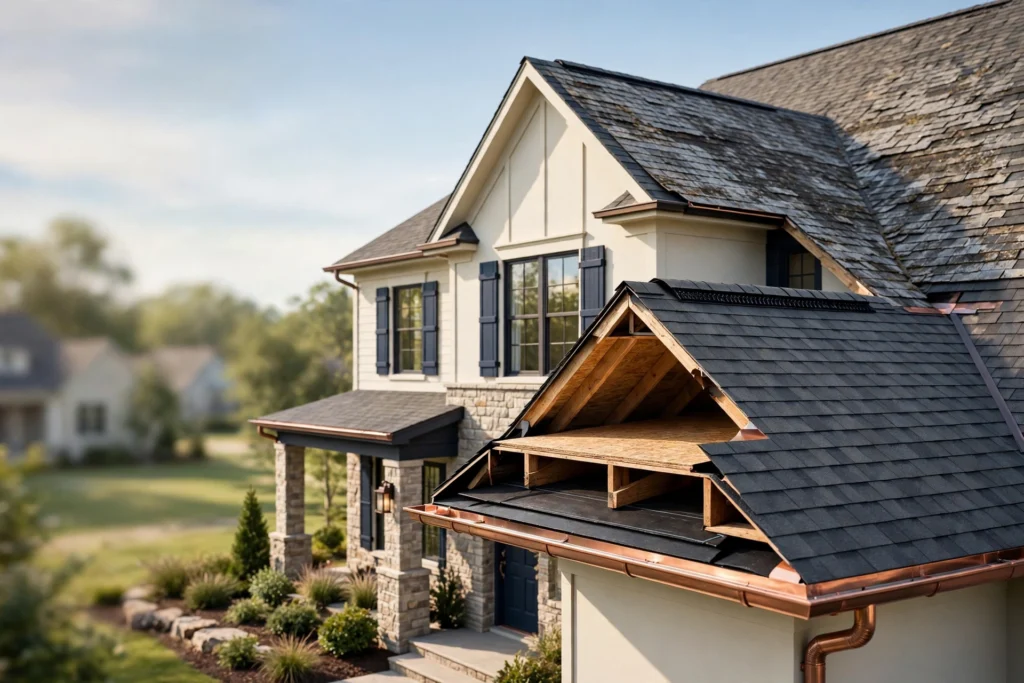
Updated October 2026. If you notice a ceiling stain after a storm, a few shingles in the yard, or a damp spot in the attic, the first question is usually the same: how expensive is this going to be? The answer depends less on the visible symptom than on what is happening underneath it.
For 2026, a useful national planning range for many roof repairs is roughly $150 to $3,000, while repairs involving widespread water or structural damage can run $3,000 to $6,000+. Angi’s August 2026 national roof-repair data puts many projects around $395 to $1,967, with an average near $1,174. Its October 2026 shingle-repair update places shingle work around $360 to $1,750, averaging about $960. HomeGuide groups minor repairs around $150–$1,000 and moderate repairs around $1,000–$3,000.
Those numbers describe different scopes, so do not use one national average as a quote. A $250 flashing repair, a $900 shingle repair, and a $4,500 leak with damaged decking can all be correctly described as “roof repair.” Roof pitch, access, material, location, emergency timing, and hidden damage can move the number quickly. If repairs keep recurring and you want to compare them with a full replacement, the Roof Replacement Cost Calculator gives a planning range for the whole roof.
2026 roof repair cost at a glance
| Repair | 2026 planning range | What usually changes the price |
|---|---|---|
| Minor leak | $150–$1,000 | Leak location, access, whether decking stayed dry |
| Asphalt shingle repair | $360–$1,750 typical overall range | Number of shingles, pitch, matching material, underlayment damage |
| Replace a few missing shingles | $100–$300 | Minimum service charge, roof height, shingle match |
| Flashing repair | $200–$500 minor; $500–$1,500+ replacement | Chimney, skylight, valley, wall intersection, surrounding shingles |
| Vent boot repair | $75–$150 | Access and whether surrounding roofing is damaged |
| Moderate leak / water damage | $1,000–$3,000 | Underlayment, decking, insulation, multiple repair areas |
| Soffit / fascia repair | $500–$2,600+ | Rot extent, gutter removal, hidden framing damage |
| Sagging roof repair | $1,000–$5,000+ | Decking, rafters, trusses, moisture history |
| Major leak / structural damage | $3,000–$6,000+ | Framing, interior repairs, mold or insulation damage, large tear-off area |
These are U.S. planning ranges compiled from current 2026 cost guides. Your local labor market, roof geometry, material, and the condition of the decking can materially change the final quote.
Why a “small leak” can have a very different price
Two homeowners can both say, “My roof is leaking,” and receive completely different estimates. One leak may come from a failed vent boot that is easy to reach. Another may have traveled under shingles, soaked underlayment, and damaged roof decking before showing up on the ceiling.
That is why the visible stain is not a reliable way to estimate the repair by itself. A good roofer should identify where water is entering, whether the surrounding materials are still sound, and whether the repair is localized or part of a broader roof problem.
Common roof repairs and what drives the bill
Missing or damaged shingles
Replacing a handful of asphalt shingles is usually one of the least expensive professional repairs. HomeGuide currently lists roughly $100–$300 for replacing up to about 25 shingles. The price rises when matching shingles are difficult to source, the roof is steep, or the damage covers a larger area.
Flashing problems
Flashing protects vulnerable transitions around chimneys, walls, skylights, and roof valleys. Repairs commonly fall around $200–$500. If the flashing failure has already allowed water into the decking or wall assembly, the real repair can extend beyond the metal itself.
Roof leaks
HomeGuide places minor leak repairs around $150–$1,000, while leaks with water damage can reach $1,000–$6,000+. Angi uses a somewhat different range for roof-leak repairs, which is a good reminder that “leak repair” can mean anything from sealing a small penetration to rebuilding damaged roof layers.
Soffit, fascia, and edge damage
Damage at the roof edge is easy to underestimate because rot can spread behind what you can see from the ground. Current HomeGuide data puts soffit and fascia repairs around $500–$2,600+, depending on how much material needs to come out and whether moisture has affected adjacent framing.
Sagging or structural issues
A sagging roof is not in the same category as a few missing shingles. It can point to decking, framing, or long-term moisture problems. HomeGuide lists roughly $1,000–$5,000 for sagging-roof repair, but structural work can go beyond that range. This is a professional-inspection situation, not a cosmetic patch.
The five factors that change roof repair cost the most
- How far the damage extends: surface damage is cheaper than wet decking, insulation, or framing.
- Roof pitch and access: steep, tall, or hard-to-reach roofs require more labor and safety setup.
- Roofing material: asphalt is generally cheaper to repair than slate, tile, or many metal systems.
- Complexity: valleys, skylights, chimneys, multiple roof planes, and transitions add labor.
- Timing: emergency work after storms can cost more than a scheduled repair.
Roof repair cost by material
The roofing material changes both labor and replacement-material cost. Asphalt shingles are usually the easiest residential material to repair and match. Metal, tile, wood shake, and slate often require more specialized labor, careful handling, and harder-to-source matching materials.
| Roof material | Repair-cost tendency | Why |
|---|---|---|
| Asphalt shingles | Usually lowest | Common material, easier patching, broad contractor availability |
| Metal roofing | Moderate to high | Panel details, fasteners, seams, coatings, matching finish |
| Tile | Moderate to high | Breakage risk, underlayment access, tile matching |
| Wood shake | Moderate to high | Material matching, flashing details, localized rot |
| Slate | Often highest | Specialized labor, fragile material, difficult matching |
HomeGuide’s 2026 leak data shows metal-roof leak repairs commonly costing more per square foot than basic asphalt work, while slate repair can be higher still. The important lesson is to compare quotes from contractors who regularly work with your specific roofing material rather than assuming every roofer prices and repairs every system the same way.
Three realistic 2026 roof-repair budgets
Scenario 1: Small wind-damage repair
A storm removes several asphalt shingles on an accessible one-story roof. The underlayment is intact, no water reached the decking, and matching shingles are available. A project like this may stay in the low hundreds, though minimum service charges can keep even a tiny repair from being inexpensive.
Scenario 2: Flashing leak with localized decking damage
A chimney flashing failure allows water under the shingles. The roofer removes the surrounding roofing, replaces part of the flashing and underlayment, repairs a small section of decking, then reinstalls matching shingles. This type of job can move into the high hundreds or low thousands because the visible flashing problem is only part of the work.
Scenario 3: Long-running leak with interior damage
A leak has been active long enough to wet decking, insulation, and part of the ceiling. The roof repair itself may require several thousand dollars, and the homeowner may also face attic insulation replacement, drywall, paint, or moisture-remediation costs. This is why catching a leak early can matter more financially than negotiating a small difference in contractor hourly rates.
Hidden costs that often appear after the roof is opened
- Decking replacement: soft or delaminated sheathing may not be visible until shingles and underlayment are removed.
- Underlayment: a repair that reaches below the shingles may require a larger waterproofing section than expected.
- Interior drying and repair: wet insulation, ceiling drywall, trim, or paint can sit outside the roofing contract.
- Matching material: discontinued shingles, tile, or metal finishes can increase labor or force a broader repair area.
- Emergency service: after-hours tarping or storm response can carry a premium.
- Permit or inspection: requirements vary by jurisdiction and scope.
- Gutter or edge work: fascia, soffit, drip edge, or gutter removal may be necessary to reach damaged material; if the gutters are worn out anyway, compare the cost of new gutter installation before reinstalling them.
Repair or replace? A practical homeowner test
If the problem is isolated, the rest of the roof is in good condition, and matching materials are available, repair is often the sensible first move. Replacement deserves a closer look when leaks are recurring, damage is spread across multiple areas, the roof is near the end of its expected service life, or the repair estimate is becoming a meaningful share of the cost of a new roof.
| Repair usually deserves priority when… | Replacement deserves a serious quote when… |
|---|---|
| Damage is limited to one small area | Leaks are appearing in several unrelated areas |
| Decking and structure are mostly sound | Decking deterioration is widespread |
| The roof still has substantial service life | The roof is near the end of its expected service life |
| Matching material is readily available | Matching material is discontinued or badly weathered |
| The repair is a small share of replacement cost | Major repairs are becoming frequent or expensive |
| The failure has a clear localized cause | The roof shows broad installation or material failure |
Do not use roof age alone as the decision rule. A relatively old roof with one clean flashing defect can still be a good repair candidate, while a younger roof with widespread storm damage, poor installation, or repeated leaks may justify replacement sooner.
For a full replacement budget, use our 2026 roof replacement cost guide. If material choice becomes part of the decision, compare asphalt, metal, tile, and other options in our roofing material guide. Comparing the repair quote with a realistic replacement number is much more useful than deciding from roof age alone.
Will homeowners insurance pay for the repair?
Insurance treatment depends on the cause of loss and the policy. Sudden covered events such as wind or hail may be handled differently from long-term wear, neglected maintenance, or an old roof that simply reached the end of its life. Before approving a large storm-related repair, photograph visible damage from a safe location, keep the contractor’s written diagnosis, and review your deductible and claim requirements.
Do not delay emergency steps that are necessary to prevent further water damage simply to wait for an adjuster. At the same time, avoid authorizing a full replacement from a door-to-door storm contractor before you understand the documented damage, your policy, and the contractor’s credentials.
A homeowner scenario
Suppose a windstorm lifts several shingles above a bedroom. If the underlayment and decking stayed dry, the job may remain a localized repair. But if rain entered for several days before the problem was noticed, the contractor may need to remove more roofing, replace damaged decking, and address interior moisture. The symptom can look nearly identical from inside the house; the scope is what changes the price.
This is also why photos of the damaged area, attic staining, and the contractor’s proposed repair area are useful when comparing quotes. You want to know whether two roofers are pricing the same scope—not simply which total is lower.
Before you call a roofer: a safe homeowner checklist
- Photograph ceiling stains, attic moisture, and exterior damage from the ground or another safe location.
- Write down when the leak appears: only during wind-driven rain, every rain, snowmelt, or continuously.
- Note whether the stain is growing and whether nearby electrical fixtures are wet.
- Move furniture and valuables away from active interior drips.
- Use a container to catch water where this can be done safely.
- Do not enter an attic area where footing is uncertain, structural damage is visible, or electrical hazards are present.
- Do not climb onto a wet, icy, storm-damaged, steep, or unfamiliar roof to locate the leak.
If water is reaching a light fixture, outlet, panel, or other energized equipment, treat that as an electrical safety issue as well as a roof problem. Do not touch wet electrical equipment. Use a safe shutoff only if you can do so from a dry, secure location; otherwise contact the appropriate emergency or electrical professional.
How to compare roof-repair quotes
| Quote item | What to verify |
|---|---|
| Diagnosis | Exact failure point and evidence supporting it |
| Repair area | Approximate square footage or specific roof section |
| Materials | Shingles, flashing, underlayment, decking, sealants, fasteners |
| Hidden damage | Unit prices or approval process for unexpected decking/framing work |
| Interior work | Whether drywall, insulation, paint, or drying is included or excluded |
| Cleanup | Debris removal, nails, magnetic sweep, protection of landscaping |
| Warranty | Workmanship term and what exactly is covered |
| Timing | Temporary weather protection and permanent repair schedule |
For larger projects, use the same contractor-vetting discipline described in our guide to hiring a home contractor. A low total is not automatically the better bid if it excludes decking, flashing, cleanup, permits, or restoration that another contractor included.
What to ask before approving a roof repair
- What exactly failed, and how did you confirm the source?
- Will you remove roofing to inspect the decking where necessary?
- Is underlayment or decking included in this quote?
- How will the new material match the existing roof?
- What happens if hidden damage is found?
- What unit price or approval process applies to extra decking or framing?
- Are cleanup, disposal, and temporary weather protection included?
- What workmanship warranty applies to the repair?
- Does this repair affect any existing manufacturer warranty?
- If you recommend replacement instead, what specific conditions make repair uneconomical?
If you are already budgeting for multiple home projects, our annual home maintenance cost guide can help you think about roof repairs as part of a broader reserve instead of a one-off surprise.
When not to climb onto the roof yourself
A roof may look walkable from the ground and still be unsafe because of pitch, moisture, loose shingles, weak decking, wind, or hidden storm damage. Roofing work carries serious fall risk; OSHA’s residential roofing guidance treats fall protection as critical and notes that adverse weather such as high winds, rain, snow, or sleet can create hazardous conditions.
Do not climb onto a roof that is wet, icy, mossy, storm-damaged, steep, unfamiliar, or close to overhead power lines. If the repair requires tracing a leak around penetrations, walking near an edge, lifting roofing, or working on questionable decking, professional inspection is the safer route.
From the ground, binoculars or a camera zoom can help document missing shingles, lifted flashing, damaged ridge caps, or debris impact without creating a fall hazard. From inside, you may be able to photograph attic staining from a stable walkway, but do not step between ceiling joists or onto wet or damaged materials.
What to do during an active leak
- Protect people first; keep children and pets away from wet ceilings or bulging drywall.
- Move valuables and furniture away from the drip.
- Catch water with containers if this can be done safely.
- Photograph the damage for the contractor and, when relevant, insurance documentation.
- Call a qualified roofer for temporary weather protection and permanent repair.
- Do not improvise a roof tarp from a ladder or wet roof during bad weather.
A temporary tarp can reduce further water entry after storm damage, but it is not a permanent repair. If tarping requires roof access, height exposure, or unstable footing, have a qualified professional do it.
A five-step roof-repair plan
- Document the symptom safely. Photograph interior stains, active drips, and visible exterior damage from the ground. Note when the problem appears and whether it followed wind, hail, or heavy rain.
- Stop further interior damage. Move belongings, catch active drips where safe, and keep people away from wet ceilings or electrical fixtures. Do not climb onto the roof during bad weather.
- Get the failure diagnosed. Ask the roofer to identify the actual entry point, not only the ceiling stain. Request photos of damaged shingles, flashing, underlayment, or decking when practical.
- Compare scope before price. Put two or three written quotes side by side. Check repair area, materials, decking allowances, cleanup, warranty, and what happens if hidden damage appears.
- Choose repair or replacement using the whole roof. A localized failure on an otherwise sound roof usually favors repair. Repeated leaks, widespread deterioration, or major repair costs on an aging roof justify a replacement quote.
Roof-repair quote worksheet
Before choosing a contractor, write these items for each estimate so you are comparing the same job:
- Diagnosed failure:
- Repair area or approximate square footage:
- Roofing material and matching method:
- Flashing included:
- Underlayment included:
- Decking allowance and price for additional sheets:
- Interior drying or repairs included/excluded:
- Permit or inspection included:
- Cleanup and disposal included:
- Workmanship warranty:
- Total price:
- Possible change-order items:
After the repair: verify the job before closing it out
- Ask for photos of the repaired area if it is not safely visible from the ground.
- Confirm that replaced flashing, underlayment, or decking matches the written scope.
- Check that debris and loose fasteners were removed from the property.
- Keep the invoice, warranty, photos, and material information with your home records.
- After the next meaningful rain, check the previous interior leak area for fresh moisture or staining.
- If the leak involved attic insulation or interior finishes, confirm those materials are dry before cosmetic repairs hide the area.
Roof repair cost FAQs
How much does a typical roof repair cost in 2026?
Many roof repairs fall between a few hundred dollars and about $2,000, while minor repairs can be lower and structural or long-running leak damage can cost several thousand dollars. The repair type and hidden damage matter more than the visible stain.
Is a roof leak always expensive to repair?
No. A small flashing, vent-boot, or shingle problem caught early may stay relatively inexpensive. The bill rises when water reaches underlayment, decking, insulation, framing, or interior finishes.
Should I repair a 20-year-old roof?
Age is only one factor. A localized defect may still be worth repairing if the rest of the roof is sound. If leaks are recurring, materials are brittle, or several areas are failing, compare the repair with a full replacement quote.
Can I wait to repair a small roof leak?
Delaying is risky because water can travel away from the entry point and damage materials that are not visible from the room below. Even when permanent repair cannot happen immediately, arrange an inspection and safe temporary weather protection.
How many roof-repair quotes should I get?
For a larger non-emergency repair, two or three detailed written quotes are useful. Compare the diagnosed failure and scope, not just the total price.
Bottom line
For 2026, many U.S. homeowners can use $150–$3,000 as a realistic starting range for minor-to-moderate roof repairs, while major water or structural damage can reach $3,000–$6,000+. The most important question is not simply “How much does roof repair cost?” but “How far has the damage actually traveled?”
A good estimate should make that scope clear. If one quote is dramatically lower than another, compare what each contractor is actually replacing before assuming you found the bargain.
Home Cost Desk compares current U.S. cost or technical references and checks safety, code, efficiency, incentive, or regulatory claims against authoritative sources when available. National figures are planning ranges, not local quotes.
Editorial review: Home Cost Desk Editorial Team · Read our research methodology · Detailed sources appear below.
Sources
- Angi — Roof Repair Cost, updated August 3, 2026
- Angi — Roof Shingle Repair Cost, updated October 1, 2026
- Angi — Roof Leak Repair Cost, updated August 3, 2026
- HomeGuide — Roof Repair Cost, 2026
- HomeGuide — Roof Leak Repair Cost, updated February 9, 2026
- OSHA — Fall Protection in Residential Construction