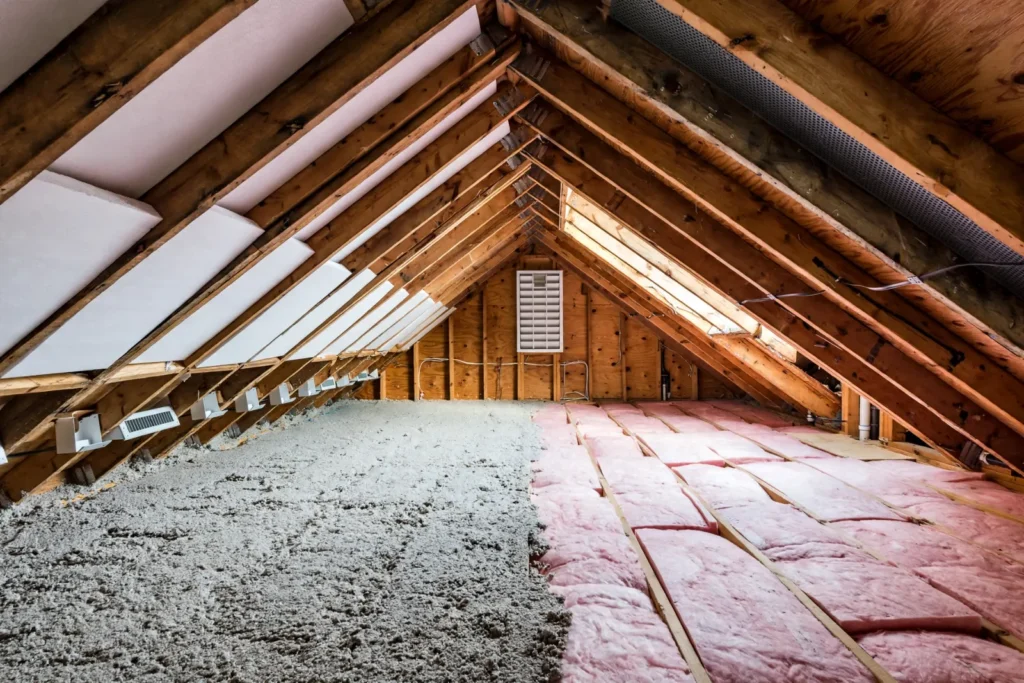
For U.S. homeowners budgeting in 2026, attic insulation typically costs about $1 to $4 per square foot installed, with many projects landing around $1,000 to $2,700. A simple top-up over clean existing insulation can cost less, while full removal, air sealing, pest or moisture cleanup, difficult access, or spray foam at the roof deck can push the project several thousand dollars higher. A blower-door test can help identify air leaks before adding insulation; see our home energy audit cost guide. If you intend to make the attic into a habitable bedroom rather than simply insulate storage space, compare the separate structural, stair and egress expenses in our attic conversion cost guide.
These are national planning ranges, not contractor quotes. Climate zone, target R-value, attic size, existing insulation, ventilation, air leakage, access, and local labor all affect the real price.
Attic insulation cost at a glance
| Scope | 2026 planning range |
|---|---|
| Typical attic insulation installed | $1–$4 per sq. ft. |
| Average attic project | $1,000–$2,700 |
| Blown-in insulation | About $0.90–$2.40 per sq. ft. |
| Batt and roll | About $0.80–$2.60 per sq. ft. |
| Spray foam | About $1.50–$5.00 per sq. ft. |
| Old insulation removal | About $1–$2 per sq. ft. |
| Air sealing | Roughly $350–$3,000 |
HomeGuide’s January 2026 data places a typical attic project at $1,000 to $2,700, or $1 to $4 per square foot, with a national average near $1,800. Angi’s July 2026 attic-specific data reports a common professional range of roughly $1,700 to $2,500. The difference is normal: datasets use different project mixes, locations, attic sizes, materials, R-values, and scopes.
Cost by insulation type
Blown-in fiberglass or cellulose
Blown-in insulation is common in vented attics because it fills irregular spaces and can be added over suitable existing insulation. HomeGuide reports roughly $0.90 to $2.40 per square foot for attic installations, or about $900 to $3,600 for many projects. Cost rises with higher R-values, fixture dams, air sealing, and difficult access.
Fiberglass batts and rolls
Batts work best where framing bays are regular and accessible. Installed pricing commonly runs about $0.80 to $2.60 per square foot, with typical projects around $1,100 to $3,900. Gaps, compression, and poor fitting reduce performance, so low material cost does not excuse sloppy installation.
Spray foam
Spray foam is usually the premium option. HomeGuide reports roughly $1.50 to $5 per square foot, with roof-deck projects often costing more than attic-floor work. Foam can be useful in specific assemblies, but it changes how air and moisture move through the building. The roof assembly, ventilation strategy, combustion appliances, and local code requirements should be evaluated before converting a vented attic to an unvented or conditioned space.
R-value matters more than inches alone
R-value measures resistance to heat flow. Different insulation materials deliver different R-values per inch, so comparing bids only by thickness can be misleading.
The U.S. Department of Energy’s guidance based on the 2021 International Energy Conservation Code shows ceiling values ranging from R-30 in Climate Zone 1 to R-49 in Zones 2 and 3 and R-60 in Zones 4 through 8 for an uninsulated attic. Those are code-reference values, not a universal prescription for every existing home. Local codes and the existing assembly control what is required.
Air sealing should usually come before adding insulation
Insulation slows conductive heat flow, but it does not automatically stop air leakage. Gaps around plumbing penetrations, wiring, top plates, chases, attic hatches, and other openings can allow conditioned air to escape into the attic.
That is why a strong quote should address air sealing before simply blowing more material on top. HomeGuide estimates attic air sealing at roughly $350 to $3,000 depending on leakage, penetrations, ductwork, and access. Some insulation contractors include basic sealing; others price it separately. If air sealing is the main project rather than an add-on to insulation, use our dedicated Attic Air Sealing Cost 2026 guide so you can compare sealing scope separately from insulation replacement.
Attic insulation replacement cost
When old insulation has to be removed and replaced rather than simply topped up, the project becomes materially more expensive. Removal alone commonly runs about $1–$2 per square foot, while HomeGuide puts full removal and replacement at roughly $2–$6 per square foot, including removal, before major contamination, structural repair or specialist remediation. Ask for removal, disposal, air sealing and new insulation as separate line items so the replacement estimate is easy to audit.
When old insulation should be removed
Existing insulation does not always need to come out. If it is dry, uncontaminated, correctly installed, and compatible with the new system, adding insulation may be reasonable. Removal becomes more likely when insulation is wet, mold-affected, heavily contaminated by rodents, fire-damaged, compacted beyond usefulness, or conceals areas that need repair and air sealing.
Mold, asbestos, extensive pest contamination, or structural damage can increase the bill substantially and may require specialist remediation.
What drives the final price?
- Attic area: more square footage means more material and labor.
- Target R-value: colder climate zones or poorly insulated homes may need more material.
- Existing insulation: topping up clean insulation is cheaper than removal and replacement.
- Access: tight hatches, low roof slopes, obstructions, and limited walking space slow crews.
- Air sealing: numerous penetrations and chases add prep time.
- Ventilation: soffit and ridge ventilation may need baffles or correction so insulation does not block airflow.
- Electrical and mechanical conditions: recessed lights, knob-and-tube wiring, flues, ducts, and equipment can require special clearances or repairs.
- Moisture or pests: insulation should not be used to hide an unresolved leak or infestation.
Practical homeowner scenarios
1,000-square-foot attic needing a straightforward top-up
If the attic is dry, accessible, already air-sealed reasonably well, and the existing insulation can remain, a blown-in top-up may fall around the lower-to-middle part of the national range. HomeGuide’s 2026 table puts a 1,000-square-foot attic broadly around $1,000 to $4,000 depending on material and scope.
Older attic needing removal and air sealing
A homeowner may start with a $2,000 insulation expectation and discover that contaminated material must be removed, penetrations sealed, and ventilation corrected first. In that case, the finished project can easily move into the mid-four figures or higher.
Attic with HVAC equipment and ducts
Where ducts or air-handling equipment sit in a hot or cold vented attic, a contractor may discuss roof-deck insulation or attic encapsulation. This is a larger building-envelope decision, not simply a thicker layer of insulation, and should be evaluated as a system.
DIY vs. professional attic insulation
DIY batt installation or a small blown-in top-up can save labor when the attic is open, safe, dry, and straightforward. Homeowners should be cautious around electrical wiring, recessed fixtures, chimneys and flues, fragile ceilings, and areas with suspected asbestos, mold, animal waste, or lead-related debris.
Professional installation is usually the better choice when old insulation needs removal, air sealing is extensive, spray foam is proposed, access is difficult, the attic contains combustion equipment, moisture problems exist, or the assembly is being converted from vented to unvented.
Federal tax credit: important 2026 change
Do not assume a new 2026 insulation project still qualifies for the former federal Energy Efficient Home Improvement Credit. The IRS states that the credit cannot be claimed for property placed in service after December 31, 2025. The prior credit had covered qualifying insulation and air-sealing materials through 2025, but federal law accelerated its termination.
State, local, and utility rebates can be different and may still exist. Check your utility and state energy office using your actual address and installation date before budgeting an incentive.
Permits and code
A basic attic insulation top-up may not require a permit in some jurisdictions, but rules vary. Spray foam at the roof deck, ventilation changes, electrical work, structural repairs, or conversion to a conditioned attic can trigger code and inspection requirements. Ask the local building department rather than relying on a national rule.
How to compare insulation quotes
For a meaningful comparison, ask each contractor to specify the same scope. A useful written proposal should identify the measured attic area, existing insulation condition, material, installed R-value, depth or density, air-sealing work, baffles and ventilation protection, treatment around fixtures and flues, removal and disposal, attic hatch treatment, cleanup, and warranty.
A lower quote that only adds loose-fill insulation may not be equivalent to a higher quote that includes removal, air sealing, ventilation corrections, and a verified final R-value.
Hidden costs to budget for
- old insulation removal and disposal;
- rodent cleanup or pest exclusion;
- mold or moisture remediation;
- roof leak repairs;
- air sealing;
- ventilation baffles;
- attic hatch insulation and weatherstripping;
- electrical corrections or fixture protection;
- duct sealing or repair;
- specialist testing when hazardous materials are suspected.
Related Home Cost Desk guides
Insulation is only one part of home energy performance. If your heating and cooling equipment is aging, compare the numbers in our Heat Pump Cost in 2026 and Mini Split Cost in 2026 guides. If roof leaks have damaged attic insulation, see our Roof Repair Cost in 2026 guide before covering the problem with new material. For a cold-climate example of how R-value targets, air sealing and ice-dam prevention shape a local scope, see our Minneapolis attic insulation cost guide.
Five-step attic insulation plan
- Inspect the attic before choosing material. Look for roof leaks, staining, pests, compressed or contaminated insulation, blocked vents, unsafe wiring conditions, and signs of moisture.
- Set the target performance. Ask the contractor to document the climate-zone basis, existing R-value, proposed final R-value, and how depth or density will be verified.
- Air-seal before adding insulation. Price penetrations, attic hatch sealing, chases, top plates, and other leakage points separately so new insulation does not simply hide them.
- Compare identical scopes. Make each quote state material, square footage, removal, disposal, air sealing, baffles, fixture and flue treatment, attic-hatch work, and cleanup.
- Verify the finished job. Confirm ventilation remains open where required, insulation coverage is even, the attic hatch is treated, and no unsafe material contact or buried service problem has been created.
What to prepare before getting quotes
- Measure the approximate attic floor area if it is safe and practical to do so.
- Photograph existing insulation, obvious gaps, water staining, ductwork, and the attic hatch.
- Tell contractors about roof leaks, pest history, mold concerns, old recessed fixtures, or older wiring.
- Ask whether removal and air sealing are included or optional.
- If spray foam is proposed, ask how the roof assembly, attic ventilation strategy, combustion appliances, and future roof repairs are affected.
- Check state, utility, and local rebate programs separately; do not assume the expired federal 25C credit applies to a 2026 installation.
What to verify after installation
- The promised insulation type and installed R-value are documented.
- Coverage is even, with no obvious bare areas or compressed sections.
- Soffit or other required ventilation paths remain open and protected by baffles where needed.
- Clearances around flues, heat-producing fixtures, and other restricted areas follow the approved installation method.
- The attic hatch is insulated and weatherstripped if included in the scope.
- Old material and job debris are removed as promised.
- You receive product information, warranty terms, and any permit or inspection documentation required locally.
Frequently asked questions
How much does attic insulation cost in 2026?
A practical national range is about $1 to $4 per square foot installed. HomeGuide reports many projects around $1,000 to $2,700, while Angi’s attic-specific 2026 data places many professional jobs around $1,700 to $2,500.
Is blown-in insulation cheaper than spray foam?
Usually. Blown-in fiberglass or cellulose is commonly one of the lower-cost attic options. Spray foam is a premium system and can cost substantially more, especially when applied at the roof deck.
Should old attic insulation always be removed?
No. Dry, uncontaminated, compatible insulation can sometimes remain and be topped up. Removal is more likely when material is wet, pest-contaminated, mold-affected, fire-damaged, or obstructs needed repairs and air sealing.
Should air sealing be done before insulation?
In many attics, yes. Air sealing addresses leakage paths that insulation alone does not stop, so it is often most effective before loose-fill or batt material covers the penetrations.
Bottom line
A realistic 2026 starting budget for attic insulation is about $1 to $4 per square foot, or roughly $1,000 to $2,700 for many standard installations. But the best value is not necessarily the lowest price per square foot. Air leakage, moisture, ventilation, electrical safety, existing insulation, and the correct R-value all affect whether the finished attic actually performs well.
Use national figures for planning, then compare detailed local quotes with the same scope. And for 2026 projects, do not budget the expired federal 25C home-improvement credit as a guaranteed offset.
Home Cost Desk compares current U.S. cost or technical references and checks safety, code, efficiency, incentive, or regulatory claims against authoritative sources when available. National figures are planning ranges, not local quotes.
Editorial review: Home Cost Desk Editorial Team · Read our research methodology · Detailed sources appear below.
Sources and methodology
Pricing ranges were cross-checked against current 2026 consumer cost datasets from HomeGuide and Angi. R-value and climate-zone guidance was checked against the U.S. Department of Energy. Federal incentive status was checked against current IRS guidance, which confirms the Energy Efficient Home Improvement Credit ended for property placed in service after December 31, 2025.