2026 cost snapshot
| Item | Planning range / amount | Basis |
|---|---|---|
| Typical Atlanta tree removal | $200–$2,002 | Angi local 2026 range |
| Atlanta average | About $751 | Angi local 2026 average |
| Small/simple removal | From about $150 | Local low-end example |
| Very large/high-risk tree | Can reach $10,010 | Local high-end example |
| Atlanta stump removal average | About $329 | Angi local 2026 data |
How to read these local figures: Angi’s Atlanta tree removal figures cited here are modeled estimates. Angi derives them from national project-cost data adjusted with U.S. Bureau of Economic Analysis regional price parities; they are not a survey of verified contractor quotes in Atlanta. Use them for planning, and base your actual budget on itemized local bids.
Quick answer
Atlanta tree removal in 2026 averages about $751, with many ordinary projects falling between roughly $200 and $2,002. Small, accessible trees may cost only a few hundred dollars, while very large trees, crane-assisted removals, storm-damaged trees, trees near buildings or power lines, and multi-day rigging jobs can reach several thousand dollars and in extreme cases approach $10,000.
Atlanta is not a city where homeowners should treat removal as a simple ‘cut it down’ job. The City of Atlanta protects trees on private property through its Arborist Division and a Tree Protection Ordinance that was substantially updated for 2026. Permit status, tree condition, location, species, lot constraints, replacement obligations, and professional qualifications can affect the project before the first cut is made.
2026 Atlanta tree-removal cost snapshot
Current Atlanta-specific cost data places the average around $751 and the common range around $200 to $2,002. Height remains one of the clearest pricing variables: smaller trees can often be removed with a compact crew and basic rigging, while 60- to 80-foot trees can require more labor, sectional dismantling, larger equipment, and additional protection for structures below.
The local market also has a lot of tight residential sites. A mature oak in an open backyard is different from the same tree leaning over a roof, driveway, fence, service drop, or neighboring property. Limited drop zones force the crew to lower branches in controlled pieces, which adds time and equipment.
Atlanta’s 2026 Tree Protection Ordinance matters
Check whether a city tree-replacement payment or planting obligation applies in addition to the contractor’s fee. Ask the Arborist Division to confirm the current rules for your tree and permit pathway before finalizing a budget.
Atlanta permit check before booking a removal date
- Confirm the property is inside Atlanta city limits rather than an adjacent jurisdiction.
- Record the tree’s location, condition and reason for removal; photograph visible defects without entering an unsafe area.
- Use the city’s Arborist Division guidance to determine whether the application is tied to building work or a dead, dying, diseased or hazardous-tree review.
- Ask which inspections, notices, approvals and replacement obligations apply, then obtain the required authorization before routine cutting begins.
Do not assume a tree declared dangerous by a contractor is automatically exempt. For an immediate threat, keep people clear and contact the city or emergency services as appropriate rather than improvising a removal.
The City of Atlanta’s updated Tree Protection Ordinance took effect January 1, 2026. The Arborist Division states that it protects the city’s tree canopy on private property and handles permitting for tree removal either through a building permit or through processes for dead, dying, diseased, or hazardous trees.
That means a homeowner should verify permit status before scheduling removal. Do not rely on a contractor saying that a tree ‘looks dead enough’ to remove without approval. The city may require documentation, inspection, posting, or another process depending on why the tree is being removed and whether other construction is involved.
The Office of Buildings also states that tree professionals involved with city tree-related submissions must meet current registration requirements. For a homeowner, the practical takeaway is simple: use a reputable tree service that understands Atlanta’s 2026 permitting workflow rather than assuming city rules are the same as nearby unincorporated areas.
Height, trunk diameter, species and wood density
Tree height changes access, rigging, labor, and equipment needs. Atlanta’s mature oaks and hickories can be large and dense, so they may take longer to dismantle and generate heavier debris than smaller ornamental trees. Tall pines may have different rigging challenges even though their wood is softer.
Diameter matters because a thick trunk takes longer to cut and produces heavier rounds that may need mechanical handling. A tree with broad lateral limbs can also be more expensive than a narrow tree of the same height because the crew must manage more canopy over a wider area.
When cranes change the budget
A crane can make a difficult removal safer and faster when a tree is too large to fell conventionally, has a weak structure, or stands over a roof or other high-value target. Crane work increases mobilization cost and often requires more planning, traffic coordination, or access clearance.
Do not assume that a crane automatically means an inflated quote. On some high-risk removals, crane access can reduce manual rigging time and improve control. Ask the contractor why the crane is needed, how long it will be on site, and whether the quoted amount includes the crane operator and any street or parking coordination.
Stump grinding, debris and wood handling
Tree removal and stump removal are usually separate scopes. Atlanta-specific stump-removal data averages about $329 for many standard projects, though root spread, stump diameter, soil conditions, access, and the chosen method can move the price.
Ask what happens to logs, chips, and branches. Angi’s Atlanta debris data shows that disposal can be a separate charge. Some homeowners keep chips for mulch or logs for firewood, but the contract should state who is responsible for final cleanup and whether the crew will rake the work area, remove sawdust, and backfill the stump hole.
For national context on the base project, compare the local quote with the Home Cost Desk Tree Removal Cost 2026 guide.
Trees near power lines
Trees touching or close to energized conductors require special caution. A general landscaping crew should not improvise around power lines. Depending on ownership and location, utility coordination or a line-clearance-qualified contractor may be necessary.
If branches are near the service drop to the house, ask who will coordinate any temporary disconnection and reconnection. The tree contractor should not treat electrical clearance as a minor add-on without a plan.
Three Atlanta project scenarios
Scenario 1 — small accessible tree: a modest tree in an open front yard with no structures below can often be removed near the low end of the local range. Stump grinding and hauling may still be separate.
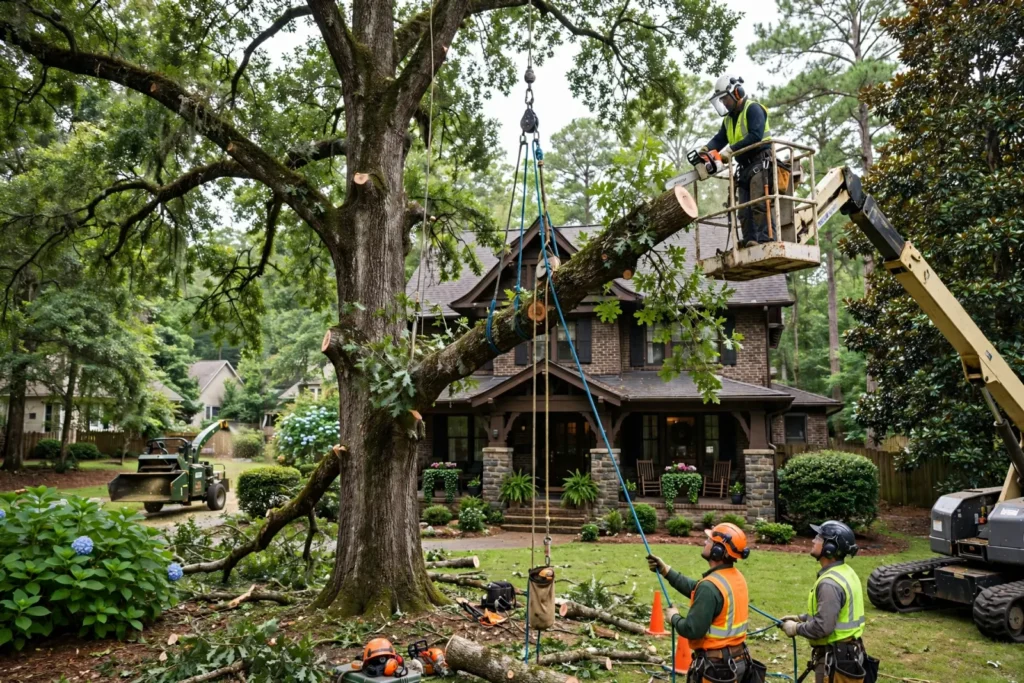
Scenario 2 — mature oak close to a house: the crew must climb or use a lift, rig heavy limbs, protect the roof and landscaping, and remove large wood in sections. The price can move into the thousands even when a crane is not required.
Scenario 3 — hazardous storm-damaged tree: a split trunk or hanging leader over a structure can require urgent stabilization, crane work, or extra crew. Emergency timing and risk can make the project far more expensive than a planned removal.
How to compare Atlanta tree-service quotes
Compare the total scope rather than the headline removal price. Ask each company to identify the tree, planned equipment, permit responsibility, stump treatment, debris hauling, site protection, and any excluded restoration in writing.
Written bid comparison worksheet
| Bid item | What to request from each contractor |
|---|---|
| Tree and method | Tree identification, access route, sectional rigging or felling, crane or lift included |
| City approval | Permit applicant, expected timing, and any separate planting or city-payment obligation |
| Site protection | Driveway mats, lawn and fence protection, utility coordination, traffic management |
| Cleanup | Brush and log hauling, stump grinding depth, chip disposal, backfill and grading |
| Exceptions | Emergency premium, unexpected decay, property restoration, and change-order approval |
Example: A lower bid that leaves the stump, logs and chips on site is not directly comparable with a higher bid covering removal, hauling and grading. Have both contractors quote the same scope before selecting one. For a broader bidding checklist, see how to hire a home contractor.
Five decisions before you authorize the crew
- Confirm jurisdiction and approval: Check the property address against City of Atlanta boundaries and ask who obtains the required tree permit; keep the approval with the job records.
- Confirm the work zone: Walk the site with the estimator and mark gates, utility lines, driveway access, fragile paving and any neighbor property that equipment might cross.
- Compare like-for-like bids: Ask each contractor to identify crane or lift use, hauling, stump grinding, site protection, permit handling and exclusions on the same worksheet.
- Verify the risk plan: For damaged or leaning trees, request the proposed method and a qualified assessment; keep people away from hanging limbs and never attempt work near energized lines.
- Close out the job: Check for remaining hanging branches, debris, ruts and stump chips; collect the final invoice, permit records and agreed restoration plan before final payment.
Require a written scope that identifies the specific tree, removal method, permit responsibility, stump work, debris handling, lawn or driveway protection, crane or lift charges, and what happens if concealed decay makes the job more difficult.
Ask for proof of insurance and confirm whether the company uses or works under qualified arborist oversight where required. A low quote is not attractive if the contractor expects the homeowner to absorb permit risk or property damage.
- Verify the City of Atlanta tree-removal path before work begins.
- Ask whether stump grinding is included and how deep the grinder will go.
- Confirm whether chips, logs and brush stay or leave.
- Identify fences, gates, septic components, irrigation and underground utilities before equipment enters the yard.
- Ask who is responsible for traffic, sidewalk or street occupancy if equipment cannot remain entirely on private property.
- Document pre-existing driveway, roof and landscape conditions.
When pruning is better than removal
A healthy tree should not be removed solely because one limb is inconvenient. Structural pruning, deadwood removal, cabling, soil improvement, or targeted clearance can sometimes address the risk while preserving shade and property value.
Conversely, severe trunk decay, root failure, major storm damage, irreparable lean, or a documented hazard may make removal the better choice. An arborist assessment is especially useful when the tree is large or protected and the homeowner is unsure whether removal is justified.
Permit timing, appeals and neighbor expectations
Atlanta’s tree rules can make timing more important than homeowners expect. Some removals are connected to arborist review, posting or an appeal process, and a contractor may not be able to begin simply because a deposit was paid. Build permit lead time into the schedule, especially when the tree is healthy but conflicts with planned construction rather than being an immediate hazard.
Talk with neighbors when equipment access, falling-zone control, shared driveways or boundary trees are involved. A permit may authorize work, but it does not eliminate practical property-line issues. Photograph the tree, fence, roof and adjacent surfaces before mobilization so there is a clear record of existing conditions.
What ‘hazardous tree’ should mean in a quote
The word hazardous should be supported by observable conditions, not used as a pricing shortcut. Significant trunk decay, root-plate movement, severe lean with target exposure, cracked unions, hanging storm limbs or documented disease can justify a more controlled removal method. A healthy tree that is simply large is not automatically hazardous.
Ask whether the contractor’s risk assessment changes the work plan. For example, a climber may be unable to tie into a decayed crown, which can make a lift or crane necessary. When the removal method follows from a stated structural concern, the added cost is easier to evaluate.
Crane access, ground protection and driveway loading
Large tree work can put substantial loads on driveways and lawns. Cranes, bucket trucks, loaders and log trucks need stable access and enough turning space. Ask where outriggers will sit, whether mats will be used, and whether underground irrigation, septic components or fragile pavement are in the equipment path.
Do not assume a contractor’s insurance automatically pays for every cracked driveway or landscape disturbance. The contract should state what protection is provided and what restoration is included. On a tight Atlanta lot, access planning can be as important as the cutting sequence.
After removal: replanting and site restoration
Tree removal can change shade, drainage, soil moisture and the visual balance of the property. The stump area may settle after grinding, and a large canopy loss can increase summer solar exposure on the house. If replanting is required by permit or desired for the landscape, include species selection and final location in the project plan rather than treating it as an afterthought.
Do not plant a replacement tree directly over a heavily compacted stump-grinding area without considering root conditions and remaining wood. A landscape professional or arborist can help choose a species and spacing that will not recreate the same conflict with the house, utilities or driveway.
Storm damage, emergency work and insurance documentation
If the falling tree damaged shingles, flashing or roof decking, treat tree extraction and roof repairs as separate scopes. Ask the tree crew to document where it will lift or cut limbs off the roof, then have a roofing professional assess water entry and structural damage. Our roof repair cost guide explains why emergency covering and permanent repairs may be billed separately.
Storm-related removal is priced differently from a planned removal because the crew may be responding after hours, working around damaged structures, or stabilizing a partially failed tree before normal dismantling can begin. If a tree has already struck the house, garage, fence, vehicle, or utility line, document the scene before cleanup when it is safe to do so. Photographs of the trunk, root plate, broken limbs, impact point, and surrounding damage can be useful for an insurance claim.
Homeowners should not assume that every tree-removal bill is covered by homeowners insurance. Coverage usually depends on why the tree fell, what it damaged, policy limits, and whether the work is considered emergency mitigation or routine landscape maintenance. Contact the insurer promptly and ask what documentation is required. If an adjuster has not yet inspected the property, emergency work should focus on making the site safe and preventing further damage while preserving reasonable evidence.
Tree companies should separate emergency stabilization, removal, hauling, crane use, roof-tarp assistance, and stump work on the invoice. A clear breakdown helps the homeowner understand what is claim-related and what is elective landscape work.
Arborist assessment before a high-cost removal
For a large, healthy-looking tree, an assessment by an ISA Certified Arborist or another appropriately qualified tree professional can be valuable before committing to removal. The goal is not to create an extra hurdle; it is to distinguish a correctable pruning or support problem from a true structural defect or disease.
A professional assessment can consider trunk defects, included bark, root damage, canopy dieback, fungal fruiting bodies, prior topping, soil changes, and the presence of targets such as bedrooms, streets, or play areas. The probability of failure and the consequence of failure both matter. A tree with a defect in an open area can represent less risk than a similar defect directly over a roof.
When contractors disagree sharply—one recommends pruning while another insists on immediate removal—an independent arborist opinion can be worth the fee, especially when the tree is valuable or the removal quote is several thousand dollars.
Multiple-tree jobs and replanting decisions
Removing several trees on the same property can reduce average cost per tree because equipment mobilization, crew travel, and disposal are shared. However, each tree still has its own risk and rigging requirements. Ask the contractor to show the individual tree prices and the multi-tree discount separately so a bundle price does not encourage unnecessary removal.
Tree removal can also change shade, drainage, soil moisture, and summer solar exposure on the house. If removal opens a west- or south-facing elevation to full sun, include replacement planting or another shading strategy in the long-term plan. Choose replacement species and locations that will not recreate conflicts with foundations, roofs, service lines, or driveways.
Bottom line
Atlanta tree removal in 2026 commonly costs around $200 to $2,002, averaging about $751, but mature hardwoods, confined lots, cranes, storm damage, utility conflicts, and stump/debris work can push the project much higher.
The city’s 2026 Tree Protection Ordinance is as important as the chainsaw work. Verify the permit path first, then compare qualified contractors on safety, rigging plan, insurance, cleanup, and total scope rather than choosing the lowest number.
Frequently asked questions
How much does tree removal cost in Atlanta in 2026?
Many projects fall between about $200 and $2,002, with a local average near $751. Large, hazardous, crane-assisted or structure-adjacent removals can cost several thousand dollars more.
Do I need a permit to remove a tree on private property in Atlanta?
Atlanta protects trees on private property through its Arborist Division and 2026 Tree Protection Ordinance. Permit or approval requirements depend on tree condition, project context and property circumstances, so verify before removal.
Is stump grinding included in tree removal?
Often it is not. Ask the contractor to price stump grinding separately and specify grinding depth, chip cleanup and whether surface roots are included.
Why are large Atlanta oaks expensive to remove?
They can be tall, wide and dense, producing heavy limbs and trunk sections. Tight urban lots often require controlled rigging instead of simple felling.
Should I remove a tree near a power line myself?
No. Trees near energized lines can be lethal. Use qualified professionals and coordinate with the utility when required.
What should I ask an Atlanta tree contractor?
Ask about permit responsibility, insurance, arborist qualifications, rigging or crane plan, stump work, debris handling, property protection and the final cleanup standard.
Does a tree-service quote include Atlanta city fees or replacement planting?
Not necessarily. Ask the contractor to distinguish cutting and cleanup charges from any city permit, tree-replacement payment, or planting requirement. Verify the current obligation for the specific property and tree with Atlanta’s Arborist Division; a tree outside city limits may be subject to different rules.
What if two Atlanta tree services recommend different removal methods?
Request each crew’s explanation of tree defects, available drop zones, nearby structures, power lines and equipment access. A crane is not automatically necessary for every tall tree, and climbing is not automatically safe for a compromised trunk. For a valuable tree or a large price difference, consider an independent arborist assessment before signing.
Sources
- Angi — Tree Removal Cost in Atlanta, GA [2026 Data]
- Angi — Tree Stump Removal Cost in Atlanta [2026 Data]
- Angi — Tree Debris Removal Cost in Atlanta [2026 Data]
- City of Atlanta — Arborist Division
- City of Atlanta — Tree Protection Ordinance Rewrite
- City of Atlanta — Office of Buildings / 2026 Tree Professional Requirements