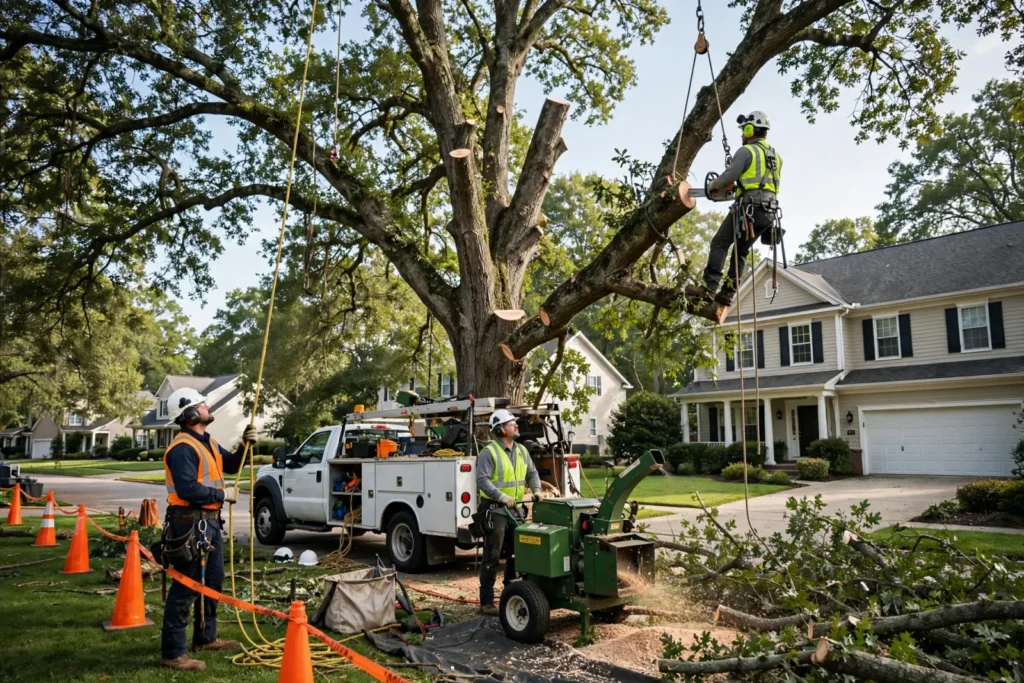
Quick answer: Professional tree removal costs about $400 to $1,200 on average in HomeGuide’s 2026 national data, with a national average around $850. Small, accessible trees can cost about $200 to $500, while large or complex removals can reach $2,000 to $3,000 or more. Angi’s 2026 height bands are similar: about $150 to $450 for trees up to 30 feet, $450 to $1,200 for 30- to 60-foot trees, $800 to $1,500 for 60- to 80-foot trees, and roughly $1,000 to $2,000 for trees over 80 feet before unusual crane, utility or emergency conditions.
2026 cost snapshot
| Tree size / item | 2026 planning range | Notes |
|---|---|---|
| Under 30 ft | $200-$500 | HomeGuide; Angi about $150-$450 |
| 30-60 ft | $500-$1,500 | Angi about $450-$1,200 |
| 60-80 ft | $850-$2,000 | Angi about $800-$1,500 |
| Over 80 ft | $1,200-$2,500+ | HomeGuide; complex crane work can exceed |
| Stump removal | $195-$609 | Angi Sept. 2026; average about $369 |
Why tree removal prices spread so widely
Unlike a project priced by square footage, tree removal is a controlled rigging and access problem. Height matters, but so do trunk diameter, lean, decay, nearby buildings, fences, power lines, slope, backyard access and where the crew can lower or drop sections. Two 50-foot trees can have completely different prices if one stands in an open front yard and the other hangs over a roof behind a narrow gate.
HomeGuide’s February 2026 data gives a useful national average range of $400 to $1,200 and an average near $850. It also reports projects as low as about $200 for small, accessible trees and as high as about $3,000 for large or complex removals. Angi’s 2026 data breaks the job down by height and lands in similar territory. Use those numbers to screen bids, but let an on-site risk assessment determine the real scope.
The quote should also make clear whether “tree removal” includes hauling the trunk and branches, chipping brush, cutting the stump low, grinding the stump, removing grindings, filling the hole and repairing lawn or hardscape. Those are often separate services.
2026 tree removal cost by height
Height is one of the easiest planning variables to understand, but it is not the whole price. HomeGuide’s bands below are a useful first budget. Angi’s ranges are close enough to serve as a cross-check.
Small trees: under about 30 feet
HomeGuide places many small-tree removals around $200 to $500. Angi’s 2026 band is about $150 to $450 for trees up to 30 feet. A healthy small tree in an open area may be a straightforward crew job, but a small tree can still become complicated if it is intertwined with a fence, growing beside a service drop, leaning over a structure or located where equipment cannot reach.
Do not assume “small” means safe DIY work. Chainsaws, falling limbs and tensioned branches can cause severe injuries. If the tree is near utilities, buildings or traffic, professional removal is the safer choice even when the tree itself is not tall.
Medium and large trees
For trees around 30 to 60 feet, HomeGuide lists roughly $500 to $1,500; Angi lists about $450 to $1,200. At 60 to 80 feet, HomeGuide’s planning range rises to about $850 to $2,000, while Angi lists about $800 to $1,500. Those overlaps show why the final price depends on more than height.
Large trees often have heavier wood, larger rigging loads and more complex branch structure. The crew may need climbing systems, bucket access, a larger chipper, traffic control or multiple rigging points. When branches extend over a roof, patio or driveway, sections may need to be lowered rather than dropped.
If access requires removing or working over a fence, coordinate the work with any planned Fence Installation Cost 2026 project. A temporary fence section may be cheaper than forcing a tree crew to work through a narrow gate with smaller equipment.
Extra-large trees and crane work
HomeGuide lists trees over 80 feet at roughly $1,200 to $2,500 and up. Angi’s general band starts around $1,000 to $2,000, but both sources note that complex conditions can push the price higher. A crane can add cost but may also make a difficult removal safer and more controlled.
Ask whether crane service is included in the quoted total or billed as an allowance. The same question applies to police details or traffic control when a public road must be occupied, and to utility coordination when branches are near energized lines. Those costs are very local and should not be invented from a national average.
Condition and hazard level
A dead or storm-damaged tree is not always cheaper because there are fewer leaves. Decay can make climbing and rigging less predictable. Split trunks, hanging limbs and root failure can force the crew to use different equipment or work from a lift or crane instead of climbing the tree.
If a tree has already fallen on a structure, the job becomes part tree removal and part damage response. Document the condition before emergency work when it is safe to do so, and contact the insurer if coverage may apply. Homeowners insurance can cover some storm-related tree removal when insured property is damaged, but coverage limits and triggers vary by policy; do not assume every fallen tree is covered.
Access, structures and hardscape
Front-yard access is often cheaper than a fenced backyard where the crew cannot bring in a lift or chipper. Narrow side yards, retaining walls, septic components, pools and steep slopes can all change the plan. If the tree is next to a deck, the crew may need to protect it or remove railing sections. Compare that risk with the value of the existing structure before authorizing shortcuts.
For homeowners already planning outdoor construction, schedule tree work first when possible. A new Deck Building Cost 2026 project, Concrete Patio Cost 2026 project or Driveway Replacement Cost 2026 can be damaged by heavy tree equipment if sequencing is wrong. Removing a problem tree before new hardscape can reduce restoration risk.
Stump removal and stump grinding
The stump is often a separate line item. Angi’s September 2026 stump-removal data reports an average around $369 and a common range of about $195 to $609, often priced by stump diameter and method. Grinding is different from pulling out the entire root mass, and the quote should say which service is included.
Ask what happens to the grindings. Some crews leave the chips for the homeowner to use or dispose of; others remove them and backfill the depression. If you plan to build a structure, drive or patio where the stump stood, discuss how much root material must be removed and whether soil compaction or settlement could affect the new work.
Debris hauling and cleanup
Some tree-removal quotes include chipping branches and hauling all logs. Others leave firewood-sized sections or charge extra for large trunk removal. Heavy wood can add truck loads and disposal time. Ask how the site will look when the crew leaves, including raking, sawdust cleanup and driveway protection.
If you want usable firewood, say so before the work starts and ask what sizes the crew will leave. Cutting, splitting and stacking are separate labor. Never assume the crew will move logs to another part of the property without an added charge.
Permits, protected trees and utility lines
Cities and homeowner associations may regulate removal based on species, trunk size, location or heritage-tree status. Some jurisdictions require a permit or replacement planting. A professional tree service familiar with the area should know the common rules, but the property owner should still confirm responsibility in the contract.
Trees near overhead power lines require special caution. Do not hire an unqualified crew to work within dangerous clearance of energized conductors. Contact the utility when the tree threatens its lines or equipment. Utility vegetation work and private-property tree removal can overlap, but who pays depends on ownership, line location and local policy.
How to choose a tree removal professional
The International Society of Arboriculture provides a directory for verifying ISA-credentialed arborists. ISA also encourages the public to hire companies with certified professionals on staff. Certification does not guarantee a perfect contractor, but it provides a useful credential to verify when the job involves tree health, risk assessment or complex removal.
Ask for proof of liability insurance and workers’ compensation where applicable. Tree work can damage roofs, cars, fences and neighboring property, so the contractor’s insurance is not paperwork to skip. Ask who is responsible for traffic control, utility coordination and permits.
Use the contractor-screening steps in How to Hire a Home Contractor 2026: obtain a written scope, compare exclusions, avoid vague cash-only arrangements and document any change in price before extra work begins.
Tree-removal quote checklist: compare the same scope
Before comparing totals, ask each bidder to walk the site and answer these questions in writing. A low number is not a bargain if it excludes the work needed to leave the property safe and usable.
- Which tree and which method? Identify the tree, approximate height and trunk diameter, whether the whole tree or only specified limbs will be removed, and whether a lift, climbing crew or crane is anticipated.
- What site protection is included? Mark fences, roofs, patios, irrigation, landscaping and vehicle access that could be affected. Ask who repairs damage and whether any fence section must be temporarily removed.
- What happens to the wood? Specify chipping, log hauling, firewood left on site, final raking and any additional disposal fees.
- What happens below ground? State whether the stump is left, cut flush, ground to an agreed depth or excavated. Clarify who removes grindings, supplies fill and restores the lawn. Stump grinding and complete root removal are not interchangeable.
- Who handles approvals and utilities? Confirm tree-protection rules, permits, neighbor or HOA notices, road access and utility coordination. If stump work involves ground disturbance, ask who will request underground utility markings through 811 and verify the response before work begins.
- What proof and schedule are provided? Verify current insurance and any required local licensing, identify the crew or subcontractors, and record the start window, estimated duration and payment milestones.
- What would change the price? Require a written process for hidden decay, unexpected rigging needs, crane delays, inaccessible equipment routes or extra debris. Do not accept an open-ended allowance without a clear approval step.
Safety boundary: Keep people and pets outside the work zone. If branches touch a power line or a line is down, stay clear and contact the utility or emergency services; do not attempt to move the tree or line. OSHA identifies contact with energized lines as a serious hazard in tree work. For stump grinding or excavation, the U.S. Department of Transportation recommends contacting 811 before digging; private lines may need separate locating arrangements. See OSHA tree-removal safety guidance and U.S. DOT’s 811 guidance.
Tree removal safety boundaries
Large-tree removal is not a homeowner tutorial project. The work combines chainsaws, falling objects, rigging, heights and sometimes cranes or energized utility hazards. A tree that looks stable from the ground can contain decay, compression wood or storm damage that changes how it behaves when cut.
Home Cost Desk does not provide felling angles, rigging instructions or chainsaw techniques. The budgeting decision is whether the tree requires professional removal, how the site will be protected and what cleanup is included. Add tree inspections after severe storms to your Home Maintenance Checklist 2026 when mature trees can affect the house.
Frequently asked questions
How much does it cost to remove a 50-foot tree in 2026?
A 50-foot tree falls in the medium range. HomeGuide’s 30- to 60-foot band is about $500 to $1,500, while Angi’s is about $450 to $1,200. Access and risk can move the final bid outside those bands.
Is stump grinding included?
Often not. Ask for it as a separate line item. Angi’s 2026 stump-removal data averages around $369, with a common range near $195 to $609.
Will a city or utility remove my tree for free?
Sometimes, when the tree is on public property or threatens utility infrastructure, but it depends on ownership and local policy. Do not schedule private removal on the assumption the city will reimburse it.
Does homeowners insurance pay for tree removal?
It can in certain covered storm-loss situations, especially when a tree damages an insured structure, but coverage is policy-specific.
Should I hire an arborist or a general tree service?
For diagnosis, risk assessment and decisions about whether a tree can be preserved, an ISA-credentialed arborist is a strong choice. For removal, verify that the company has appropriate insurance, equipment and experienced crews.
Budget scenarios: why two trees of the same height can price differently
Picture a 40-foot ornamental tree in an open front lawn with clear truck access and no wires or structures nearby. It may sit comfortably inside the standard medium-tree range because the crew can stage equipment close to the trunk, control the drop zone and move debris directly to the chipper. Stump grinding may still be a separate line, but access is working in the homeowner’s favor.
Now picture another 40-foot tree behind the house, inside a fenced yard, with branches over a deck and no access for a bucket truck. The same height does not mean the same job. The crew may have to climb, rig sections, protect the deck, hand-carry debris and remove a fence panel. The quote can be substantially higher even though a national height table puts both trees in the same category.
A third scenario is a storm-damaged 70-foot tree leaning toward a house or tangled near utility lines. Emergency scheduling, unstable wood, crane use or utility coordination can push the price well beyond an ordinary large-tree removal. The homeowner’s first priority is not bargaining from an average; it is securing the area, avoiding the hazard zone and getting qualified help. If insured property is damaged, document conditions when it is safe and contact the insurer before non-emergency cleanup erases evidence.
Season and scheduling can also matter. Non-emergency work may be easier to schedule when crews are not responding to widespread storm damage, while emergency calls often carry higher labor and mobilization costs. Ask whether the quote is fixed for the defined scope, how long it remains valid and what conditions would trigger a change order once the crew begins.
Local example: For permit, arborist and crane considerations in one city, see our Atlanta tree removal cost guide.
Bottom line
For 2026 budgeting, $400 to $1,200 is a useful national range for many tree removals, with about $850 a national average from HomeGuide. Small accessible trees may be a few hundred dollars; tall, decayed or difficult trees can reach $2,000 to $3,000 or more. The quote should tell you more than the price: it should define debris handling, stump work, access, permits, utility risks and site protection.
Sources used for this article
- HomeGuide — How Much Does Tree Removal Cost? (2026), February 4, 2026: https://homeguide.com/costs/tree-removal-cost
- Angi — Tree Removal Cost [2026 Data]: https://www.angi.com/articles/how-much-does-tree-removal-cost.htm
- Angi — Stump Removal Cost [2026 Data], updated September 14, 2026: https://www.angi.com/articles/stump-removal-cost.htm
- International Society of Arboriculture — Find an Arborist: https://www.treesaregood.org/find-an-arborist
- Angi — How To Hire A Tree Removal Service, updated August 1, 2026: https://www.angi.com/articles/what-you-need-know-hiring-tree-service.htm