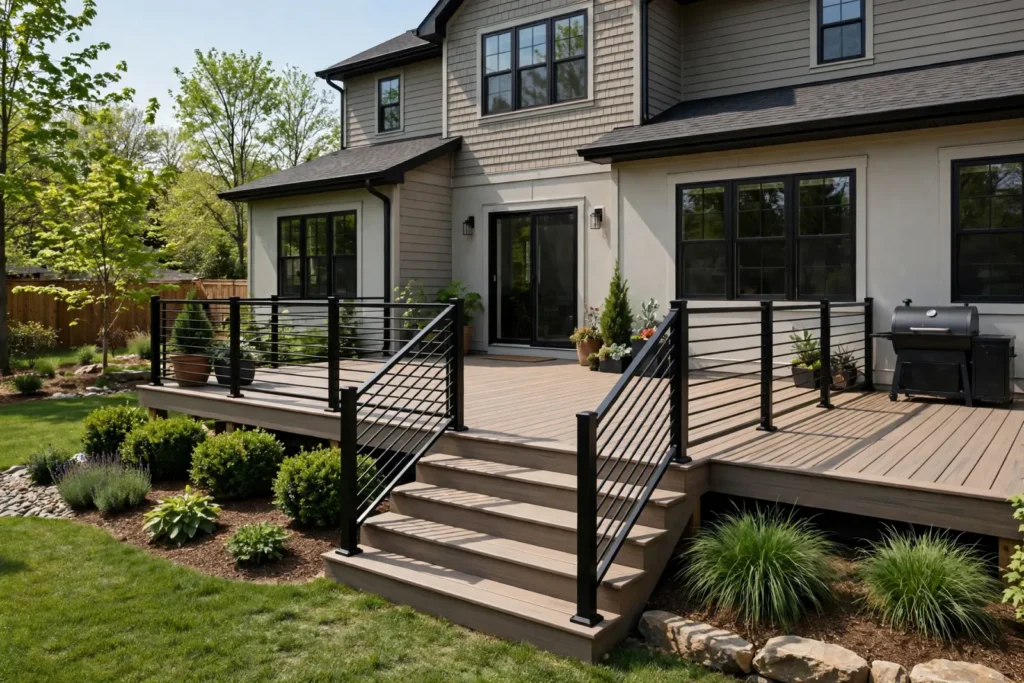
A professionally built deck in the U.S. typically costs $25 to $60 per square foot in 2026. Most complete projects land between $4,339 and $12,652, and Angi’s September 2026 data puts the national average at about $8,320. The final price depends on size, height, framing, decking material, stairs, railings, site access, and local code requirements.
Open the Deck Building Cost Calculator →
Cost sources measure projects differently. Angi’s 2026 dataset shows roughly $30 to $60 per square foot for professional builds. HomeGuide reports about $25 to $50 per square foot for a basic new deck and prices a typical 12-by-12-foot pressure-treated deck at about $3,600 to $7,200. Use these figures as planning ranges, not contractor quotes.
Deck building cost at a glance
The spread is wide because a simple ground-level platform and a second-story composite deck with stairs, lighting, and premium railings are entirely different projects.
Quick decision table: which deck fits your budget?
How deck size changes the budget
Size is the clearest cost driver. For common wood construction, HomeGuide puts a 10-by-10-foot deck at about $2,500 to $5,000, a 12-by-16-foot deck at $4,800 to $9,600, and a 20-by-20-foot deck at $10,000 to $20,000. Angi’s 2026 figures run somewhat higher on many sizes because they include more complex designs and higher-cost markets.
Start with total square footage, then add premiums for height, stairs, railings, difficult access, unusual shapes, built-in seating, pergolas, and specialty materials. Small decks often cost more per square foot because fixed costs like permits, mobilization, and stairs are spread over less area.
Cost by decking material
Pressure-treated pine
About $25–$50 per sq. ft. installed. Cheapest conventional option, but needs periodic cleaning, staining, or sealing.
Cedar and redwood
Cedar runs about $30–$47 and redwood about $28–$54 per sq. ft. installed. Chosen for appearance and natural resistance characteristics.
Composite
About $40–$80 per sq. ft. installed, including structure. Higher upfront price, less routine finishing than wood.
Hardwoods and aluminum
Ipe and metal systems exceed standard wood pricing. Specialty fasteners, framing, and installation add substantially.
Remember that most composite and premium decks still sit on pressure-treated framing, so the substructure cost doesn’t disappear when you upgrade the surface boards. Premium brands and complex railing systems push totals higher.
Labor cost to build a deck
Labor is often the largest single component. HomeGuide estimates about $11 to $22 per square foot for common new-deck labor, while Angi’s 2026 data shows $15 to $35 per square foot depending on design and market.
Expect labor to rise when the site is sloped, access is tight, the deck is elevated, an old deck must be removed, footings are hard to excavate, or the plan includes multiple stair runs and custom railings.
Ground-level vs. elevated and second-story decks
A basic attached ground-level wood deck runs about $25 to $30 per square foot, according to HomeGuide, because it needs less structure and fewer guard and stair components. Elevated decks rise to roughly $30 to $50 per square foot. Second-story and multi-level decks cost much more because framing, bracing, foundations, access, and fall protection become more demanding.
Railings and stairs
Railings, stairs, landings, gates, and custom balusters look like details but add significant material and labor. A compact deck with several stair runs can cost more per square foot than a larger rectangular platform. Ask contractors to price the surface, framing, railings, stairs, and optional features separately.
Three realistic budget scenarios
These examples apply the published per-square-foot ranges above. They are illustrations, not quotes.
- Starter deck: 12′ × 12′ (144 sq. ft.) ground-level pressure-treated deck at $25–$30 per sq. ft. ≈ $3,600–$4,320, before any permit fee.
- Family deck: 12′ × 16′ (192 sq. ft.) elevated pressure-treated deck at $30–$50 per sq. ft. ≈ $5,760–$9,600, plus a likely $230–$500 permit. Extra stair runs push it higher.
- Upgrade deck: 16′ × 20′ (320 sq. ft.) composite deck at $40–$80 per sq. ft. ≈ $12,800–$25,600, before lighting, demolition, or premium railings.
Permits, codes, and calling 811
Permit rules vary by city, county, deck height, size, and whether the deck attaches to the house. Angi’s 2026 data suggests fees often run $230 to $500, though local fees can be lower or higher. Never assume a small deck is exempt. Confirm requirements with your local building department and, where applicable, your homeowners association. Elevated decks often require inspected footings, guards, stairs, and ledger attachment.
Digging for posts or footings also means calling 811 first. The national 811 service advises homeowners and contractors to request a utility locate before excavation. Required notice varies by state, so submit the request ahead of the dig date. Hitting a buried gas, electric, communications, or water line can cause injury, outages, and major unplanned expense.
Hidden costs homeowners often miss
- Demolition: Removing an old deck adds labor, hauling, and disposal, so replacements often cost more per square foot than new builds on a clear site.
- Rot at the house: Removal can reveal damaged rim joists, siding, flashing, sheathing, or ledger connections that must be repaired before attaching the new deck.
- Drainage and grading: Standing water under a deck causes long-term moisture problems; minor grading may be needed before framing.
- Electrical: Lighting, receptacles, hot-tub circuits, or outdoor kitchens need licensed work. See our 2026 electrician cost guide.
- Finishing: Wood may need stain or sealer soon after installation. Angi puts professional deck painting at about $2 to $5 per square foot, before heavy prep.
- Furnishings: Furniture, grills, heaters, shades, pergolas, and decorative lighting are rarely in the construction quote and can add thousands.
DIY vs. professional installation
An experienced homeowner with strong carpentry skills, proper tools, and code knowledge can build a simple, low, freestanding deck. HomeGuide estimates materials alone for a basic DIY 12-by-12-foot deck at about $2,000 to $4,000.
Structural decks, however, are unforgiving. Incorrect footings, poorly attached ledgers, missing flashing, weak guard connections, or improper stair geometry create safety hazards and water intrusion. We do not recommend DIY for elevated, attached, multi-level, roofed, or hot-tub decks, or for difficult sites needing engineered details. Weigh savings against structural risk, permit compliance, and durability.
Five-step planning process
- Define the scope: size, height, attachment, material, stairs, and railings.
- Check rules: confirm permit, setback, and HOA requirements locally.
- Set a budget with a contingency for rot repairs, drainage, or soil surprises.
- Collect two or three written bids using the same design and specifications.
- Schedule 811 before footing work, and confirm who pulls the permit and books inspections.
Contractor quote checklist
A useful written bid should state:
- deck dimensions and total square footage;
- framing lumber and decking product;
- footing type and assumed soil and site conditions;
- ledger and flashing scope where attached to the house;
- railing and stair materials;
- demolition and disposal;
- permit responsibility;
- electrical or lighting exclusions;
- finishing or sealing work;
- estimated schedule;
- labor and material warranties;
- total installed price and payment schedule.
The lowest quote isn’t automatically best if it omits railings, permits, demolition, finishing, or structural corrections another contractor included.
Costly mistakes to avoid
- Building without a required permit, which can trigger fines, rework, or problems at resale.
- Skipping 811 before digging footings.
- Attaching a ledger without proper flashing, inviting rot in the house framing.
- Comparing bids by price per square foot without matching scope.
- Choosing a material without budgeting its long-term maintenance.
After-build inspection and maintenance checklist
- Confirm the final inspection passed and keep permit records.
- Check railings and stair handrails for firmness each season.
- Look for loose fasteners, soft boards, or cracked framing.
- Inspect the ledger and flashing area for water staining.
- Keep gaps between boards clear of debris so water drains.
- Clean and refinish wood decking per manufacturer guidance.
For ongoing budgeting, see our home maintenance budget guide.
Frequently asked questions
Is composite worth the higher price?
It can be if you want less staining and sealing. Composite costs more upfront ($40–$80 per sq. ft. installed vs. $25–$50 for pressure-treated pine), so weigh that against years of wood maintenance.
Do I need a permit for a small deck?
Possibly. Requirements depend on height, size, attachment, and local rules, so always check with your building department.
Why is replacing a deck more expensive than building new?
Demolition, disposal, and hidden repairs to rim joists or flashing add labor and materials.
Related exterior projects
Coordinate the deck with other exterior work so contractors don’t damage new finishes or repeat setup costs. Our exterior house painting cost guide helps with repainting budgets, and our fence installation cost guide covers another common backyard project.
Bottom line
For 2026, plan on about $25 to $60 per square foot for a professionally built deck, with most projects between $4,339 and $12,652 and a national average near $8,320. Large composite, second-story, or heavily customized decks can exceed that. Match quotes to the full scope, including size, height, materials, railings, stairs, demolition, permits, electrical, finishing, and drainage, rather than headline per-foot prices.
Home Cost Desk compares current U.S. cost or technical references and checks safety, code, efficiency, incentive, or regulatory claims against authoritative sources when available. National figures are planning ranges, not local quotes.
Editorial review: Home Cost Desk Editorial Team · Read our research methodology · Detailed sources appear below.
Sources and methodology
Home Cost Desk uses current national consumer cost datasets for budget ranges and checks safety recommendations against relevant U.S. resources. Actual prices vary by location, contractor availability, design, site conditions, and product selection.