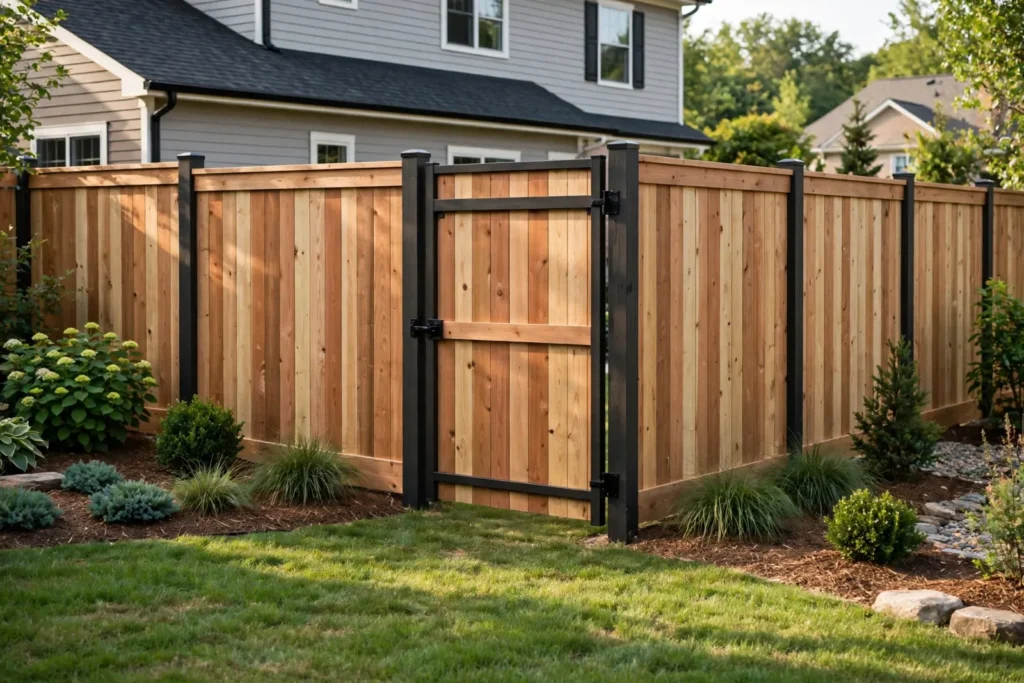
A fence project looks simple on paper: measure the yard, choose a material, and multiply by a price per foot. In practice, the final quote can change quickly once you add height, gates, old-fence removal, sloped ground, tree roots, or difficult access.
Open the Fence Installation Cost Calculator →
Updated October 2026. Homeowners should expect a broad national range because fence projects are priced very differently depending on material, height, site conditions, and whether the job is a new installation or a replacement. Angi’s August 2026 data puts the average new fence installation at about $3,277, with many projects between $1,860 and $4,843 and a broad material-driven range of roughly $6 to $50 per linear foot. HomeGuide’s February 2026 data uses about $20 to $60 per linear foot installed for many common wood and vinyl fences, or about $4,000 to $12,000 for a 200-linear-foot project.
Those numbers are not really in conflict. A basic chain-link boundary fence, a six-foot privacy fence, and a custom decorative metal fence are different construction projects. The useful budget starts with linear feet + material + height + gates + site work, then adds demolition, permits, surveying or boundary work, and any difficult excavation.
Fence installation cost at a glance
| Project or material | 2026 planning range |
|---|---|
| Typical installed fence | About $6–$60 per linear foot |
| 150 linear feet | About $3,000–$9,000 for many wood/vinyl projects |
| 200 linear feet | About $4,000–$12,000 for many wood/vinyl projects |
| Wood | About $20–$50 per linear foot |
| Vinyl | About $30–$60 per linear foot |
| Chain-link | About $9–$30 per linear foot |
| Privacy fence | About $25–$60 per linear foot |
| Aluminum | About $25–$75 per linear foot |
| Wrought iron | About $50–$85 per linear foot |
These are national planning ranges from current 2026 cost guides. Local labor, material pricing, terrain, permits, fence height, gate count, demolition, and access can move the final quote substantially.
New fence vs. fence replacement cost
A replacement project is often more expensive per foot than a new fence because the contractor first has to remove posts, panels, concrete, wire, and debris before installing anything new. HomeGuide’s 2026 planning data places many new wood or vinyl installations around $20 to $60 per linear foot, while replacement can run roughly $30 to $80 per linear foot once demolition and disposal are included.
That difference matters when comparing quotes. A contractor quoting only the new fence may look much cheaper than one who has already included old-fence removal, concrete extraction, hauling, grading, and cleanup.
Hidden costs that can move the budget quickly
| Possible extra | Why it changes the price |
|---|---|
| Old-fence removal | Demolition, post and concrete removal, hauling, and disposal |
| Land grading | Uneven ground may need leveling or stepped fence sections |
| Tree or root conflicts | Post locations may need to move or require extra excavation |
| Rocky soil | Post-hole drilling can take longer and require different equipment |
| Property survey | May be needed when the legal boundary is uncertain |
| Permit or HOA review | Local rules can affect height, setback, style, and placement |
| Utility conflicts | Buried gas, electric, water, telecom, or other lines can force layout changes |
| Custom gates | Wider openings, reinforced posts, premium hardware, and automation add cost |
Angi’s 2026 wood-fence data notes that grading, old-fence removal, tree clearing, and permit-related work can add meaningful costs beyond the fence itself. The important budgeting rule is simple: ask which site-preparation items are included before comparing totals.
What matters more than the average price?
The biggest mistake is comparing two fence quotes only by the total. One contractor may include demolition, haul-away, concrete, gates, and site preparation while another may price only the new fence.
Ask each contractor to break the estimate into the same components. A lower total is not necessarily cheaper if important work has been left out.
Fence cost by material
Wood fencing
HomeGuide currently lists installed wood fencing around $20 to $50 per linear foot. Wood is popular because it works well for privacy, can be customized, and usually costs less upfront than many decorative materials. The long-term tradeoff is maintenance: staining, painting, warped boards, and rot can add ownership costs later.
Vinyl fencing
Vinyl commonly falls around $30 to $60 per linear foot installed. It usually costs more upfront than basic wood but requires less routine finishing. For homeowners who want a clean privacy fence without regular staining, the lower-maintenance profile can justify the initial cost.
Chain-link fencing
Chain-link is usually among the less expensive professionally installed options. HomeGuide’s 2026 range is about $9 to $30 per linear foot, while Angi’s late-September 2026 update shows a broader installed range of roughly $8 to $40 per linear foot, with many residential projects around $10 to $20 per foot. Height, wire gauge, coating, gates, and privacy slats can move the price upward.
Chain-link is practical when the main goals are security, pet containment, or boundary definition rather than full privacy. If appearance matters, compare black or coated chain-link with basic galvanized material rather than assuming all chain-link quotes describe the same product.
Aluminum and wrought iron
Decorative metal fencing moves the project into a higher price tier. HomeGuide lists aluminum around $25 to $75 per linear foot and wrought iron around $50 to $85. These materials are often chosen for appearance, durability, and visibility rather than full privacy.
The factors that change fence installation cost the most
- Total length: more linear feet means more posts, panels, fasteners, and labor.
- Fence height: taller fences use more material and may require larger posts or more structural support.
- Terrain: slopes, rocks, tree roots, and drainage problems slow installation.
- Number of gates: gates add framing, hardware, alignment work, and labor.
- Old fence removal: demolition and haul-away can become a meaningful extra charge.
- Access: tight side yards or sites that cannot be reached easily with equipment can increase labor.
- Permits and local rules: requirements vary by city and county.
- Property preparation: grading, stump removal, or clearing vegetation may be separate jobs.
A realistic homeowner example
Suppose you need about 180 linear feet of backyard privacy fencing. If the installed cost is $25 per foot, the starting budget is about $4,500. At $50 per foot, the same length becomes $9,000.
Now add two gates, removal of an aging fence, and uneven ground. The final quote can rise substantially even though the measured fence length did not change.
This is why a practical budget should include a contingency for site conditions instead of relying only on the headline cost per foot.
Three realistic 2026 fence budgets
Budget example 1: 100-foot chain-link boundary
A basic residential chain-link project around 100 linear feet may start in the low thousands depending on height, coating, gates, and site access. If the yard is flat and the layout has one simple gate, the job can stay near the lower end of the market. Add taller fabric, privacy slats, a double gate, or difficult digging and the budget rises quickly.
Budget example 2: 150-foot wood privacy fence
Using a broad planning range of $20 to $50 per linear foot, 150 feet of installed wood fencing points to roughly $3,000 to $7,500 before major extras. Old-fence removal, two gates, rocky soil, or premium cedar can push the final price above that simple calculation.
Budget example 3: 200-foot vinyl privacy fence
At roughly $30 to $60 per linear foot, a 200-foot vinyl project points to about $6,000 to $12,000. A clean, level site with standard panels and one gate may stay closer to the middle of the range; custom heights, multiple gates, complex corners, or demolition can move it toward the upper end.
These examples are budgeting tools, not contractor quotes. Their value is that they let you test the effect of one variable at a time before you request bids.
How much can gates add?
Gate pricing varies widely because a basic pedestrian gate is very different from a wide driveway gate. Material, width, hinges, latches, reinforcement, automation, and decorative hardware all matter.
When comparing contractor estimates, ask for each gate to be itemized. If one quote includes a heavier gate frame or upgraded hardware, the difference may be justified.
Can you reduce the cost without buying the cheapest fence?
Usually, yes. The biggest savings often come from simplifying the project rather than choosing the lowest-grade material.
- Keep the fence line as simple as possible.
- Reduce unnecessary gates.
- Use a lower-cost material only where appearance matters less.
- Remove an old fence yourself only when it is practical and safe.
- Get multiple quotes using the exact same scope.
- Ask whether seasonal scheduling affects pricing in your area.
DIY or professional installation?
A short, simple fence on flat ground can be a realistic DIY project for an experienced homeowner, but a long privacy fence is much less forgiving. Post depth, spacing, alignment, drainage, wind exposure, gate geometry, and property-line accuracy all matter. A fence can look straight on installation day and still lean or rack later if posts, soil conditions, or drainage were handled poorly.
Before any post-hole digging, contact 811 or the applicable state 811 center and wait for the required utility responses. Also verify the property boundary independently; utility marking does not establish ownership lines. If the boundary is disputed or unclear, a survey is a project-control cost rather than an unnecessary extra.
Professional installation deserves stronger consideration when the fence is tall, the yard slopes sharply, the soil is rocky, there are retaining walls or major roots, several gates are involved, local wind loads matter, or the fence sits close to property lines and easements.
Permits, setbacks, HOA rules, and property lines
Fence rules are unusually local. A city may allow one height in a backyard and a lower height near a street or driveway sight triangle. Corner lots, pools, easements, historic districts, and homeowners associations can add separate rules.
Before ordering materials, verify:
- Maximum permitted height
- Required setbacks from streets, sidewalks, or property lines
- Whether a permit or inspection is required
- Pool-barrier rules if the fence serves a pool area
- HOA material, color, and style restrictions
- Recorded easements that may limit placement
- Who is responsible for confirming the legal boundary
Moving a finished fence because it violated a setback, easement, or neighboring property line is far more expensive than resolving the question before installation.
What should be included in a contractor quote?
- Total linear feet and a sketch of the fence line
- Fence material, grade, style, and height
- Post material, size, spacing, and setting method
- Concrete or other footing assumptions
- Number, width, and hardware specification for each gate
- Old-fence demolition, concrete removal, haul-away, and disposal
- Permit and inspection responsibility
- Utility-locate responsibility before digging
- Ground preparation, grading, or vegetation clearing
- Cleanup and final debris removal
- Material warranty and workmanship warranty
- How hidden conditions or change orders will be priced
How to compare fence bids fairly
Do not rank bids by the bottom-line number until the scopes match. Put each proposal into the same comparison table.
| Quote item | What to compare |
|---|---|
| Length | Same measured linear feet and layout |
| Material | Same species, grade, panel, gauge, or product line |
| Height | Same finished fence height |
| Posts | Size, spacing, material, and installation method |
| Gates | Width, framing, hinges, latch, drop rods, automation if any |
| Demolition | Old panels, posts, concrete, hauling, and disposal |
| Site work | Grading, roots, rock, clearing, and access |
| Permits | Who pulls them and whether fees are included |
| Warranty | Material coverage and labor/workmanship term |
A quote that is several thousand dollars lower may simply exclude demolition, gates, permits, or site work. Ask the contractor to identify exclusions in writing instead of relying on assumptions.
A five-step fence budgeting plan
- Confirm the line. Decide the intended layout, verify the legal boundary where necessary, and check easements, setbacks, HOA rules, and permit requirements.
- Measure the project. Record approximate linear feet, desired height, corners, gate locations, and areas with slopes, roots, rock, or tight access.
- Choose the performance level. Decide whether your priority is privacy, pet containment, security, low maintenance, appearance, or the lowest initial cost.
- Get comparable written bids. Ask at least two or three contractors to price the same material, height, gate count, demolition, and site-preparation scope.
- Keep a contingency. Do not spend the entire budget on the base fence price. Leave room for boundary questions, difficult excavation, hidden concrete, or other site conditions.
Before requesting quotes: write down these numbers
- Approximate total linear feet
- Desired fence height
- Preferred material and second-choice material
- Number and approximate width of gates
- Whether an old fence must be removed
- Areas with slope, rock, large roots, retaining walls, or limited access
- Whether the property boundary is clearly established
- Known HOA, permit, or setback requirements
Giving every contractor the same starting information makes the bids easier to compare and reduces the chance that a low initial quote grows because basic scope was missing.
Before you sign: homeowner checklist
- Final fence line and property-boundary responsibility are clear.
- Required permits and HOA approvals are identified.
- 811 utility marking will be completed before digging.
- Material, height, post spacing, and gate details are written in the contract.
- Demolition and disposal are either included or clearly excluded.
- Payment schedule and change-order rules are written.
- Warranty terms are documented.
- Final cleanup and restoration responsibilities are clear.
If you are trying to budget several home projects at once, our annual home maintenance cost guide can help you think about fence replacement as part of a larger homeowner reserve rather than a one-off expense. For another outdoor project benchmark, see our deck building cost guide. Before hiring any contractor, our home contractor hiring guide explains how to compare scope, insurance, warranties, and change orders.
Frequently asked questions
How much does a 100-foot fence cost in 2026?
For common professionally installed wood or vinyl fencing, a broad planning range is about $2,000 to $6,000. Chain-link can be lower, while decorative metal, tall privacy designs, difficult terrain, or several gates can be higher.
How much does a 200-foot fence cost?
HomeGuide’s 2026 planning data puts many 200-foot wood and vinyl projects around $4,000 to $12,000. Replacement, demolition, custom gates, grading, or premium materials can push the project beyond that range.
Is wood or vinyl cheaper?
Wood generally has the lower initial installed cost. Vinyl typically costs more upfront but usually requires less routine staining or painting. Compare both the installation price and the maintenance you are willing to perform over the years you expect to own the fence.
Do I need a survey before installing a fence?
Not every project requires a new survey, but if the legal boundary is uncertain, disputed, or close to the proposed fence line, confirming it before construction can prevent an expensive relocation later. Local permit or HOA rules may also require specific documentation.
Do I need to contact 811 for fence posts?
Yes. The national 811 service specifically includes fence installation among projects that require a utility-locate request before digging. Follow the instructions and waiting period provided by your state 811 center and confirm required utilities have responded before excavation begins.
Bottom line
For 2026, a reasonable starting point for many U.S. fence projects is roughly $20 to $60 per linear foot for common professionally installed wood and vinyl fencing, while lower-cost chain-link and higher-end decorative metal can fall outside that range. A 200-foot fence often lands around $4,000 to $12,000 depending on material and site conditions.
Do not compare contractor totals until you know that each quote includes the same length, height, material, gates, demolition, preparation, permits, and cleanup. The cheapest-looking fence bid is not necessarily the lowest final project cost.
Home Cost Desk compares current U.S. cost or technical references and checks safety, code, efficiency, incentive, or regulatory claims against authoritative sources when available. National figures are planning ranges, not local quotes.
Editorial review: Home Cost Desk Editorial Team · Read our research methodology · Detailed sources appear below.