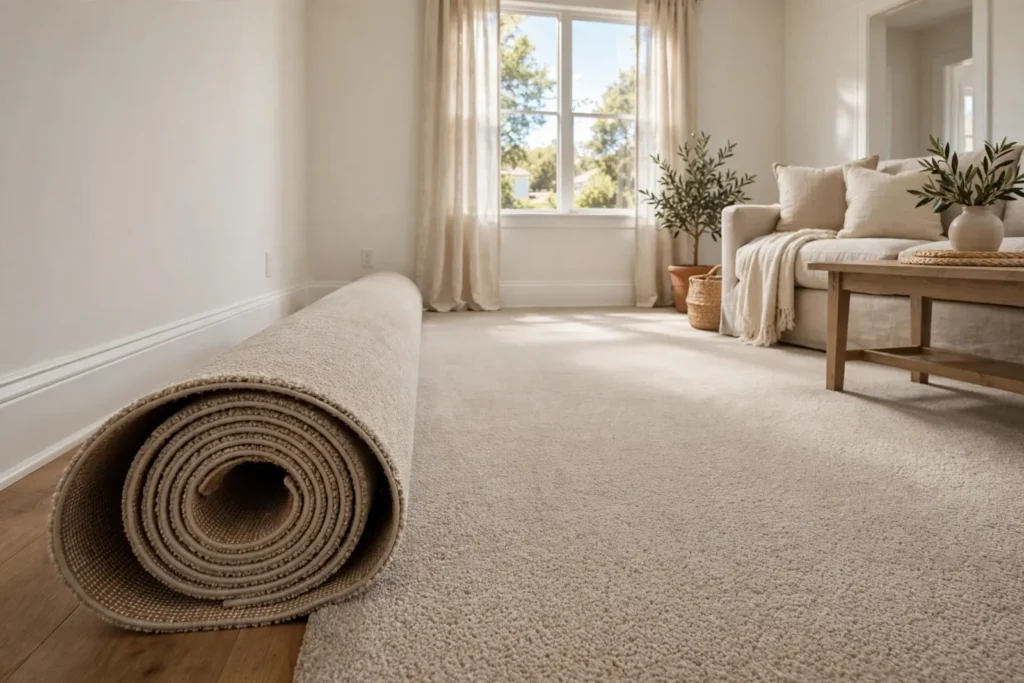
Carpet remains one of the more affordable ways to finish bedrooms, family rooms, and other dry living spaces, but the advertised carpet price is only part of the bill. For a U.S. homeowner budgeting in 2026, a practical installed range is about $2 to $8 per square foot for many projects. Angi‘s 2026 project data is broader at roughly $3 to $11 per square foot, with a national average project around $1,778 and most reported projects between about $780 and $2,812.
Those are planning ranges, not contractor quotes. Fiber, padding, stairs, room shape, furniture, old-floor removal, subfloor condition, local labor, and minimum service charges can change the real price substantially.
Carpet installation cost at a glance
| Cost item | Typical planning range |
|---|---|
| Carpet installed | $2–$8 per sq. ft. (HomeGuide) |
| Broader 2026 installed range | $3–$11 per sq. ft. (Angi) |
| Carpet material | $1–$5 per sq. ft. typical |
| Padding | $0.25–$1.00 per sq. ft. material |
| Basic installation labor | $0.50–$1.50 per sq. ft. |
| Old carpet and pad removal | About $0.70–$1.60 per sq. ft. |
| Subfloor repair/replacement | About $1.75–$4.70 per sq. ft. |
| Typical 10×12 room | About $200–$900 |
| Flight of stairs | About $150–$600 |
National guides use different datasets and scopes, so do not expect every line item to stack neatly. Use the figures to establish a budget envelope, then replace them with itemized local bids.
What a typical room can cost
A 12-by-12 bedroom has 144 square feet of floor area. At $2 to $8 per square foot, the simple mathematical range is $288 to $1,152 before considering waste and unusual prep. HomeGuide‘s current guide puts a 12-by-12 room at roughly $250 to $1,100, which is consistent with that calculation.
For 1,000 square feet, a basic $2-per-foot calculation is $2,000 and an $8-per-foot project is $8,000. HomeGuide notes that a whole-house estimate often assumes carpet covers only part of the home’s total living area, so clarify whether a quote refers to total house size or actual carpeted square footage.
Where the money goes
Carpet
The carpet itself commonly runs about $1 to $5 per square foot, although builder-grade products can be lower and premium wool or designer products can be far higher. Fiber is only one quality signal. Density, face weight, pile construction, twist, backing, stain treatment, warranty requirements, and expected traffic all matter.
Padding
Padding is easy to overlook because it disappears after installation, but it affects feel and can affect how the carpet performs. HomeGuide lists roughly $0.25 to $1 per square foot for pad material in its installed-cost breakdown. Do not automatically buy the thickest pad: use the carpet manufacturer’s required density and thickness so the installation remains compatible with the product warranty.
Labor
Basic carpet installation labor is commonly around $0.50 to $1.50 per square foot in HomeGuide’s national data, while difficult layouts and extra preparation cost more. Small jobs can also be subject to a minimum charge. Ask whether seams, transitions, tack strip, door trimming, cleanup, and moving ordinary furniture are included.
Carpet type and material change the budget
Polyester and olefin are commonly found at the budget end. Nylon is popular for durability and high-traffic rooms, while triexta competes in the stain-resistant residential market. Wool sits at the premium end and can move a project well beyond the standard $2-to-$8 range.
Instead of choosing solely by fiber name, match the product to the room. A low-traffic guest room does not need the same specification as stairs, a hallway, or a family room. If pets or children are part of the household, ask specifically about stain performance, cleaning requirements, warranties, and whether the chosen pad is approved for the carpet.
Removal, disposal, and floor preparation
Replacement is usually more expensive than installing carpet in a clean new room. HomeGuide currently lists old carpet and pad removal around $0.70 to $1.60 per square foot, while subfloor repair or replacement can add roughly $1.75 to $4.70 per square foot where needed.
After old carpet comes up, an installer may discover squeaks, damaged panels, pet contamination, moisture staining, uneven seams, loose fasteners, or deteriorated tack strip. A quote should explain which basic preparation is included and how additional repair is priced.
Do not cover an unresolved moisture problem with new carpet. The U.S. Environmental Protection Agency notes that damp carpeting can support microbial growth. If there is active leakage, recurring basement moisture, or a wet subfloor, correct the source and dry the assembly before installing new finishes.
Stairs, hallways, and patterned carpet
Stairs consume more installer time than an open rectangular room because every tread and riser requires fitting and fastening. HomeGuide gives a broad planning range of about $150 to $600 for a flight of 13 stairs. Curved stairs, runners, upholstered sides, premium material, and pattern matching can raise the price.
Patterned carpet can also create more waste because adjoining pieces must align visually. Hallways, closets, alcoves, angled walls, and multiple doorways add cuts and transitions. This is why a professional measure can produce a material order noticeably larger than the room’s raw floor area.
Hidden costs homeowners should ask about
Before comparing bids, identify whether each proposal includes old flooring removal, disposal, furniture moving, new tack strip, transitions, thresholds, baseboard handling, door trimming, stairs, closets, floor leveling, subfloor repair, delivery, sales tax, and any minimum installation charge.
HomeGuide lists furniture moving around $25 to $75 per room and transitions around $25 to $100 each in its national planning data. These are useful benchmarks, but a contractor’s written scope is more important than any national average.
DIY versus professional installation
Removing old carpet, pulling staples, cleaning the subfloor, and clearing furniture are tasks some homeowners can reasonably do themselves. Installing wall-to-wall carpet well is more specialized. Stretch-in carpet requires accurate measuring, seam work, cutting, tack strip placement, and proper stretching. Errors can leave visible seams, loose edges, ripples, or wasted material.
HomeGuide estimates DIY replacement at roughly $1.25 to $6 per square foot before accounting for the value of your time, and notes that tool rental can erode the labor savings. Carpet tile is generally more approachable for a careful DIYer because individual pieces are easier to handle and replace.
Professional installation is especially sensible for stairs, multiple connected rooms, patterned carpet, expensive material, irregular layouts, or any project where warranty terms require approved installation practices.
Indoor air and new-carpet odor
New carpet systems, cushions, and some adhesives can emit volatile organic compounds for a period after installation. EPA consumer guidance recommends asking about emissions, using low-emitting adhesives where needed, and increasing fresh-air ventilation during and after installation. EPA specifically advises keeping ventilation running for roughly 48 to 72 hours after new carpet is installed.
For households particularly concerned about emissions, ask the retailer for product emissions information before purchase. EPA also points consumers toward low-emitting carpet and adhesive choices and manufacturer installation instructions.
Does carpet installation require a permit?
Simple interior carpet replacement generally is not treated like structural, electrical, or plumbing work, but permit rules are local and can change with the surrounding scope. If the project includes structural subfloor repair, accessibility work, major alterations, or work in a regulated multifamily property, verify requirements with the local building department rather than assuming.
How to compare contractor quotes
Get at least two or three itemized proposals when the project is large enough to justify it. Give each bidder the same scope and ask for actual measured carpet area, material manufacturer and product line, pad specification, waste allowance, labor, old-floor removal, disposal, stairs, transitions, furniture, floor preparation, warranty, exclusions, and total installed price.
A retailer advertising “free installation” may still have a competitive total price, but compare the final installed total rather than one promotional line item. The carpet, pad, removal, prep, extras, and installation together determine the real cost.
Three realistic homeowner scenarios
One straightforward bedroom: A cleared 12-by-12 room with sound subfloor and mid-priced synthetic carpet may stay within the published few-hundred-to-about-$1,100 range. Premium carpet or substantial removal and prep can push it higher.
Three bedrooms and a hallway: The larger area improves installation efficiency, but doorways, seams, closets, furniture, and transitions matter. A mid-range material can turn what looks like a simple flooring job into a several-thousand-dollar project.
Whole-house carpet with stairs: Material grade, waste, removal, stair labor, furniture logistics, and subfloor surprises become major variables. For this scope, insist on a room-by-room measure and an itemized proposal rather than accepting a rough per-square-foot verbal estimate.
When replacement makes more sense than repair
Professional cleaning, spot repair, seam repair, or re-stretching can make sense when the carpet is otherwise in good condition. Replacement is easier to justify when wear is widespread, backing is failing, stains or odors cannot be corrected, repeated rippling returns, the carpet has significant water damage, or the homeowner wants a different performance level.
If damage came from water, identify the moisture source first. New carpet should be the final step, not a way to conceal an unresolved leak.
Five-step carpet buying and installation plan
- Measure the actual carpeted area. Include closets, stairs and waste allowance rather than using the home’s total square footage.
- Choose carpet and pad together. Match fiber, pile and cushion to traffic level, pets, stairs and the manufacturer’s warranty requirements.
- Inspect the subfloor before installation. Resolve moisture, squeaks, damaged panels and contamination before covering the floor.
- Compare complete installed quotes. Require removal, disposal, pad, transitions, stairs, furniture, prep, taxes and minimum charges to be stated.
- Inspect the finished work. Look for flat seams, stretched surfaces, secure edges, clean transitions and doors that open without dragging.
Questions to ask a carpet installer
- How much measured carpet and how much waste are included?
- What pad density and thickness are specified?
- Where will seams be placed?
- Are old carpet removal and disposal included?
- How are stairs, closets and transitions priced?
- What happens if subfloor damage is found?
- What labor warranty applies to seams, stretching and installation?
Frequently asked questions
How much does carpet installation cost in 2026?
Angi’s September 2026 data places professional carpet replacement around $3 to $11 per square foot, with a national average project near $1,778 and most reported projects around $780 to $2,812.
How much extra should I budget for carpet removal?
Angi’s 2026 removal data shows many professional removal projects around $120 to $720, depending on area, adhesive, stairs, furniture and disposal.
Can rippled carpet be repaired instead of replaced?
Often, yes. Professional stretching can be much cheaper than replacement when the carpet is otherwise in good condition and the problem is limited to looseness or wrinkles.
Should carpet go over a damp basement floor?
No. Resolve the water or humidity problem first. New carpet should not be used to conceal an active moisture issue.
Related Home Cost Desk guides
Bottom line
For a 2026 U.S. planning budget, $2 to $8 per square foot installed is a useful mainstream range, while current Angi data shows that projects can span roughly $3 to $11 per square foot. The carpet itself is only part of the price. Padding, removal, stairs, furniture, transitions, waste, and subfloor work can materially change the final invoice.
The best value is not automatically the lowest carpet price. Choose a product and pad suited to the room, resolve moisture or subfloor problems first, and compare complete installed scopes from local contractors.
Home Cost Desk compares current U.S. cost or technical references and checks safety, code, efficiency, incentive, or regulatory claims against authoritative sources when available. National figures are planning ranges, not local quotes.
Editorial review: Home Cost Desk Editorial Team · Read our research methodology · Detailed sources appear below.
Sources and methodology
Home Cost Desk treats published national figures as planning benchmarks rather than guaranteed local prices. Cost ranges in this guide were cross-checked against HomeGuide’s carpet installation guide updated October 31, 2025 and Angi’s 2026 carpet replacement data based on thousands of reported projects. Indoor-air and moisture guidance was checked against current U.S. Environmental Protection Agency consumer and indoor-air guidance. Actual bids vary by market, material, room geometry, taxes, retailer, installer, and site conditions.