2026 cost snapshot
| Item | Planning range / amount | Basis |
|---|---|---|
| Denver hardwood refinishing | $3-$8 per sq. ft. | Angi Denver 2026 |
| Typical Denver project | $1,068-$2,532 | Angi Denver 2026 |
| Denver reported average | About $1,764 | Angi Denver 2026 |
| Labor | $2.50-$7 per sq. ft. | Angi Denver 2026 |
| Screen-and-recoat | Usually below full sand/refinish | Scope dependent |
Quick answer
Hardwood floor refinishing in Denver costs about $3 to $8 per square foot in 2026. Angi’s Denver-specific data shows many projects around $1,068 to $2,532, with a reported average near $1,764. Labor represents most of the bill, commonly around $2.50 to $7 per square foot.
The final price depends on whether the floor needs a full sand to bare wood or only a screen-and-recoat, plus stain changes, board repair, pet stains, stairs, furniture moving and the selected finish. A 500-square-foot open living area is very different from 500 square feet divided among bedrooms, closets and stairs.
Denver’s dry climate matters
Denver’s low relative humidity can cause wood flooring to shrink seasonally, showing gaps that close when indoor humidity rises. Refinishing improves the surface but does not eliminate normal dimensional movement.
Before filling every winter gap with hard filler, ask whether the opening is seasonal. Permanently filling joints that need to move can create edge damage or new cracks when the wood expands.
Full sand and refinish versus screen and recoat
A full refinish removes the old coating and a small amount of wood so deeper scratches, gray wear areas and stain color can be addressed. A screen-and-recoat lightly abrades the existing finish and adds a compatible topcoat without sanding to bare wood.
If the floor is deeply scratched, stained, worn through or needs a color change, full refinishing is usually appropriate. If the finish is dull but intact and the wood is not exposed, a recoat can cost less and preserve the floor’s wear layer.
Sanding quality is the core skill
Drum sanders, belt machines, edgers and orbital equipment can leave waves, dish marks, edge halos and cross-grain scratches if used poorly. A low price is not a bargain if excessive sanding permanently removes useful wood.
Ask the contractor how grit progression is handled, how edges blend into the field and how nails or fasteners are addressed before machines pass over them.
Dust containment
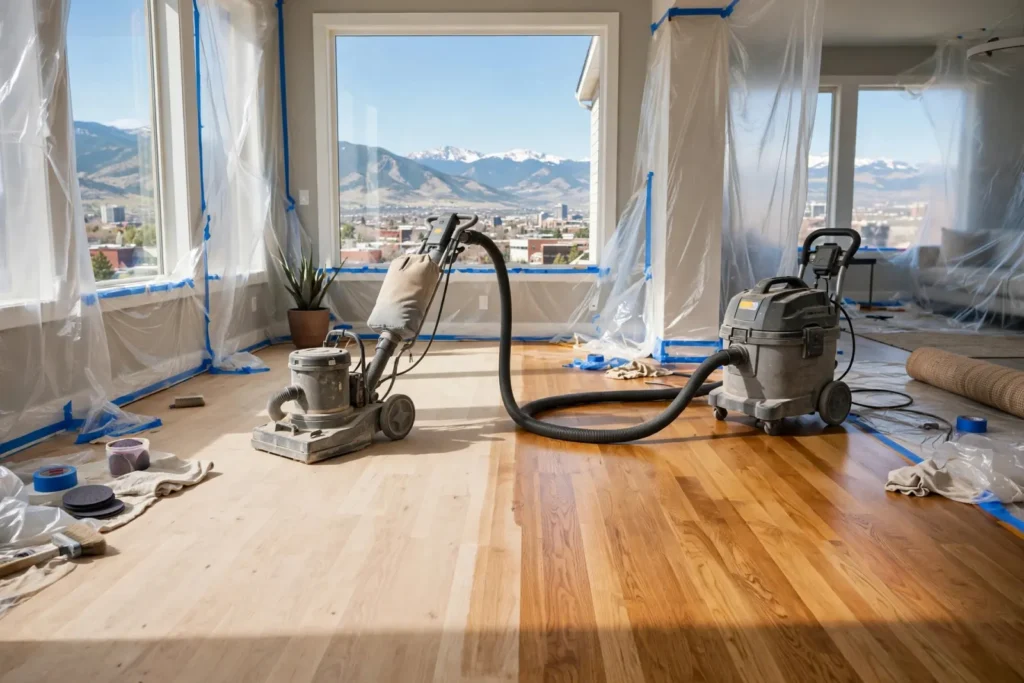
Modern dust-containment systems can capture much of the sanding debris, but no residential process is perfectly dust-free. Contractors should isolate the work zone, protect HVAC returns and clean the surface carefully before finish is applied.
Ask what “dustless” means in the proposal. A connected vacuum sanding system is different from simply hanging plastic in doorways.
Stain changes
Going darker is generally easier than making a heavily stained floor dramatically lighter because pigment can remain in pores, edges and deep scratches. Red oak, white oak, maple and other species also accept stain differently.
Approve a sample on the actual sanded floor rather than a small store chip. Denver’s strong daylight can make a stain appear very different between north-facing and south-facing rooms.
Water-based versus oil-based finish
Water-based polyurethane and commercial waterborne finishes dry faster, usually have lower odor and remain clearer over time. Oil-based polyurethane tends to amber and generally has longer dry and cure times.
Modern products in both categories can perform well. Choose based on desired appearance, occupancy schedule, durability needs and the contractor’s experience rather than assuming one chemistry is universally superior.
Drying and cure at altitude
Denver’s dry air can help some coatings release water or solvent, but temperature, ventilation and manufacturer requirements still control application. Very dry conditions can also shorten open time and affect leveling.
Ask when socks, furniture, rugs and pets can return. “Dry to touch” is not the same as fully cured, and placing rugs too early can mark or discolor a new finish.
Board repairs and pet stains
Black stains from urine, water or metal reactions can penetrate deeper than sanding can remove. Some boards need replacement or strategic stain blending rather than endless aggressive sanding.
Request a unit price for board repair before work begins. If several boards are replaced, species, width and grade should match as closely as practical so the repair does not stand out after finishing.
Stairs and handwork
Stair treads, landings, borders and tight corners cost more per square foot because machines cannot do the whole job. Hand sanding and detailed coating make a small staircase surprisingly labor-intensive.
Clarify whether risers, stringers, nosing and handrail components are included or whether the quote covers only tread surfaces.
Older Denver floors and wear layer
Older homes may have face-nailed boards, mixed repairs, previous sanding or thin remaining material. Engineered hardwood also has a limited top wear layer and cannot always tolerate another full sanding.
A professional should assess the floor before promising refinishing. If the wear layer is too thin, a recoat, selective repair or replacement may be safer.
Baseboards and trim after refinishing
Sanding and edge work can leave a visible paint line at baseboards or shoe molding. Some crews remove and reinstall shoe molding; others mask it in place. The method should be agreed before the project starts.
If trim is being repainted, coordinate the schedule so the new floor has cured enough to protect it from ladders, tape and paint drops.
Subfloor and moisture problems
Refinishing is a surface treatment. It will not correct a loose subfloor, active plumbing leak, chronic basement moisture or structural movement. If boards are cupping or buckling, the moisture source should be diagnosed before sanding removes evidence.
Use the Flooring Installation Cost 2026 guide when comparing repair with full replacement and the Hardwood Floor Refinishing Cost 2026 guide for national context.
Permits and structural repairs
Ordinary refinishing is finish work, but Denver requires permits for many construction, alteration and repair scopes. If the project expands into structural subfloor repair, stair alteration or other regulated building work, verify the permit path with the City.
A flooring contractor should not hide a serious structural or moisture problem under a new finish simply because refinishing itself is straightforward.
Three Denver project scenarios
Scenario 1 – 400 square feet of oak in good condition: full sand and clear finish, no stain change. At $3 to $8 per square foot, a planning range is roughly $1,200 to $3,200.
Scenario 2 – 800 square feet with dark stain and several repairs: added staining, furniture moving and board replacement push the project higher.
Scenario 3 – engineered floor with a thin wear layer: the contractor determines full sanding is risky and recommends a recoat or replacement instead.
How to compare Denver bids
Require square footage, rooms, sanding level, grit sequence, stain brand and color, finish system, number of coats, dust control, furniture handling, baseboard protection, repair allowances and return-to-service schedule.
A low square-foot price can omit stairs, closets, furniture or repairs. Compare the entire finished scope and the contractor’s sanding experience rather than one number.
Repair versus replace
Refinishing is usually the better value when the floor is structurally sound and has enough wear layer. Replacement becomes more sensible when boards are extensively damaged, moisture problems continue, the floor cannot be sanded again or the owner wants a different material.
Do not replace a recoverable solid hardwood floor solely because the finish looks old. A careful refinish can restore decades of useful service.
Humidity management after refinishing
Wood flooring performs best when indoor humidity is kept within a reasonable range recommended by the flooring manufacturer. Denver winters can become extremely dry inside heated homes, while summer conditions can be more humid.
A whole-home humidifier may help some houses, but settings should be managed carefully to avoid window condensation or other moisture problems. The goal is stable indoor conditions, not forcing the floor to remain dimensionally unchanged year-round.
When stains cannot be sanded out
Pet urine, iron reactions and long-term water damage can penetrate deeper than a normal sanding pass. Chasing the stain by removing more wood can thin the floor without producing a uniform color.
Ask the contractor to show options: board replacement, darker stain, selective bleaching where appropriate or accepting a small character mark. The best solution protects the remaining wear layer.
Furniture, appliances and room sequencing
A whole-floor project requires somewhere to put furniture. Some contractors move large pieces for a fee; others require the homeowner to empty rooms completely. Pianos, safes and large appliances may need specialists.
If the house remains occupied, discuss whether rooms can be completed in phases. Phasing adds setup time and can complicate color consistency, so it may cost more than refinishing one continuous area at once.
Final walkthrough
Inspect the floor in daylight and normal room lighting after the final coat has cured enough for safe access. Look for missed edges, heavy debris, visible sanding scratches, finish drips and obvious color inconsistency while allowing for natural wood variation.
Keep the finish product, stain color, cure instructions and contractor warranty. Those records help a future recoat contractor choose a compatible system.
Homeowner records and final QA
Keep the signed proposal, approved change orders, product specifications, permit or inspection records where applicable, warranty and completion photographs.
Before final payment, compare the completed work with the written scope and document any remaining punch-list items.
Finish durability and maintenance
No finish makes hardwood scratch-proof. Entry grit, pet nails, rolling chairs and furniture can damage even premium coatings. Felt pads, walk-off mats and routine dust removal protect the finish more effectively than simply buying the hardest advertised product.
Ask the contractor when normal cleaning can resume and which cleaners are compatible. Oil soaps, waxes and some polishes can interfere with future recoating.
Matching adjacent rooms
If only one room is refinished while adjacent hardwood remains older, color and sheen may not match exactly. Sun exposure and finish ambering can make the old floor darker or warmer than freshly sanded wood.
Discuss transition points before work. Sometimes refinishing a continuous area together produces a better visual result even though it increases the immediate square footage.
Denver bid checklist
Compare square footage, species, existing finish, full sanding versus recoat, stain, finish brand, coat count, repairs, furniture, stairs, dust containment, cure schedule and warranty. Every item can change price.
Ask for references or photographs of comparable refinishing work. Sanding skill is difficult to judge from a materials list alone, and visible machine marks are expensive to correct after finish is applied.
Pets and occupancy planning
Pets should remain away from wet finish and sanding equipment. Paw prints, hair and accidental contact can damage a final coat, while strong odors or dust can be uncomfortable during parts of the project.
Plan access to bedrooms, bathrooms and exits before work starts. A beautiful finish is not worth trapping the household on the wrong side of a freshly coated hallway.
Insurance against workmanship problems
Verify the flooring contractor carries appropriate liability coverage and has a written workmanship warranty. Refinish problems can affect a large connected floor, making corrective sanding expensive.
Document pre-existing scratches, loose boards and stains before work so warranty discussions focus on the actual refinishing result rather than old defects.
Bottom line
Denver hardwood refinishing in 2026 costs about $3 to $8 per square foot, with many reported projects around $1,068 to $2,532. Labor quality is the most important value driver.
Choose the contractor for sanding skill, dust control, finish-system knowledge and repair judgment, not simply the lowest square-foot price. Denver’s dry climate also makes seasonal movement and moisture evaluation part of a professional job.
Frequently asked questions
How much does hardwood refinishing cost in Denver in 2026?
About $3 to $8 per square foot, with many reported projects around $1,068 to $2,532.
Does Denver’s dry climate affect hardwood?
Yes. Seasonal gaps and movement are common, so humidity and moisture should be considered before filling or repairing boards.
What is the difference between refinishing and recoating?
Refinishing sands to bare wood; a recoat abrades the existing finish and applies a compatible topcoat.
How long before furniture can return?
It depends on the finish system. Follow the manufacturer and contractor’s cure schedule, not just surface-dry time.
Can engineered hardwood be refinished?
Some can, depending on wear-layer thickness. Others cannot safely tolerate a full sanding.
Do I need to leave the house?
Strong-odor finishes or large projects can make temporary relocation practical, while some waterborne systems reduce disruption.