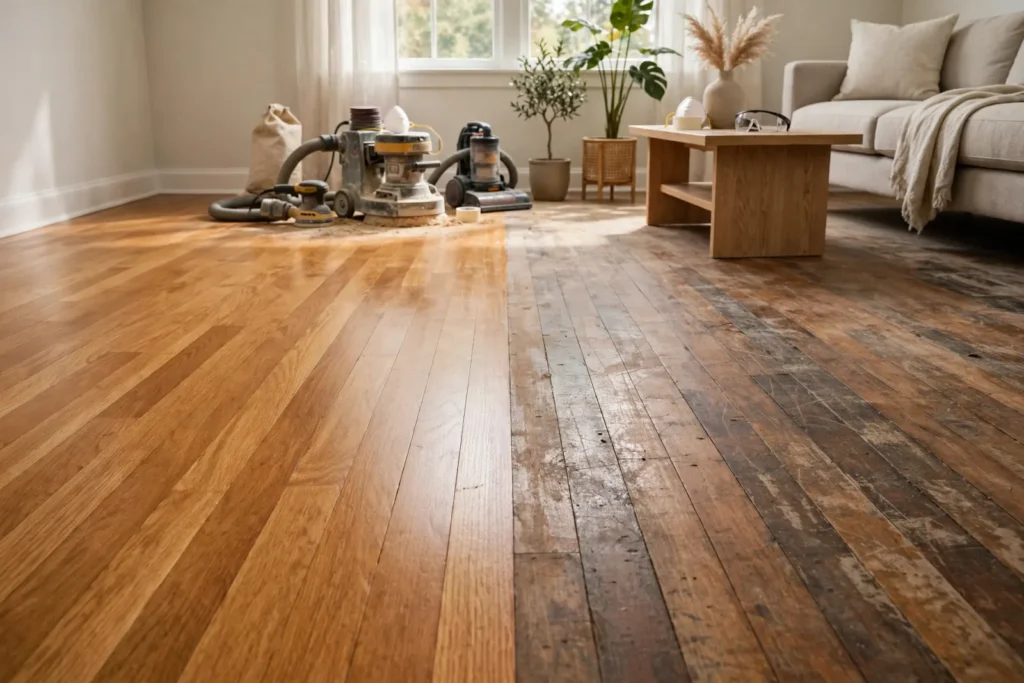
Hardwood floor refinishing can restore worn, scratched, or faded flooring without the cost and disruption of replacing every board. For U.S. homeowners planning a 2026 project, a realistic professional budget is about $3 to $8 per square foot for a full sand-and-refinish job, with many projects totaling roughly $1,100 to $2,700. Large areas, dark stain changes, damaged boards, stairs, dustless sanding, and specialty finishes can push the total higher.
Angi’s August 2026 cost data puts the national average at about $1,892, with most projects between $1,107 and $2,681. HomeGuide reports about $2 to $7 per square foot without staining and $3 to $8 per square foot with staining. Those ranges are useful for planning, but the condition and construction of your existing floor matter as much as square footage.
Hardwood floor refinishing cost at a glance
| Project or cost factor | 2026 planning range |
|---|---|
| Professional full refinishing | $3–$8 per sq. ft. |
| Typical total project | $1,100–$2,700 |
| Traditional sanding and refinishing | $3–$8 per sq. ft. |
| Dustless refinishing | $5–$8 per sq. ft. |
| Screen-and-recoat / buff-and-recoat | About $1–$2.50 per sq. ft. |
| Sanding only | About $0.50–$3 per sq. ft. |
| Staining | About $1–$3 per sq. ft. |
| Finish application | About $1–$2 per sq. ft. |
| Damaged-board repairs | Often $200–$600+ |
| Carpet removal before refinishing | Often $120–$720+ |
Small jobs may have minimum service charges, while larger continuous areas can sometimes cost less per square foot because setup is spread across more flooring.
Cost by room and floor area
Square footage is usually the clearest starting point. Current 2026 cost data gives the following practical planning ranges:
| Floor area | Typical refinishing budget |
|---|---|
| 100 sq. ft. | $200–$800 |
| 250 sq. ft. | About $500–$2,000 |
| 400 sq. ft. | $800–$3,200 |
| 1,000 sq. ft. | $2,000–$8,000 |
| 1,500 sq. ft. | About $3,000–$12,000 |
| 2,000 sq. ft. | About $4,000–$16,000 |
The upper end is more likely when staining, extensive prep, premium finishes, complicated layouts, or multiple repairs are involved. An open rectangular floor usually costs less per square foot than several small rooms connected by hallways, closets, thresholds, and stairs.
Traditional vs. dustless refinishing
Traditional refinishing
Traditional refinishing generally costs about $3 to $8 per square foot. The contractor sands off the worn finish and a thin layer of wood, repairs minor defects, applies stain if desired, and then applies protective finish coats.
The biggest inconvenience is dust. Professional crews use containment and vacuum equipment, but conventional sanding still creates fine wood dust that can travel beyond the work area if preparation is poor.
Dustless refinishing
Dustless systems connect commercial extraction equipment directly to sanding machines. Angi’s 2026 data puts this method around $5 to $8 per square foot. It is not literally dust-free, but it can reduce airborne dust and cleanup substantially.
Dustless refinishing may be worth the premium in occupied homes, homes with extensive built-ins, or projects where minimizing cleanup is especially important.
Screen and recoat vs. full refinishing
Not every dull hardwood floor needs aggressive sanding. A screen-and-recoat, sometimes called buff-and-recoat, lightly abrades the existing finish and adds a new protective coat. HomeGuide estimates roughly $1 to $2.50 per square foot.
This lower-cost option can make sense when:
- the finish is dull but the wood itself is not deeply scratched;
- there are no major stains or worn-through areas;
- the existing finish is compatible with a new coat;
- you are happy with the current color.
A full sand-and-refinish is more appropriate when scratches penetrate the finish, the color needs to change, old finish is failing, or wear has become uneven across the room.
Refinish or replace hardwood flooring?
Refinishing is usually much cheaper than installing new hardwood. Angi’s 2026 hardwood-installation data puts average new hardwood installation around $4,726, compared with roughly $1,887 for refinishing in its current dataset.
Refinishing makes the most sense when the boards are structurally sound and the main problems are surface wear, scratches, fading, or an outdated stain color.
Replacement becomes more reasonable when:
- large areas are severely cupped, crowned, or warped;
- water damage extends deeply into many boards;
- the subfloor has structural problems;
- boards have been sanded so many times that little usable wear layer remains;
- there is widespread rot or insect damage;
- you want a different flooring material or plank layout.
For broader replacement pricing, see our 2026 flooring installation cost guide.
Can engineered hardwood be refinished?
Sometimes—but not always. Solid hardwood can generally tolerate more sanding because the wood is solid through its thickness. Engineered hardwood has a real-wood wear layer over a manufactured core, so refinishing depends on how thick that top veneer is and whether it has already been sanded before.
Some engineered floors can be refinished once or twice; thin-veneer products may not be safe to sand at all. A flooring professional should inspect the wear layer before using a drum or belt sander. Sanding through the veneer permanently damages the plank.
What drives refinishing cost?
Floor condition
Deep scratches, pet stains, black water marks, loose boards, squeaks, gaps, damaged tongues, or previous coating problems add preparation time. Angi’s 2026 data suggests damaged-floor repairs often add roughly $200 to $600, although widespread board replacement can cost much more.
Wood species
Different species sand and accept stain differently. Softer woods can be easier to damage with aggressive sanding, while some dense or naturally oily species require careful product selection. Species can therefore affect both labor and finishing method.
Stain color
Keeping the natural wood tone is usually simpler than making a major color change. Dark stains can highlight sanding marks and uneven absorption, while very light or whitewashed finishes may require additional preparation and test samples.
Stairs
Stairs are slower than open flooring because treads, risers, corners, nosings, and balusters often require hand work or smaller machines. Ask for stair pricing separately rather than assuming the normal per-square-foot floor rate applies.
Furniture and appliance moving
The work area normally needs to be completely empty. Contractors may charge to move heavy furniture, appliances, or pianos. In kitchens, refinishing around fixed cabinets and islands also requires extra edge work.
How long does hardwood floor refinishing take?
Angi’s July 2026 scheduling guidance says many complete refinishing projects take about three to five days. The actual timeline depends on square footage, stain, humidity, finish system, number of coats, and curing requirements.
After the final coat, the floor may need roughly 24 to 48 hours before basic use, while full cure can take two to seven days depending on the product. Furniture, rugs, pets, and heavy traffic may need to stay off the floor longer than light foot traffic.
Follow the finish manufacturer’s written cure schedule rather than a generic rule, especially before replacing area rugs or moving heavy furniture back into the room.
Water-based vs. oil-based finish
Both systems can provide durable results, but they differ in appearance, odor, drying time, and application characteristics.
Water-based finishes generally dry faster and tend to remain clearer. Oil-based polyurethane usually develops a warmer amber tone and often has a stronger odor and longer cure time. Product quality varies widely within both categories, so compare the specific finish rather than assuming one chemistry is always superior.
If indoor-air exposure is a concern, ask the contractor for the exact product name and safety data before work begins.
Ventilation and indoor-air quality
Some stains, sealers, coatings, and cleaning products can release volatile organic compounds. The U.S. Environmental Protection Agency advises increasing ventilation when using products that emit VOCs, following label precautions, and providing plenty of fresh air during use.
Before refinishing starts, ask the contractor:
- which stain and finish products will be used;
- whether occupants should leave during application;
- how ventilation will be handled;
- when children and pets can safely return;
- when windows can be closed and HVAC returned to normal operation.
Do not rely on odor alone to decide whether a room is ready for normal use. Follow the product manufacturer’s instructions.
DIY vs. professional refinishing
Hardwood refinishing is possible as a DIY project, but the margin for error is smaller than it looks. Rental drum sanders remove material quickly. Stopping in one place, using the wrong grit sequence, or sanding unevenly can leave dips, waves, chatter marks, and edge damage that become more visible after stain is applied.
DIY is more realistic for a small, forgiving area when the floor is in good condition and the homeowner already understands sanding and finishing. Professional refinishing makes more sense when:
- the floor is valuable or historic;
- several connected rooms must match;
- dark stain is planned;
- stairs are included;
- there are damaged boards or moisture stains;
- the flooring is engineered and wear-layer thickness is uncertain;
- you want dust-controlled equipment.
This project is therefore a strong fit for our DIY vs. Professional category: the potential labor savings are real, but a sanding mistake can permanently remove usable wood.
Hidden costs to include in the budget
- Floor repairs: Angi suggests roughly $200–$600 for common damaged-floor repairs.
- Carpet removal: roughly $120–$720 in Angi’s 2026 dataset.
- Furniture moving: may be included, excluded, or charged separately.
- Baseboard or shoe-molding work: damaged or removed trim may need replacement and paint touch-up.
- Stair refinishing: often priced separately because of hand labor.
- Color samples: custom stain matching can add time.
- Cleaning: even dustless systems still require cleanup.
- Temporary relocation: strong odors, curing time, pets, or multiple coated rooms may make staying elsewhere more practical.
- Unexpected board replacement: hidden damage may not be fully visible until sanding begins.
How to compare refinishing quotes
Get at least two or three written estimates and make sure they cover the same scope. A useful quote should identify:
- square footage included;
- traditional or dustless sanding method;
- repair allowance or board-replacement pricing;
- number of sanding passes and general prep scope;
- stain brand and color process;
- finish manufacturer and product;
- number of finish coats;
- stairs, closets, and hallways included;
- furniture moving;
- baseboard or shoe-molding responsibility;
- cleanup;
- expected project duration;
- walk-on and full-cure timing;
- workmanship warranty.
A cheaper bid may exclude stain, repairs, furniture, trim, or additional finish coats. Compare complete scope rather than the headline total.
When refinishing is the better financial choice
If your floor is structurally sound, refinishing can extend its useful life for far less than full replacement. It is especially compelling when the existing hardwood is a quality product that would be expensive to replicate.
Replacement is more attractive when the floor has major structural damage or the layout no longer suits the renovation. If the problem is limited to surface wear, refinishing usually preserves more of the original material and avoids the demolition and disposal associated with installing a new floor.
A five-step hardwood refinishing plan
- Confirm the floor can be refinished. Identify whether the floor is solid or engineered hardwood, check the wear layer where possible, and document deep damage, pet stains, loose boards, and water problems before sanding begins.
- Choose the right level of work. Decide whether a screen-and-recoat is enough or whether full sanding, stain, repairs, and multiple finish coats are justified.
- Approve stain and finish samples. Ask for a sample on the actual floor when changing color. Confirm the exact stain, sealer, finish product, sheen, number of coats, ventilation plan, and cure schedule.
- Prepare the rooms. Remove furniture, rugs, fragile items, and anything that may collect dust. Clarify who removes appliances, base shoe, doors, or other obstacles.
- Plan for curing, not just drying. Arrange access so people, pets, rugs, and heavy furniture stay off the floor for the time required by the exact finish manufacturer.
Three realistic refinishing budget scenarios
Open living room in good condition: Natural-color refinishing with limited repairs and straightforward sanding is the type of project most likely to stay near the lower-to-middle cost range.
Multiple rooms with dark stain: More edge work, transitions, color sampling, and the need for very even sanding can move the project toward the upper end.
Older floor with board damage: Pet stains, water damage, loose boards, or uncertain engineered-floor wear layer can add repair cost or make replacement a better decision in isolated areas.
Final refinishing checklist
- Inspect the surface in daylight for missed scratches, swirl marks, uneven stain, debris, or lap marks.
- Confirm repaired boards are stable and transitions are smooth.
- Get the written walk-on, furniture, rug, pet, and full-cure schedule for the exact finish used.
- Ask for the stain and finish product names so future touch-ups can match.
- Replace felt pads on furniture before moving it back and avoid dragging heavy items.
- For future room-by-room flooring choices, see our best flooring for every room guide and our home maintenance checklist.
Local example: For refinishing prices in a dry, high-altitude climate, see our Denver hardwood floor refinishing cost guide.
Bottom line
For 2026, a professional hardwood floor refinish typically costs about $3 to $8 per square foot, with many projects around $1,100 to $2,700. A simple natural-color refinish on an open floor can stay toward the lower end, while dustless sanding, dark stain, damaged boards, stairs, multiple rooms, and premium finishes can move the project considerably higher.
The best quote is one that clearly defines sanding method, repairs, stain, finish system, coats, cleanup, and cure time. If the floor is sound, refinishing is often one of the most cost-effective ways to restore hardwood without paying for a full replacement.
Home Cost Desk compares current U.S. cost or technical references and checks safety, code, efficiency, incentive, or regulatory claims against authoritative sources when available. National figures are planning ranges, not local quotes.
Editorial review: Home Cost Desk Editorial Team · Read our research methodology · Detailed sources appear below.
Sources and methodology
Home Cost Desk uses current national consumer cost datasets for planning ranges and authoritative U.S. indoor-air guidance for safety-related recommendations. Actual prices vary by location, floor condition, wood species, finish system, contractor availability, and project size.