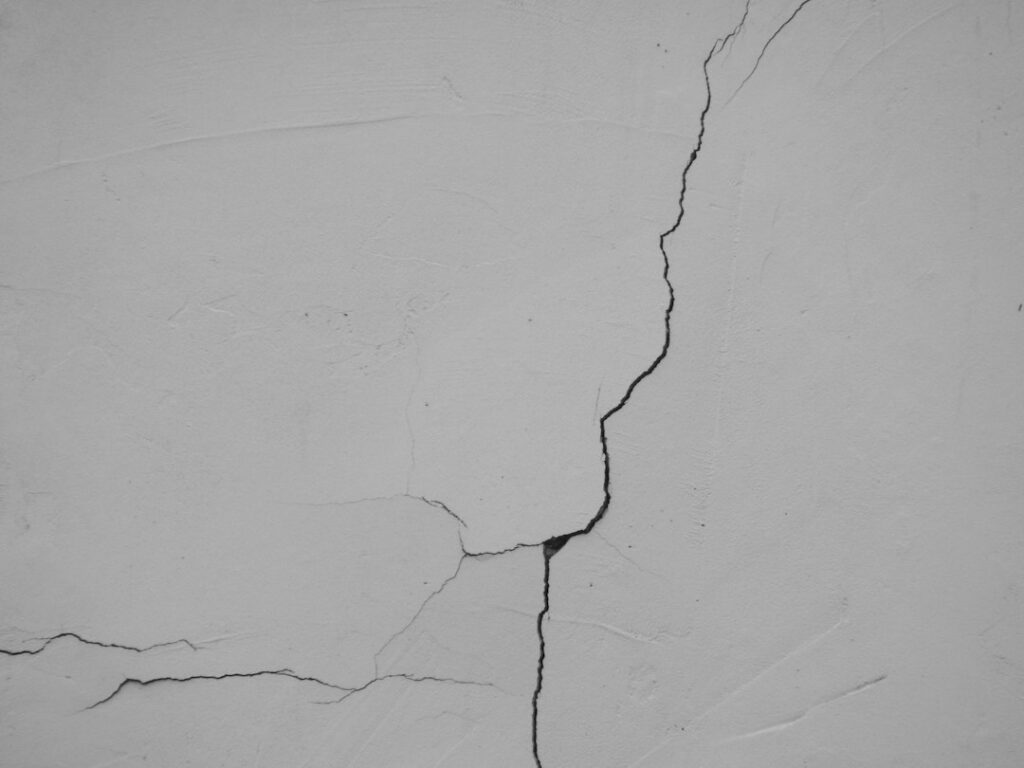
A crack in a foundation can mean very different things. Some cracks are the result of concrete shrinkage or minor movement and remain stable for years. Others can be early evidence of soil pressure, water intrusion, differential settlement, or movement that deserves professional evaluation.
The useful question is not simply, ‘How wide is the crack?’ A better 2026 homeowner test is: What direction does it run, is it changing, is the wall moving, is water coming through, and are there other symptoms elsewhere in the house?
This guide explains how to document and triage common foundation cracks without pretending that a photograph or internet checklist can replace an on-site structural evaluation. If a wall is bowing, a crack is growing, masonry is separating, floors are changing noticeably, or doors and windows have suddenly become difficult to operate, move beyond DIY monitoring and get qualified help.
Quick Decision Guide: Monitor, Investigate, or Act Now?
| What you see | Typical next step | Why it matters |
|---|---|---|
| Very fine, stable vertical crack in poured concrete with no water or displacement | Document and monitor | Some narrow vertical cracks can result from shrinkage and may remain non-structural |
| Crack that is visibly widening, lengthening, or reopening after repair | Professional evaluation | Change over time matters more than one snapshot |
| Horizontal crack in a basement or foundation wall | Prompt professional evaluation | Horizontal cracking can be associated with lateral soil pressure and wall movement |
| Stair-step cracking through brick or block mortar joints | Investigate, especially if new or growing | It can be associated with movement in masonry assemblies |
| Any crack with bowing, bulging, leaning, or displacement | Structural evaluation | Visible movement is more important than crack width alone |
| Crack that leaks during rain or snowmelt | Address water source plus crack condition | Sealing the interior surface alone may not solve drainage or pressure problems |
| Crack plus sticking doors, sloping floors, gaps, or separated trim | Professional evaluation | Multiple symptoms can indicate broader building movement |
First: Understand What a Foundation Crack Can—and Cannot—Tell You
A crack is evidence that a material moved or changed enough to separate. What it does not tell you by itself is the cause, whether movement is still active, or how much structural capacity remains.
Concrete shrinks as it cures. Soil can settle. Expansive soil can swell when wet. Poor drainage can keep soil next to a foundation saturated. Freeze-thaw cycles can affect some sites. Tree roots, nearby excavation, erosion, plumbing leaks, and changes in groundwater can also influence conditions around a house.
That is why responsible crack evaluation uses a pattern rather than one number. Location, orientation, width, displacement, moisture, wall shape, age of the house, soil conditions, and change over time all matter.
Vertical Foundation Cracks
Vertical cracking is common in poured concrete foundations. A fine, uniform vertical crack that appeared as concrete cured and has not changed can be far less concerning than a crack that is widening, offset, leaking, or accompanied by wall movement.
FEMA guidance for older unreinforced concrete foundation walls notes that thin vertical shrinkage cracks are common and may not significantly reduce wall strength, while larger or tapered cracks deserve closer investigation. That is useful context, but it is not a universal homeowner rule for every foundation type.
Monitor a vertical crack when all of these are true
- It is narrow and appears stable.
- The two sides remain in the same plane with no obvious offset.
- There is no bowing or bulging of the wall.
- No water is entering through it.
- No related movement is showing elsewhere in the house.
Escalate a vertical crack when one or more of these are true
- It is getting wider or longer.
- One side is displaced relative to the other.
- The crack is tapered rather than fairly uniform.
- Water repeatedly enters through it.
- The wall is leaning, bowing, or showing multiple new cracks.
- You also see floor slope changes, drywall cracking, separated trim, or doors and windows going out of square.
Horizontal Cracks Deserve More Attention
A horizontal crack in a basement or foundation wall should not be treated as a cosmetic defect until the cause is understood. Current homeowner guidance from This Old House emphasizes that horizontal cracks can be associated with lateral pressure from soil outside the wall, particularly when the wall is also bowing inward.
Soil pressure can increase when drainage is poor or water accumulates next to the foundation. The correct repair may therefore involve more than sealing the visible crack. Drainage, grading, gutters, downspouts, waterproofing, wall reinforcement, or other structural work may be part of the real solution.
If you already know your basement has water problems, compare the crack pattern with the broader drainage issues explained in our basement waterproofing guide.
Stair-Step Cracks in Brick or Concrete Block
Stair-step cracks follow mortar joints rather than cutting straight through masonry units. They can occur for different reasons, including settlement and movement in the supporting soil or foundation.
A small, old crack that has not changed may be a different situation from a fresh stair-step crack that is opening, extending, or appearing beside a leaning wall or separated brickwork. FEMA emergency-response material notes that stair-step patterns can be significant in unreinforced masonry after damaging movement, although post-earthquake conditions are not the same as everyday residential settlement.
For a homeowner, the practical rule is simple: new or changing stair-step cracking deserves investigation, especially when there is displacement or another symptom of movement.
Diagonal Cracks and Cracks Near Windows or Doors
Diagonal cracking can be associated with stress concentrations around openings, settlement, or movement. The context matters. A diagonal crack in interior drywall is not automatically a foundation failure, but when diagonal cracking appears with foundation movement, exterior masonry cracks, sticking doors, or sloping floors, the pattern becomes more important.
Do not use one drywall crack as proof that a house is “sinking.” Document the full set of symptoms and their timing. A professional should evaluate the building as a system rather than diagnose the foundation from one surface defect.
How Wide Is Too Wide?
Homeowners naturally want a single measurement that separates harmless from dangerous. Real structures are not that simple.
Several current homeowner and engineering references use roughly one-quarter inch as a point where closer evaluation becomes more important in certain types of cracks. FEMA guidance for older unreinforced concrete foundation walls, for example, says uniform cracks around that size or wider should be investigated more carefully.
But a width threshold should never override more important evidence. A narrower crack can still matter if it is growing, leaking, displaced, horizontal, or associated with a bowing wall. A wider old crack can sometimes be stable. Trend and movement are often more informative than width alone.
How to Monitor a Foundation Crack Correctly
If a crack appears minor and there are no urgent warning signs, create a simple record instead of relying on memory.
- Photograph the whole area. Take one wide photo that shows where the crack is located.
- Take a close-up with scale. Place a ruler or tape measure next to the crack without hiding it.
- Record the date. Keep the photo and measurement together.
- Mark the ends lightly. A pencil mark can help show whether the crack extends.
- Measure the widest point. Note whether the width is uniform or tapered.
- Check after major weather events. Heavy rain, prolonged drought, freeze-thaw cycles, or nearby construction can provide useful context.
- Watch the surrounding house. Note new sticking doors, gaps, sloping floors, separated trim, or masonry changes.
Do not install a cosmetic patch immediately if your goal is to learn whether the crack is moving. Covering the evidence can make monitoring harder.
Water Through a Foundation Crack Changes the Problem
A crack that leaks is no longer just a concrete-surface question. It is also a moisture-management problem.
The U.S. Environmental Protection Agency emphasizes that moisture control is the key to mold control. EPA guidance recommends fixing leaks and seepage, keeping indoor relative humidity below 60 percent when possible, and drying wet materials promptly—ideally within 24 to 48 hours.
That means the correct response to a leaking crack is not simply “inject it and forget it.” You should also inspect exterior drainage conditions:
- Are gutters overflowing?
- Do downspouts discharge next to the foundation?
- Does soil slope toward the house?
- Does water collect near the wall after rain?
- Is a sump system failing or cycling unusually?
- Could a plumbing leak be contributing?
If water is repeatedly entering a basement, solve the source before finishing walls or flooring. EPA specifically advises correcting basement moisture problems before converting or remodeling the space.
DIY Repair vs. Professional Evaluation
Some stable, non-structural cracks can be sealed by a capable homeowner using an appropriate concrete or masonry repair system. But DIY sealing is appropriate only after you have reasonable confidence that you are dealing with a stable crack rather than active structural movement.
DIY may be reasonable when
- The crack is small, stable, and well documented.
- There is no displacement, bowing, or leaning.
- There are no related movement symptoms elsewhere.
- The purpose is moisture control or cosmetic repair, not structural stabilization.
- The repair product is specifically designed for the material and condition.
Call a professional when
- The crack is growing or repeatedly reopening.
- The wall is bowing, bulging, or leaning.
- The crack is horizontal and appears related to wall movement.
- There is significant displacement from one side of the crack to the other.
- There are multiple new cracks in different parts of the house.
- Floors are changing slope or doors/windows have suddenly gone out of square.
- Water intrusion is recurring despite basic drainage corrections.
- You are planning a major remodel, addition, or structural change near the affected area.
If you need major work, use our 2026 contractor hiring guide to compare scopes, insurance, contracts, exclusions, and change-order terms.
Structural Engineer or Foundation Repair Contractor?
These roles are not identical.
A foundation repair company sells and installs repair systems. A structural engineer is hired to evaluate structural behavior and recommend what, if anything, is needed. When the diagnosis is uncertain or the proposed repair is expensive, an independent engineer can be valuable because the evaluation is separated from the sale of a particular repair system.
A practical sequence for a serious or ambiguous crack is:
- Document the symptoms.
- Correct obvious surface drainage problems that are safe to address.
- Obtain an independent structural assessment when movement is suspected.
- Use the written findings to request comparable repair scopes.
- Confirm whether permits or engineering documents are required locally.
For likely cost categories, our foundation repair cost guide explains common repair methods and budget drivers. Do not choose a repair system from price alone; it should match the diagnosed cause.
Red Flags That Should Move You Beyond “Wait and See”
- A crack changes noticeably over weeks or months.
- A foundation wall is visibly bowing or leaning.
- There is a horizontal crack plus inward wall movement.
- Masonry is separating around corners or openings.
- Floors have developed a new or worsening slope.
- Doors and windows that operated normally now bind in several areas.
- There are growing gaps between walls, ceilings, cabinets, or trim.
- Water is entering repeatedly through cracks or wall-floor joints.
- A chimney, porch, or attached structure appears to be separating from the house.
- Movement followed flooding, erosion, excavation, a major plumbing leak, an earthquake, or another significant event.
No single symptom proves structural failure. Several symptoms appearing together, however, make professional evaluation more important.
Drainage Is Part of Foundation Maintenance
Foundation care is not limited to inspecting concrete. Water management around the house can reduce unnecessary moisture and soil-pressure problems.
EPA guidance recommends keeping gutters functional and grading the ground so water flows away from the foundation. Regularly check downspout discharge, low spots beside the house, splashback, clogged drains, and areas where hardscape sends water toward the wall.
Add these checks to your home maintenance checklist, especially before and after your wettest season.
What Not to Do
- Do not diagnose structural safety from crack color or a phone photo alone.
- Do not assume every crack requires expensive underpinning.
- Do not assume every narrow crack is harmless. Movement and displacement matter.
- Do not repeatedly patch a leaking crack without investigating drainage.
- Do not finish a damp basement before resolving moisture.
- Do not excavate beside a foundation wall casually. Soil removal can affect support and is a job that may require professional planning.
- Do not let a contractor’s product determine the diagnosis. Start with the cause, then choose the repair.
A Simple Homeowner Foundation Log
Once a year—and any time you notice a new issue—record:
| Item | What to note |
|---|---|
| Cracks | Location, direction, width, length, date, change |
| Walls | Bowing, leaning, bulging, displacement |
| Doors and windows | New sticking, gaps, out-of-square operation |
| Floors | New slopes, dips, separation, cracking |
| Exterior drainage | Gutters, downspouts, grading, pooling water |
| Basement/crawl space | Dampness, leaks, musty odor, standing water |
| Recent events | Drought, heavy rain, flooding, excavation, plumbing leak |
This record does not replace an inspection. It makes an inspection more useful because you can show whether a condition is stable or changing.
Bottom Line
Most homeowners should think about foundation cracks in three categories: stable and monitorable, uncertain and worth evaluating, or actively changing and requiring prompt professional attention.
Fine vertical shrinkage cracks can be benign. Horizontal cracks, bowing walls, displacement, recurring water intrusion, growing cracks, and multiple symptoms across the house deserve more caution. Do not use crack width as the only decision rule.
The best response is disciplined rather than alarmist: document the condition, manage water, watch for change, and bring in an independent structural professional when movement or structural behavior is uncertain. That approach helps you avoid both expensive overreaction and costly delay.
Home Cost Desk compares current U.S. cost or technical references and checks safety, code, efficiency, incentive, or regulatory claims against authoritative sources when available. National figures are planning ranges, not local quotes.
Editorial review: Home Cost Desk Editorial Team · Read our research methodology · Detailed sources appear below.
Sources and Methodology
This guide uses current homeowner guidance and U.S. public-agency references to distinguish monitoring from escalation. Key references include FEMA guidance on foundation-wall crack evaluation and settlement indicators, the U.S. Environmental Protection Agency’s guidance on moisture and mold control, and 2026 foundation-crack guidance from This Old House. Because foundation design, soil, climate, construction method, and local code vary, the article intentionally avoids presenting any single crack width as a universal structural diagnosis.
- FEMA P-50-1 Seismic Retrofit Guidelines
- U.S. EPA: A Brief Guide to Mold, Moisture and Your Home
- U.S. EPA: Remodeling Your Home and Indoor Air Quality
- This Old House: Foundation Cracks—What Is Normal and When to Worry
Featured photo: Lallaoke via Unsplash.