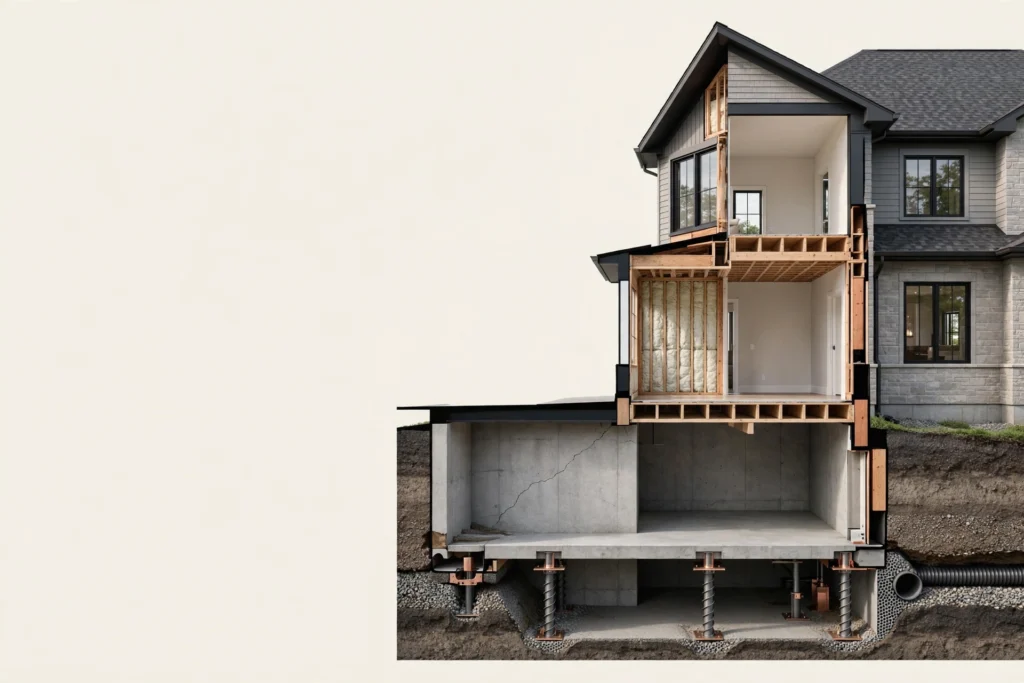
Updated October 2026. Foundation repair is a diagnosis-first project. The same visible crack can come from normal concrete shrinkage, poor drainage, expansive soil, plumbing leaks, settlement, structural loading, or a combination of causes. The useful question is not simply “How much does a crack cost to fix?” but “What is moving, why is it moving, and what repair actually addresses the cause?”
Quick answer: Foundation repair cost in 2026
For 2026 planning, Angi reports an average foundation repair cost of about $5,174, with many projects falling between $2,225 and $8,133. Minor crack repairs can cost a few hundred dollars, while serious settlement, wall stabilization, foundation lifting, or extensive underpinning can cost $10,000 to $30,000 or more. Angi’s separate 2026 underpinning data places many whole-project underpinning jobs in that higher range, which is why a simple “average foundation repair” number can be misleading for structurally significant movement.
Home Cost Desk planning rule: Spend money on diagnosis before committing to a major repair method. A $20,000 stabilization plan based on the wrong cause is more expensive than paying for an independent evaluation first.
Open the Project Budget Calculator →
Foundation repair cost by issue
| Issue | 2026 planning range | What usually drives the price |
|---|---|---|
| Foundation cracks | $250–$800 | Width, depth, activity, access, and whether water intrusion is involved |
| Foundation leaks | $2,000–$7,000 | Drainage correction, waterproofing method, excavation, and interior damage |
| Home settling | $5,000–$25,000 | Extent of movement, number of supports, soil conditions, and access |
| Foundation reinforcement | $1,000–$5,000 | Wall length, reinforcement system, and structural condition |
| Bowing walls | $4,000–$12,000 | Displacement, wall type, bracing or tieback method, and excavation |
| Poor soil drainage | $800–$15,000 | Grading, gutters, drains, excavation, waterproofing, and site constraints |
Foundation repair cost by foundation type
| Foundation type | Broad 2026 repair range |
|---|---|
| Basement | $2,300–$7,600 |
| Concrete slab | $350–$20,000 |
| Brick or block | $350–$25,000 |
| Pier and beam | $750–$25,000 |
| Stem wall | $350–$20,000 |
These ranges are broad because foundation type alone does not determine the repair. A slab with one nonstructural crack and a slab with widespread settlement are completely different projects.
Common repair methods and costs
| Repair method | Typical 2026 planning range | Best understood as |
|---|---|---|
| Mud- or slab-jacking | $500–$1,300 | A lifting or void-filling approach for selected slab problems |
| Piering or underpinning | Often $1,000–$3,000 per pier or support in general pricing tables | Structural support below a settling foundation |
| Whole-project underpinning | Commonly $10,000–$30,000+ | A multi-pier stabilization project rather than one support |
| Reinforcement systems | Often several thousand dollars | Wall or structural reinforcement where appropriate |
| Foundation lifting | About $20,000–$23,000 in some 2026 datasets | Major correction for substantial settlement |
Do not compare repair methods by price alone. The correct method depends on what is moving, the soil conditions, load path, foundation type, and whether water or drainage is contributing to the problem.
What changes foundation repair cost?
Cause of movement
Repairing a cosmetic crack without correcting drainage or soil movement can waste money. A proper evaluation should identify why the foundation moved and whether movement is active.
Foundation type
Slab, basement, crawl-space, pier-and-beam, brick, block, and stem-wall foundations require different repair techniques and access.
Soil and drainage
Expansive soils, poor grading, plumbing leaks, groundwater, erosion, and inconsistent moisture around the foundation can contribute to movement. In some cases, drainage work is part of the long-term repair plan.
Severity and accessibility
A small accessible crack is fundamentally different from widespread settlement beneath a finished home. Excavation, interior demolition, landscaping, driveways, porches, and limited equipment access can add cost.
Engineering and soil investigation
Angi notes that a soil report can cost roughly $500 to $3,000. A professional foundation inspection can also range widely—from a few hundred dollars to several thousand for more complex homes or investigations. That diagnostic cost can be worthwhile when the proposed repair is expensive, the cause is disputed, or several contractors recommend different systems.
Who should diagnose the problem?
A foundation repair contractor is useful for pricing and installing a repair system, but a contractor may naturally specialize in the systems that company sells. For significant movement, a large proposed underpinning job, a home purchase, or conflicting bids, consider an independent structural engineer who is not being paid to sell piers, anchors, or waterproofing. Soil-related movement may also justify a geotechnical professional.
The goal is not to add professionals unnecessarily. The goal is to separate diagnosis from sales when the financial or structural stakes are high.
Drainage and moisture can be part of the foundation problem
Foundation movement and foundation water problems are not always separate issues. Water collecting near the structure can contribute to moisture damage and, in some soils, changing moisture conditions can contribute to movement. The U.S. EPA recommends correcting exterior water sources such as poor grading, downspout discharge toward the house, leaks, and seepage rather than simply covering interior symptoms.
- Confirm that gutters are functioning and downspouts move water away from the foundation.
- Look for soil that slopes toward the house or areas where water ponds after rain.
- Repair plumbing leaks that may be adding water beneath or beside the foundation.
- Do not finish or cover a damp basement wall until the water source is understood.
- Include drainage corrections in the same long-term plan when they are contributing to the problem.
Warning signs that deserve professional evaluation
- Horizontal foundation cracks
- Stair-step cracking in masonry
- Cracks that are widening over time
- Doors and windows suddenly sticking throughout the house
- Noticeably sloping or uneven floors
- Walls separating from ceilings or floors
- Persistent foundation water intrusion
- Visible bowing or displacement
Safety: Foundation movement can involve structural risk. Major cracking, wall movement, sudden settlement, or other significant changes should be assessed by an appropriately qualified professional rather than diagnosed from appearance alone. If a wall is visibly shifting, a floor has dropped suddenly, or doors and windows change dramatically over a short period, treat that as a higher-priority evaluation rather than a cosmetic repair.
Three realistic budgeting scenarios
Scenario 1: Limited crack repair
A homeowner has one accessible crack with no evidence of ongoing movement, no bowing, and no widespread sticking doors or sloping floors. After evaluation, the repair is limited to sealing or epoxy work. This type of project may remain in the hundreds of dollars, but only if the crack is truly nonstructural and the underlying cause has been addressed.
Scenario 2: Drainage plus localized stabilization
A home has water collecting near one corner, minor settlement, and a few related cracks. The final project may combine grading or drainage corrections with localized structural repair. In this situation, the homeowner should budget for both the visible repair and the site condition that caused or worsened it.
Scenario 3: Significant settlement requiring underpinning
A house shows measurable settlement across part of the structure, multiple related cracks, sloping floors, and recurring movement. If an engineer confirms that multiple piers or supports are required, a whole-project budget of $10,000–$30,000 or more may be more realistic than the national average repair number.
How to compare foundation repair proposals
Do not compare only the bottom-line number. Ask each contractor to state the diagnosed cause, repair method, number and type of piers or supports, depth or refusal criteria where relevant, drainage work, engineering responsibility, permit requirements, warranty terms, and how floors or finishes will be restored.
| Proposal item | What should be written clearly |
|---|---|
| Diagnosis | What is moving and the evidence supporting that conclusion |
| Repair system | Exact method, materials, and number of supports or anchors |
| Performance target | Stabilization only, attempted lift, wall correction, or water control |
| Engineering | Who designs or reviews the repair and who pays for that work |
| Permits | Who obtains permits and schedules inspections |
| Drainage | Whether grading, gutters, drains, waterproofing, or plumbing issues are included |
| Restoration | Who repairs drywall, flooring, landscaping, concrete, or finishes |
| Warranty | Coverage, exclusions, transferability, and service-call conditions |
When monitoring may be reasonable—and when it is not
Not every crack automatically means a major structural repair. Small, stable cracks can sometimes be monitored after the cause has been evaluated. Take dated photographs, measure the crack at consistent locations, note whether doors or windows are changing, and watch for moisture after storms.
Monitoring is not a substitute for evaluation when there is horizontal cracking, measurable displacement, rapid change, bowing, widespread stair-step cracking, significant floor slope, recurring water intrusion, or multiple symptoms appearing together. Those conditions justify professional assessment sooner rather than later.
Common foundation-repair mistakes that waste money
- Repairing the crack but ignoring the cause. Cosmetic patching does not correct active settlement, water pressure, or unstable soil.
- Accepting the first expensive system without an independent opinion. This is especially risky when bids differ substantially.
- Comparing price per pier without comparing pier type and design. Two “eight-pier” proposals may not be equivalent.
- Assuming lifting the house is always the goal. Some repairs are designed primarily to stabilize future movement; aggressive lifting can create finish damage or other complications.
- Ignoring drainage after structural repair. If water management contributed to the problem, the long-term plan should address it.
- Forgetting restoration costs. Landscaping, patios, drywall, flooring, trim, plumbing adjustments, and repainting may be outside the structural quote.
- Relying on a warranty without reading exclusions. Check transfer rules, service requirements, movement thresholds, and what happens if drainage conditions change.
Five-step foundation repair planning process
- Document the symptoms. Photograph cracks, floor changes, wall separation, water entry, and sticking doors. Note when each symptom appeared and whether it is changing.
- Check obvious water sources. Review gutters, downspouts, grading, plumbing leaks, drainage paths, and standing water around the foundation.
- Get the right diagnosis. For substantial movement or a high-cost proposed repair, consider an independent structural engineer before selecting a repair system.
- Compare written repair scopes. Make each bidder state the diagnosis, repair method, quantity of supports, engineering, permits, drainage work, restoration, and warranty.
- Keep a contingency. Excavation can reveal additional damage, poor drainage, deteriorated materials, or access problems. Do not spend the entire budget on the base structural quote.
Before you request quotes: homeowner checklist
- Take clear dated photos of every crack and visible movement.
- Mark crack widths or measurement points so future change can be compared.
- Write down when sticking doors, sloping floors, leaks, or wall separation began.
- Collect previous foundation, drainage, plumbing, or structural reports if available.
- Photograph gutters, downspouts, grading, and areas where water ponds after rain.
- Ask bidders to price the same diagnosed scope so totals are actually comparable.
- Keep engineering, permits, drainage, restoration, and landscaping as separate budget lines.
Questions to ask before signing
- What evidence shows the foundation is still moving?
- What is the suspected root cause?
- Is the goal stabilization, lifting, wall correction, water control, or a combination?
- Do I need an independent structural engineer?
- Is a soil report necessary?
- How was the number of piers, anchors, or supports determined?
- What type of pier or support is specified and why?
- Are drainage corrections included?
- Are permits and inspections included?
- Who pays for engineering or third-party inspection?
- What finish repairs are excluded?
- What does the warranty cover, and is it transferable?
Frequently asked questions
How much does foundation repair cost in 2026?
A useful national planning average is about $5,174, with many projects around $2,225–$8,133. Minor repairs can cost hundreds, while major stabilization or underpinning can reach $10,000–$30,000+.
How much does underpinning cost?
Pricing may be quoted per pier, but a whole underpinning project often costs much more than a single support. Angi’s 2026 underpinning data places many complete projects around $10,000–$30,000, depending on the number of piers, access, foundation type, and soil conditions.
Should I call a foundation company or a structural engineer first?
For a small, obvious repair, a qualified foundation contractor may be enough. For widespread movement, a home purchase, conflicting bids, or a proposed five-figure repair, an independent structural engineer can help separate diagnosis from the sale of a particular repair system.
Can drainage really affect foundation problems?
Yes. Water pooling near a foundation, poor grading, gutter discharge, plumbing leaks, and persistent seepage can contribute to moisture problems and may affect supporting soils. The U.S. EPA recommends correcting water sources and directing runoff away from the foundation.
Does every foundation crack need repair?
No. Some cracks are related to shrinkage or minor movement, but appearance alone is not enough to determine significance. Crack direction, width, displacement, change over time, water entry, and other symptoms all matter.
Bottom line
For 2026 planning, roughly $5,174 is a useful national-average reference point, but foundation repair has one of the widest cost ranges in home improvement. The most important purchase is often the correct diagnosis. A cheaper repair that treats the wrong cause is not a bargain, and an expensive repair system is not automatically correct simply because it sounds permanent.
Related Home Cost Desk guides
- Foundation Cracks in 2026: Which Are Serious?
- Basement Waterproofing Cost in 2026
- Houston Foundation Repair Cost 2026
- New Orleans Foundation Repair Cost 2026
- French Drain Installation Cost 2026
- How to Hire a Home Contractor in 2026
- Annual Home Maintenance Cost in 2026
Home Cost Desk compares current U.S. cost or technical references and checks safety, code, efficiency, incentive, or regulatory claims against authoritative sources when available. National figures are planning ranges, not local quotes.
Editorial review: Home Cost Desk Editorial Team · Read our research methodology · Detailed sources appear below.
Sources and methodology
- Angi — Foundation Repair Cost, updated August 2026
- Angi — Underpinning Foundation Cost, updated July 2026
- Angi — Foundation Inspection Cost, updated July 2026
- U.S. EPA — Remodeling, basement moisture and drainage guidance
- U.S. EPA — Moisture control in the home
Updated October 2026. Cost figures are national planning estimates rather than local bids. Foundation type, soil, drainage, engineering, access, repair method, permits, and local labor can materially change the final price.