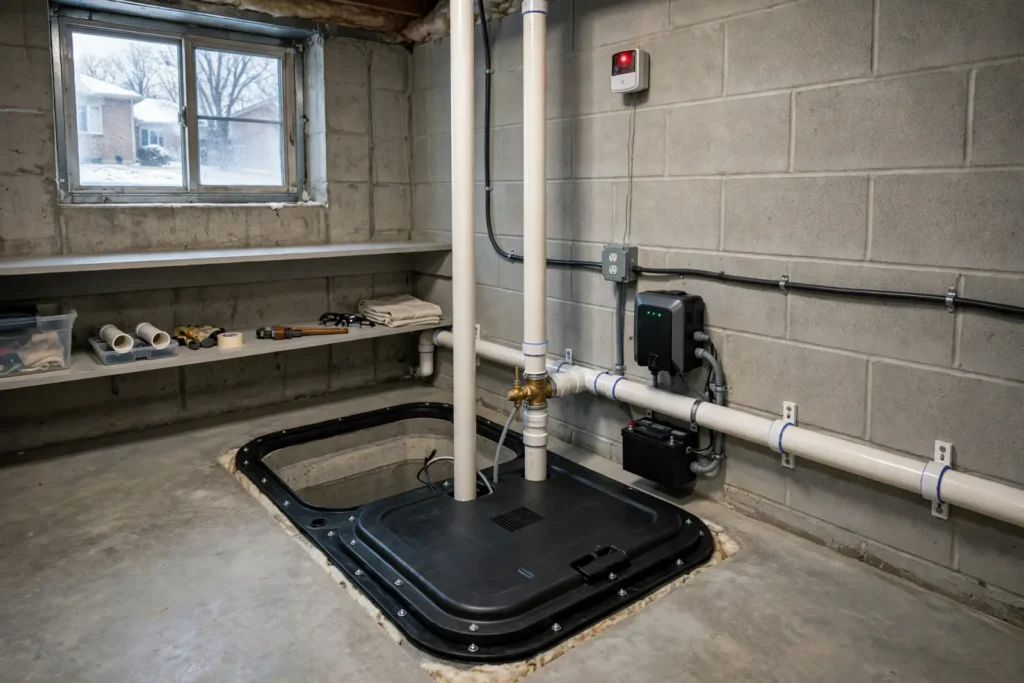
2026 cost snapshot
| Item | Planning range / amount | Basis |
|---|---|---|
| National replacement range | $309-$755 typical | Angi 2026 |
| Broader replacement range | $120-$1,350 | Angi 2026 |
| Milwaukee existing-pit replacement | $350-$1,200 common planning range | 2026 regional guides |
| Battery backup add-on | $500-$1,500+ | 2026 regional guides |
| New pit / full installation | $800-$2,500+ | Angi/regional 2026 |
Quick answer
Milwaukee sump pump replacement in 2026 commonly costs about $350 to $1,200 when an existing pit and discharge system are usable. National Angi data places standard replacement around $309 to $755, while regional Milwaukee-area waterproofing guides show replacement and service packages extending toward $1,000 to $1,200 or more.
Costs rise when the job includes a battery backup, new check valve, discharge correction, electrical work, sealed lid, alarm, new sump basin or basement waterproofing. Milwaukee’s cold winters also make discharge routing and freeze protection important in a way that a national average does not fully capture.
Why sump pumps matter in Milwaukee
Milwaukee-area homes frequently have basements, seasonal snowmelt and heavy rain events. A working sump system protects lower levels and foundations by moving groundwater or drain-tile water away from the structure.
The pump is only one part of the system. A perfect new pump cannot overcome a clogged basin, frozen discharge line, failed check valve or blocked drain tile.
Replacement versus first-time installation
Replacing a pump in an existing crock is usually straightforward: disconnect power, remove the old unit, inspect and clean the basin, install the new pump, verify the check valve and discharge and test the float.
A first-time installation is a different project. It may require concrete cutting, excavation, a new basin, drain-tile connection, a dedicated electrical supply and new discharge piping. That is why complete installations can cost several times more than a simple pump swap.
Submersible versus pedestal
Submersible pumps sit inside the basin and are common because they are compact and quieter. Pedestal pumps keep the motor above the pit, making some components easier to service but requiring adequate clearance.
Choose by pumping capacity, head height, basin size, reliability and serviceability rather than horsepower alone. An oversized pump can short-cycle if the pit and inflow do not justify the added capacity.
Battery backup
Power outages often occur during storms, exactly when the sump pump is needed most. A battery backup adds a second pump and power source when utility power fails or the primary pump cannot keep up.
Backup systems add cost but can be especially valuable in a finished basement or a house with repeated groundwater inflow. Ask about battery type, expected runtime, alarm, maintenance and battery replacement interval.
Milwaukee freeze risk at the discharge
A poorly sloped or exposed discharge line can freeze during a Wisconsin cold spell. A frozen line can cause the pump to run against a blockage or force water back toward the basin.
Discharge piping should drain after each cycle where possible and terminate where water will not flow back toward the foundation. Exterior routing should be designed for local winter conditions, not copied from a warm-climate installation.
Check valves and cycling
A check valve prevents water already pushed up the discharge pipe from falling back into the pit when the pump stops. A failed, missing or poorly positioned valve can cause frequent cycling, noise and unnecessary wear.
Ask whether the replacement includes a new check valve or whether the existing valve will be tested and reused. The valve is a small part of the bill but a meaningful part of system performance.
Milwaukee plumbing permit rules
The City of Milwaukee states that plumbing work generally requires a permit obtained through the Development Center and performed by properly credentialed contractors, with a limited homeowner exception for owner-occupied one-family buildings. City plumbing fixture documentation specifically includes sump pumps.
That means a homeowner should not automatically treat a sump pump project as a plug-in appliance swap. Ask the plumber whether the particular scope requires a permit and whether the permit fee is included.
Electrical safety in a wet area
Sump pumps operate in a wet environment and need safe, code-compliant power. Extension cords, improvised adapters and receptacles exposed to potential flooding are poor permanent solutions.
If the project reveals damaged wiring or needs a new circuit or receptacle, electrical work should be handled by an appropriately qualified contractor and permitted when required.
Pit condition and sealed covers
During replacement, inspect the basin for sediment, broken lids, float obstructions and poor pipe penetrations. A sealed lid can reduce moisture and soil-gas entry when it is compatible with the system design.
If a radon mitigation system connects to the sump, the lid and piping are part of the pressure boundary. Do not disturb that arrangement without restoring an airtight seal.
Insurance and finished-basement risk
Homeowners insurance coverage for groundwater, seepage or sump failure varies by policy. Some insurers offer water-backup or sump-overflow endorsements with separate limits and deductibles.
A homeowner with a finished basement should compare the cost of backup power and alarms with the value of flooring, drywall, furniture and mechanical equipment at risk. The cheapest pump is not always the lowest-risk decision.
Three Milwaukee scenarios
Scenario 1 – basic pump swap: the existing pit, discharge and power are sound. A new submersible pump and check valve keep the project near the lower local range.
Scenario 2 – finished-basement protection: the homeowner adds a battery backup, high-water alarm and improved discharge. The cost moves toward $1,200 to $2,000-plus but adds meaningful redundancy.
Scenario 3 – chronic water problem: the pump fails because the pit or drain system is undersized or clogged. The project expands into drain tile or waterproofing instead of another simple replacement.
Repair versus replace
A stuck float, clogged intake or failed check valve may be repairable. A burned motor, repeated failures, heavy corrosion or an older pump that does not pass testing usually justifies replacement.
Compare with the Sump Pump Replacement Cost 2026 guide for national context, but include Milwaukee winter discharge conditions in the decision.
Maintenance after replacement
Test the pump periodically by adding water to the basin, keep the pit free of debris, inspect the discharge outlet, test alarms and maintain backup batteries. Before spring snowmelt and storm season, confirm the float moves freely.
A pump that has not needed to run for months can still fail on the first major storm. Routine testing is inexpensive compared with basement restoration.
How to compare Milwaukee quotes
Require the pump model and capacity, check valve, discharge work, backup system, electrical scope, permit responsibility, old-pump removal, testing, warranty and emergency-service terms.
If one quote is much cheaper, check whether it excludes the permit, battery, check valve, discharge correction or after-hours support. Those items can explain most of the gap.
When the pump is not the main problem
Frequent cycling can indicate high groundwater, blocked drainage, negative grading, downspout problems or a drain-tile issue. Replacing the pump may only treat the symptom.
Use the Basement Waterproofing Cost 2026 guide if the home has broader wall seepage, floor leakage or drain-tile needs.
Pump capacity and head height
Pump ratings depend on how high and how far water must be moved. A pump advertised at a high gallons-per-hour number can deliver much less at the actual discharge head in the house.
Ask the plumber to match capacity to the vertical rise, pipe length and expected inflow. Oversizing by horsepower alone can cause rapid cycling; undersizing can allow the basin to overflow during a major storm.
Backup battery ownership cost
A battery backup adds ongoing maintenance. Batteries age, terminals corrode and chargers can fail. The homeowner should know the battery chemistry, replacement interval, test procedure and approximate replacement cost.
Some systems provide Wi-Fi or cellular alerts. Remote notification is valuable when the house is vacant, but confirm whether the feature requires a subscription or depends on home internet that may also fail during an outage.
Discharge destination
Moving water out of the basement is only useful if it is discharged to a legal location where it will not return to the foundation or create ice on a public walkway. The plumber should show the homeowner the final discharge point.
Do not connect or redirect sump discharge to a sanitary sewer without verifying local rules. Municipal requirements differ, and improper connections can overload public systems.
Emergency-preparedness checklist
Before spring storms, test the primary and backup pumps, confirm the outlet is open, inspect exterior piping, check the battery and make sure the homeowner knows which breaker supplies the pump.
Keep the plumber’s contact information and pump model near the mechanical area. During a widespread storm, service companies can be overwhelmed, so basic maintenance done in advance has real value.
Homeowner records and final QA
Keep the signed proposal, approved change orders, product specifications, permit or inspection records where applicable, warranty and completion photographs.
Before final payment, compare the completed work with the written scope and document any remaining punch-list items.
Primary pump versus backup pump sizing
The backup pump does not have to match the primary system exactly, but it should move enough water to protect the basement during a realistic outage. A tiny emergency pump may provide false confidence if groundwater inflow is heavy.
Ask for rated flow at the actual lift height for both pumps. This is more useful than comparing horsepower labels.
High-water alarms and monitoring
A high-water alarm can warn the household when the pump is not keeping up, the float is stuck or the discharge is blocked. Smart monitors can add remote alerts when no one is home.
Test the alarm along with the pump. An alarm that has a dead battery or relies on failed home Wi-Fi provides little protection during a storm.
Spring thaw and seasonal inspection
Before snowmelt and spring rain, clear the exterior outlet, test the pump with water and inspect visible piping for cracks or separation. Winter movement and ice can damage fittings even when the pump itself is healthy.
After a major storm, listen for unusually rapid cycling. A sudden change can indicate a check-valve, discharge or groundwater condition that deserves inspection.
Dual-pump systems
Homes with unusually high groundwater inflow may use two primary-capacity pumps or a staged dual-pump arrangement. The second pump can handle peak flow and provide redundancy if the first fails.
A dual system is more expensive and requires enough basin space, discharge capacity and power planning. It should be justified by measured inflow or a real flooding history rather than sold automatically.
What to test before the plumber leaves
Have the installer fill the basin and demonstrate primary-pump operation, check-valve function, backup operation and alarm. Listen for banging, vibration or short cycling and verify that water exits at the intended exterior location.
Record the pump model, warranty and breaker location. These small details are valuable during the next storm when the homeowner needs to troubleshoot quickly.
Bottom line
Milwaukee sump pump replacement in 2026 commonly falls around $350 to $1,200 for an existing pit, with battery backup and discharge improvements pushing the project higher. First-time pit installation is a separate, more expensive scope.
Prioritize reliability, backup power, freeze-resistant discharge and permit-compliant plumbing. In Milwaukee, a sump pump is a home-protection system rather than a minor appliance.
Frequently asked questions
How much does sump pump replacement cost in Milwaukee in 2026?
A common local planning range is about $350 to $1,200 for replacement in an existing pit.
Does Milwaukee require a plumbing permit for sump pump work?
The City states that plumbing work generally requires a permit, and sump pumps appear on its plumbing fixture documentation.
Is a battery backup worth it?
It can be very valuable in finished basements or homes where outages occur during heavy storms.
How do I prevent a frozen discharge line?
Use proper slope, protected routing and a discharge design that can drain after cycles. A local plumber should evaluate exposed piping.
Should I replace an old pump proactively?
Age alone is not the only factor, but noise, corrosion, cycling problems or unreliable testing are reasons to replace before an emergency.
Can a new pump fix a wet basement?
Only if the pump is the limiting problem. Drain tile, grading, wall seepage and discharge issues may require separate work.