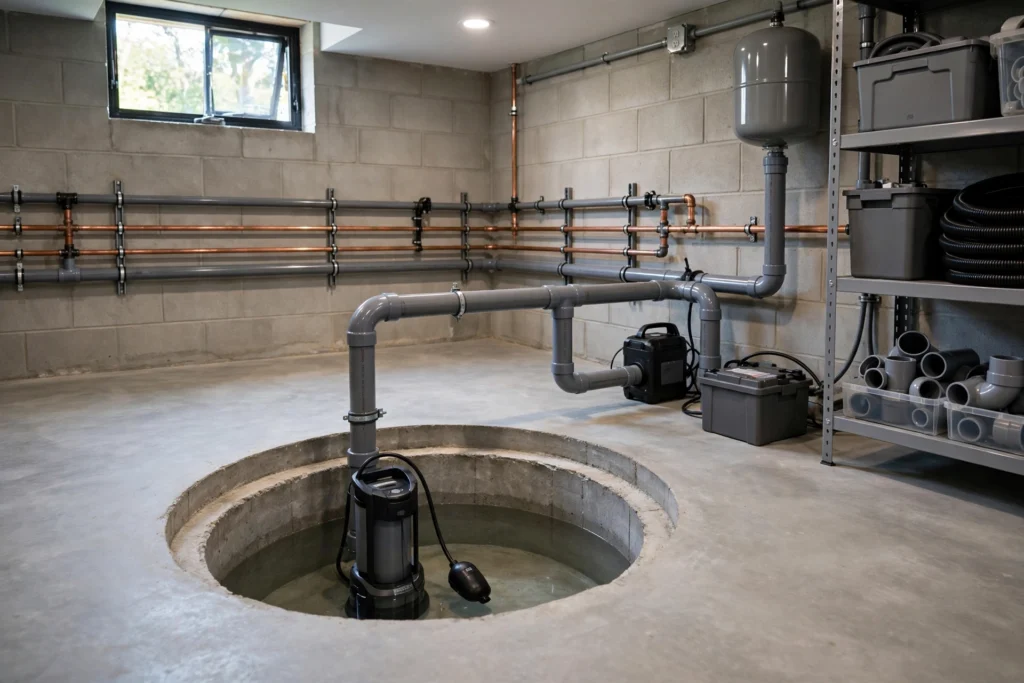
A sump pump is easy to ignore until it fails during a storm. For U.S. homeowners planning a 2026 replacement, a practical national budget is roughly $300 to $800 for many straightforward replacements. Current consumer cost datasets show a broader range from about $120 to $1,350 depending on pump type, labor, access, emergency timing, and whether the existing basin and discharge piping can be reused.
A replacement is usually much cheaper than installing an entirely new sump system because the pit, drain connections, electrical supply, and discharge route may already exist. A first-time installation can cost roughly $600 to $2,500, and difficult concrete-floor or drainage work can push the total higher.
For a typical professional sump pump replacement in 2026, use about $309–$755 as the core planning range. If the project also needs a battery backup, emergency service, discharge-pipe changes, electrical work, a new basin or concrete repair, price those items separately instead of treating them as part of the basic pump swap.
Sump pump replacement cost at a glance
| Project | 2026 planning range |
|---|---|
| Typical professional sump pump replacement | About $309–$755 |
| Broader replacement range | About $120–$1,350 |
| HomeGuide replacement benchmark | About $400–$700 |
| New sump pump installation | About $600–$2,500 |
| Sump pump repair | About $200–$870 |
| Battery backup system | About $150–$500 installed in many cases |
Interactive estimator
Sump Pump Cost Estimator
Choose the project type, then add only the options that apply. The calculator uses the 2026 ranges already cited in this guide.
This is a planning estimate, not a local quote. The calculator adds only the backup and emergency ranges stated in this article. It does not invent charges for access, piping, electrical or concrete work.
Angi’s 2026 replacement data puts many professional jobs around $309 to $755, while HomeGuide reports about $400 to $700 for a typical replacement. These are national planning figures, not guaranteed local prices. Your actual quote depends on the pump, discharge setup, access, labor rates, and whether related problems are discovered.
Replacement vs. new installation
A replacement normally means removing an existing failed or aging pump and installing a compatible new unit in an existing sump basin. If the discharge pipe, check valve, electrical connection, and pit are usable, the job can be relatively quick.
A new installation is a different project. It may require cutting or breaking a basement floor, excavating a sump pit, installing a basin, connecting perimeter drainage, adding discharge piping, and arranging suitable electrical service. HomeGuide reports typical new installations around $600 to $2,500, while difficult concrete-floor projects can reach several thousand dollars more.
Pedestal vs. submersible sump pumps
Pedestal pumps
A pedestal pump keeps the motor above the sump basin. The design is easy to access for service and is often less expensive. Angi’s current replacement data places pedestal pump units around $60 to $170, while broader retail and installation datasets may show higher prices depending on capacity and features.
Submersible pumps
A submersible pump sits inside the basin and is designed to operate while submerged. These units are usually quieter and can offer higher capacity, but they often cost more. Angi reports unit prices around $100 to $400, while HomeGuide’s broader equipment range extends higher for larger or more capable models.
Do not choose only by horsepower. The installer should consider the amount of incoming water, vertical lift, discharge-pipe length and diameter, check-valve setup, and the pump manufacturer’s performance curve.
What drives sump pump replacement cost?
Pump size and capacity
A larger or higher-capacity pump costs more. Homes with frequent groundwater intrusion, long discharge runs, or greater vertical lift may need a stronger unit than a small basement with occasional seepage.
Access
A pump in an open basement is easier to replace than one in a tight crawlspace, finished closet, or hard-to-reach pit. Difficult access increases labor time.
Discharge piping
If the existing pipe, fittings, or check valve are cracked, undersized, poorly routed, or leaking, the contractor may recommend replacing them at the same time.
Electrical work
A direct replacement may not require electrical changes. But damaged wiring, an unsuitable receptacle, or a new backup system can require an electrician. Electrical requirements are local, so the quote should identify any separate electrical work.
Emergency timing
After-hours service during a storm can cost more. HomeGuide reports emergency sump pump service commonly adds roughly $50 to $150 beyond normal service costs.
Repair or replace?
Not every malfunction means the pump itself is finished. Some problems can be caused by a stuck or failed float switch, clogged intake, blocked discharge line, damaged check valve, or power problem.
HomeGuide reports sump pump repair costs of roughly $200 to $870. When a repair approaches the cost of a dependable replacement—especially on an older pump—replacement may be the more predictable choice.
Repair can make sense when the unit is relatively new, the motor is healthy, and the fault is clearly limited to a serviceable component. Replacement becomes more attractive when the pump has repeated failures, corrosion, bearing noise, overheating, inadequate capacity, or a history of failing during heavy water events.
For general plumbing labor benchmarks, see our Plumber Cost in 2026 guide.
Why battery backup matters
Storms that bring groundwater into a basement can also cause power outages—the exact time an electric sump pump is most needed. FEMA’s homeowner flood guidance specifically recommends choosing a sump pump with a battery-operated backup to keep pumping during a power failure.
HomeGuide reports battery backup systems around $150 to $500 in many installations. More sophisticated systems with larger batteries, secondary pumps, monitoring, alarms, or water-powered backup can cost more.
A backup system should not be treated as unlimited runtime. Battery age, charging system, pump demand, and outage duration all matter. Test the backup periodically according to the manufacturer’s instructions.
Hidden costs homeowners should ask about
- New check valve or shutoff components
- Discharge-pipe repair or rerouting
- Battery backup or secondary pump
- Alarm or monitoring system
- Electrical repair or new outlet work
- Replacement sump basin or lid
- Concrete repair around the pit
- Emergency or after-hours service fees
- Water cleanup or drying after a failure
Ask the contractor to separate the pump replacement from optional system upgrades so you can compare quotes fairly.
Sump pits and radon
In homes where radon is a concern, the sump pit can be part of the radon-control strategy. U.S. EPA guidance for radon-resistant construction says an open sump can provide a pathway for soil gas and recommends a durable, removable, airtight sump cover where appropriate. Penetrations for wiring, discharge piping, or radon vent piping should also be sealed.
If your home already has an active radon system connected to the sump, do not remove or alter the sealed cover casually. Tell the sump-pump contractor about the radon system before work begins and restore the cover and seals correctly after service.
Can you replace a sump pump yourself?
A like-for-like replacement can be mechanically straightforward for an experienced homeowner when the basin, discharge piping, check valve, and electrical connection are already correct. But errors can leave a basement unprotected or create leaks exactly when the system is under the most stress.
Professional installation is the safer choice when the pump size is uncertain, discharge piping needs changes, a backup system is being added, electrical work is required, the pit is tied into radon mitigation, or the basement has a history of serious flooding.
How to compare contractor quotes
For a meaningful comparison, ask each contractor to specify:
- pump brand, model, horsepower, and pumping capacity;
- pedestal or submersible design;
- whether the existing basin is reused;
- whether a new check valve is included;
- discharge-pipe changes;
- electrical work or exclusions;
- backup-pump or battery options;
- testing after installation;
- cleanup and disposal of the old pump;
- equipment and labor warranty.
A lower quote is not automatically a better value if it reuses a failing check valve, ignores an undersized discharge line, or excludes testing.
Three homeowner scenarios
Simple replacement: The existing basin and piping are sound, the old pump has failed, and a compatible submersible unit can be swapped in. This is the type of project most likely to stay in the typical $300-to-$800 range.
Replacement plus backup: The main pump is replaced and a battery backup is added because the home experiences storm-related outages. Expect the total to rise beyond a basic replacement, but the homeowner gains protection during power loss.
Chronic basement water: The pump runs constantly and water still enters the basement. Replacing the pump alone may not solve the underlying drainage problem. The homeowner may need an evaluation of grading, gutters, foundation drainage, or waterproofing rather than simply buying a larger pump.
Maintenance after replacement
Test the pump regularly, keep the basin free of debris, confirm the float moves freely, and make sure discharge water exits away from the foundation. Check the backup battery and alarm if equipped. A pump that is never tested may fail unnoticed until groundwater rises.
FEMA describes sump pumps as an effective defense against basement seepage and flooding, but they are only one part of water management. Gutters, grading, exterior drainage, foundation conditions, and backup power all influence how well the system protects the home.
If exterior drainage is contributing to basement moisture, our Gutter Installation Cost in 2026 guide can help you budget another common water-management upgrade.
Five-step sump pump replacement plan
- Confirm the failure. Check power, float movement, intake blockage, discharge line and check valve before assuming the motor is dead.
- Match the pump to the water load. Ask the installer to consider vertical lift, pipe diameter, discharge distance and expected inflow rather than choosing horsepower alone.
- Decide on backup protection. If outages commonly occur during storms, price a battery or secondary backup at the same time.
- Inspect the whole system. Have the basin, lid, check valve, discharge piping, outlet and any radon seal evaluated while the pump is accessible.
- Test under load. Before final payment, fill the basin enough to trigger the pump, verify shutoff, listen for abnormal noise and confirm discharge water exits away from the foundation.
Questions to ask before approving the quote
- What pump model, capacity and warranty are included?
- Is the existing check valve being reused or replaced?
- Is the discharge line correctly sized and routed?
- Does the quote include removal of the old pump?
- Is a backup pump or battery included or optional?
- Will any electrical work require a separate trade?
- How will a sealed radon sump cover be restored if present?
Frequently asked questions
How much does sump pump replacement cost in 2026?
Angi’s August 2026 data places many professional replacements around $309 to $755. A straightforward job can stay near that range, while emergency service, piping changes or backup systems can push the total higher.
How long does a sump pump last?
Service life varies with run time, water volume, maintenance and pump quality. A heavily used pump may wear out much sooner than one that runs only occasionally.
Should I replace the check valve too?
If it is worn, noisy, leaking or old, replacement is usually sensible while the pump is being serviced. A failed check valve can make the pump cycle more often.
Is a battery backup worth it?
It can be valuable where storm-related power outages and basement water occur together. The decision depends on flood risk, outage history and the potential cost of water damage.
Related Home Cost Desk guides
- Basement Waterproofing Cost 2026
- French Drain Installation Cost 2026
- Gutter Installation Cost 2026
- Plumber Cost 2026
Local example: For battery backup and discharge rules in a basement-heavy market, see our Milwaukee sump pump replacement cost guide.
Bottom line
For 2026 planning, many straightforward sump pump replacements cost roughly $300 to $800, while the broader market can range from about $120 to $1,350. New installations are a different category and commonly cost about $600 to $2,500 before unusually difficult excavation, drainage, or electrical work.
Before replacing the pump, confirm the problem is actually the pump rather than the float, check valve, discharge line, or power supply. If basement flooding would cause major damage, price a battery backup at the same time rather than waiting for the next outage.
Home Cost Desk compares current U.S. cost or technical references and checks safety, code, efficiency, incentive, or regulatory claims against authoritative sources when available. National figures are planning ranges, not local quotes.
Editorial review: Home Cost Desk Editorial Team · Read our research methodology · Detailed sources appear below.
Sources and methodology
Home Cost Desk uses current U.S. consumer cost datasets as national planning references and federal guidance for flood and radon considerations. Local contractor quotes may differ substantially based on labor, access, drainage conditions, pump capacity, and electrical work.