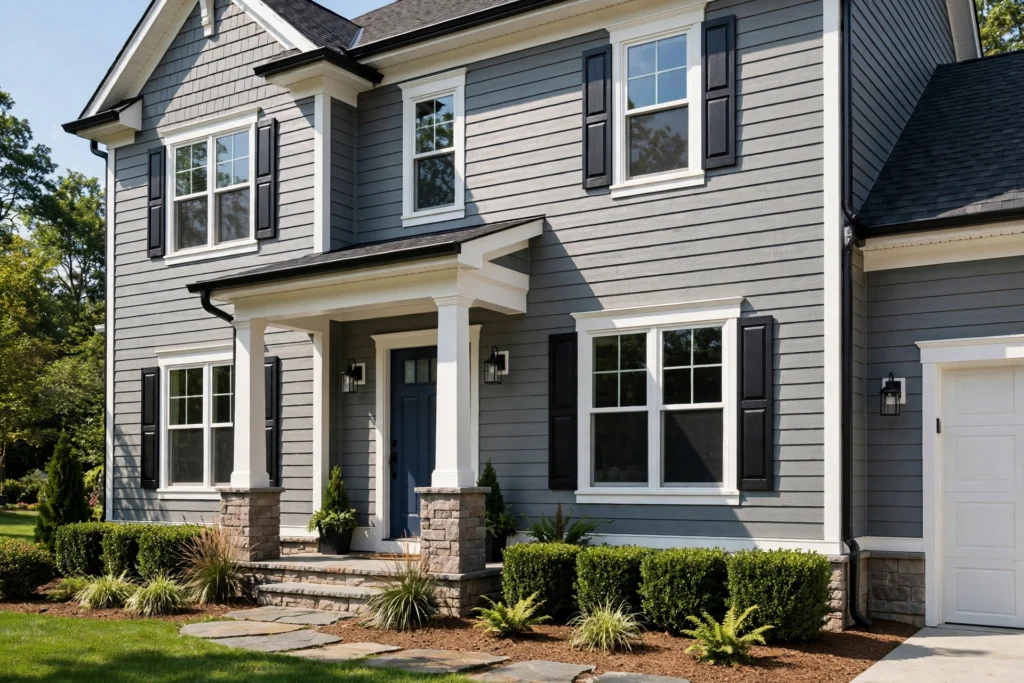
Updated October 2026. Siding damage does not automatically mean you need to reside the whole house. A cracked panel, one rotted board, impact damage, or a failed trim detail can sometimes be repaired locally. Full replacement becomes more reasonable when deterioration is widespread, water is getting behind multiple elevations, matching material is unavailable, or repeated repairs are no longer fixing the underlying wall problem.
Quick answer: In 2026, full siding replacement commonly budgets around $4 to $13 per square foot installed, with many national projects around $5,500 to $18,000. A repair can cost far less when damage is truly localized, but the right decision depends on the pattern of failure, the condition of the sheathing and weather barrier, and whether a repair can be integrated without creating new moisture paths. This guide is a decision framework, not a substitute for an on-site inspection.
| Situation | Repair is more plausible | Replacement is more plausible |
|---|---|---|
| Damage area | One or a few isolated panels/boards | Multiple walls or widespread deterioration |
| Moisture | Surface damage with dry wall assembly | Recurring leaks, soft sheathing, rot or mold concerns |
| Matching material | Same profile and finish are available | Product is discontinued or color mismatch is severe |
| Age/condition | Most of the siding has useful life left | Material is brittle, warped, cracked or repeatedly failing |
| Project goal | Restore one defect | Change material, maintenance level or exterior performance |
For full-replacement pricing by material, see our Siding Replacement Cost 2026 guide. The ranges below use that researched national cost framework so this article does not create a second, conflicting price system.
What siding repair can and cannot solve
A repair is useful when the failure is local and the surrounding wall system is still sound. Examples include replacing a damaged vinyl panel after impact, repairing a limited section of wood siding, correcting a small area of loose material, or addressing one flashing transition after the leak source has been identified.
What a repair cannot do is make a widespread moisture problem disappear. If several windows show staining, multiple boards are soft, panels are buckling across large areas, or the same leak returns after prior work, treating each visible defect separately can become an expensive cycle. In that situation, the useful question is not “Can this piece be patched?” but “Why is the wall system failing in more than one place?”
A practical 2026 cost framework
Repair pricing is less standardized than full replacement because the labor can be dominated by access, diagnosis, matching, and small-job minimums. Instead of presenting a universal repair price that may not fit your market, compare the repair quote with the replacement baseline and the area actually affected.
| Planning item | 2026 reference | How to use it |
|---|---|---|
| Full siding replacement | About $4–$13 per sq. ft. installed | Baseline for a whole-wall or whole-house alternative |
| Many whole-house projects | About $5,500–$18,000 | National project-level planning band |
| Old siding removal | About $0.70–$2.00 per sq. ft. extra | Useful when comparing repair with full tear-off |
| Fiber cement replacement | About $6–$15 per sq. ft. installed | Material-specific replacement reference |
| Vinyl replacement | About $4–$12 per sq. ft. installed | Material-specific replacement reference |
These are national planning figures from the current Home Cost Desk siding cost research, not repair quotes. A localized repair might be inexpensive relative to replacement, but a small project can still carry a high per-square-foot cost because the crew must mobilize, diagnose the problem, remove trim, match material, flash the opening correctly, and return the wall to a weather-tight condition.
The five questions that should decide repair vs. replacement
1. Is the damage cosmetic, material failure, or water intrusion?
Fading, a small dent, or one cracked panel is different from rot, soft sheathing, active staining, or repeated leaks. Cosmetic damage can often stay local. Moisture damage requires tracing the water path before deciding how much siding to remove.
Ask the contractor to identify the likely source of the problem. A failed window flashing detail, roof-to-wall transition, deck ledger, plumbing penetration, or missing kick-out flashing can damage siding even when the siding itself was not the original cause.
2. Is the underlying wall dry and structurally sound?
The visible finish is only one layer. Behind it may be sheathing, a water-resistive barrier, flashing, insulation, and framing. If those layers are wet or deteriorated, replacing only the outer panel may hide the evidence without fixing the risk.
Where there is suspected hidden damage, ask how the contractor will investigate it and how additional repairs will be priced. A written unit price for sheathing or framing work is better than an undefined change order after demolition starts.
3. Can the existing material actually be matched?
A technically sound repair can still look poor if the profile, texture, width, or color no longer matches. Sun exposure also changes older siding over time, so a new “same color” piece can look different beside weathered material.
For a side or rear elevation, a visible but acceptable mismatch may be worth the savings. On a prominent front elevation, partial replacement may create a result you dislike even when it performs correctly.
4. How much service life is left in the rest of the siding?
Do not replace an otherwise healthy exterior simply because one section failed. But also do not spend heavily on a local repair if several other areas are likely to fail soon. Ask the contractor to separate current defect from remaining-system condition.
5. Are you solving one problem or combining several projects?
Replacement may become more attractive if you are already planning new windows, exterior insulation, major trim work, a weather-barrier correction, or a substantial exterior redesign. Combining coordinated work can reduce repeated demolition and finish repair. It can also make the project more expensive, so the scope should be intentional rather than allowed to expand casually.
Damage patterns and the right next step
| What you see | Likely next step | Why |
|---|---|---|
| One cracked vinyl panel after impact | Price a localized replacement first | Damage may be isolated if wall behind is dry |
| Several warped panels on one sunny wall | Inspect fastening, heat exposure and wall condition | Replacing panels without finding the cause may repeat the problem |
| Soft wood siding near a window | Open enough area to inspect flashing and sheathing | Rot often points to a moisture path, not only a bad board |
| Repeated leaks at multiple windows | Investigate wall-wide flashing/weather barrier | Multiple failures can indicate a system-level problem |
| Widespread brittle or cracked material | Compare full replacement quotes | Frequent future repairs may be hard to justify |
| Storm damage on one elevation | Document damage and compare partial vs. full-elevation work | Matching and water management can determine the practical scope |
When partial replacement makes sense
There is a middle option between replacing one panel and residing the entire house: replacing one elevation or a defined architectural section. This can work when damage is concentrated on the weather-facing side, material can be transitioned cleanly at corners, and the remaining elevations are still serviceable.
Ask how the new section will terminate, how corners and trim will be handled, and whether the manufacturer allows the planned transition. A cheap partial job that creates awkward flashing details is not a bargain.
Pre-1978 homes: lead-safe work can change the repair plan
If paid renovation work disturbs painted surfaces in a pre-1978 home, the U.S. EPA Renovation, Repair and Painting rules may apply. Exterior siding work is specifically relevant because disturbance above applicable thresholds can require certified lead-safe practices when lead-based paint is present.
That matters for both repairs and replacement. A “small” siding repair can still involve cutting, scraping, demolition, dust, and debris from older painted material. Ask the contractor how the age of the home affects containment, cleanup, and certification before work starts.
DIY repair vs. professional work
A homeowner with appropriate skills may be able to replace a simple, accessible panel or board. The risk rises quickly when the job involves upper stories, fiber cement, hidden moisture, window or door flashing, roof-to-wall intersections, electrical penetrations, old painted surfaces, or structural repairs.
The difficult part is often not attaching the new piece. It is restoring the drainage plane behind it. Incorrect house-wrap laps, missing flashing, over-caulked drainage paths, or poorly detailed penetrations can create moisture problems that remain hidden for years.
A three-quote comparison worksheet
| Item | Quote A | Quote B | Quote C |
|---|---|---|---|
| Repair, elevation replacement, or full replacement? | |||
| Area/material included | |||
| Removal/disposal included | |||
| Weather barrier/flashing scope | |||
| Sheathing repair pricing | |||
| Trim/caulk/paint included | |||
| Lead-safe procedures if applicable | |||
| Permit responsibility | |||
| Material warranty | |||
| Workmanship warranty | |||
| Change-order rules |
A simple decision rule for homeowners
- Find the cause. Separate impact, aging, installation failure and water intrusion.
- Check the wall behind the damage. A dry, sound wall supports a smaller repair; hidden deterioration can expand the scope.
- Price the smallest durable fix. Ask what a localized repair would solve and what it would leave unresolved.
- Price the next larger scope. Compare a full elevation or whole-house replacement when repairs are recurring or matching is poor.
- Compare five-year consequences. Consider likely repeat repairs, maintenance, appearance and future planned work—not just today’s invoice.
Three realistic scenarios
Scenario 1: one damaged vinyl panel. The panel was cracked by impact, the wall behind is dry, matching material is available, and the rest of the exterior is in good condition. A localized repair is usually the logical first option.
Scenario 2: recurring rot below several windows. Replacing the visible boards one at a time may keep failing if the flashing or water-resistive barrier is wrong. The better project is to investigate the shared moisture path and open enough wall to correct it.
Scenario 3: brittle siding across multiple elevations. Individual repairs may be technically possible but increasingly difficult to match, and handling old material can create more breakage. At that point, compare full replacement bids rather than continuing an open-ended patch cycle.
Frequently asked questions
Is siding repair always cheaper than replacement?
The initial invoice is usually lower when damage is localized, but not every repair is durable. Repeated repairs, hidden rot, poor matching, difficult access, and system-wide installation problems can make a larger scope more economical over time.
Can I replace only one side of my house?
Sometimes. One-elevation replacement can be practical when the transition can be detailed cleanly and the remaining siding is still serviceable. Appearance, material compatibility, corner details and water management should be reviewed first.
Does damaged siding always mean the sheathing is damaged?
No. Impact or surface aging can affect siding without harming the wall behind it. But soft material, staining, recurring leaks, or damage around openings are reasons to investigate further.
Should I replace siding when I replace windows?
Not automatically. However, coordinating the projects can make sense when window flashing and surrounding siding already need major work. Compare the combined scope with doing the jobs separately.
How do I know whether a quote is for the same scope?
Compare removal, siding material, weather barrier, flashing, trim, repairs, permits, disposal, finish work, warranties and change-order rules line by line. Two bottom-line prices can describe very different projects.
What is the biggest siding-repair mistake?
Replacing the visible damaged piece without identifying why it failed. A durable repair addresses the source—especially when water is involved.
Before you approve a siding repair: final checklist
- The contractor has identified the likely cause, not only the damaged surface.
- The proposed repair area and material are clearly defined.
- The plan explains how weather barrier and flashing will be restored.
- Hidden sheathing or framing repair pricing is agreed in advance.
- Matching limitations for color, profile and texture are disclosed.
- Lead-safe procedures are addressed for applicable pre-1978 painted surfaces.
- Trim, caulk, paint and cleanup responsibilities are clear.
- Permit responsibility is identified where local rules require one.
- The workmanship warranty covers the repaired transition, not only the replacement piece.
- You understand what condition would cause the project to expand from repair to partial or full replacement.
Related Home Cost Desk guides
- Siding Replacement Cost 2026
- Window Replacement Cost 2026
- Exterior House Painting Cost 2026
- Gutter Installation Cost 2026
- How to Hire a Home Contractor 2026
Home Cost Desk uses current 2026 U.S. cost references as planning data and official safety guidance where applicable. Repair decisions are framed around scope, moisture risk, remaining service life and contractor evidence rather than a universal replacement threshold.
Editorial review: Home Cost Desk Editorial Team · Read our research methodology.
Sources and methodology
- Angi — Siding Replacement Cost, updated August 2026
- HomeGuide — House Siding Cost
- U.S. EPA — Renovation, Repair and Painting Program
National cost figures are planning references, not contractor quotes. Repair scope can change materially after siding is removed and the wall assembly is visible.