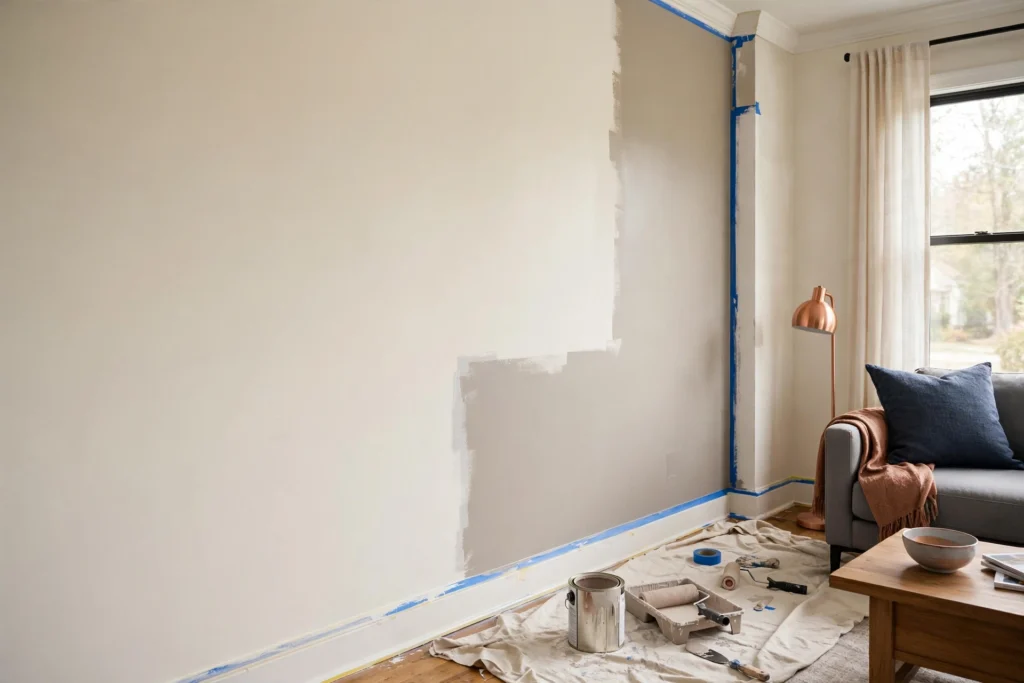
Updated October 2026. Interior painting looks simple until prep work, ceilings, trim, wall repairs, furniture moving, and multiple colors are added to the scope. Those details explain why two quotes for the same house can be very different.
Open the Paint Quantity Calculator →
Quick answer: Interior painting cost in 2026
For 2026 planning, professional interior painting commonly runs about $400 to $1,600 for a single room. Angi reports an average of roughly $2,022 to paint the interior of a house, with a broad range of about $350 to $5,800 depending on home size, surfaces, paint, prep, and location. Another useful planning method is about $2 to $6 per square foot for interior painting, but the number changes substantially depending on whether the quote covers walls only or also includes ceilings, trim, doors, closets, repairs, and multiple colors.
Home Cost Desk planning rule: Do not compare painting quotes until you confirm that both bids cover the same surfaces, preparation, number of coats, paint line, furniture protection, cleanup, and repair work. A lower quote may simply include less work.
Typical 2026 planning ranges
| Project | 2026 planning range | What can change it most |
|---|---|---|
| Single room | $400–$1,600 | Room size, ceiling height, prep, trim, number of colors |
| Interior house average | About $2,022 | Home size and number of surfaces included |
| Broad whole-house range | $350–$5,800+ | Small refresh vs. large multi-room project |
| Per-square-foot planning rate | About $2–$6 | Walls only vs. walls, ceilings and trim |
| Interior walls across a home | Often $1,500–$5,000 | Prep, access, paint quality and local labor |
These are national planning figures rather than local quotes. A 1,500-square-foot home does not automatically cost three times as much as a 500-square-foot project because painters price surfaces, prep, access, protection, setup, and complexity—not only floor area.
How to estimate your own painting budget
A useful early estimate starts with the scope rather than a single national average. List every room, then note whether each room needs walls only or also ceilings, doors, closets, baseboards, crown molding, window trim, and repairs. Next, identify unusually tall walls, stairwells, textured surfaces, damaged drywall, stains, or dark-to-light color changes.
Example: one standard bedroom
A normal bedroom with sound walls, standard ceiling height, one color, and limited trim work may fit near the lower or middle part of the $400–$1,600 room range. The same-size bedroom can cost materially more if it requires patching, stain blocking, two finish colors, ceiling paint, several doors, or detailed trim.
Example: whole-house refresh
For a whole-house project, ask the painter to separate walls, ceilings, trim, doors, closets, and repairs. This makes it easier to identify optional work and prevents a misleading comparison between a basic wall-only quote and a full repaint.
How much paint will you need?
Paint quantity is based on wall area and number of coats, not floor area alone. Angi notes that one gallon can cover roughly 400 square feet for one coat under typical conditions, while two coats and a small waste allowance are common planning assumptions. Porous drywall, textured surfaces, dramatic color changes, and some primers can reduce practical coverage.
For a rough calculation, measure each wall’s width by height, add the wall areas, subtract large doors and windows, then multiply by the number of coats. Use the manufacturer’s stated coverage for the actual paint you plan to buy rather than assuming every product performs identically.
What drives interior painting cost?
Wall condition and prep
Fresh, smooth walls are faster to paint than surfaces with cracks, nail holes, peeling coatings, stains, texture damage, or previous poor repairs. Sanding, patching, caulking, stain blocking, and primer can add significant labor.
Ceiling height and access
Vaulted ceilings, stairwells, two-story foyers, and tight spaces require more setup, ladders, staging, and time. A room with the same floor area can cost more simply because the walls are taller or harder to reach.
Trim, doors, and ceilings
Baseboards, crown molding, window trim, doors, cabinets, and ceilings are typically separate line items. These surfaces require careful cutting-in and often different paint products or finishes.
Number of colors and coats
More colors mean more setup and cleanup. Large color changes—especially dark-to-light or highly saturated colors—may require primer and extra coats.
Paint quality
Premium paint costs more per gallon but can offer better hide, washability, stain resistance, and durability. The cheapest material is not always the lowest-cost choice over the life of the finish.
DIY vs. professional painting
DIY can make sense when the project is one or two standard rooms, the walls are in good condition, ceilings are normal height, and you have time for careful preparation. Professional painting becomes more attractive when the project includes substantial drywall repair, stairwells, vaulted ceilings, detailed trim, many doors, textured walls, multiple colors, occupied rooms, or a tight completion deadline.
| Situation | DIY may fit | Professional help may fit better |
|---|---|---|
| One simple bedroom | Yes, if surfaces are sound | Useful if time is limited |
| Whole-house repaint | Possible but time-intensive | Usually faster and more consistent |
| Tall foyer or stairwell | Higher access risk | Usually preferable |
| Extensive wall repair | Requires repair skill | Often better for finish quality |
| Pre-1978 painted surfaces | Lead-safe planning is essential | Use appropriately certified professionals where required |
What DIY actually saves
DIY primarily removes professional labor from the budget. You still need paint, primer where needed, patching materials, caulk, rollers, brushes, trays, masking materials, drop cloths, ladders or access equipment, and disposal supplies. If you must buy equipment for a one-time job, the savings can be smaller than expected.
When DIY becomes false economy
DIY can cost more when poor prep causes peeling, visible patches, lap marks, overspray, damaged flooring, or the need for an extra coat. If the project includes water stains, active moisture, recurring peeling, or major drywall damage, identify and correct the underlying problem before repainting.
Important safety issue for pre-1978 homes
Paint disturbance in older homes can create lead-contaminated dust. The U.S. EPA’s Renovation, Repair and Painting program applies to many paid contractors who disturb painted surfaces in pre-1978 housing and child-occupied facilities. Covered firms generally need certification and trained renovators using lead-safe work practices.
For interior work, the federal rule generally includes an exception for minor repair and maintenance disturbing six square feet or less of painted surface per room, but important exceptions and state-authorized requirements can apply. Homeowners doing work in their own owner-occupied home are generally not regulated the same way as paid firms, but EPA still recommends lead-safe practices because sanding, scraping, cutting, and demolition can create hazardous dust.
If your home predates 1978, ask a contractor whether the proposed prep will disturb old coatings, whether the firm is properly certified for covered work, and how dust will be contained and cleaned. Do not treat aggressive dry sanding of unknown old paint as routine prep.
Questions to ask before accepting a quote
- Is wall repair, sanding, caulking, and spot priming included?
- Will stains receive a stain-blocking primer?
- How many finish coats are included?
- Are ceilings, doors, closets, baseboards, crown molding, and window trim included?
- Who moves and protects furniture?
- What paint brand, product line, color, and sheen are specified?
- Are paint and consumable materials included in the quoted price?
- How will floors, counters, cabinets, fixtures, and adjacent rooms be protected?
- Is cleanup and debris removal included?
- How are change orders handled if hidden wall damage is found?
- What is the expected start date, crew size, and completion window?
- What workmanship warranty, if any, is included?
How to compare two painting quotes correctly
Write the major scope items in rows and put each contractor’s answer beside them. Compare wall preparation, primer, coat count, walls, ceilings, trim, doors, closets, paint line, repairs, protection, cleanup, schedule, and warranty. If one proposal says “paint interior” and another lists every surface and preparation step, the two totals are not directly comparable.
Also distinguish an allowance from a firm inclusion. If drywall repair, stain treatment, or trim work is an allowance, ask how additional work will be priced and approved before it begins.
Paint sheen can change both appearance and cost
Flat and matte finishes hide minor wall imperfections better but may be less washable than higher-sheen products. Eggshell and satin are common for living areas because they balance appearance and cleanability. Semi-gloss is often used on trim and doors because it is durable and easier to wipe down. Higher-sheen finishes can make wall defects more visible, which may increase the amount of preparation needed for a polished result.
For a room-by-room breakdown, see our Interior Paint Finish Guide for 2026. If the existing coating is already failing, first review our Peeling Paint Guide so the underlying moisture or adhesion problem is not hidden under a new finish.
How to reduce cost without sacrificing the result
- Keep the color plan simple. Fewer colors reduce setup, cut-in work, and leftover paint.
- Group rooms when practical. A larger scheduled project can reduce repeated setup and travel.
- Decide which surfaces truly need paint. Sound ceilings or trim may not need repainting just because the walls do.
- Remove small items yourself. Wall art, fragile objects, and light furniture can often be cleared before the crew arrives.
- Resolve moisture first. Repainting over an active leak or condensation problem wastes money.
- Do not cut necessary prep. Skipping patching, cleaning, adhesion prep, or primer can shorten the life of the finish.
- Ask for alternatives. A painter may be able to quote walls-only, walls plus ceilings, and a full walls/trim package so you can choose deliberately.
Common interior painting mistakes that increase the final cost
- Choosing a paint color before viewing it in the room’s actual lighting
- Assuming one coat will cover every color change
- Ignoring stains or moisture damage
- Failing to specify whether closets, doors, and trim are included
- Buying paint before confirming the contractor’s preferred product and quantity
- Comparing quotes that use different paint grades
- Painting over peeling or poorly bonded existing coatings
- Disturbing old paint without considering lead safety
If the existing coating is peeling, bubbling, or repeatedly failing, review our Peeling Paint Guide before repainting. Paint cannot solve an unresolved moisture or adhesion problem.
Interior painting budget checklist
- List every room and surface to be painted.
- Measure approximate room and wall dimensions.
- Identify drywall repairs, cracks, stains, peeling areas, or texture problems.
- Decide whether ceilings, closets, doors, and trim are included.
- Choose the approximate color family and sheen before final quoting.
- Ask whether primer and two finish coats are included where needed.
- Confirm furniture protection and cleanup.
- For pre-1978 homes, address lead-safe requirements before sanding or scraping.
- Compare at least two written scopes for larger projects.
- Keep a contingency for repair work discovered during preparation.
Frequently asked questions
How much does it cost to paint one room in 2026?
A typical professional room-painting project is roughly $400 to $1,600. Small, simple rooms with sound walls may be near the lower end, while large rooms, high ceilings, detailed trim, repairs, or multiple colors can push the job higher.
How much does interior painting cost per square foot?
A broad professional planning range is about $2 to $6 per square foot. Always ask what the contractor’s square-foot figure includes, because walls-only pricing and a full walls/ceiling/trim package are different scopes.
Does a painter’s quote normally include paint?
Sometimes, but not always. The proposal should state whether paint and primer are included and should identify the product line or an allowance. Never assume that two quotes use comparable paint quality.
Is primer always necessary?
No. Primer is especially useful on bare drywall, repaired areas, stains, difficult color changes, or surfaces with adhesion concerns. A professional should explain where primer is needed instead of applying a one-rule-fits-all approach.
Should I paint before replacing flooring?
When both projects are planned, painting before new flooring can reduce the risk of drips or damage to the finished floor. Project sequencing still depends on baseboards, trim, and the flooring installation method, so coordinate both contractors before work begins.
What to do next: a five-step plan
- Define the scope. Decide exactly which rooms and surfaces are included.
- Inspect the walls. Note cracks, stains, peeling paint, texture damage, and moisture concerns before requesting quotes.
- Choose finish level. Set a realistic paint quality, color plan, and sheen so every contractor prices the same target.
- Compare written proposals. Match prep, coat count, paint line, protection, cleanup, schedule, and warranty line by line.
- Fix underlying problems first. Address leaks, condensation, damaged drywall, or lead-safety issues before final painting begins.
Bottom line
For 2026, a professional room repaint often costs $400 to $1,600, while whole-interior projects can range from a few hundred dollars for a limited refresh to several thousand dollars for a larger home. National data puts a typical whole-interior average near $2,022, with a broad planning rate around $2 to $6 per square foot.
The cheapest quote is not automatically the lowest-cost project. The most useful proposal clearly defines surface preparation, repairs, coat count, paint products, all included surfaces, protection, cleanup, and how additional work will be approved.
Related Home Cost Desk guides
- Dallas Interior Painting Cost 2026
- Interior Paint Finish Guide in 2026
- Peeling Paint in 2026: Causes and Fixes
- Flooring Installation Cost in 2026
- Bathroom Remodel Cost in 2026
- Kitchen Remodel Cost in 2026
- How to Hire a Home Contractor in 2026
Home Cost Desk compares current U.S. cost or technical references and checks safety, code, efficiency, incentive, or regulatory claims against authoritative sources when available. National figures are planning ranges, not local quotes.
Editorial review: Home Cost Desk Editorial Team · Read our research methodology · Detailed sources appear below.
Sources and methodology
- Angi — Interior and Exterior Painting Costs, updated April 16, 2026
- Angi — Cost to Paint a Room, updated July 8, 2026
- Angi — Cost to Paint the Interior of a House, updated July 9, 2026
- Angi — How Much Paint Do I Need?, updated July 31, 2026
- U.S. EPA — Renovation, Repair and Painting Program: Contractors
- U.S. EPA — RRP Program: Consumers
Updated October 2026. Cost figures are national planning estimates rather than local contractor quotes. Labor rates, prep needs, paint products, room geometry, and scope can materially change the final price.