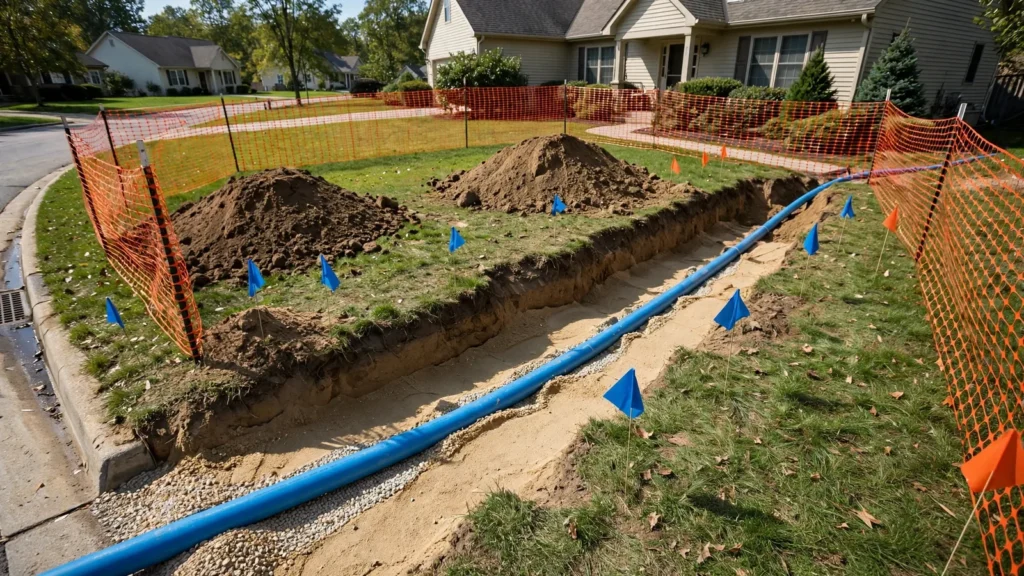
Quick answer: how much is a main water line replacement?
For a homeowner replacing the underground water service pipe between a public water main and the house, HomeGuide reports an average total of $2,000–$5,000. Its national method-specific estimates are $50–$200 per linear foot for a trenched replacement and $70–$250 per linear foot for trenchless work, including labor and pipe. Angi’s separate 2026 sample of 5,474 verified projects reports an average of $1,703, with most projects between $647 and $2,835; Angi also cites about $50–$150 per linear foot, reaching $250 in high-cost areas. Different job sizes and reporting methods explain why these totals should not be treated as contradictory fixed bids.
For a difficult site—long distance from curb to house, a driveway above the pipe, deep frost protection, rock, tree roots or restricted equipment access—the cost may exceed either average. The plumber’s written quote matters more than a single national number.
Terminology matters: The large pipe serving the street is usually the municipal water main. The smaller pipe bringing water from that main to your property is the water service line (often called a main water line by homeowners). This guide prices replacing the home service line, not replacing miles of public utility pipe. Responsibility for the connection, meter and public-side or private-side segments varies by utility and jurisdiction.
Water service line replacement: price by method
| Method | Published installed price per linear foot | Common cost trade-off |
|---|---|---|
| Open trench | $50–$200 | Often simpler pipe work, but excavation and surface restoration can be extensive |
| Trenchless replacement | $70–$250 | Higher pipe-work price can avoid major digging and some restoration |
Source: HomeGuide, Water Line Replacement Cost, December 22, 2025. Installed per-foot rates are broad national estimates and may overlap with access or restoration items in a particular bid.
Consider the length of the entire run: the connection at the street or meter, underground bends, depth, the foundation penetration and interior shutoff. A plumber may measure the straightforward pipe route while leaving excavation at a foundation wall for another contractor. Get the measured footage and the proposed route on the quote.
Open-trench replacement
A crew locates utilities, opens a trench, removes or bypasses the old pipe, lays a new service, performs tests, backfills and restores the surface as the contract requires. This offers direct visibility into the trench and pipe bedding, but can mean removing shrubs, grass, pavement or a concrete walkway. The work may require traffic, sidewalk or right-of-way approvals in addition to a plumbing permit.
In cold regions, local burial depth can be significant. In rocky soils or where other utility lines cross the route, manual excavation and protection may increase labor time. Ask whether the price assumes ordinary soil, and how unexpected rock, groundwater or buried debris would be billed.
Trenchless replacement
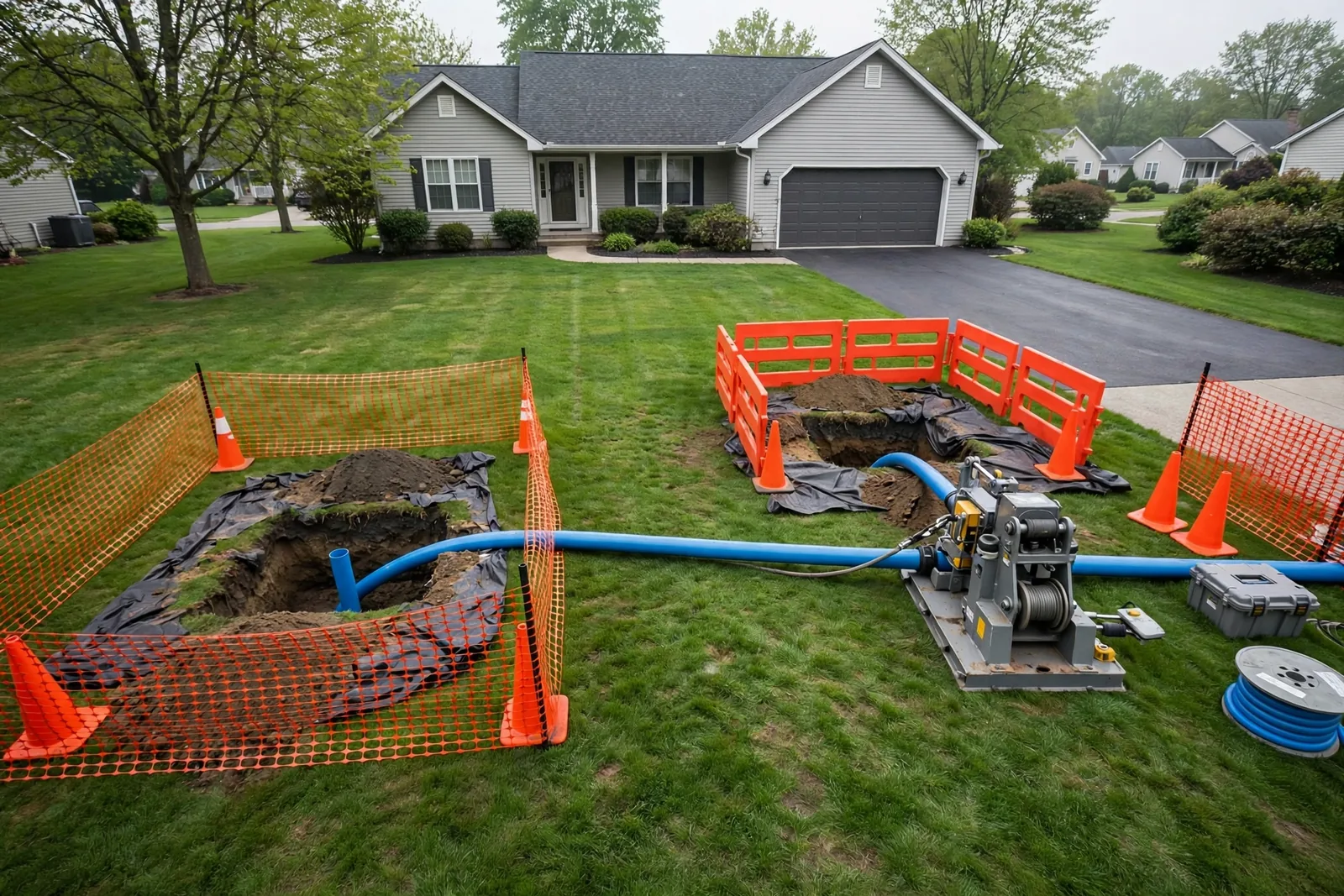
Trenchless methods include pulling a new pipe through a prepared route or replacing the old pipe through limited access pits. Pipe bursting may break apart the old line while drawing a replacement line behind it, but suitability depends on pipe material, fittings, nearby utilities, alignment and local approval. Not every existing service line can be treated this way.
The meaningful comparison is not just $70 versus $50 per foot. It is the complete amount after permits, access pits, pavement work and landscaping are considered. Ask whether each trenchless proposal includes the service connection and entry through the foundation, not merely the underground run.
What pushes a replacement quote up?
Distance from street to house
Length is important but does not tell the whole story. Many contractors have minimum mobilization costs for labor, equipment, traffic control and inspections. A 20-foot service may therefore cost much more than one-half of a 40-foot service. Deep or complicated runs can also exceed published averages.
Pipe depth and local frost conditions
Pipe depth must meet local code and utility specifications. In some areas the line can be comparatively shallow; in colder locations, it may be buried much deeper. Excavation near an old foundation needs care because undermining soil and damaging waterproofing can create structural or moisture problems beyond the plumbing scope.
Driveways, landscaping and hardscape
HomeGuide reports about $600–$3,000 for major driveway repair in its water-line cost discussion, with minor repair sometimes lower. This is a separate planning consideration only when the contractor’s installed price excludes restoration. You cannot simply add the full national repair range to every water-line job. A trenchless route may avoid most pavement removal, but access pits can still disturb landscaping.
Materials and approvals
Pipe choice must follow local plumbing and potable-water requirements. Flexible polyethylene and approved PEX-type materials, copper or other approved products may be options depending on climate, chemical conditions, service pressure and utility standards. Material price by foot is not the same as a safe, tested, permitted installation. Have the plumber specify size, material, fittings, tracer or locating requirements, and the manufacturer’s intended use.
HomeGuide cites $30–$500 for ordinary plumbing permits in its national guide, but utility connection and right-of-way fees can follow different schedules. Angi budgets $150–$500 for permits and inspections. Use the fee schedule for the municipality that will actually inspect the work.
Water main, sewer line, and whole-house repiping are different
If water leaks into your yard before entering the house, the water service line is one possible source. A sewer-line failure may instead cause backup or wastewater contamination and involves different methods, materials and approvals. Read our sewer line replacement cost guide rather than transferring sewer-repair prices to drinking-water plumbing.
A leaking pipe under the home’s slab can also involve an interior distribution pipe, not the outside service. See our slab leak repair cost guide. Replacing old plumbing inside the walls is a repipe (see our whole-house repiping cost guide) and does not automatically fix the buried line between the street and the house. The plumber should determine the failure location first.
Worked example: a 45-foot line crossing a driveway
Suppose a homeowner has a 45-foot water service line and must choose an open-trench route. HomeGuide’s national open-trench benchmark is $50–$200 per installed foot. The quote also says that major driveway restoration and permits are excluded.
| Component | Low-end planning math | High-end planning math |
|---|---|---|
| Trenched pipe: 45 × $50–$200 | $2,250 | $9,000 |
| Driveway repair, if genuinely excluded | $600 | $3,000 |
| Plumbing permit, if genuinely excluded | $30 | $500 |
| Illustrative planning total | $2,880 | $12,500 |
The arithmetic is 45×50 + 600 + 30 = 2,880 at the low end and 45×200 + 3,000 + 500 = 12,500 at the high end. This is a cost-build-up exercise, not a prediction that your plumber will charge the top or bottom figure. It can exceed the average because the scenario includes a relatively long run and driveway restoration.
For the same 45-foot distance, the trenchless pipe-work benchmark alone would be 45×$70–$250 = $3,150–$11,250, before deciding what access pits or permit charges are excluded. Do not declare either method cheaper without two actual full-scope bids. Enter both bids into our home-improvement cost calculator on equal terms.
Repair a leak or replace the entire service?
A localized, accessible failure might be repairable. But recurring leaks, widespread corrosion, obsolete pipe materials or a history of patching can make full replacement the more durable option. Angi’s separate main-line repair guide reports an average of $1,025, usually $354–$1,696; that is a different service and should not be advertised as the cost of replacing an entire run.
Ask for the remaining pipe’s condition, not only the visible leak. Request leak-location findings, pipe material identification, pressure data where appropriate, and a written explanation of why a short repair would or would not last. When the entire run is replaced, confirm whether the old pipe is removed, disconnected and abandoned in place, or left for future locating—and whether local standards permit that approach.
Lead service lines: verify the utility’s program first
An older property may have a lead or galvanized service line. Do not assume the owner must pay privately for replacement without checking the utility. Under the Lead and Copper Rule Revisions, the U.S. Environmental Protection Agency requires water systems to prepare and maintain service-line material inventories, classifying both the system-side and customer-side portions where ownership is split; initial inventories were due to state agencies by October 16, 2024. Local replacement programs, notices and cost-sharing rules can change the project.
Before scheduling excavation, contact the water utility for its material record, whether the line is affected by lead-service-line rules, and whether it offers or requires coordinated full replacement. Do not treat an unverified pipe as safe merely because the water looks clear. Use the utility’s drinking-water testing and public-health guidance. A private plumbing contractor should coordinate with the utility rather than cutting into public equipment without authorization.
How to choose the right contractor
A strong quote should specify:
- The measured length, source-to-house route, pipe size, material and required burial depth.
- Whether the water meter, curb stop, corporation stop and utility connection are in scope.
- How underground utilities will be located and protected.
- How the method handles driveway crossings, roots and existing buried services.
- Who obtains permits and schedules utility shutdown and inspections.
- Pressure-testing, flushing, disinfection or water-quality steps required by the utility.
- Restoration of lawn, pavement, walkways and disturbed foundation waterproofing.
- Warranty length, exclusions, and a unit price for unforeseen rock or extra footage.
Have licensed professionals handle permitted service-line work. Excavation carries cave-in and utility-strike hazards; do not enter unsupported trenches or attempt to connect to a live public main yourself. Our plumber cost guide explains why call-out rates and complete bid prices are different.
Frequently asked questions
What is the average cost to replace the water line from street to house?
HomeGuide reports $2,000–$5,000 on average. Angi’s separately sampled 2026 projects yield a smaller typical band of $647–$2,835. A real quote depends on footage, depth, method, access and surface restoration.
Is trenchless always cheaper?
No. The installed per-foot benchmark is often higher, while avoided landscaping and pavement restoration can offset it. Request comparable totals with permits, connection and restoration explicitly listed.
Who pays for the water service line?
It depends on the utility, local ordinance, meter location, property rights and sometimes lead-pipe replacement programs. Get the responsibility boundary in writing from the water utility.
Does homeowners insurance pay for this?
Ordinary deterioration and buried service lines are not universally covered. Review your policy and any service-line endorsement for covered causes, exclusions, deductibles and restoration before assuming reimbursement.
Can a plumber repair only the damaged section?
Sometimes. That may be appropriate for a single isolated failure in otherwise sound pipe. Repeated failures or restricted materials can make replacement more sensible.
Is this the same as whole-house repiping?
No. Whole-house repiping replaces interior supply plumbing; the underground service from the public network to the home is a distinct scope.
Bottom line
Start with the $2,000–$5,000 national service-line replacement average as a reference, then measure the actual pipe route and compare trenching with trenchless on the same complete scope. The potentially largest surprises are depth, utility connection, excavation conditions and restoration. If an older property has lead or unknown service materials, check the public water utility’s inventory and replacement program before ordering private work.
Reviewed by the Home Cost Desk editorial team on November 4, 2026. Prices are national planning ranges from dated sources; local rules, utility requirements and quotes govern.
Sources for editorial verification
- HomeGuide, Water Line Replacement Cost, written December 22, 2025: installed per-foot costs, $2,000–$5,000 average, driveway restoration and permit examples.
- Angi, Main Water Line Replacement Cost, updated October 14, 2026: separate national project dataset and method considerations.
- Angi, Main Water Line Repair Cost, updated September 23, 2026: separate repair-only reference.
- U.S. EPA, Planning and Developing a Service Line Inventory, last updated March 11, 2026: lead service materials and system/customer-side inventory.
- Worked 45-foot estimates are explicit arithmetic on a sourced per-foot range, with conditional excluded fees; no restoration is charged twice.