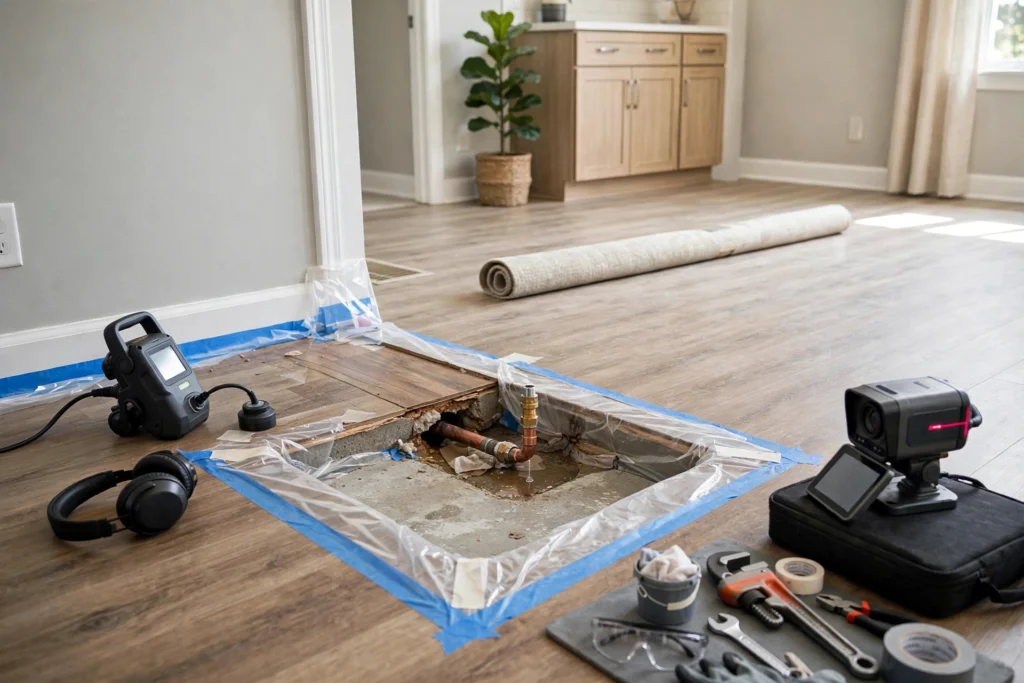
2026 cost snapshot
| Item | Planning range / amount | Basis |
|---|---|---|
| Typical slab leak repair | $630-$4,400 | Angi 2026 range |
| National average | About $2,280 | Angi 2026 average |
| Leak detection | $150-$400 | Angi 2026 |
| Slab leak reroute | $600-$4,000 | Angi 2026 |
| CIPP / pipe lining | $80-$250 per linear ft. | Angi 2026 |
| Digging + pipe replacement | $700-$5,000 | HomeGuide 2026 |
Quick answer
Slab leak repair in 2026 costs about $2,280 on average, with many homeowners paying roughly $630 to $4,400 for detection and repair. That range can cover a straightforward accessible leak, a reroute, or limited concrete access. It does not always include the full cost of replacing finished flooring, cabinets, drywall, or a large section of damaged slab. When a leak sits under expensive finishes or has caused structural or moisture damage, the all-in project can move well beyond the basic plumbing repair range.
The first money-saving step is accurate detection. Modern plumbers can use acoustic equipment, thermal imaging, pressure testing, and line isolation to narrow down the leak before demolition. The second decision is repair strategy: access the pipe through the slab, reroute it through walls or ceilings, line a suitable pipe, tunnel from the exterior in some regions, or replace a larger plumbing run when multiple failures make spot repair poor value.
What a slab leak actually is
A slab leak usually means a pressurized water line or, less commonly, a drain line leaking beneath a concrete slab foundation. Symptoms can include unexplained water bills, warm spots on the floor, sounds of running water when fixtures are off, low pressure, damp flooring, baseboard damage, or moisture appearing at the slab edge.
Not every wet floor is a slab leak. Appliance leaks, shower pan failures, exterior water intrusion, condensate, and roof leaks can create similar symptoms. A professional diagnosis should confirm that the leaking pipe is beneath the slab before the homeowner authorizes concrete demolition.
What the national slab-leak average does—and does not—cover
The $2,280 national average and $630–$4,400 typical range are planning benchmarks, not a quote for a fully restored room. Angi describes its average as including leak detection; that does not mean every contractor’s estimate includes detection or every damaged finish. HomeGuide’s method-specific ranges also describe different scopes, so do not add a full pipe-lining price to a full dig-and-replace price as if both repairs will be performed.
Ask for three separate subtotals: (1) locating and isolating the leak, (2) plumbing repair plus access and concrete closure, and (3) drying and finished-room restoration. A contractor may handle only the second part. Flooring, cabinets, drywall, paint, and any separately justified structural work can make the actual household expense materially higher than the national repair average. Confirm what each quoted number includes before comparing bids.
Leak detection before demolition: a homeowner checklist
Before approving slab access, request a written leak-location finding, the method used to confirm it, the expected demolition footprint, and an explanation of alternatives such as rerouting. Ask who is responsible for restoring flooring and finishes after the pipe is repaired.
- Obtain the leak-location report.
- Request an itemized spot-repair estimate.
- Ask for a rerouting alternative.
- Compare access and restoration exclusions.
- Confirm testing and warranty documentation.
Good detection reduces unnecessary damage. A plumber may compare water-meter movement with all fixtures off, pressure-test hot and cold lines, isolate branches, listen for leak noise, use thermal imaging to find hot-water patterns, or trace pipe routes. The exact tools depend on the house and pipe material.
Ask whether the detection fee is included in the repair quote or billed separately. Also ask what level of certainty the plumber has before opening the slab. No detection method is perfect, but a contractor should be able to explain why the proposed access point is the most likely location.
Spot repair through the slab
A spot repair exposes the damaged section by removing flooring and cutting or breaking a controlled opening in the slab. The plumber replaces the failed section, tests the line, and the concrete opening is patched. This can be economical when the pipe failure is isolated and the access area is inexpensive to restore.
The method becomes less attractive when the leak is under cabinets, tile, hardwood, stone, built-ins, or another expensive finish. It also deserves scrutiny when the plumbing system has already had multiple under-slab failures. Fixing one weak point in an aging system can leave the homeowner facing another slab opening later.
For a post-tensioned slab, ask the contractor how structural tendons and other embedded elements will be located and protected before access work begins. Specialist assessment may be necessary; a routine plumbing quote should not assume cutting is harmless.
Rerouting the leaking line
Rerouting abandons the leaking under-slab run and installs a new line through walls, ceilings, attics, chases, or another accessible path. Angi places many reroutes around $600 to $4,000, with complex whole-route work sometimes much higher. Rerouting can avoid breaking finished floors and can make future repairs easier.
The new route still has to meet code, protect piping from freezing or heat where relevant, maintain pressure and pipe sizing, and limit unnecessary wall damage. Ask which portions of the old pipe will be abandoned and whether future shutoff or isolation will remain straightforward.
Pipe lining: first identify whether the leak is in a drain or a drinking-water supply line
Cured-in-place pipe lining can rehabilitate some existing lines without exposing the entire buried run, but a gravity drain and a pressurized drinking-water supply pipe are not interchangeable applications. A liner suitable for a sewer or drain is not automatically suitable for a small-diameter residential hot- or cold-water line. If a contractor proposes lining, ask them to identify the failed pipe’s purpose, diameter, material, condition, fittings, and accessibility before treating lining as a realistic option.
Angi lists roughly $80 to $250 per linear foot for certain cured-in-place projects; HomeGuide cites $500 to $3,500 for some lining repairs. These published figures cover varying pipe types and project sizes and are not a guaranteed price—or proof of technical suitability—for an under-slab household supply leak. Ask for the specific lining system, its documented approval for the proposed use, the method for assessing the pipe, expected reduction in internal diameter, testing, and warranty. For any potable-water application, require evidence that the actual product is approved for drinking-water contact and the intended pressure and temperature, as applicable; NSF explains the scope of drinking-water component standards. Where suitability is unclear, obtain a conventional repair or reroute quote instead.
When broader repiping makes more sense
One under-slab leak can be an isolated event. Repeated failures, widespread corrosion, poor original material, or multiple weak branches can change the economics. In that situation, replacing or rerouting a larger portion of the plumbing system may cost more now but reduce the chance of repeated slab openings.
Use the Home Cost Desk Whole-House Repiping Cost 2026 guide when the plumber recommends more than a single localized repair. Ask for a side-by-side price and scope for spot repair versus broader rerouting so the decision is based on lifecycle risk, not fear.
Concrete and foundation repair after the plumbing work
Angi places concrete slab repair after a leak anywhere from a few hundred dollars to several thousand, depending on the size and location of the opening. A normal plumbing access hole is different from structural foundation damage caused by long-term soil movement or erosion.
If the leak has contributed to settlement, voids, cracking, or foundation movement, a structural professional may need to evaluate the slab separately. Use the Foundation Repair Cost 2026 guide to keep structural stabilization distinct from the plumbing bill. Do not let a plumber sell foundation piers without clear evidence that the foundation actually requires them.
Build-back: the hidden cost category
The leak may cost $2,000 to fix while the room costs another $5,000 to restore. Build-back can include tile, hardwood, vinyl, carpet, subfloor, cabinets, drywall, trim, paint, and moving appliances. Angi notes that restoration can range from a few hundred dollars to $10,000 or more when expensive finishes sit above the access point.
Ask whether the plumber restores the floor or only patches the concrete. Many plumbing contracts stop at a rough slab patch. Get a separate reconstruction quote before approving a repair method that requires demolition through a high-value room.
Example of a misleading price comparison: Contractor A proposes opening a kitchen floor, replacing the failed pipe section, and patching the slab; matching tile and drying are excluded. Contractor B proposes rerouting the line through a wall, with drywall repair included but final paint excluded. Neither proposal is automatically cheaper in total. Ask a flooring professional to price A’s tile restoration and a painter to price B’s finish work, then compare both completed-room totals. If the home has already had several under-slab leaks, also request a broader repiping option rather than treating either localized repair as the only choice.
Water damage and mold
A pressurized line can release a large amount of water before it is discovered. Drying may be needed in wall cavities, subflooring, cabinets, or insulation even after the pipe is repaired. If materials remain wet, mold can develop and flooring can continue to deteriorate.
For a large or long-running leak, include moisture mapping and drying in the plan. If mold is confirmed, use the Mold Remediation Cost 2026 guide to budget that scope separately rather than assuming a plumber will provide full remediation.
Permits and licensed plumbing work
Permit requirements vary by city and project. Angi notes that slab-leak permits often fall around $75 to $200, but local fee schedules control the real amount. A repair that only changes a short pipe section may be handled differently from a reroute, water-main repair, or foundation modification.
Ask the plumber to identify the permit required for the exact scope and whether inspection is included. Structural work may trigger a separate building permit or engineering review. Because slab work can affect both plumbing and the foundation, a vague “permit included” line is not enough on a complex project.
Insurance and warranty questions
Insurance treatment depends on the cause of the leak and policy language. Sudden resulting water damage may be covered differently from the cost of replacing a worn pipe. Corrosion, long-term seepage, or poor maintenance may be excluded. Some policies cover access and resulting damage but not the failed plumbing itself.
Document the condition before demolition when practical, notify the insurer promptly if a claim may apply, and ask the plumber to separate detection, pipe repair, slab access, drying, and reconstruction on the invoice. This makes coverage discussions easier.
How to compare slab leak quotes
Get at least two strong opinions when the repair is expensive or invasive. Each proposal should identify the confirmed or suspected leak location, detection method, repair method, pipe material, length of new pipe, demolition area, concrete repair, permit responsibility, water shutoff duration, testing, and build-back exclusions.
Compare like with like: Ask both contractors to mark each of these items as included, excluded, or priced separately: leak detection; pipe work; floor or wall access; concrete closure; finish restoration; drying; permit and inspection; and post-repair leak testing. A cheaper pipe-only quote may be more expensive once another contractor restores the room.
Use the Plumber Cost in 2026 guide to understand labor pricing, but compare the full scope rather than hourly rate alone. A contractor with a higher hourly rate may finish with less demolition if the diagnosis is better.
- Ask whether the leak is isolated or part of a broader pipe problem.
- Compare spot repair with rerouting before cutting expensive finished floors.
- Separate plumbing repair from concrete patching and room reconstruction.
- Confirm leak testing after the repair and before the slab is closed.
- Keep photos, permits, pressure-test results, invoices, and warranty documents.
What to compare on two slab-leak bids
| Line item | Check both proposals |
|---|---|
| Diagnosis | Confirmed location, detection charge, and test report. |
| Pipe repair | Pipe type, repair length, and alternative route. |
| Access | Slab or wall openings, debris removal, and protection. |
| Closure | Leak test, concrete patch, and any inspection. |
| Build-back | Flooring, cabinetry, drywall, painting, and drying. |
Hot-water slab leaks versus cold-water slab leaks
Hot-water leaks often reveal themselves through warm floor areas, unusually high water-heating use, or the sound of water movement even when fixtures are off. Cold-water leaks may be harder to feel and can show up first as a rising water bill, pressure loss, or damp finishes. The detection approach may differ because thermal imaging is more useful when escaping water changes surface temperature.
The repair decision can also differ. A single hot-water branch may be relatively easy to reroute through a wall or attic, while a main cold-water distribution line may serve several fixtures and require a more deliberate design. Ask the plumber to map the affected branch before choosing the least invasive route.
Water pressure, corrosion and root-cause prevention
Repeated slab leaks sometimes point to a system condition rather than random bad luck. Excessive water pressure, aggressive water chemistry, pipe movement, poor original installation, or corrosion can shorten pipe life. Fixing one pinhole without checking pressure and the rest of the system can leave the homeowner exposed to another failure nearby.
Ask the plumber to measure static pressure and evaluate whether a pressure-reducing valve or thermal expansion control is working properly where applicable. If the failed material shows broad corrosion, consider whether the leak is evidence for a larger repiping decision. The goal is not to sell unnecessary replacement; it is to understand whether the damaged section is isolated or representative.
Temporary water service and living in the home during repair
A slab-leak project can leave parts of the house without water for hours or days depending on the method. Before work begins, ask what fixtures will be unavailable, whether the water can be restored overnight, and whether a temporary bypass is possible. Households with children, elderly residents, or medical needs may need a more detailed plan.
Protect belongings and finished areas near demolition. Concrete cutting creates dust and vibration, and rerouting can require wall or ceiling access far from the leak location. A good contractor should identify the work path and protection plan before the first cut so the homeowner understands the disruption as well as the price.
Bottom line
Slab leak repair in 2026 averages about $2,280, with many projects between $630 and $4,400. The final project can cost more when leak detection, slab access, flooring, cabinets, structural repairs, water damage, or broader repiping are involved.
The lowest-cost repair is not always the smallest hole in the floor. The best solution is the one that accurately locates the leak, matches the repair method to the condition of the plumbing system, minimizes unnecessary demolition, and leaves a documented, tested repair that can be serviced in the future.
Frequently asked questions
How much does slab leak repair cost in 2026?
A practical national range is about $630 to $4,400, with an average near $2,280. Finished-floor restoration and structural or water damage can increase the total.
How much does slab leak detection cost?
Angi reports about $150 to $400 for many detection jobs, with an average near $280.
Is rerouting cheaper than breaking the slab?
Sometimes. Rerouting often costs about $600 to $4,000 and can avoid expensive floor demolition, but the best choice depends on pipe routing and the condition of the rest of the system.
Can a slab leak be repaired without jackhammering?
Yes in some cases. Rerouting and cured-in-place lining can avoid direct slab access, but not every leak or pipe is suitable for those methods.
Does insurance cover slab leaks?
It depends on the policy and cause. Resulting sudden water damage may be treated differently from worn or corroded plumbing. Ask the insurer before demolition when a claim may apply.
Should I repair one leak or repipe the house?
One isolated leak may justify spot repair. Repeated failures or widespread aging pipe can make broader rerouting or repiping better long-term value.
Does the average slab-leak price include replacing tile or hardwood?
Not necessarily. Published repair averages do not guarantee that a particular contractor will replace flooring, cabinets, or other finishes. Request separate written prices for pipe repair, slab closure, drying, and room restoration. This is especially important when a spot repair opens an expensive kitchen or bathroom floor.
Can a sewer-pipe liner be used on a leaking drinking-water line?
Do not assume so. A product designed for gravity drains is not automatically approved for pressurized potable-water plumbing. Ask for documentation that the proposed system is suitable for the exact pipe, drinking-water contact where applicable, operating pressure, temperature, and local requirements. Compare with rerouting if the contractor cannot substantiate suitability.