Quick answer
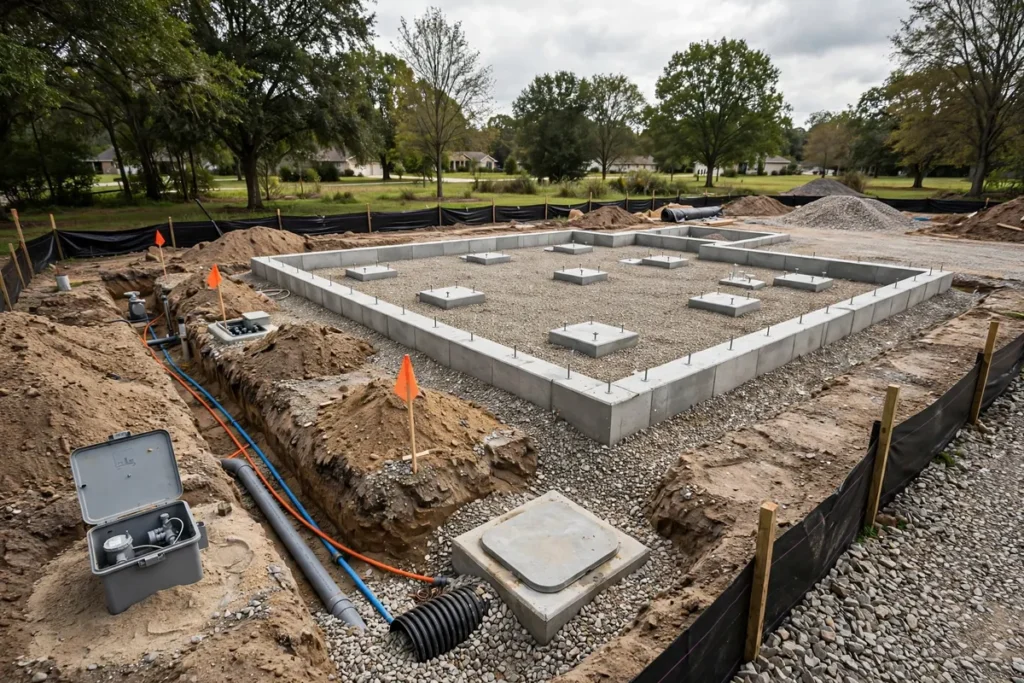
Putting a manufactured home on your own land costs far more than the delivery fee. Beyond the home, you pay for site preparation, a foundation or support system, utilities, transport and set-up, permits and inspections. HomeGuide’s national guide (updated December 2025) lists site preparation at about $4,000 to $11,000, a permanent foundation at $3,000 to $36,000, full-service delivery and set-up at $2,000 to $14,000 depending on the home’s size, and permits, impact fees and tax assessments at $7,500 to $28,500. Utilities on raw land can add tens of thousands more.
The biggest unknowns are local: whether zoning allows the home, what the soil will support and how far the nearest power, water and sewer lines are. This guide covers HUD-code manufactured homes placed on private land in the United States; costs for a leased lot in a community are different.
Costs at a glance
| Item | National range (HomeGuide) | What drives it |
|---|---|---|
| Land survey | $350–$1,000 | Parcel size, existing markers |
| Land clearing | $1,400–$4,000 | Trees, brush, debris |
| Excavation | $1,600–$4,400+ | Soil, rock, slope |
| Grading | $600–$2,000 | Drainage away from the home |
| Foundation | $3,000–$36,000 | Pier system vs. full permanent foundation; lender and code requirements |
| Running electricity | $2,500–$12,500 | Distance to the utility line |
| Well and septic system | $6,000–$20,000 | Depth to water, soil percolation, system type |
| City water connection | $1,000–$6,000 | Distance to the main, tap fees |
| City sewer connection | $1,600–$11,000 | Distance, depth, fees |
| Full-service delivery and set-up | Single-wide $2,000–$5,000; double-wide $4,000–$10,000; triple or multi $10,000–$14,000 | Number of sections, distance, escorts |
| Permits, impact fees, tax assessments | $7,500–$28,500 | Local fee schedules |
Source: HomeGuide, “How Much Does It Cost to Buy a Mobile Home?” (written December 19, 2025; retrieved October 20, 2026). National planning ranges; they exclude buying the land.
Step 1: confirm zoning and placement rules
Start at the local planning or zoning office, before buying land or a home. HUD’s research office notes that zoning laws often require a conditional use permit or special approval to place a HUD-code manufactured home in a single-family zone. Ask in writing whether the exact home type is allowed, whether a minimum size, roof pitch, foundation or skirting standard applies, and whether private deed restrictions or HOA rules exist. A permit denial after you have ordered the home is the most expensive surprise in this process.
Step 2: survey, soil and site preparation
A boundary survey confirms where the home, driveway, well and septic system may legally go, including setbacks. HUD lists stable soil and a foundation system approved for that soil class among the key installation requirements, and advises that the site be prepared so water drains away from the foundation. Expect clearing, excavation and grading; wooded, sloped or wet land costs more. If trees must come down, see our tree removal cost guide.
Step 3: access for delivery
Each section travels as an oversized load. HUD advises making sure the transporter will not be blocked by trees. Check road width, turns, bridges, overhead lines and soft ground on the way in. HomeGuide notes that many dealers include delivery within about 100 miles, while others charge by the mile. Budget for a driveway or temporary access road if needed; our driveway cost guide covers paving options.
Step 4: foundation and support system
The installation must follow the manufacturer’s instructions and any state installation rules, using a foundation and anchoring system approved for the soil. A pier-and-anchor system usually costs less than a full permanent foundation, but some lenders require a permanent foundation for a real estate mortgage. HUD notes that a perimeter enclosure (skirting) may be recommended or required. Confirm the foundation type with your lender and building department before getting quotes. The home’s data plate shows the wind, thermal and roof-load zones it was built for; HUD says a home should never be placed in a more restrictive zone than its design.
Step 5: utilities
Utilities are often the largest site cost on raw land. Public water and sewer mean connection and tap fees; rural land usually needs a well and a septic system, which require soil testing and a permit. Electric service may need a pole, a long trench or a new meter base. HUD lists utility hook-ups and dryer-vent discharge among installation items covered by the manual that comes with the home. See our septic system installation cost guide and electrical panel guide for those pieces.
Step 6: installation, inspections and the contract
HUD regulates manufactured-home installation in every state unless the state runs its own accepted program, and some states license or certify installers. The installer may be the retailer or a contractor working for the retailer. HUD recommends that every installation-related service be listed separately in the contract, and that you keep written records of any problems with the retailer, manufacturer and installer. Ask who schedules inspections and who pays for corrections.
Illustrative example: a double-section home on owned rural land
Illustrative only. These numbers are invented to show how the line items add up. They are not a quote or a national average.
| Line | Amount |
|---|---|
| Home price from dealer (set-up included) | $160,000 |
| Land (already owned) | $0 |
| Survey | $800 |
| Clearing, excavation and grading | $7,000 |
| Permanent foundation required by lender | $15,000 |
| Gravel driveway for delivery access | $5,000 |
| Well and septic | $17,000 |
| Electric service extension | $7,000 |
| Permits, impact fees and inspections | $9,000 |
| Skirting, steps and decks | $6,000 |
| Contingency (10% of added costs) | $6,680 |
| Cash move-in budget | $233,480 |
Test your own figures in the total move-in cost calculator, which keeps delivery and set-up from being counted twice when a dealer includes them.
FAQ
How much does it cost to put a manufactured home on land?
Beyond the home and land, HomeGuide’s national ranges for site prep, foundation, utilities, delivery and fees add up to tens of thousands of dollars, and more on raw rural land. Your zoning, soil and utility distances decide the real number.
Do I need a permit to put a manufactured home on my land?
Generally yes. HUD lists local zoning, septic, electrical and building permits among installation requirements. Check with your local building and zoning offices.
Does the dealer handle installation?
Often, through the sales agreement or a contractor the dealer hires. HUD advises making sure the installer follows the manufacturer’s instructions and any state rules.
Is a permanent foundation required?
Not always by code, but many real estate mortgages require one, and local rules may set standards. Ask your lender and building department.
Can I put a used manufactured home on my land?
Possibly. Check the HUD label, the data plate zones and local rules for older homes, and get a moving and set-up quote. HUD notes that state laws regulate the size and weight of homes moved on highways.
How long does the process take?
HUD’s research brief estimates about four months from ordering a HUD-code home to moving in. Permits, wells, septic approvals and weather can extend that.
Who do I call if the home is damaged during installation?
HUD says to contact the retailer first if it arranged the installation, or the installer you hired; if not resolved, contact your State Administrative Agency or HUD.
Bottom line
Treat the land as a construction project before you treat the home as a purchase. Confirm zoning in writing, price the foundation and utilities your site really needs, and get a contract that lists every installation service.
Comparing home types first? Read manufactured vs. modular homes.
Reviewed by the Home Cost Desk editorial team on October 20, 2026. Prices are national planning ranges from dated sources; local rules and quotes govern.
Part of our Prefab Homes guide. Considering a modular home instead? Compare totals in the modular home cost guide. Comparing written quotes? Print the free prefab home quote comparison checklist.