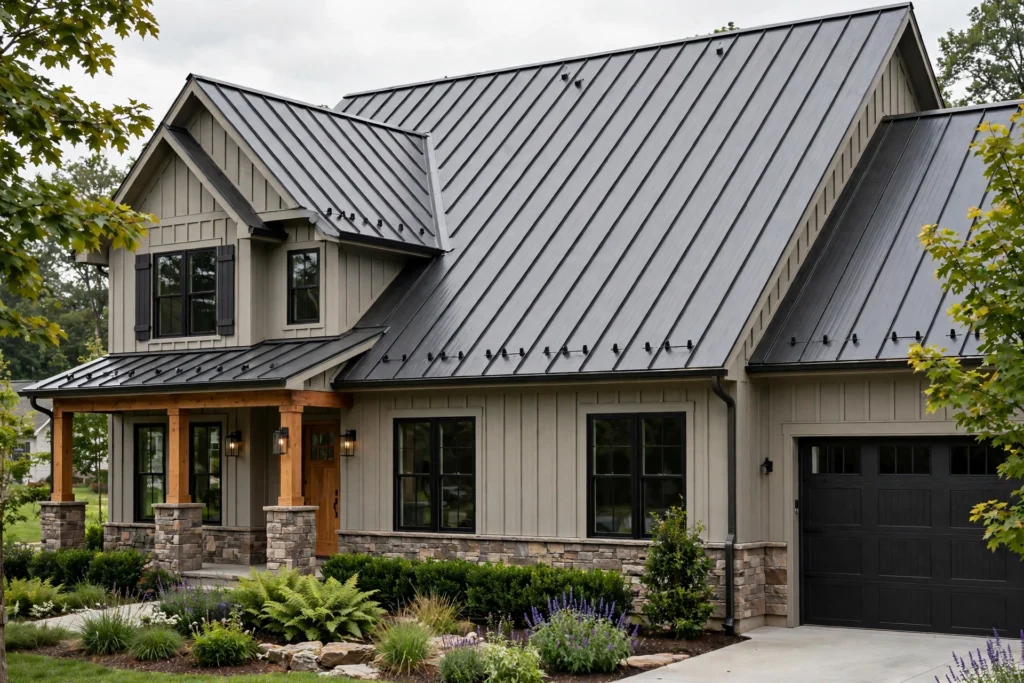
Updated October 2026. Metal roofing and asphalt shingles can both be good choices, but they solve the homeowner’s priorities differently. Asphalt usually wins on lower upfront cost and broad installer availability. Metal usually asks for a larger initial budget in exchange for a different maintenance profile, longer potential service life, strong wind/fire performance when properly specified, and more design options around reflective finishes.
Quick answer: Current 2026 Home Cost Desk research puts many asphalt-shingle replacements around $7,500 to $24,000, with a national average near $10,500 in Angi’s October 2026 shingle data. Many common metal-roof systems plan around $5 to $16 per square foot installed, while premium standing-seam, copper, zinc, complex geometry, and difficult tear-offs can go far higher. The right choice depends on roof shape, climate, how long you expect to own the home, installer quality, and the complete system—not just the surface material.
| Decision factor | Asphalt shingles | Metal roofing |
|---|---|---|
| Upfront budget | Usually lower | Usually higher |
| Installer availability | Very broad | More system-specific |
| Maintenance focus | Shingles, flashing, seal strips, granule loss | Seams, fasteners, coatings, penetrations |
| Appearance | Traditional, wide product range | Panels, shingles, standing seam, multiple metals |
| Heat performance | Depends on product/color | Depends strongly on coating/reflectance |
| Best fit | Budget-sensitive replacements and familiar systems | Long-term ownership, premium systems, design/resilience priorities |
For full cost detail, see our Roof Replacement Cost 2026 and Metal Roof Cost 2026 guides. This comparison uses the same researched price framework so the site does not create competing numbers for the same project.
2026 cost comparison
Asphalt shingles remain the baseline roofing option for many U.S. homes. Angi’s October 2026 shingle data reports a national average around $10,500, with many projects around $7,500 to $24,000. Broader roof-replacement data spans much more widely because roof size, pitch, tear-off, decking, labor, and product grade can dominate the total. The Roof Replacement Cost Calculator lets you price asphalt and metal options for the same roof size.
Metal roofing is harder to summarize with one number because exposed-fastener steel, metal shingles, standing seam, aluminum, copper, and zinc are very different systems. Current Home Cost Desk research uses roughly $5 to $16 per square foot installed for many common metal projects, with premium systems above that.
| Budget item | Asphalt reference | Metal reference |
|---|---|---|
| Common whole-project range | About $7,500–$24,000 in Angi’s 2026 shingle data | About $6,045–$18,340 in Angi’s broad 2026 metal dataset |
| Typical installed pricing | Varies widely by product and roof geometry | About $5–$16 per sq. ft. for many common systems |
| Premium end | Designer shingles and complex roofs can rise sharply | Standing seam, copper, zinc and complex roofs can move far higher |
| Tear-off | Can materially increase total | Can add about $1,000–$5,000 in current metal-roof data |
| Decking repair | Project-specific | Often around $2–$5 per sq. ft. where replacement is needed |
Do not compare only price per square foot. One bid may include full tear-off, upgraded underlayment, flashing replacement, ventilation corrections, permits, disposal, and decking allowances while another does not.
Lifespan: use it as a planning factor, not a guarantee
Homeowners often choose metal because they expect it to outlast asphalt. That can be reasonable, but lifespan claims depend on the exact product, coating, underlayment, roof exposure, ventilation, fasteners, installation quality, and maintenance. Asphalt service life also varies substantially between basic three-tab, architectural, and premium products.
Instead of comparing a marketing number for “years,” ask each contractor for the manufacturer’s warranty, workmanship warranty, exclusions, wind rating, coating warranty, and maintenance requirements. A theoretically long-lived material installed poorly can underperform a more ordinary material installed correctly.
Maintenance: different problems, not no problems
Asphalt shingles can lose granules, crack, lift, tear in storms, or fail around flashing and penetrations. Metal does not eliminate roof maintenance. Exposed-fastener systems have washers and fasteners that can become service points. Standing-seam systems reduce exposed fasteners but still depend on seams, clips, flashing, penetrations, coatings, sealants, and edge details.
Whichever material you choose, inspect after major storms and pay attention to leaks, loose components, damaged flashing, gutters, and roof penetrations. Do not walk on the roof simply to inspect it; use safe ground-level observation and professional assessment when needed.
Noise: metal is not automatically loud
The “rain on a barn roof” comparison is misleading for many houses. Residential metal roofs are usually installed over roof decking and underlayment, with attic insulation and interior ceilings below. Those assemblies change sound transmission considerably. Noise depends on the complete roof and attic system, not only the outer panel.
If sound matters to you, ask the installer about deck type, underlayment, attic insulation, and the specific panel system rather than assuming all metal roofs perform the same way.
Heat and energy performance
Metal is not automatically a cool roof, and asphalt is not automatically a hot roof. ENERGY STAR explains that cool-roof performance depends on solar reflectance and thermal emittance. Both metal and shingle products can be designed with different surface performance.
Reflective products tend to provide the most benefit in hot, sunny climates, especially where the roof/attic assembly has limited insulation. In heating-dominated climates, the trade-offs can differ. Ask for rated product data rather than judging by color alone.
Storm, wind and fire considerations
Material choice is only part of storm performance. FEMA guidance emphasizes roof-deck attachment, underlayment, edge details, fastener patterns, wind-rated products, and a sealed roof deck as important resilience elements in high-wind areas. A premium roof covering on a weakly detailed roof assembly can still fail.
Metal can be attractive in wildfire-prone or storm-exposed locations because many systems offer strong fire and wind characteristics, but the exact assembly and local code requirements matter. Asphalt products also carry fire and wind classifications. Compare the tested rating of the specific product being quoted, not a generic claim about the material family.
Complex roof geometry can change the winner
A simple gable roof is easier to price and install in almost any material. Valleys, dormers, skylights, chimneys, hips, wall intersections, and steep slopes increase labor for both asphalt and metal. Metal can become especially expensive on complicated roofs because panels require precise layout, cutting, transitions, and flashing.
Ask contractors to identify whether your roof geometry creates unusual waste or labor. A material that looks competitive on a simple roof may be far less competitive on a highly cut-up roof.
Overlay vs. full tear-off
Some metal systems may be installed over an existing roof layer where local code, manufacturer instructions, roof condition, and building details allow it. That can reduce demolition cost, but it also makes hidden decking problems harder to see and can complicate future work.
Asphalt-over-asphalt overlays are also allowed in some situations, but full tear-off is often the better diagnostic opportunity when the existing roof has leaks, unknown layers, poor decking, or ventilation concerns. Ask for the advantages, warranty implications, and exclusions of both options.
A homeowner decision matrix
| Your priority | Usually favors | What to verify |
|---|---|---|
| Lowest upfront project cost | Asphalt | Complete scope, not just shingle price |
| Long ownership horizon | Often metal | Warranty, coating, installer experience |
| Complex roof with many cuts | Often asphalt on price | Metal waste and labor premium |
| Architectural standing-seam appearance | Metal | Panel profile, gauge, coating and details |
| Hot-sun energy strategy | Either | Actual reflectance/emittance ratings |
| Storm resilience | Either can work | Deck attachment, underlayment, edge details, rated system |
The hidden costs that matter more than homeowners expect
- Decking repair: hidden rot can change the final bill after tear-off.
- Flashing: chimneys, walls, skylights, valleys and penetrations deserve explicit scope.
- Ventilation: new roofing does not correct a poor attic airflow system automatically.
- Underlayment: product and temperature rating matter, especially under some metal systems.
- Gutters and fascia: edge damage may be discovered during replacement.
- Permits and disposal: these vary by jurisdiction and number of roof layers.
- Snow guards or accessories: some metal roofs in snow climates need additional planning.
- Interior damage: an existing leak may already have affected insulation or finishes.
Three-bid worksheet
| Scope item | Bid A | Bid B | Bid C |
|---|---|---|---|
| Measured roof area | |||
| Exact product/system | |||
| Tear-off layers | |||
| Underlayment | |||
| Decking unit price | |||
| Flashing scope | |||
| Ventilation work | |||
| Permits/disposal | |||
| Material warranty | |||
| Workmanship warranty | |||
| Change-order rules |
Three realistic scenarios
Scenario 1: budget-focused replacement. The home has a simple roof, sound decking, and the owner expects to move within several years. A well-specified architectural asphalt system may make more financial sense than paying a large premium for a roof whose longer-term benefits the current owner may not fully use.
Scenario 2: long-term owner on a simple roof. The homeowner plans to stay for decades, wants standing-seam appearance, and can afford the higher initial cost. Metal may be compelling if the contractor has strong experience with the exact system and details.
Scenario 3: complex roof with hidden damage. Multiple valleys, dormers, old decking, and flashing problems make labor and repairs a major share of the project. In this case, geometry and hidden-condition allowances may matter more than the material comparison itself.
Frequently asked questions
Is a metal roof always more expensive?
Usually upfront, but not in every project. Material type, roof complexity, market, tear-off, and product grade can create overlap between premium asphalt and lower-cost metal systems.
Does metal always last longer?
Metal systems often have longer potential service lives, but real performance depends on coating, corrosion exposure, fasteners, flashing, installation quality and maintenance. Warranty terms are more useful than a generic lifespan claim.
Is metal better in hot climates?
Not automatically. Reflective surface properties matter. Compare rated solar reflectance and thermal emittance for the exact product.
Can metal go over shingles?
Sometimes, where code, manufacturer instructions and roof condition allow. Ask about hidden decking, warranty, ventilation and future removal before choosing an overlay.
Which roof is better for resale?
There is no universal answer. Local buyer preferences, roof age, workmanship, warranty transfer, home value and market conditions all matter more than a single national rule.
What matters most when comparing bids?
The complete system: tear-off, decking, underlayment, flashing, ventilation, fasteners, permits, warranties and change-order rules—not only the visible roofing material.
A 7-step decision process before you sign a roofing contract
- Measure the actual roof area. Do not use interior floor area as a substitute for roof surface.
- Choose the material level you are truly comparing. Put architectural asphalt against the exact metal system—not “shingles” against an undefined premium metal roof.
- Inspect the existing roof assembly. Ask about decking, number of layers, flashing, ventilation and known leak areas before finalizing material.
- Price the complete scope. Include tear-off, disposal, underlayment, flashing, edge metal, ventilation, permits and cleanup.
- Set hidden-damage prices in advance. Get unit pricing for decking, fascia or other repairs that may be discovered after tear-off.
- Compare warranty documents. Separate manufacturer coverage from contractor workmanship coverage and note maintenance requirements.
- Choose on ownership horizon and risk, not headline price. Consider how long you expect to own the home, local climate, roof complexity and installer quality.
Final pre-contract checklist
- Exact manufacturer and product line are written into the proposal.
- Roof area and waste assumptions are stated.
- Tear-off layers and disposal are included.
- Underlayment and flashing details are identified.
- Decking-repair pricing is written before work starts.
- Ventilation scope is clear.
- Permit responsibility is assigned.
- Wind/fire ratings for the exact product are documented where relevant.
- Material and workmanship warranties are separated.
- Payment schedule and change-order approval rules are written.
- Final cleanup, magnetic sweep and permit closeout are included.
Related Home Cost Desk guides
- Roof Replacement Cost 2026
- Metal Roof Cost 2026
- Roof Repair Cost 2026
- Best Roofing Material 2026
- How to Hire a Home Contractor 2026
Home Cost Desk compares current 2026 national cost references with official energy and resilience guidance. Cost figures are planning references, while performance decisions are tied to the exact roof system, local conditions and contractor scope.
Editorial review: Home Cost Desk Editorial Team · Read our research methodology.
Sources and methodology
- Angi — Shingle Roof Cost, updated October 2026
- Angi — Metal Roof Cost, updated September 2026
- HomeGuide — Metal Roof Cost
- ENERGY STAR — Cool Roofs
- FEMA — Wind Retrofit Guide for Residential Buildings
National cost figures are budgeting references, not bids. Local labor, roof geometry, hidden decking damage, code requirements and product grade can materially change actual pricing.