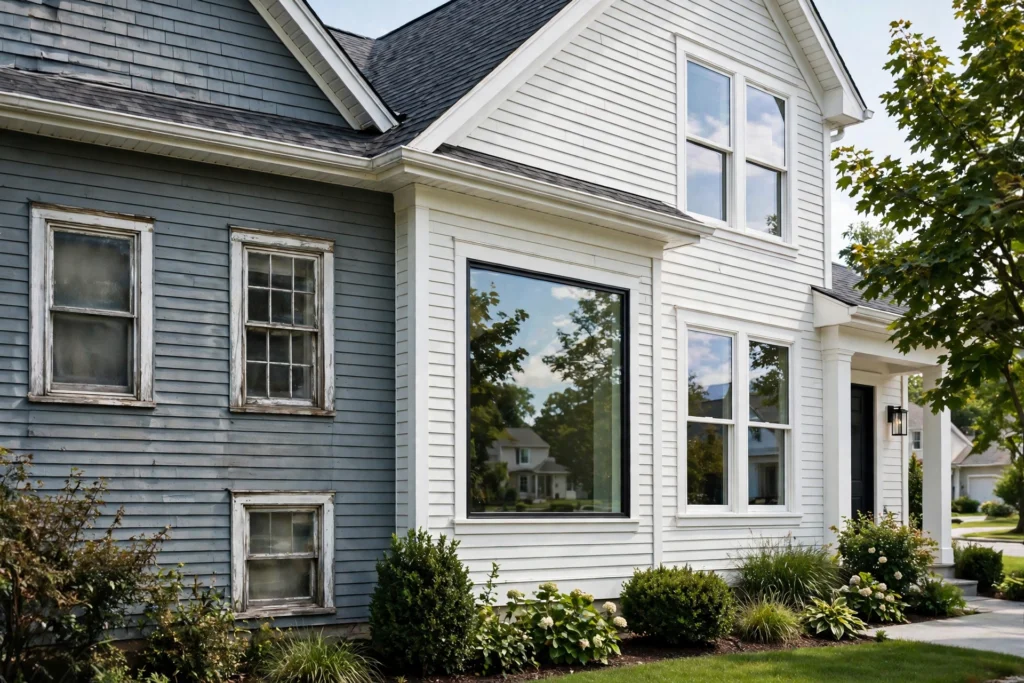
Choosing replacement windows is not mainly about finding the cheapest frame or the brand with the longest feature list. The better question is: which window type fits your climate, house, maintenance tolerance, budget, and installation conditions? In 2026, most U.S. homeowners will be comparing vinyl, fiberglass, wood, composite, and metal-clad products, along with double- or triple-pane glass, different low-e coatings, and several operating styles.
This guide focuses on buying decisions rather than installation cost. If you want detailed price ranges, use our 2026 window replacement cost guide. Here, the goal is to help you compare performance, durability, maintenance, climate fit, and the specifications that matter before you sign a contract.
Quick answer: which replacement window is best?
| Homeowner priority | Strong starting choice | Why |
|---|---|---|
| Lowest maintenance and broad availability | Vinyl | Moisture resistant, no painting, wide price range |
| Strength and thermal performance | Fiberglass | Dimensionally stable, can be insulated, strong frames |
| Traditional appearance and interior finish quality | Wood or clad wood | Warm appearance, strong customization potential |
| Hot, sunny climate | Low-SHGC efficient window | Reduces unwanted solar heat gain |
| Cold climate | Very low U-factor window | Reduces heat loss and improves comfort |
| Coastal or very wet exposure | Moisture-resistant frame with suitable hardware | Reduces maintenance risk; product details matter |
| Historic appearance | Wood, clad wood, or specialty composite | Better profile and trim flexibility in many projects |
There is no universal winner. A high-quality vinyl window can outperform a poorly designed fiberglass or wood product, and installation quality can erase the advantage of an expensive window if the opening is not flashed, sealed, and insulated correctly.
Start with the NFRC label, not the marketing brochure
The U.S. Department of Energy recommends comparing the overall window using the NFRC label. The National Fenestration Rating Council independently rates whole-window performance, which is more useful than judging the glass or frame in isolation.
The most important ratings are:
- U-factor: how quickly heat moves through the complete window. Lower is better for insulation.
- Solar Heat Gain Coefficient (SHGC): how much solar heat enters through the window. Lower values block more solar heat.
- Visible Transmittance: how much visible daylight passes through.
- Air Leakage: how much air passes through the window assembly.
- Condensation Resistance: how well the product resists interior condensation under test conditions. Higher is better.
The NFRC label allows you to compare two products that may look similar but perform very differently. Do not rely only on terms such as “premium,” “high efficiency,” or “insulated.” Those are not substitutes for certified ratings.
ENERGY STAR 7.0: the 2026 climate-zone targets
The current ENERGY STAR residential window specification is Version 7.0, effective since October 23, 2023. Certified windows must use NFRC-tested ratings and meet climate-specific limits.
| ENERGY STAR climate zone | Maximum U-factor | SHGC requirement |
|---|---|---|
| Northern | 0.22 | At least 0.17 |
| North-Central | 0.25 | 0.40 or lower |
| South-Central | 0.28 | 0.23 or lower |
| Southern | 0.32 | 0.23 or lower |
These thresholds show why a single “best window” does not exist nationwide. A cold-climate homeowner generally benefits from the lowest practical U-factor, while a hot-climate homeowner should pay close attention to SHGC because solar heat can become a major cooling load.
ENERGY STAR also notes that orientation matters. In colder climates, south-facing windows may benefit from a somewhat higher SHGC when winter solar gain is useful, while east- and west-facing windows often benefit from lower solar gain or exterior shading. In hot climates, low SHGC is especially important on south-, east-, and west-facing glass.
Vinyl windows: best for value and low maintenance
Vinyl remains one of the most common replacement-window choices in the U.S. The Department of Energy notes that vinyl frames resist moisture, do not need painting, and can have insulated cavities that improve thermal performance.
Best fit: homeowners who want low maintenance, broad product availability, and a wide range of efficiency levels.
Advantages:
- no routine painting;
- good moisture resistance;
- many ENERGY STAR-qualified options;
- usually lower cost than premium fiberglass or wood;
- available in many standard replacement sizes.
Watch-outs:
- frame thickness can reduce visible glass area;
- quality varies substantially between product lines;
- very dark exterior colors need proper formulation for heat exposure;
- some lower-cost frames have limited reinforcement or hardware quality.
Do not buy vinyl based on the word “vinyl” alone. Compare the NFRC rating, frame construction, reinforcement, weatherstripping, warranty, hardware, and installation method.
Fiberglass windows: strong, stable, and efficient
The Department of Energy describes fiberglass frames as dimensionally stable and notes that their cavities can be filled with insulation. This makes fiberglass a strong option for homeowners who want a relatively slim, rigid frame with good thermal performance.
Best fit: long-term owners, larger openings, harsh temperature swings, and buyers willing to pay more upfront for a more rigid frame.
Advantages:
- strong dimensional stability;
- good thermal potential;
- less expansion and contraction than some plastics;
- can support relatively narrow frame profiles;
- available in painted or factory-finished options.
Watch-outs:
- higher purchase price in many markets;
- fewer local suppliers than vinyl in some regions;
- installation still matters as much as the frame material.
Fiberglass is often a strong all-around choice when budget allows, but it should still be compared using whole-window NFRC values rather than frame reputation alone.
Wood windows: best for appearance and customization
Wood frames insulate relatively well and remain popular in traditional, high-end, and historic-style homes. Their biggest tradeoff is maintenance. Unprotected wood needs regular coating and careful moisture management.
Many modern wood windows use aluminum or vinyl cladding on the exterior to reduce maintenance while preserving a wood interior. The Department of Energy notes that clad wood may have slightly different thermal performance from all-wood frames, so again, use the whole-window rating rather than assumptions.
Best fit: homeowners who prioritize interior appearance, historic character, custom profiles, or stain-grade finishes.
Advantages:
- premium interior appearance;
- excellent customization potential;
- can be repaired and refinished;
- works well with traditional trim details.
Watch-outs:
- higher cost;
- greater maintenance if exterior wood is exposed;
- rot risk if water management is poor;
- finish quality and installation detailing are critical.
Composite windows: evaluate the actual construction
Composite is a broad category rather than one standardized material. The Department of Energy notes that composite frames may combine wood fibers, engineered wood, or polymer materials and can offer good structural and thermal properties with improved moisture resistance.
Because formulations differ, the word “composite” tells you less than an NFRC label and the manufacturer’s construction details. Ask what the frame is actually made from, whether it is painted or capped, how corners are joined, and what the warranty excludes.
Aluminum and metal frames: strength with a thermal tradeoff
Metal frames are strong, slim, and low maintenance, but metal conducts heat quickly. The Department of Energy therefore recommends a proper thermal break when metal is used in energy-efficient residential windows.
Metal can make sense for modern architecture, large glass areas, or specific coastal and commercial-style applications, but a thermally poor aluminum frame can be uncomfortable and inefficient even when the glass itself is good.
Double-pane vs. triple-pane glass
Most efficient replacement windows use at least double glazing. Two or more panes create an insulated glazing unit with a sealed space between the panes. That space may contain air, argon, or krypton.
The Department of Energy says argon is commonly used because it performs well in typical glazing gaps and is relatively economical. Triple-pane windows can lower U-factor further, but they add cost and weight.
Triple pane is most compelling when:
- you live in a very cold climate;
- comfort near windows is a major concern;
- noise reduction is also valuable;
- the incremental cost is reasonable;
- the frame and installation quality match the glass package.
In mild or hot climates, spending the same money on a better low-e coating, lower SHGC, improved air sealing, or higher installation quality may be more useful than adding a third pane. Compare complete NFRC performance, not pane count alone.
Low-e coatings: often more important than buyers realize
Low-emissivity coatings are microscopically thin layers that control radiant heat transfer through the glass. The Department of Energy says low-e windows typically cost about 10% to 15% more than regular windows but can reduce energy loss through the window by roughly 30% to 50%.
Not all low-e coatings are the same. Manufacturers can tune coatings for low, moderate, or higher solar gain. That means the correct coating depends on climate, orientation, shading, and heating-versus-cooling needs.
In a hot climate, prioritize a lower SHGC. In a cold climate, do not automatically choose the lowest SHGC for every orientation because useful winter solar gain may be reduced.
Which window style is best?
Frame material and glazing are only part of the buying decision. Operation type affects ventilation, air sealing, cleaning, emergency egress, and appearance.
Casement
Casement windows hinge at the side and close against compression seals. They can provide excellent ventilation and often strong air-sealing performance when closed. They work well where an outward-opening sash will not interfere with walkways or landscaping.
Double-hung
Double-hung windows are familiar, easy to match in traditional homes, and allow both sashes to move. Tilt-in designs can simplify cleaning. Because the sashes slide rather than compress against seals, compare air-leakage ratings carefully.
Single-hung
Single-hung windows resemble double-hung units, but only one sash moves. They can be economical and simple but provide less ventilation flexibility.
Sliding
Horizontal sliders can work well in wide openings and where an outward-swinging sash would be inconvenient. As with hung windows, weatherstripping and air-leakage performance deserve close comparison.
Fixed or picture windows
Fixed windows do not open, which can make them highly efficient and relatively airtight. They work well for views and daylight but cannot provide ventilation or emergency egress.
Hot-climate buying strategy
In warm regions, the Department of Energy recommends low SHGC to limit unwanted solar heat. Spectrally selective low-e coatings can reduce infrared heat while preserving much of the visible daylight.
For hot-climate homes, prioritize:
- low SHGC, especially on east-, south-, and west-facing windows;
- good air-leakage performance;
- proper low-e coating;
- exterior shading where practical;
- well-sealed installation;
- durable frame and hardware for local humidity, salt, and UV exposure.
Do not assume that a metal-looking reflective window is automatically efficient. Use the NFRC numbers.
Cold-climate buying strategy
For cold regions, the Department of Energy recommends a low U-factor to reduce heat loss. Condensation resistance and air leakage also become important because cold interior glass and frame surfaces can create comfort and moisture problems.
For cold-climate homes, prioritize:
- the lowest practical U-factor;
- low air leakage;
- appropriate SHGC by orientation;
- warm-edge spacers and efficient glazing;
- high condensation resistance where winter humidity is a concern;
- excellent perimeter air sealing.
Replacement inserts vs. full-frame windows
An insert replacement installs a new window inside an existing frame that is still structurally sound. A full-frame replacement removes the old frame and exposes the rough opening.
Inserts can reduce disruption and preserve interior trim, but they slightly reduce glass area and can hide existing flashing or frame problems. Full-frame replacement costs more and disturbs more finishes, but it gives the installer access to the opening so damaged wood, poor insulation, or failed flashing can be corrected.
Choose full-frame replacement when the existing frame is rotted, badly out of square, leaking, structurally compromised, or poorly integrated with the wall. Do not use an insert merely to cover a damaged opening.
Installation quality can matter as much as window quality
A premium window can perform poorly if the installer leaves gaps, misaligns the frame, compresses it out of square, or fails to manage exterior water. The Department of Energy maintains installation guidance because air sealing, flashing, shimming, fastening, and integration with the wall are part of the performance system.
Ask the installer how the rough opening will be inspected, how existing water damage is handled, what flashing method is used, how the perimeter gap is insulated, and how exterior and interior seals are finished.
Pre-1978 homes: window replacement can trigger lead-safe rules
This is especially important in older U.S. housing. The EPA states that paid window replacement in pre-1978 homes is a covered activity under the federal Renovation, Repair and Painting program when applicable painted components are disturbed. EPA guidance treats window replacement as a covered renovation activity rather than a minor-repair exemption simply because the area is small.
If your house was built before 1978, ask the contractor whether the firm is Lead-Safe Certified and how the work area will be contained and cleaned. EPA updated its lead-safe renovation guidance in March 2026.
Homeowners doing their own work are generally treated differently under the federal rule, but EPA still recommends lead-safe work practices because window jambs, sills, and trim are friction surfaces that can generate contaminated dust.
When you may not need replacement windows
Replacement is not always the most cost-effective answer. Existing windows may still be serviceable when the main problem is failed caulk, worn weatherstripping, damaged hardware, an isolated broken pane, or an interior comfort issue that can be improved with shading or air sealing.
Replacement becomes more compelling when frames are rotted, seals have failed across many units, windows no longer operate safely, air leakage is widespread, or the existing single-pane units create severe comfort problems.
Before replacing an entire house at once, ask whether the problem is product failure, installation failure, or maintenance. That diagnosis can prevent a five-figure project from solving the wrong problem.
Questions to ask before signing a window contract
- What is the exact manufacturer and product line?
- What are the NFRC U-factor and SHGC for the exact size and glass package?
- Is the product ENERGY STAR certified for my climate zone?
- What is the air-leakage rating?
- Is the installation insert or full-frame?
- How will the rough opening be inspected and flashed?
- What happens if rot or water damage is found?
- What low-e coating and gas fill are specified?
- What hardware, screens, and locks are included?
- What exterior and interior trim work is included?
- Who handles permits if they are required?
- For a pre-1978 home, is the contractor Lead-Safe Certified?
- What does the product warranty exclude?
- What separate workmanship warranty does the installer provide?
Common buying mistakes
Buying by frame material alone. A frame category does not tell you the whole-window performance.
Choosing the lowest U-factor without considering SHGC. Solar gain matters, especially in cooling-dominated climates.
Paying for triple pane without comparing the complete NFRC label. A high-quality double-pane window may be a better value in some climates.
Ignoring installation scope. A low bid may exclude flashing corrections, trim, rot repair, disposal, or lead-safe work.
Replacing windows before diagnosing water intrusion. A leak above or around a window may come from siding, roofing, flashing, or the wall—not the window itself.
If exterior work is also planned, coordinate with our siding replacement guide because siding and full-frame window work often share flashing and trim details.
Five-step replacement window buying plan
- Diagnose the problem first: separate failed windows from failed caulk, flashing, trim, or wall-water issues.
- Choose climate targets: use NFRC U-factor, SHGC, air leakage, and condensation resistance rather than frame material alone.
- Decide insert vs. full-frame: do not use an insert to hide rot, failed flashing, or an out-of-square opening.
- Compare identical specifications: require the same frame type, glass package, installation method, trim scope, disposal, and warranty across quotes.
- Verify installation: inspect operation, locks, perimeter sealing, trim, screens, and any required lead-safe cleanup before final payment.
Post-installation checklist
- Every sash opens, closes, locks, and stays in position correctly.
- No visible gaps, daylight, or loose exterior sealant remain around the frame.
- Screens fit correctly and hardware operates smoothly.
- Interior trim and exterior water-management details are complete.
- NFRC labels, warranty information, and installer documentation are retained.
If doors are part of the same exterior opening upgrade, compare scope and sequencing with our front door replacement cost guide so trim, flashing, and finish work are coordinated efficiently.
Bottom line
For many U.S. homeowners in 2026, vinyl is the practical value choice, fiberglass is a strong premium all-around option, and wood or clad wood is the best fit when appearance and architectural detail justify the added cost and maintenance. But frame material should never be the final decision by itself.
Use the NFRC label, match U-factor and SHGC to your climate, choose glazing based on orientation, and scrutinize the installation method. A properly selected mid-range window installed correctly can be a better investment than an expensive product installed poorly.
Home Cost Desk compares current U.S. cost or technical references and checks safety, code, efficiency, incentive, or regulatory claims against authoritative sources when available. National figures are planning ranges, not local quotes.
Editorial review: Home Cost Desk Editorial Team · Read our research methodology · Detailed sources appear below.
Sources and methodology
Home Cost Desk uses current U.S. government and independent performance-rating guidance for product-selection recommendations. This article is a buying guide, not a product endorsement; individual models should be compared using their certified ratings and installation specifications.