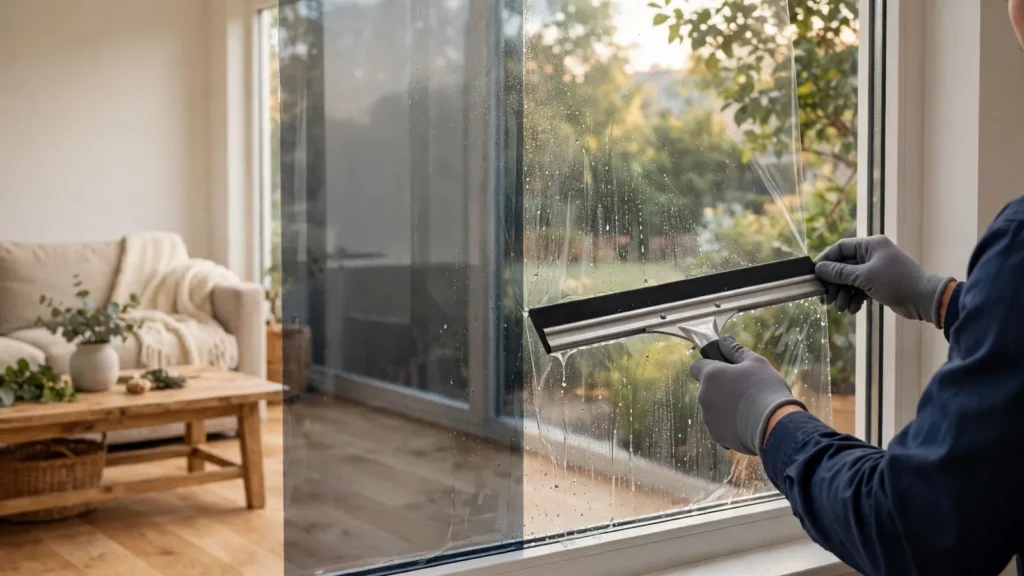
Quick answer: how much does residential window tinting cost?
Professional residential window tinting commonly costs $6–$15 per square foot installed, or about $500–$1,200 per project, according to HomeGuide’s nationwide guide (dated September 20, 2024, so treat it as an older benchmark). Angi’s separate 2026 data, based on 4,586 verified projects, gives a national average of $614, with most reported projects between $317 and $944 and a broad installed range of about $5–$20 per square foot. The figures represent different samples and film choices; a large house with floor-to-ceiling glass can exceed any published “typical” total.
The most useful way to price window film is by measured glass area and a specified product, not by counting windows. Ten small bedroom panes and ten enormous living-room panes are not equivalent. Film type matters too: a privacy film for a bathroom does not have the same performance specifications as solar-control film for south- or west-facing glazing.
Window tint can improve comfort and reduce glare, but it cannot repair a broken insulated-glass seal, stop every type of heat transfer or guarantee a particular utility-bill saving. If the window itself has failed, compare our window glass replacement guide before treating film as a repair.
Window tint installed prices by film type
The following material categories and installed national prices are from HomeGuide. Each range is per square foot of glass, not per window or per square foot of house floor area.
| Residential film type | HomeGuide installed price | Typical buying objective |
|---|---|---|
| Standard non-reflective | $6–$7/sq ft | Basic solar or privacy treatment |
| Reflective / mirror | $7–$9/sq ft | Daytime outward visibility control and glare |
| Ceramic | $7–$12/sq ft | Solar and infrared heat management with product-specific appearance |
| Security / shatter-resistant | $8–$15/sq ft | Holding some broken-glass fragments together, not making glass unbreakable |
| Frosted / decorative | $6–$13/sq ft | Visual screening, pattern and privacy |
| Specialty spray finish | $6–$11/sq ft | Different application system; check permanence and suitability |
A contractor’s final price can include minimum trip charges, detailed edge work, installation access, preparation and old-film removal. Confirm whether the film is approved for the exact glass construction and whether labor, material and tax are included. The table does not claim every ceramic film performs the same; product tests and manufacturer specifications matter.
The real question: which problem are you trying to solve?
Heat and glare in sunny rooms
Solar-control film can reduce the amount of solar energy entering through glass. The Department of Energy describes solar heat gain coefficient (SHGC) as a measure of heat transmitted through glass, on a scale of 0 to 1: the lower the number, the less heat is transmitted. But the performance of a film depends on the existing pane, coating and climate. Reducing heat gain can be useful during a hot summer while reducing beneficial solar warmth in a cold season.
Ask the installer for the film’s solar heat rejection, SHGC effect, visible light transmission and reflectance on the actual type of glass. Do not make a purchase on “blocks 99% of heat” advertising unless the product’s test method and denominator are clear. Blocking most ultraviolet radiation is not the same as blocking most infrared or all solar heat.
Privacy during the day versus at night
Mirror-like film may limit inward visibility when sunlight makes the outside brighter than the room. At night, with lights on indoors, the effect can reverse. A homeowner who needs nighttime privacy may want blinds, curtains or frosted film in appropriate locations. Avoid repeating “100% privacy” claims without stating the lighting conditions.
Fading of furniture and flooring
Window film can reduce ultraviolet exposure, an important contributor to fading, but cannot stop all color changes. The International Window Film Association (IWFA) says film can reduce the sun’s UV rays, a cause of fading, by up to 99%, but that no window film can eliminate fading. Be wary of guarantees that furniture, hardwood floors or fabrics will never fade after installation.
Security and glass safety
Security film can help hold broken glass fragments, depending on the product and attachment system. It does not make a typical residential window bulletproof, stormproof or a substitute for code-required impact glazing. Ask for manufacturer-tested performance and whether the film system requires edge attachment or a compatible frame. Fire-safety and emergency-egress requirements remain in force; do not install a treatment that defeats a required exit or manufacturer warning.
What changes the final installation bill?
Glass area and window shape. Measure the actual glass, not the outside casing. Standard rectangles are usually easier than arches, divided lites, skylights or multiple narrow panes. Some installers quote a minimum job price rather than exact material area alone.
Accessibility. A ground-level bathroom pane is easier to reach than an upper-story stairwell window or skylight over a roof. Working-at-height protections add labor and can make DIY inappropriate.
Existing film and glass condition. Old adhesive, tint or scratches can require additional preparation. Replacement of a failed or cracked glazing unit is a separate expense. Film should never be presented as a seal repair for a fogged insulated window.
Film compatibility. Existing low-emissivity (low-E), tinted, laminated or insulating glass may have limitations. The IWFA recommends checking the specific film-to-glass combination. An unsuitable film can raise glass temperatures or create thermal stress; some window manufacturers may restrict film under their glazing warranty. A good installer should assess pane type, orientation and shading patterns first.
Installation details. Demand clean edges, consistent appearance, approved adhesives, manufacturer warranty terms, and an explanation of curing time. A quote for the film roll alone does not include installing it correctly on large glass surfaces.
Worked example: ten large living-room windows
Suppose a house has ten windows, each with a measured filmable glass rectangle 3 feet wide by 4 feet tall. That is 12 square feet per window, or 120 square feet total. The homeowner requests ceramic film. HomeGuide’s published installed ceramic range is $7–$12 per square foot.
| Step | Low | High |
|---|---|---|
| Ten panes × (3 × 4 sq ft) | 120 sq ft | 120 sq ft |
| Ceramic installed price | $7/sq ft | $12/sq ft |
| Installed planning total | $840 | $1,440 |
The math is 10 × 3 × 4 = 120 square feet; 120 × $7 = $840 and 120 × $12 = $1,440. This is a straightforward sourced unit-rate example, not a contractor’s written price. Because it covers relatively large windows, it may exceed the average whole project amount that Angi reports; this is not a contradiction.
The example excludes a special charge for removing old film, repairs to damaged glass, unusual ladder access, sales tax if not in the bid, and any minimum-job fee. Ask the installer to specify whether those costs apply. If you are comparing with full window replacement, use the same glass area but recognize that replacement includes a new glazing unit and possibly a frame; it is not the same product. See window replacement cost.
Film vs. blinds vs. low-E replacement windows
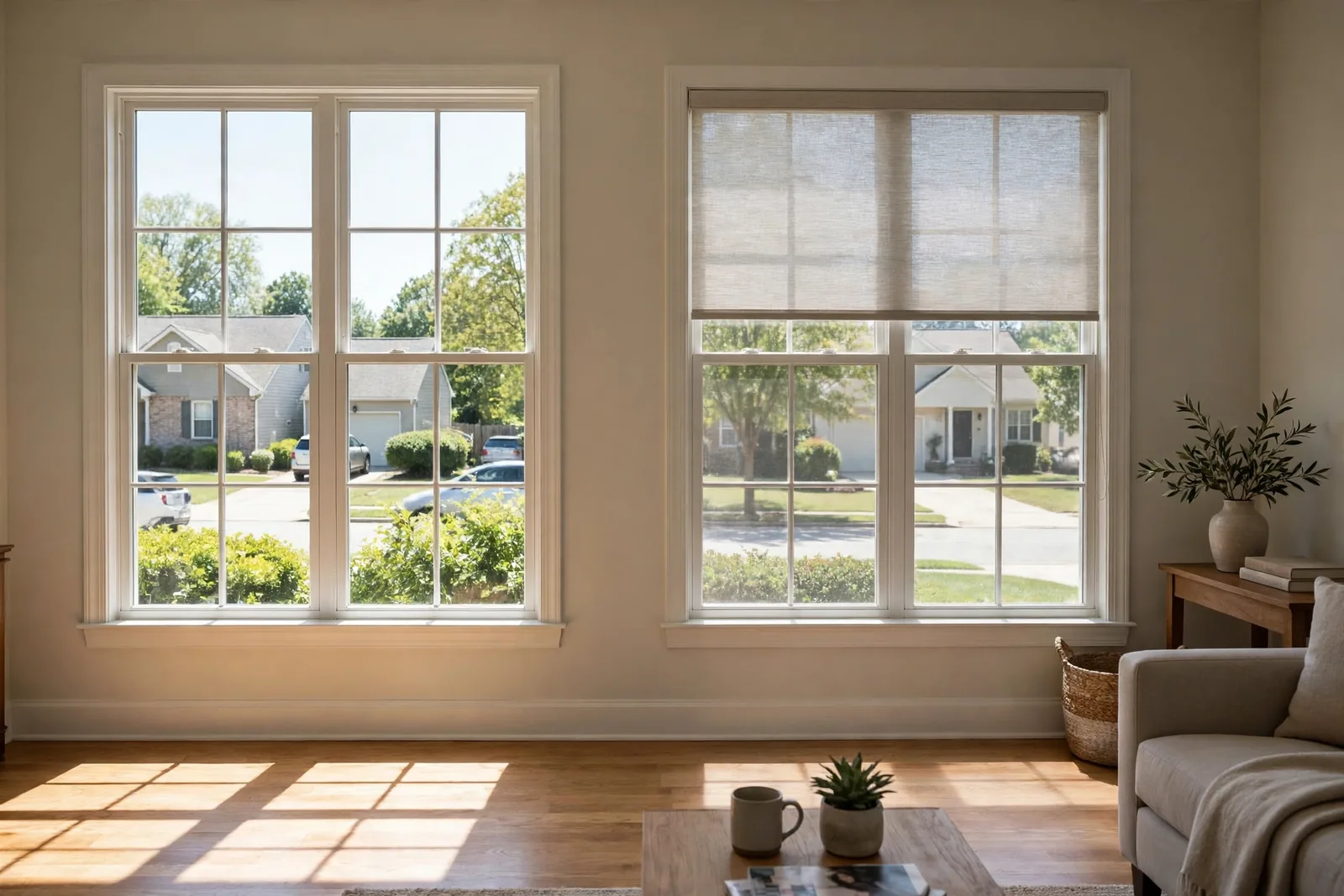
Blinds or curtains provide adjustable privacy and light control without adhering to the glass. They may be preferable for bedrooms where nighttime privacy matters more than uninterrupted views. Their cost depends on measurements, material and whether they are custom fitted.
Window film is a retrofit to glass that can target glare, UV, privacy or solar gain. It may be far cheaper than replacing intact windows, but it cannot add a modern insulated-glass unit’s full thermal performance to a single-pane window. It also cannot fix air leaks around a deteriorated sash.
New low-E or insulated windows may be the better project when frames are rotten, seals have failed, panes are cracked or the whole window is inefficient. DOE notes that low-e coatings and tints affect SHGC, and ENERGY STAR explains that the lower the U-factor, the better the window insulates. A replacement-window proposal should specify those values rather than just a marketing label. See our best replacement windows guide.
Will tinting lower your electric bill enough to pay back?
Possibly, but a guaranteed return is not supportable from national cost averages alone. Payback depends on glass orientation and area, existing window performance, shade trees, local weather, HVAC efficiency, electricity prices and the film’s tested solar properties. Some rooms are primarily uncomfortable because of air leakage or poor insulation, which film will not solve.
If a homeowner spends a hypothetical $1,000 on film and achieves a measured, weather-normalized $100 per year reduction in electricity cost, the simple payback would be $1,000 ÷ $100 = 10 years. That $100 saving is only an illustrative assumption, not a predicted saving or a manufacturer claim. If savings are lower, payback is longer; if conditions change, year-over-year utility bills can be misleading.
For a broader diagnosis, see our home energy audit cost guide. A qualified assessment can determine whether the bigger opportunity is solar gain, roof insulation, air sealing or HVAC operation.
Installation, cleaning and warranty questions
Before ordering a film, ask the installer to name the exact brand, product series, shade and intended glass types. Request a written glass-compatibility statement and ask whether the original insulated-glass warranty could be affected. Examine the contract for peeling, discoloration, bubbling and labor coverage. The film manufacturer’s product warranty and the installer’s workmanship warranty may be different.
Installations often use a liquid solution that needs time to dry or cure. Follow the specific manufacturer’s curing and cleaning instructions and do not scrape at fresh film. For routine cleaning, the IWFA recommends a soft cloth, paper towel or synthetic sponge with a glass cleaner that contains no abrasives. Ask the installer when the window can be washed and what imperfections qualify for a callback after curing.
DIY products can be suitable for small, accessible panes when a manufacturer explicitly supports homeowner application, but risk rises with large, expensive insulated glass and high windows. Always prioritize safe access and compatibility rather than treating film installation as a trivial sticker job.
Frequently asked questions
How much does it cost to tint all the windows in a house?
HomeGuide reports around $500–$1,200 for an average project, but large homes can exceed that. Multiply the measured glass area by a film-specific installed rate, then ask for any minimum charges or access adjustments.
What does ceramic window film cost?
HomeGuide reports roughly $7–$12 per square foot installed. Actual solar performance depends on the product, not just the word ceramic.
Can reflective film provide privacy at night?
Not reliably. With indoor lighting brighter than outdoors, outside viewers may be able to see in. Choose a treatment designed for nighttime privacy where that matters.
Does film replace low-E glass?
No. Some films improve solar or insulating performance, but cannot duplicate all properties of a new multi-pane insulated-glazing assembly or fix a failed seal.
Can window tint crack glass?
An incompatible film can contribute to thermal stress on certain glazing configurations. The IWFA advises using manufacturer film-to-glass compatibility guidelines. Ask the installer before applying film to low-E, tinted or insulated units.
Will film stop furniture fading completely?
No. It can reduce UV exposure, but visible light, heat and material aging also cause fading.
Bottom line
Budget by measured glass area, choose film for the actual problem you are solving, and verify that it is compatible with your windows. National professional-installed pricing commonly falls near $6–$15 per square foot. The best quote includes film identity, glass assessment, installation, curing guidance and a clear warranty—not only the cheapest price per pane.
Reviewed by the Home Cost Desk editorial team on November 4, 2026. Prices are national planning ranges from dated sources; product selection and glass compatibility require manufacturer and local installer verification.
Sources for editorial verification
- HomeGuide, Home Window Tinting Cost, byline September 20, 2024 (older benchmark): installed unit prices and film-type breakdown.
- Angi, Home Window Tinting Cost, updated October 30, 2026: separate 2026 national price sample.
- U.S. Department of Energy (FEMP), Purchasing Energy-Efficient Residential Windows, Doors, and Skylights: SHGC definition and low-e coatings; accessed November 4, 2026.
- ENERGY STAR, Independently Tested and Certified Energy Performance: U-factor and SHGC ratings; accessed November 4, 2026.
- International Window Film Association, FAQ, modified September 28, 2026: low-e compatibility, UV fading, thermal stress and cleaning guidance.
- The 120-sq-ft ceramic example is simple unit-price arithmetic. The $100/year saving scenario is expressly hypothetical, not an energy-saving forecast.