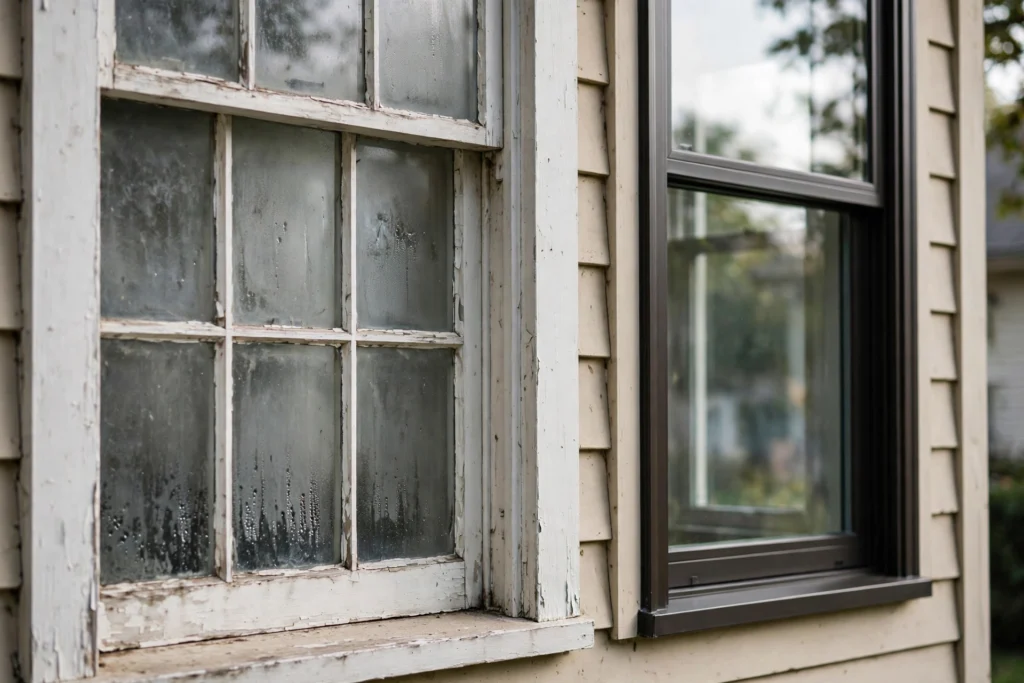
Quick answer: Repair usually makes sense when the problem is isolated—such as failed hardware, a draft, damaged weatherstripping, a broken pane, or a failed insulated-glass seal—and the frame and sash are still structurally sound. Replacement is usually the better long-term choice when the frame is rotted or warped, the window leaks repeatedly, operation problems are widespread, several components are failing at once, or you want a meaningful upgrade in energy performance and comfort.
For 2026 planning, a typical window repair often lands around $178 to $634, with a national average near $405, while full replacement can range from roughly $300 to $2,500 per window depending on size, frame material, glass package, installation method, and local labor. Glass-only replacement can be much cheaper than replacing the entire unit when the frame is still in good condition.
Window Repair vs. Replacement: 2026 Cost Snapshot
| Option | Typical 2026 planning range | Best fit |
|---|---|---|
| Minor hardware or latch repair | $25–$150 | Window is otherwise sound |
| Foggy-window / seal-related repair | $75–$200 | Frame and sash remain serviceable |
| Draft repair / weatherstripping | $100–$400 | Air leakage is localized |
| Rotted-frame repair | $250–$800 | Damage is limited and structurally repairable |
| Broken window seal repair | $70–$245 | Glass unit can be repaired or replaced without replacing the whole window |
| Glass-only replacement | About $181–$414 for many standard double-pane jobs | Frame is good but insulated glass unit has failed |
| Full window replacement | About $300–$2,500 per window | Frame, sash, operation, or performance no longer justify repair |
These are national planning benchmarks, not local contractor quotes. Window size, access, frame type, glass specification, trim work, water damage, structural repair, permits, and finish work can move the final price substantially.
When Window Repair Usually Makes More Sense
Repair is generally the stronger choice when the failure is concentrated in one component and the rest of the window still performs well. The most repair-friendly situations include:
- Broken locks, handles, cranks, or balances. Mechanical parts can often be replaced without disturbing the frame.
- Localized drafts. New weatherstripping, sash adjustment, caulk, or minor air-sealing work may solve the problem.
- A single failed insulated glass unit. If moisture is trapped between panes but the frame and sash are sound, replacing the glass unit can restore clarity without replacing the entire window.
- One cracked or broken pane. Glass replacement may be the most economical route when the surrounding window is in good condition.
- Limited wood decay. Small areas of deterioration may be repairable if the damage has not spread into structural framing or repeatedly returned.
- Historically significant windows. Original wood windows are sometimes worth repairing, especially when they contribute to the character of an older home and remain fundamentally sound.
The main principle is simple: repair the failed component when the window as a system is still worth keeping.
When Full Window Replacement Is the Better Decision
Replacement becomes easier to justify when the problem is no longer isolated. Common signs include:
- Rot, warping, severe corrosion, or structural frame damage.
- Repeated seal failures or recurring water intrusion.
- Sashes that bind, rack, or no longer stay square.
- Multiple failed components on the same unit.
- Noticeable drafts that remain after reasonable air-sealing work.
- Single-pane windows in a home where comfort and energy performance are major priorities.
- Windows that no longer meet the homeowner’s functional needs, such as egress, ventilation, ease of operation, or maintenance.
- A whole group of aging windows reaching similar failure points at the same time.
ENERGY STAR specifically points to old, drafty, poorly made, or degraded windows as candidates for replacement. It also notes that storm windows can be a lower-cost alternative when the existing primary windows are still in good condition.
Foggy Double-Pane Windows: Repair or Replace?
Condensation between panes usually indicates failure of the insulated glass unit seal. That is different from ordinary condensation on the room-side surface of the glass.
If the frame, sash, hardware, and operation are all good, the most economical fix may be to replace only the insulated glass unit. Angi reports broken-seal repair around $70 to $245, while its 2026 glass-replacement data puts many standard double-pane replacements around $181 to $414. This Old House reports a broader installed glass-replacement range of roughly $300 to $880, reflecting differences in glass type, size, and complexity.
If the seal failure is only one symptom of a deteriorating frame, recurring leaks, warped sash, or repeated glass-unit failures, full replacement may be the better use of money.
For a deeper explanation of moisture location and what it means, see our Window Condensation Guide 2026.
How Much More Does Replacement Cost?
The gap can be large. Angi’s 2026 data places the national average window repair around $405, while its average replacement project is around $7,347. That project figure covers multiple windows, so it should not be compared directly with a single repair. On a per-window basis, replacement often falls in the $300 to $2,500 range.
This is why a failed latch, worn weatherstripping, or one bad insulated glass unit should not automatically trigger a whole-window replacement. At the same time, repeatedly spending a few hundred dollars on an old unit that has frame damage, chronic leakage, and poor operation can become false economy.
Use Total Expected Scope, Not Just the Cheapest Price
A repair estimate and a replacement estimate often cover very different scopes. Before comparing them, normalize what each quote actually includes.
| Scope question | Repair quote | Replacement quote |
|---|---|---|
| Glass included? | May be glass-only or seal-only | Usually included with new unit |
| Frame repair included? | Sometimes separate | Depends on insert vs. full-frame installation |
| Interior/exterior trim? | Often limited | May be included or excluded |
| Flashing / water management? | Only if repair touches those areas | Critical for full-frame work |
| Painting / staining? | Often excluded | Frequently excluded or optional |
| Disposal? | Minimal | Old-window removal and disposal should be stated |
| Lead-safe procedures? | May apply in older homes | May materially affect scope and cost |
Insert Replacement vs. Full-Frame Replacement
Not all replacement projects are the same.
Insert or pocket replacement typically installs a new window unit within the existing frame. It can reduce disruption when the existing frame is square, dry, and structurally sound.
Full-frame replacement removes the old frame down to the rough opening. It is more invasive, but it allows the contractor to address hidden rot, failed flashing, insulation gaps, and water-management details that an insert replacement may not expose.
If a contractor recommends replacement because of frame or water damage, ask which method is included. A low quote for an insert is not equivalent to a higher full-frame quote if the existing frame itself is the problem.
Energy Efficiency: What Actually Matters
If your existing window is structurally sound, professionally installed film may be another option for managing sunlight and glare. Compare its cost and glass-compatibility considerations in our home window tinting cost guide; film is not a repair for broken seals or damaged frames.
Replacement windows can improve comfort and energy performance, but the product specification and installation quality matter more than marketing language.
The U.S. Department of Energy recommends comparing windows using recognized performance ratings and considering frame material, glazing, gas fills, spacers, and operating type. The most useful ratings include:
- U-factor: how readily the whole window transfers heat. Lower values generally mean better insulating performance.
- Solar Heat Gain Coefficient (SHGC): how much solar heat enters through the window. The right target depends on climate and orientation.
- Visible Transmittance (VT): how much visible light passes through.
- Air Leakage: how much air passes through the product under test conditions. Lower is better.
- Condensation Resistance: how well the window resists interior surface condensation. Higher values indicate better resistance.
Look for an NFRC label when comparing replacement products, and choose ENERGY STAR-qualified products appropriate for your climate rather than assuming the same glass package is ideal everywhere.
For a broader product comparison, see Best Replacement Windows 2026. For project pricing, see Window Replacement Cost 2026.
Do Not Ignore Air Sealing Around the Window
A draft does not always mean the window itself has failed. Air may be leaking around the frame, trim, rough opening, or adjacent wall assembly. Caulk, weatherstripping, and targeted air sealing can improve comfort when the window remains structurally sound.
The Department of Energy includes air sealing around windows and doors among common home-efficiency improvements. That is one reason it is worth diagnosing the actual leakage path before ordering a new unit.
What About Storm Windows?
Storm windows can be a useful middle path. ENERGY STAR describes certified storm windows as a more affordable option in situations where full replacement is difficult or unnecessary. They work best when the existing primary window is still in good condition.
They are not a cure for rotted frames, severe operational failure, or damage beyond reasonable repair. But for serviceable older windows—especially in preservation-sensitive homes—they can improve performance without removing the original window.
Pre-1978 Homes: Lead-Safe Work Can Change the Scope
Window work in older homes deserves extra planning. EPA’s Renovation, Repair and Painting rule generally applies to paid renovation work that disturbs painted surfaces in most pre-1978 housing unless a valid exclusion applies or the affected components are properly determined to be lead-free.
EPA specifically lists window replacement as a covered renovation activity. Smaller repair work can be treated differently depending on how much painted surface is disturbed and whether it qualifies as minor repair and maintenance. Replacing glass or a balance system is not automatically treated the same as removing the entire window.
For a pre-1978 home, ask the contractor how lead-safe requirements affect containment, cleanup, schedule, and price before comparing bids.
Four Common Decision Scenarios
1. One foggy double-pane window
The sash operates correctly, the frame is dry, and the only problem is moisture between panes. Likely starting point: glass-unit or seal-related repair.
2. Multiple 25-year-old windows are drafty and difficult to operate
Several units have worn hardware, seal problems, poor operation, and recurring comfort complaints. Likely starting point: compare coordinated replacement against continued piecemeal repairs.
3. Original historic wood window with localized decay
The window is architecturally valuable and most of the wood remains sound. Likely starting point: specialist repair, weatherstripping, and possibly a storm window.
4. Water staining around the opening
Do not assume the glass or sash is the root cause. The leak may involve flashing, siding, trim, or the wall assembly. Likely starting point: diagnose the water path before authorizing repair or replacement.
Illustrative Cost Comparison
The following is a planning example only—not actual contractor bids:
| Option | Illustrative cost | What it solves |
|---|---|---|
| Replace failed insulated glass unit + weatherstripping | $325 | Fogged glass and minor localized air leakage |
| Replace sash assembly | $650 | Glass plus sash-level operation problems |
| Full replacement window | $1,150 | Complete new unit with broader performance and component reset |
The cheapest option is not automatically the best one. The right choice depends on how many years of useful service each option is likely to restore and whether the underlying frame, flashing, and wall opening are sound.
What to Ask for in a Window Replacement Quote
- Exact manufacturer, product line, and window style.
- Frame material and color/finish.
- Glass package, low-e coating, gas fill, and spacer specification.
- NFRC U-factor, SHGC, VT, air-leakage data if available, and condensation-resistance rating.
- Insert/pocket installation or full-frame replacement.
- Removal and disposal of old units.
- Flashing and water-management scope.
- Insulation and air sealing around the rough opening.
- Interior and exterior trim.
- Painting or staining.
- Permit responsibility where required.
- Lead-safe procedures for applicable pre-1978 homes.
- Product warranty and labor/workmanship warranty.
- How hidden rot or structural damage will be priced if discovered.
If you are comparing contractors, also see How to Hire a Home Contractor 2026.
A Better Decision Rule Than the “50% Rule”
You may hear a simple rule that says to replace a window whenever repair costs exceed a certain percentage of replacement cost. That can be a useful screening shortcut, but it is too simplistic to use by itself.
A $400 repair on a high-quality wood window that could deliver another decade of service may be reasonable. A $200 repair on a severely warped, leaking, low-performing unit that will likely fail again next year may not be.
Instead, compare:
- repair cost,
- expected years of added service,
- risk of another failure,
- energy and comfort performance,
- maintenance burden,
- installation disruption, and
- the real scope of the replacement alternative.
5-Step Window Repair vs. Replacement Decision Process
Use this sequence before you approve either a repair or a full replacement. The goal is to identify the actual failure first, then compare the cost and likely remaining service life of each option.
Step 1: Identify the exact symptom
- Fog between panes: likely insulated-glass seal failure.
- Draft: may come from weatherstripping, sash alignment, frame gaps, or the rough opening.
- Hard to open or close: check balances, rollers, hardware, frame distortion, and sash condition.
- Water staining: investigate flashing, trim, siding, and wall drainage before blaming the window unit.
- Rot or softness: determine whether decay is superficial, sash-level, frame-level, or extends into the wall opening.
Step 2: Separate component failure from whole-window failure
If the frame is square, dry, structurally sound, and still seals well, a glass unit, balance, lock, crank, weatherstripping, or sash repair may restore useful service at far lower cost. If several components are failing together, replacement becomes more compelling.
Step 3: Get repair and replacement scopes in writing
Ask each contractor to state exactly what is included. A $350 glass-only repair cannot be compared directly with a $1,200 full-frame replacement unless you understand what each option actually fixes and what remains untouched.
Step 4: Compare cost per expected year of service
Do not look only at the upfront price. A repair that reasonably adds many years of service can be excellent value. A cheaper repair that is likely to be followed by another failure within a short period may not be. Ask the contractor what failure risk remains after the proposed repair.
Step 5: Choose the least invasive option that solves the root problem
Repair when the problem is truly localized. Replace when the frame, water management, operation, or multiple components have reached the point where repair is unlikely to provide durable value.
30-Second Symptom-to-Action Guide
| What you see | First action | Likely next step |
|---|---|---|
| Fog between panes | Confirm moisture is inside the insulated glass unit | Price glass-unit replacement before pricing a whole new window |
| Small draft | Check weatherstripping, sash fit, caulk, and frame gaps | Repair air leakage first if the frame is sound |
| Broken lock or crank | Identify hardware model and condition | Replace hardware unless broader damage exists |
| Window will not stay open | Inspect balances, springs, or sash hardware | Repair the operating mechanism if the sash and frame are sound |
| Localized wood rot | Probe the extent of decay and check for moisture source | Repair if damage is limited; replace if frame integrity is compromised |
| Water stain around opening | Trace the water path before ordering a window | Check flashing, siding, trim, and wall assembly |
| Several old windows with multiple problems | Document failures by window and get grouped pricing | Compare phased replacement with continued piecemeal repairs |
Before You Call a Contractor: 7 Homeowner Checks
- Photograph the problem. Capture the full window plus close-ups of condensation, rot, cracks, staining, or hardware failure.
- Test operation. Open, close, lock, and unlock the window. Note binding, looseness, unusual gaps, or sash movement.
- Check where moisture appears. Surface condensation, moisture between panes, and wall staining point to different causes.
- Look for frame movement or softness. Visible distortion, soft wood, cracked joints, or recurring separation raises the likelihood that a simple component repair will not be enough.
- Check adjacent finishes. Inspect trim, drywall, siding, and sill areas for clues that the problem extends beyond the window itself.
- Write down the window age if known. Age alone does not force replacement, but it helps put repair spending in context.
- Decide what outcome matters most. Your priority may be stopping a leak, restoring operation, improving comfort, preserving historic material, or reducing maintenance—not simply buying the newest product.
When to Stop DIY Troubleshooting and Call a Professional
Simple maintenance such as replacing weatherstripping, tightening loose hardware, or renewing a small bead of exterior-grade caulk may be reasonable for a capable homeowner. Stop and get professional help when the problem involves:
- active water intrusion that may involve flashing or the wall assembly,
- significant rot or suspected structural deterioration,
- large or high-access windows,
- broken insulated glass that is difficult to handle safely,
- repeated seal or leakage failures with no obvious cause,
- full-frame removal, opening modification, or egress changes, or
- paint disturbance in a pre-1978 home where lead-safe requirements may apply.
What to Do Next
- Classify the problem as glass, hardware, air leakage, frame damage, water intrusion, or multiple failures.
- Get at least one repair scope and one replacement scope when both are technically reasonable.
- Make sure both quotes state what is included for trim, flashing, insulation, disposal, finish work, permits, and hidden damage.
- Compare not only price, but also expected service life, remaining failure risk, warranty, disruption, and energy-performance improvement.
- If replacement is chosen, compare NFRC-rated products and confirm whether the quote is for insert or full-frame installation.
Decision shortcut: if one component has failed but the frame, sash, flashing, and surrounding opening are healthy, start with repair. If the frame or opening is damaged, water problems are recurring, or several components are failing at once, move replacement higher on the list.
Bottom Line
Repair when the failure is isolated and the frame, sash, and surrounding opening are fundamentally sound. Replace when deterioration is structural, widespread, recurring, or when multiple performance problems are stacking up at the same time.
For many homeowners, the best value is not “repair everything” or “replace everything.” It is to repair the windows that still have good bones and replace the units that have crossed the point where repeated fixes no longer make financial or practical sense.
For budgeting across the rest of the house, see our Annual Home Maintenance Cost 2026 guide and our Research Methodology.
Frequently Asked Questions
Is it cheaper to repair a window than replace it?
Usually, yes. Minor hardware, weatherstripping, seal, or glass work can cost far less than a new window. The exception is when repair does not address frame deterioration, recurring leaks, or multiple failing components.
Can you replace just the glass in a double-pane window?
Often, yes. If the frame and sash are sound, a failed insulated glass unit can frequently be replaced without replacing the entire window.
Does fog between panes mean I need a whole new window?
No. It usually indicates an insulated-glass seal failure. Glass-unit replacement may be enough if the rest of the window remains in good condition.
Should I replace all windows at once?
Not necessarily. Whole-house replacement can make sense when many windows are the same age and failing together, but phased replacement may be more economical when only a few units have serious problems.
Are new windows always more energy efficient?
New products can offer better thermal performance, but actual results depend on product ratings, climate-appropriate glass selection, air leakage, and installation quality. A poorly installed premium window can still perform badly.
Can old wood windows be worth repairing?
Yes. Well-built wood windows can sometimes be repaired, weatherstripped, reglazed, and paired with storm windows. The decision depends on the extent of decay, historical value, maintenance needs, and repair cost.
Sources & Methodology
Home Cost Desk uses national cost data as planning guidance rather than as a substitute for local bids. For this guide, we reviewed 2026 cost data and technical guidance from Angi, This Old House, ENERGY STAR, the U.S. Department of Energy, the National Fenestration Rating Council, and the U.S. Environmental Protection Agency. Local labor, product availability, code requirements, building age, access, and hidden damage can materially change actual pricing.
- Angi — 2026 Window Repair Cost
- Angi — 2026 Window Replacement Cost
- Angi — Broken Window Seal Repair vs. Replacement
- This Old House — Window Glass Replacement Cost
- ENERGY STAR — High Performing Windows or Storm Windows
- U.S. Department of Energy — Window Types and Technologies
- U.S. EPA — Renovation, Repair and Painting / Lead-Safe Guidance