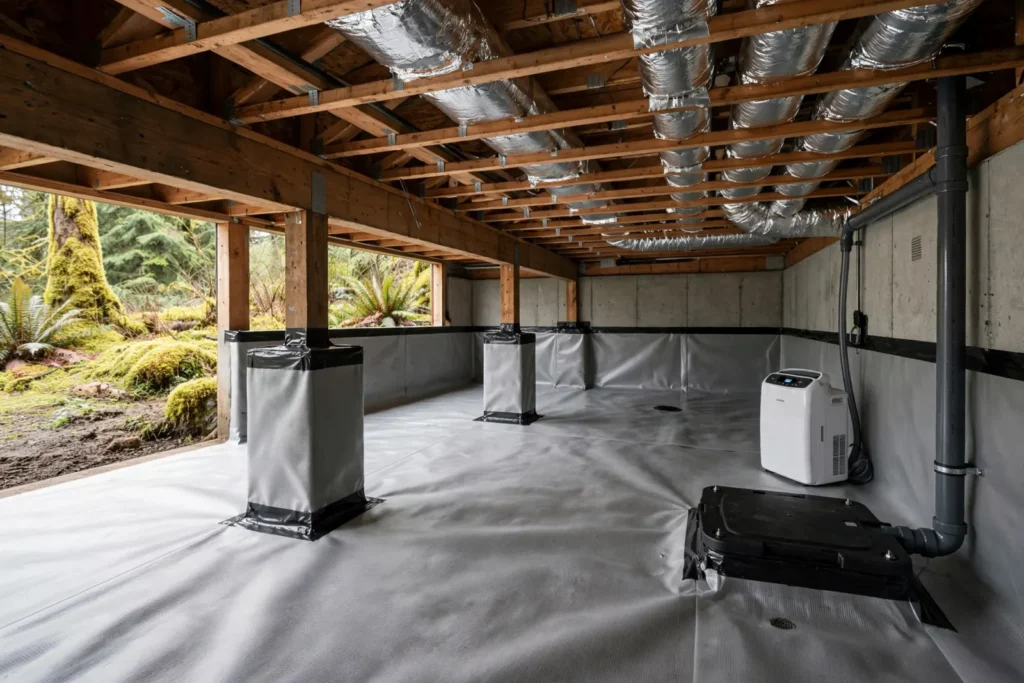
Quick answer
Seattle crawl space encapsulation in 2026 is expensive compared with many national projects because damp soil, drainage work, cleanup, dehumidification, insulation, mold, and code-required details can add scope before the liner is installed. Angi’s Seattle-specific 2026 data reports an average around $6,111, with many projects between about $5,555 and $16,665. It gives a broad local rate of roughly $2 to $11 per square foot depending on how complete the encapsulation is.
Seattle also has unusually specific crawl-space code language. The 2021 Seattle Residential Code requires ground cover in crawl spaces and regulates ventilation. For an unvented crawl space, it calls for a continuous Class I vapor retarder sealed at seams and up the stem wall, a radon system meeting Appendix AF, and continuously operated mechanical exhaust ventilation at a specified rate, subject to the code’s details and exceptions. That means a Seattle “encapsulation” should not be sold as simply laying thick plastic and closing the vents.
2026 Seattle crawl space cost snapshot
Angi’s Seattle range of $5,555 to $16,665 is the best current city-specific benchmark available for this guide, with an average near $6,111. The source also reports roughly $2 to $4 per square foot for basic work and $3 to $11 per square foot for more extensive encapsulation that includes cleaning, repairs, or added moisture-control features.
How to read these local figures: Angi’s Seattle crawl space encapsulation figures cited here are modeled estimates. Angi derives them from national project-cost data adjusted with U.S. Bureau of Economic Analysis regional price parities; they are not a survey of verified contractor quotes in Seattle. Use them for planning, and base your actual budget on itemized local bids.
A 1,000-square-foot crawl space can therefore be a $3,000 liner-and-sealing project in one house and a $12,000-plus moisture-remediation project in another. The difference is usually not the plastic. It is standing water, drainage, mold, damaged insulation, wood repair, sump pumps, electrical work, dehumidification, and access.
Use the national Home Cost Desk Crawl Space Encapsulation Cost 2026 guide to understand the base project, then apply Seattle-specific code and moisture conditions.
Seattle moisture is a system problem
A damp crawl space can receive moisture from several directions: wet soil, poor exterior grading, roof runoff, failed downspouts, groundwater, plumbing leaks, condensation, or humid outdoor air. Encapsulation works only when those sources are identified.
If liquid water enters after storms, covering the soil with a liner does not solve the water path. The project may need exterior grading, downspout extensions, perimeter drainage, an interior drain channel, a sump pump, or a combination approach.
The French Drain Installation Cost 2026 guide can help separate drainage cost from the encapsulation contract when subsurface water management is proposed.
Seattle Residential Code ground-cover rules
Which code edition applies in 2026? Seattle’s adopted residential code is the 2021 edition. The city reported in 2026 that implementation of the next (2024) code edition was not expected before May 2027. For a retrofit, confirm the requirements applicable to the actual permit and scope with the Seattle Department of Construction and Inspections rather than assuming a draft code is in force.
The 2021 Seattle Residential Code Section R408 requires a ground cover in crawl spaces with earth floors. The code text specifies at least 6-mil black polyethylene or an approved equivalent, with minimum lap and extension to foundation walls. This is a code baseline, not a statement that 6-mil material is the ideal durable encapsulation product for every retrofit.
Professional encapsulation systems often use thicker reinforced liners because service technicians will crawl over the material for years. Ask the contractor to distinguish the code minimum from the proposed product thickness and warranty.
Seams, piers, plumbing penetrations, access areas, and wall terminations matter as much as nominal liner thickness. A thick liner with loose seams can perform worse than a properly detailed system.
Vented versus unvented crawl spaces
Seattle’s code allows different crawl-space ventilation approaches. Conventional vented crawl spaces use exterior ventilation openings sized and distributed under the code. The 2021 Seattle Residential Code permits reduced vent area when the ground is covered with an approved Class I vapor retarder and certain conditions are met.
An unvented crawl space has a more demanding specification. Seattle’s R408.3 calls for a continuous Class I vapor retarder with sealed overlaps and edges extending up the stem wall, a radon system meeting Appendix AF, and continuously operated mechanical exhaust ventilation, subject to the code’s exact provisions.
This is why a contractor should not simply close foundation vents because the homeowner dislikes damp air. Changing from a vented to an unvented crawl space is a building-system decision.
Radon details are part of Seattle’s code path
Seattle’s crawl-space code connects reduced ventilation and unvented crawl spaces with radon venting requirements. Appendix AF includes soil-gas-retarder and vent-pipe provisions for crawl-space foundations.
A homeowner does not need to design the radon system personally, but the encapsulation contractor should explain whether the proposed configuration triggers a radon vent and how that component is installed. If radon testing or active mitigation is separately needed, use the Radon Mitigation Cost 2026 guide to budget that work.
Do not assume a sealed liner alone is a tested radon mitigation system.
Drainage before the liner
If the crawl space has standing water, install the water-management solution first. That can involve correcting exterior drainage, adding an interior perimeter drain, creating a sump basin, or routing groundwater to a legal discharge point.
Ask the contractor to show the water path from entry to discharge. A sump pump that sends water beside the foundation simply recycles the problem.
Seattle’s wet season makes backup planning important where the pump is essential. A high-water alarm, battery backup, or secondary pump may be appropriate if pump failure would rapidly flood the crawl space.
Sump pump costs and scope
Angi’s Seattle encapsulation guide lists pedestal sump pumps as a possible additional cost, but actual installed sump systems can cost much more once basin excavation, electrical service, discharge piping, check valves, alarms, and backup are included.
Do not compare the retail pump price with the installed drainage system. Require the quote to identify basin size, pump type, discharge route, electrical connection, backup strategy, and warranty.
A sump should remain accessible after encapsulation. The liner should be detailed around the basin rather than hiding it.
Dehumidifiers
Seattle’s local Angi guide lists dehumidifiers as a meaningful add-on, with costs that can approach several thousand dollars installed depending on equipment and scope. A dedicated crawl-space dehumidifier can be useful when the design relies on active humidity control.
Ask how the unit is sized, where condensate drains, what relative-humidity target is expected, and how filters are serviced. A small portable basement dehumidifier placed on a block is not the same as an integrated crawl-space system.
Monitor humidity after the project. A simple remote sensor can reveal a failed drain, new plumbing leak, open access door, or equipment problem before wood moisture rises again.
Mold and wood condition
Mold-like growth, staining, odor, or high wood moisture can increase cost before encapsulation. Cleaning and remediation should follow the actual condition; not every stained joist needs aggressive demolition.
If there is confirmed mold contamination, separate remediation from moisture control. The Mold Remediation Cost 2026 guide can help frame that scope.
Wood decay is more serious. Damaged joists, beams, sill plates, subfloor, or posts may need repair before the crawl space is sealed. Encapsulation can prevent future moisture but it cannot restore lost structural capacity.
Insulation in Seattle crawl spaces
Many older crawl spaces have fiberglass batts between floor joists. When batts are damp, falling, compressed, or contaminated, the encapsulation project may include removal and replacement.
The insulation strategy depends on whether the crawl space remains vented or becomes part of a sealed/conditioned approach. Perimeter-wall insulation, floor insulation, ducts, and mechanical ventilation need to work together.
Do not let a contractor spray foam over inspection areas without considering moisture, future access, pest inspection, and code. The thermal boundary should be deliberate, not improvised.
Ducts and air leakage
Seattle homes with heating ducts in crawl spaces can lose energy through leaky joints and poorly insulated runs. If the encapsulation contractor is already working around the duct system, coordinate an HVAC inspection rather than sealing damaged ducts behind a new liner.
Air leakage from the crawl space into the house can also carry odors and moisture. Seal plumbing, wiring, and framing penetrations as part of a coherent air-control plan.
The goal is not to make the crawl space airtight in every direction; it is to create the code-compliant pressure and moisture boundary intended by the chosen design.
Pest and access considerations
Rodent damage is common in neglected crawl spaces. Remove contaminated insulation and debris, close entry points, and preserve access for future inspection. Encapsulation should not hide active pest problems.
Service technicians still need to reach plumbing, ducts, wiring, and structural components. A premium liner should make the space cleaner to service, not create a fragile surface that tears every time someone enters.
Ask how access doors are sealed and whether their size remains compliant. Photograph buried utilities before the liner covers the soil.
Does encapsulation need a permit in Seattle?
Permit requirements depend on project scope. A simple ground-cover replacement is not the same as structural repair, new electrical work, mechanical exhaust, drainage discharge, or alterations to the building’s ventilation strategy.
Because Seattle’s Residential Code specifically regulates crawl-space ground cover and ventilation, ask the contractor to identify which code path is being used and whether a permit or trade permit applies to the proposed changes. Verify significant alterations through Seattle Department of Construction and Inspections rather than relying on a blanket statement that “crawl spaces never need permits.”
If the project includes structural beams, new circuits, pumps, mechanical exhaust, or drainage work, the permit question becomes more important.
Three Seattle project scenarios
Scenario 1: damp but structurally sound crawl space
The crawl space has an old torn ground cover, high humidity, and some falling insulation, but no standing water or structural decay. Cleaning, a durable vapor retarder, sealing, code-compliant ventilation, and selective insulation repair may keep the project near the lower-middle part of the Seattle range.
Scenario 2: recurring seasonal water
Water enters after prolonged rain. The project adds perimeter drainage, a sump pump, discharge piping, liner, sealed details, and monitoring. The price can move well beyond a simple per-square-foot liner estimate because water management is the main job.
Scenario 3: mold, damaged insulation, and unvented conversion
The crawl space has extensive contaminated insulation, mold-like growth, high wood moisture, and the owner wants an unvented system. The scope can include remediation, insulation removal, liner, radon provisions, mechanical exhaust, electrical work, and dehumidification. Five-figure pricing can be reasonable when multiple trades are involved.
How to compare Seattle encapsulation bids
Ask every contractor to define cleaning, debris removal, old insulation removal, drainage, sump pump, liner thickness, wall height, pier wrapping, seam method, vent strategy, radon detail, dehumidifier, mechanical exhaust, electrical work, mold treatment, insulation, structural repair, access-door work, monitoring, and warranty.
Five steps before approving the work
- Diagnose the water path. Request photos and observations after rain. Separate a plumbing leak, runoff at downspouts, and water rising from soil; each may need a different repair.
- Confirm the intended crawl-space design. Ask whether it will remain vented or be converted. Request the contractor’s explanation of the applicable Seattle code requirements before anyone closes vents.
- Price essential repairs separately. Obtain written allowances for debris removal, insulation replacement, drainage, sump electrical service, and any concealed wood damage.
- Compare identical scope. Ask each bidder to state liner specifications, seam details, wall attachment, discharge route, equipment service access, permit responsibility, and exclusions.
- Set completion tests. Require before-and-after photographs, a drainage demonstration where applicable, accessible pump and humidity equipment, and written maintenance instructions.
Use this Seattle-specific decision checklist:
- What is the measured crawl-space area?
- Where is moisture entering?
- Is there liquid water or only high humidity?
- Will the crawl space remain vented or become unvented?
- How does the proposal comply with Seattle R408?
- Is a radon vent required by the chosen code path?
- What is the final liner thickness and reinforcement?
- What humidity target will be monitored?
- What items are excluded from the warranty?
- Which permit or trade permits apply?
A lower quote may include only a liner. A higher bid may include drainage, mold work, insulation removal, mechanical ventilation, and a dehumidifier. Compare systems, not plastic thickness.
Seattle bid comparison worksheet
| Work item | Questions to ask | Quote detail to retain |
|---|---|---|
| Site inspection | Was water entry documented after rain? | Photos, measured area, access limitations |
| Drainage | Where will collected water discharge? | Drain, sump, piping, power, backup scope |
| Barrier | How are seams, piers, walls and access sealed? | Product thickness, attachment, warranty |
| Ventilation | Will the space remain vented? | Code approach, permits, equipment |
| Closeout | What evidence shows the work is complete? | Photos, checks, maintenance instructions |
Example: two quotes that are not equivalent
Suppose one contractor proposes a reinforced ground liner and sealed seams, while another includes the same liner plus an interior drain, sump basin, discharge piping and a dedicated electrical connection. The second quote is solving a documented water-entry problem that the first quote excludes. Ask the first contractor to quote the drainage package separately before comparing totals. This is an illustrative scope comparison, not a Seattle price estimate.
Maintenance after encapsulation
Inspect the crawl space at least periodically and after major plumbing or drainage events. Check the liner for tears, standing water, sump operation, dehumidifier filters, condensate drains, rodent entry, and new plumbing leaks.
Keep storage and future contractors from blocking drainage or damaging the liner. If a plumber cuts the vapor retarder, repair the seam using the system’s approved method rather than leaving an open flap.
Maintain a humidity monitor and keep completion photographs. The value of encapsulation comes from controlling moisture for years, not from how white the liner looks on installation day.
Frequently asked questions
How much does crawl space encapsulation cost in Seattle in 2026?
Angi’s Seattle-specific data reports an average near $6,111 and a typical range around $5,555 to $16,665, with basic work around $2 to $4 per square foot and more extensive projects around $3 to $11 per square foot.
Why is Seattle crawl space work expensive?
Wet soil, drainage, cleanup, mold, insulation, sump pumps, dehumidification, access, and code-required ventilation or radon details can turn a liner project into a multi-trade moisture-control project.
Can I just close the crawl-space vents?
Not without a code-compliant design. Seattle’s Residential Code regulates vented and unvented crawl spaces and specifies vapor-retarder, radon, and mechanical-ventilation provisions for unvented configurations.
Does encapsulation stop mold?
It can reduce the moisture conditions that support future growth, but existing contamination and leaks must be corrected. Encapsulation should follow moisture-source diagnosis and any necessary remediation.
Do I need a dehumidifier?
Not every crawl space does. The answer depends on the chosen code-compliant ventilation strategy, moisture load, and measured humidity. The contractor should explain the target and control method.
Should drainage be installed before the liner?
Yes when liquid water is entering. The water source or drainage path should be corrected before the crawl space is sealed.
What should I check after Seattle’s first heavy rain?
Look for new standing water, damp liner seams, water collecting beside the foundation, and whether any installed pump actually discharges away from the home. Review humidity-monitor trends rather than judging by appearance alone. If water returns, contact the contractor promptly and document conditions before disturbing the installation.
Should a quote include the sump pump’s power and discharge line?
Yes, ask for those items to be explicitly included or excluded. A pump price alone does not cover a basin, piping, discharge destination, electrical connection, backup plan or inspection. The contractor should explain where water can be discharged and who will handle any required trade work.
Can a 6-mil ground cover be called full encapsulation?
Seattle’s minimum ground-cover requirement and a durable, fully detailed encapsulation system are not interchangeable descriptions. Ask whether the proposal includes sealed seams and penetrations, wall terminations, moisture-source repairs and the ventilation approach appropriate to the project.
Bottom line
Seattle crawl space encapsulation cost in 2026 commonly falls between about $5,555 and $16,665, but the liner itself is rarely the reason for a five-figure project. Drainage, mold, damaged insulation, pumps, dehumidification, electrical work, and Seattle’s specific crawl-space code requirements drive the total.
A good Seattle encapsulation proposal identifies the moisture source first, then shows the code path for vapor control, ventilation, radon, drainage, and long-term monitoring. Do not compare bids by liner thickness alone.