Quick answer: A shallow exterior French drain generally costs about $10 to $35 per linear foot in 2026, or roughly $500 to $8,800 for common yard and curtain-drain projects, according to HomeGuide. Interior basement perimeter drains are a different job: HomeGuide lists about $40 to $85 per foot and $4,000 to $17,000 installed. Deep exterior perimeter drainage around an existing foundation can run about $30 to $90 per foot. The wide spread is the reason homeowners should identify the drainage problem before comparing bids.
2026 cost snapshot
| French drain type | 2026 planning range | Typical scope |
|---|---|---|
| Surface yard drain | $10-$30 per LF | Shallow exterior drainage |
| Curtain drain | $10-$35 per LF / $1,500-$8,800 | Intercepts shallow groundwater/runoff |
| Interior basement perimeter | $40-$85 per LF / $4,000-$17,000 | Concrete demo, perimeter drain, often sump |
| Interior crawl-space drain | $20-$40 per LF / $2,000-$8,000 | Crawl-space perimeter drainage |
| Deep exterior perimeter / weeping tile | $30-$90 per LF | Excavation beside foundation |
The first question is not price — it is which drain you need
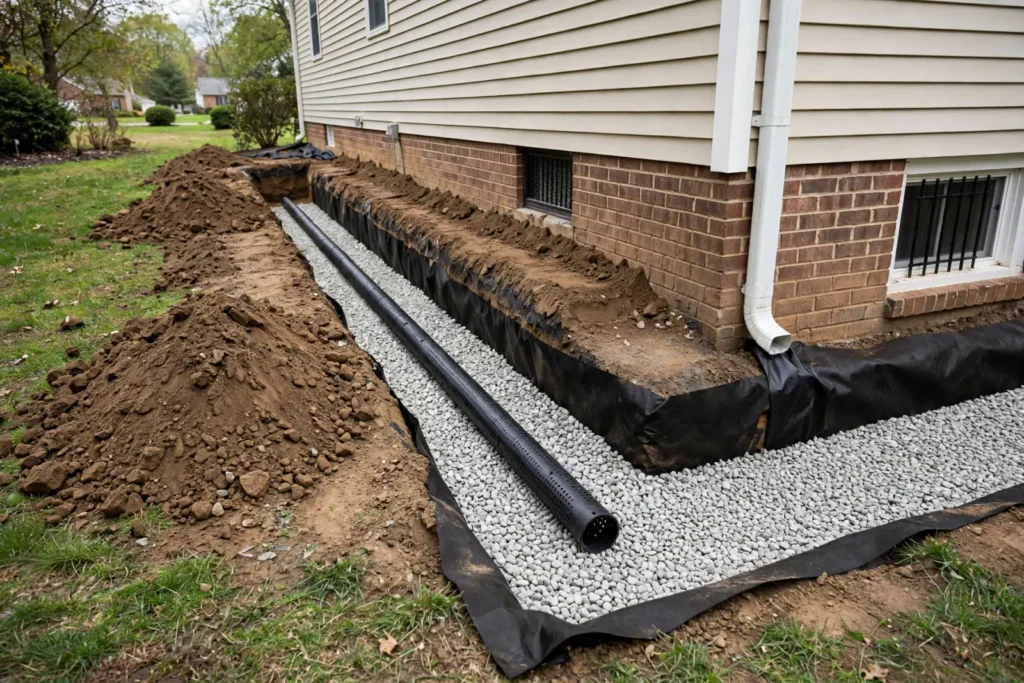
“French drain” is used for several very different projects. A shallow yard drain may intercept groundwater or surface water moving across a soggy section of lawn. An interior basement perimeter drain is cut into or installed beside the slab and usually works with a sump system. A deep exterior perimeter drain may require excavation down beside the foundation wall. Those jobs should never be compared as if they were the same number per foot.
HomeGuide’s February 2026 data makes the scope difference clear: shallow exterior systems average roughly $10 to $35 per linear foot, interior basement systems about $40 to $85 per foot, and deep exterior perimeter systems about $30 to $90 per foot. Angi’s May 2026 national article reports an extremely broad professional range from about $400 to $27,000, which makes sense only when very small yard projects and complex foundation drainage are placed under the same label.
Home Cost Desk therefore recommends describing the problem and the proposed outlet before discussing price. “Install 100 feet of French drain” is not enough. A useful quote says where the water is coming from, how deep the trench will be, what pipe and aggregate are used, how slope is established, where the water discharges, what surfaces are restored, and whether a sump pump is part of the system.
Use the table below to identify the correct project family before you apply a per-foot number. The length matters, but depth, access and restoration can matter just as much.
Exterior yard and curtain drains
A shallow exterior French drain is often used where a section of yard stays wet, water moves toward a structure, or runoff needs to be intercepted before it reaches a lower area. HomeGuide lists surface-level yard drains around $10 to $30 per foot and curtain drains around $10 to $35 per foot. At 100 feet, that suggests a rough national planning band of about $1,000 to $3,500 before unusual excavation or restoration.
The drain still needs a legitimate outlet. Water cannot simply be collected and sent to a random low point where it floods a neighbor, sidewalk, retaining wall or septic area. The contractor should explain whether the outlet is daylight, a dry well, a storm connection where legally permitted, a sump discharge, or another approved location. Local drainage and stormwater rules matter.
If the project is tied to new hardscape, coordinate drainage before the surface is installed. For example, a Concrete Patio Cost 2026 project can become more expensive if drainage is discovered after the slab is poured. The same is true for a Driveway Replacement Cost 2026 project: grading and drainage should be part of the design conversation, not an afterthought.
Interior basement French drains
Interior perimeter drainage is a more invasive project. The contractor may need to remove a strip of slab near the basement wall, excavate, place drainage material and pipe, route the system to a sump basin, and patch the concrete. If the project also needs a new or upgraded pump, compare that scope with our Sump Pump Replacement Cost 2026 guide. HomeGuide’s 2026 range of $40 to $85 per foot and $4,000 to $17,000 total reflects that added demolition and interior work.
An interior drain manages water after it reaches the foundation area; it does not necessarily correct the exterior source. That can still be a practical strategy, especially where exterior excavation is impossible or extremely expensive, but homeowners should understand the trade-off. Compare the proposal with Basement Waterproofing Cost 2026 so the contractor’s system is described accurately rather than sold as a universal cure.
If the basement has structural cracking, movement or settlement, drainage should not be used to explain away those signs. Water can contribute to soil and foundation problems, but structural distress deserves its own assessment. The Foundation Repair Cost 2026 guide explains why crack type, movement and soil conditions matter.
Deep exterior perimeter drains
A deep exterior perimeter drain—sometimes called footing drain, weeping tile or exterior French drain—can be the most excavation-heavy option for an existing house. The crew may need to dig beside the foundation, protect utilities, manage soil, work around decks or landscaping, waterproof the wall, place drainage components and then backfill and restore the site. HomeGuide’s $30 to $90 per foot planning range is therefore not comparable with a shallow lawn trench.
Exterior excavation can become expensive when access is limited. A narrow side yard may prevent an excavator from reaching the work. Patios, porches, steps, HVAC condensers, fences and mature landscaping can all create removal and restoration costs. Ask the contractor which of those items are included and which are excluded before comparing totals.
Where crawl spaces are involved, water management may be combined with vapor control or encapsulation. If that is part of the proposal, compare it with Crawl Space Encapsulation Cost 2026 and make sure the drainage path, sump system and membrane scope are each itemized.
What changes French drain cost
Length is the obvious variable, but depth is often more important than homeowners expect. A shallow trench across open lawn is faster than a deep excavation next to a foundation. Soil matters as well: rocky soil, heavy clay, roots and buried debris can slow trenching and increase disposal or equipment needs.
Access changes the labor and equipment plan. A machine can trench an open yard quickly, while a fenced side yard may force more hand work. Interior drains require concrete demolition and patching. Deep exterior systems can require shoring or other excavation controls depending on depth and soil conditions. Those are not reasonable places to assume a simple “price per foot.”
Materials also vary. Quotes may specify perforated pipe, rigid or flexible products, washed stone, filter fabric and cleanouts. The exact design should come from site conditions, but the quote should name the components so you can compare like with like. Ask how the contractor will prevent sediment from clogging the system and how future maintenance will be handled.
Restoration can be a major hidden cost. Lawn, beds, pavers, concrete, drywall, flooring and basement finishes may all need to be repaired. A contractor that leaves restoration to others can still be the right choice, but the exclusion should be explicit so the project budget includes it.
Safe digging and utility locating
French drain work involves excavation, which means buried utilities are a serious concern. The national 811 system tells homeowners and contractors to contact 811 before digging so participating utilities can mark underground lines. The required waiting period and rules vary by state, so the contractor should follow the local process rather than assuming a generic number of days.
This article is not a trenching tutorial. Deep excavation, work near foundations and digging around utilities can create collapse, damage and electrocution hazards. For a small landscape project, a homeowner may be tempted to start digging immediately; the safer planning step is to locate utilities first and decide whether the drainage design is simple enough for homeowner work at all.
When a French drain may not be the first fix
If roof water is dumping beside the foundation, extending or correcting downspouts may be more direct than installing a large subsurface drain. If the ground slopes toward the house, regrading may be part of the solution. If a basement leak is coming through a plumbing penetration or a failed window well, a perimeter drain may not be the most targeted first repair.
The goal is to diagnose the water path before buying a system. A contractor should be able to explain why the proposed drain intercepts that path and where the water will go. If the answer is only “French drains fix wet basements,” ask more questions.
How to compare French drain quotes
- Identify the actual water source and have each contractor mark the proposed drain route, depth and discharge point before comparing price.
- Compare two or three written bids on the same pipe, aggregate, excavation, sump work, restoration and permit scope rather than price per foot alone.
- Resolve utility conflicts, outlet legality and grading or foundation issues before excavation begins so the drain is solving the right problem.
Ask each bidder to mark the proposed drain route and outlet on a sketch. Request a written, itemized scope rather than a single price per foot. For a fair comparison, use this French-drain bid checklist:
- Water problem and design: What evidence points to groundwater, surface runoff or an interior seepage path? Why is the proposed drain positioned there?
- Route and discharge: Where does the collected water go, how will flow be achieved, and is the outlet permitted and unlikely to cause damage elsewhere?
- Trench and materials: What are the planned length and depth, pipe specification, washed aggregate, filter fabric, access points and sediment-control approach?
- Related work: Does the price include a sump basin or pump, electrical work, slab demolition and patching, hauling excavated material, and any required inspections?
- Restoration and contingencies: Who reinstalls sod, pavers, irrigation, basement finishes or landscaping? How will buried obstructions or unexpected foundation damage be priced and approved?
- Completion and upkeep: How will the installer demonstrate the intended flow path, document the installed route and explain future inspection or cleaning access?
For an interior basement system, ask specifically how the concrete strip will be repaired and whether finished walls or flooring must be removed first. Compare bids only after exclusions and allowances are visible; a cheaper drainage-only quote is not directly comparable with one that includes pump work and full restoration.
For exterior work, confirm who handles utility locating, permits, erosion control and any required stormwater approvals. Ask whether the contractor guarantees positive flow to the outlet and what maintenance is expected. Use the quote-comparison approach in How to Hire a Home Contractor 2026 rather than choosing the lowest total before the scopes match.
Frequently asked questions
How much does a 100-foot French drain cost?
A shallow exterior system using HomeGuide’s $10 to $35 per-foot range suggests roughly $1,000 to $3,500. A 100-foot interior basement system at $40 to $85 per foot suggests roughly $4,000 to $8,500. Those are different projects.
Does a French drain need a sump pump?
Not always. An exterior system may drain by gravity to an approved outlet. Interior basement systems commonly discharge to a sump basin and pump when gravity drainage is not available.
Can a French drain fix foundation cracks?
It can reduce water pressure or groundwater exposure in the right situation, but it does not structurally repair a moving or damaged foundation.
Is landscaping restoration included?
Sometimes, but never assume it. Ask whether sod, planting beds, pavers and irrigation repairs are included.
How long does installation take?
A simple shallow yard drain can be relatively quick. Deep perimeter excavation or an interior basement system can take several days and may involve other trades. Ask whether the stated schedule includes utility marking, inspections, concrete curing where applicable, and site restoration.
How can I tell whether a proposed French drain will address my water problem?
Ask the contractor to identify the water source, show the proposed interception route and explain the discharge destination. Roof runoff, poor surface grading, a leaking pipe and groundwater entering a basement may call for different remedies. A drawing of the route and outlet is more useful than a promise that a French drain will fix every wet area.
What maintenance access should a French drain have?
Ask the installer to identify any cleanouts or accessible inspection points, explain how sediment or root blockages would be investigated, and provide the final route and outlet location for your records. Keep visible outlets clear of debris and check for recurring pooling after rain; do not enter or dig into an unstable trench to investigate a blockage.
Budget scenarios: three very different “French drain” jobs
Consider a 75-foot shallow yard drain across open lawn. Using HomeGuide’s $10 to $35 per-foot exterior band produces a rough $750 to $2,625 planning range. If a trencher can reach the area and the outlet is simple, the project may stay near that framework. If the route crosses irrigation, mature roots, a retaining wall or hardscape, restoration can become a large share of the final bill.
Now consider a 100-foot interior basement perimeter system. At $40 to $85 per foot, the basic national planning math is about $4,000 to $8,500. But the homeowner may also face finished-wall removal, flooring removal, a new sump basin, pump replacement, battery backup, electrical work and finish restoration. A contractor quoting $6,500 for the drainage work and another quoting $9,000 including pump, concrete patching and cleanup may not be offering the same project.
A deep exterior foundation drain is different again. Excavating beside an existing foundation can expose waterproofing defects and damaged wall surfaces that were invisible beforehand. If a deck, patio, porch or air-conditioning equipment blocks access, temporary removal and reinstatement may dominate the budget. The homeowner should ask for allowances or unit prices for concealed conditions rather than approving an open-ended “repair as needed” line.
When bids differ sharply, draw the proposed routes on a simple plan and label the outlet, depth, sump location and surfaces to be restored. That one-page comparison often reveals why one quote is cheaper. The goal is not to force every contractor into the same construction method; it is to make sure every proposal is solving the same water problem and leaves the property in a clearly defined condition.
Common budgeting mistakes to avoid
Do not price the project only from trench length while ignoring the outlet and restoration. A drain with nowhere legal and reliable to discharge is not a complete system. Do not assume an interior basement drain is equivalent to fixing exterior grading, or that a shallow yard drain can solve deep foundation water pressure. Finally, do not let excavation begin before buried utilities are marked and the route has been checked against irrigation, septic components and other underground features.
Bottom line
French drain pricing makes sense only after the project type is defined. In 2026, use about $10 to $35 per foot for shallow exterior planning, $40 to $85 per foot for interior basement drainage, and $30 to $90 per foot for deep exterior perimeter work. Then add the site-specific costs that national tables cannot see: access, excavation, sump equipment, utility conflicts and restoration.
Sources used for this article
- HomeGuide — How Much Does a French Drain Cost? (2026), February 5, 2026: https://homeguide.com/costs/french-drain-cost
- Angi — How Much Does a French Drain Cost? [2026 Data], updated May 30, 2026: https://www.angi.com/articles/how-much-does-french-drain-cost.htm
- Angi — What to Know About Putting a French Drain Around a Foundation, updated July 9, 2026: https://www.angi.com/articles/foundation-french-drain.htm
- 811 — National Safe Digging Month / safe digging guidance: https://call811.com/NSDM