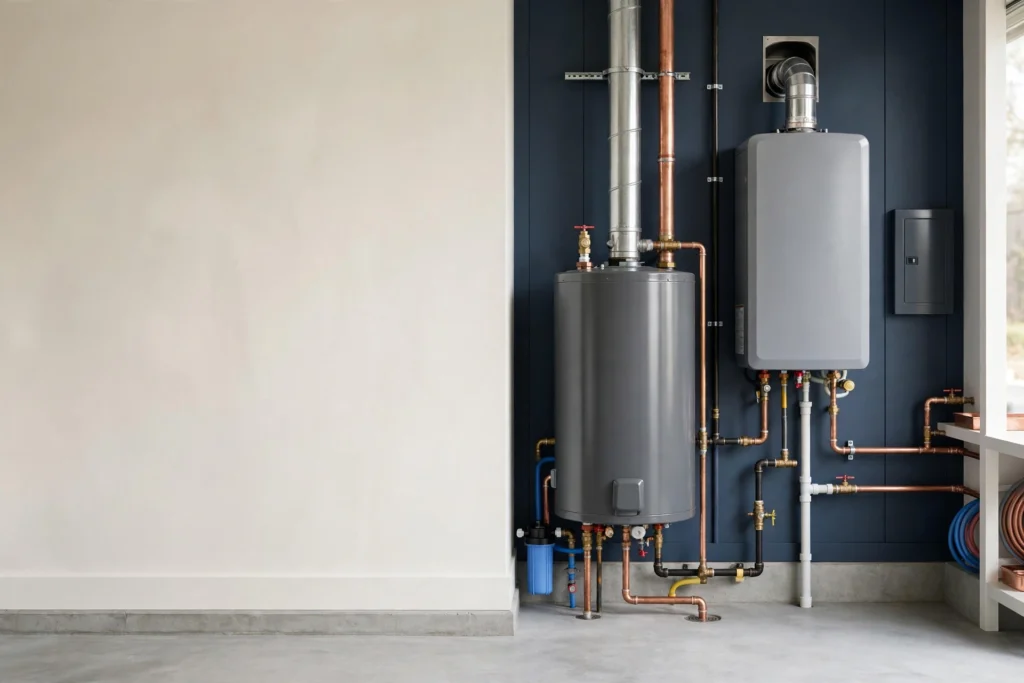
Updated October 2026. Water heater replacement cost depends on much more than the appliance price. Fuel type, storage capacity, recovery rate, venting, electrical service, gas piping, permits, drain work, location, removal of the old unit, and code upgrades can all change the final bill.
Quick answer: Water heater replacement cost in 2026
For 2026, Angi reports that a conventional tank-style water heater replacement commonly costs about $882 to $1,826, with an average near $1,348. Tankless installation typically runs about $1,400 to $3,900. A simple like-for-like replacement may stay near the middle of those ranges, while fuel conversions, difficult access, panel upgrades, gas-line changes, new venting, or major code work can push the project much higher.
Home Cost Desk planning rule: compare the installed system, not the appliance price. A $900 heater can become a much larger project if the home needs electrical, gas, venting, drainage, expansion-control, or permit work.
Typical 2026 installed cost ranges
| System | Typical 2026 installed range | Best fit |
|---|---|---|
| Conventional tank | $882–$1,826 | Lower upfront cost and straightforward replacement |
| Tankless | $1,400–$3,900 | Space savings and long-duration hot-water demand when properly sized |
| Heat pump water heater | Varies widely by equipment and installation | Homes replacing electric resistance equipment with suitable indoor space |
These are national planning figures rather than local quotes. Angi’s July 2026 data puts the average tank-style replacement near $1,348, while tankless projects have a higher upfront range because installation can require more extensive utility work. For an example of how one metro market can differ, see our Charlotte water heater replacement cost guide.
Interactive estimator
Water Heater Replacement Estimator
Choose the equipment, then flag anything about the installation. Equipment sets the 2026 planning range from this guide; installation factors are listed separately because they can push the final quote above it.
How it works: the range comes only from the equipment type, using this guide’s national installed ranges (Angi, 2026). This guide gives no dollar amounts for the installation factors, so the tool lists them instead of adding made-up numbers. Ask for each one as its own line item.
How to estimate your own replacement budget
Start with the existing heater. Write down the fuel type, tank capacity or tankless input rating, approximate age, location, vent type, and available electrical service. Then decide whether you are replacing like-for-like or changing technology.
A like-for-like replacement in an accessible garage or utility room is usually the simplest project. A conversion can be more expensive because the contractor may need to modify gas piping, add a dedicated electrical circuit, upgrade a panel, change venting, add condensate drainage, relocate equipment, or alter plumbing connections. If you are considering an electric heat pump water heater instead of a conventional tank, compare the equipment, electrical work, ventilation, operating costs and 2026 incentive rules in our heat pump water heater cost guide.
Example: straightforward tank replacement
If an existing tank water heater is replaced with a similar-size unit using the same fuel and the surrounding plumbing, venting, drainage, and electrical setup are already suitable, the project may fall near the common tank-replacement range.
Example: tank-to-tankless conversion
A tankless conversion can cost substantially more than the unit itself. Some gas models need greater gas-flow capacity and different venting, while high-output electric tankless models may require significant electrical capacity. The correct comparison is therefore total installed cost, not retail equipment price.
What changes the price?
Fuel type
Replacing like-for-like is generally simpler than switching between gas and electric. A fuel conversion can require new wiring, panel capacity, gas piping, venting, or other infrastructure.
Tank size and household demand
Larger households usually need more hot-water capacity or greater recovery performance. Oversizing wastes money; undersizing creates comfort problems. Size the system around actual household demand.
Tank vs. tankless
Tankless systems can save space and avoid standby losses, but installation may require larger gas lines, new venting, or significant electrical capacity depending on the model. Compare total installed cost, not just equipment price.
Heat pump water heaters
Heat pump water heaters move heat from the surrounding air into the tank rather than creating all of their heat with electric resistance elements. ENERGY STAR says certified models can cut water-heating energy use substantially compared with standard electric resistance units. For a household of four, ENERGY STAR currently estimates annual electric-bill savings of roughly $550 under its stated assumptions.
The technology is not ideal for every location. ENERGY STAR guidance says many units perform best in spaces that remain roughly 40°F to 90°F year-round and have sufficient surrounding air volume. They also cool and dehumidify the room, create some operating noise, and may require condensate drainage. A contractor should evaluate the actual installation space rather than treating a heat pump model as a universal drop-in replacement.
Fuel type and conversion costs
Replacing gas with gas or electric with electric is usually simpler than changing fuel type. A conversion may require capping or extending gas piping, installing new electrical circuits, increasing panel capacity, modifying venting, or changing the installation location. Ask for these infrastructure costs as separate line items so you can see what the technology change itself is costing.
Venting, electrical, and gas work
Older installations may not meet the needs of new equipment. Dedicated circuits, gas-line changes, venting modifications, combustion-air requirements, condensate handling, expansion tanks, drain pans, seismic restraints where locally required, or other code upgrades can increase the quote.
Location and access
A heater in an open garage or utility room is easier to replace than one in a tight attic, crawl space, closet, platform, or finished area. Difficult removal paths, stairs, narrow openings, or finished surfaces can add labor and protection work.
Capacity and first-hour demand
Do not size a storage heater only by household head count. Capacity should reflect how much hot water the household uses during peak periods and how quickly the unit can recover. For tankless systems, sizing is based on required flow rate and the temperature rise between incoming water and the desired outlet temperature. Colder incoming water can reduce the amount of hot water a tankless unit can deliver at once.
Permits and local code
Permit and inspection rules differ by jurisdiction. A replacement may trigger requirements involving venting, combustion air, pressure control, drain pans, discharge piping, seismic bracing, electrical disconnects, or other safety provisions. A complete quote should state who obtains permits and which code upgrades are included.
Repair or replace?
Angi’s August 2026 data puts professional water heater repair at an average of about $616, with many repairs falling between $228 and $1,017. A repair may make sense when the unit is relatively young, the tank itself is sound, and the problem is a replaceable control, heating element, thermostat, valve, igniter, or similar component.
Replacement becomes more attractive when the tank itself leaks, corrosion is extensive, hot-water capacity no longer meets the household’s needs, repairs are recurring, or a major repair approaches a meaningful share of the installed replacement cost. A leaking storage tank is generally not a normal component-level repair; the tank assembly usually needs replacement.
| Situation | Repair may make sense | Replacement may make more sense |
|---|---|---|
| Young unit, isolated component failure | Often | Not necessarily |
| Tank itself is leaking | Rarely | Usually |
| Repeated service calls | Less attractive | More attractive |
| Major efficiency or capacity problem | Depends on cause | Often worth comparing |
| Conversion needed for other home upgrades | Possibly temporary | Compare full installed alternatives |
Tank vs. tankless vs. heat pump: how to choose
Conventional tank
A conventional storage tank usually has the lowest upfront replacement cost and is often easiest when replacing an existing similar unit. The tradeoff is standby heat loss and finite stored capacity.
Tankless
Tankless units save floor space and heat water on demand, but the household still needs a correctly sized system. Multiple simultaneous showers, appliances, and fixtures can exceed the unit’s flow capacity if sizing is too aggressive. Gas tankless installations can also require larger gas supply and new venting; electric tankless units can place heavy demand on the electrical service.
Heat pump water heater
A heat pump water heater can be especially attractive when replacing a conventional electric resistance tank in a suitable location. ENERGY STAR reports substantial operating savings for certified models, but installation space, ambient temperature, noise, condensate drainage, household demand, and electrical requirements should all be checked first.
Hidden costs that can change the final bill
- Old-unit removal: Confirm hauling and disposal rather than assuming it is included.
- Permit and inspection: Local rules vary and can add direct fees and contractor time.
- Electrical upgrades: New circuits, disconnects, wire size, breakers, or panel work can materially change the project.
- Gas piping: A higher-input appliance may require gas-line evaluation or modification.
- Venting: Gas equipment can require new vent materials, routing, combustion-air provisions, or termination changes.
- Drainage: Heat pump and condensing equipment may require condensate management.
- Expansion control: Some plumbing systems require an expansion tank or other pressure-control measures.
- Drain pan and discharge routing: Location and local code can require additional water-damage protection.
- Access: Attics, closets, platforms, stairs, and narrow openings can increase labor.
- Relocation: Moving a water heater can turn a simple replacement into a larger plumbing and utility project.
What about rebates and tax credits in 2026?
Do not rely on older articles that still advertise the former federal Energy Efficient Home Improvement Credit for a 2026 heat pump water heater installation. The IRS states that the Section 25C credit is not allowed for property placed in service after December 31, 2025. ENERGY STAR’s water-heater tax-credit page likewise lists eligibility only through 2025.
That does not mean all incentives disappeared. Utilities, state programs, manufacturers, and local efficiency programs may still offer rebates for qualifying equipment. ENERGY STAR provides a rebate finder for certified products. Check eligibility before buying because programs can depend on ZIP code, equipment model, income, fuel type, installer requirements, or pre-approval.
What should a replacement quote include?
- Exact manufacturer and model number
- Tank capacity, tankless flow/input rating, or heat-pump specifications
- Fuel type and efficiency rating
- Removal and disposal of the existing heater
- Permit and inspection responsibility
- Gas, vent, electrical, drain, or plumbing modifications
- Expansion tank, drain pan, discharge piping, or condensate requirements
- Any code upgrades and whether they are included or allowances
- Startup and functional testing
- Manufacturer warranty and labor warranty
- Payment schedule and how change orders are approved
Questions to ask the installer before signing
- Why is this capacity appropriate for my household’s peak demand?
- Is this a like-for-like replacement or does the quote include a conversion?
- Does my electrical panel or gas supply need modification?
- Will existing venting remain compliant with the new model?
- Who obtains the permit and schedules inspection?
- Are removal, disposal, and cleanup included?
- What maintenance does this model require?
- Are there utility or local rebates for this exact model?
- What items could legitimately create a change order after work starts?
- What is covered by the manufacturer’s warranty versus the installer’s labor warranty?
Safety: do not treat water-heater work as a casual DIY swap
Water heaters combine pressurized hot water with gas combustion or high-voltage electrical equipment. Incorrect installation can create fire, carbon-monoxide, scalding, flooding, pressure, or shock hazards. Local code may also require permits or licensed trades. For most full replacements, professional installation is the prudent choice.
The U.S. Consumer Product Safety Commission recommends lowering water-heater temperature to about 120°F to reduce tap-water scald risk. Household needs and health circumstances can differ, so follow the appliance instructions and any appropriate medical or local guidance rather than changing safety settings casually.
Five-step replacement plan
- Identify the existing system. Record fuel type, capacity, age, model, location, and vent type.
- Define the goal. Decide whether you want the lowest replacement cost, more capacity, lower operating cost, space savings, or a technology change.
- Check infrastructure. Have the contractor evaluate electrical service, gas supply, venting, drainage, and installation space before final pricing.
- Compare complete written quotes. Match equipment, permits, utility work, disposal, warranties, and code items line by line.
- Verify incentives before purchase. Confirm any utility or local rebate requirements before ordering equipment or starting work.
Frequently asked questions
How much does a tank water heater replacement cost in 2026?
A common national planning range is about $882 to $1,826, with an average near $1,348. Local labor, capacity, access, permits, and code work can move the price outside that range.
How much does a tankless water heater cost to install?
Angi’s 2026 data places many tankless installations around $1,400 to $3,900. Conversions can cost more when gas supply, venting, or electrical infrastructure needs significant work.
Is a heat pump water heater worth it?
It can be a strong option for homes replacing standard electric resistance equipment when the installation space is suitable. ENERGY STAR estimates meaningful annual operating savings, but upfront cost and site requirements need to be considered together.
Should I replace a water heater before it leaks?
Planning before failure can give you more time to compare technologies, contractors, rebates, and installation changes. An emergency failure can force a faster decision and may increase water-damage risk.
Can I reuse the old vent or electrical circuit?
Sometimes, but not automatically. The new model’s manufacturer requirements and local code determine what is acceptable. A contractor should verify compatibility before finalizing the quote.
Bottom line
For 2026 budgeting, use roughly $882–$1,826 for many conventional tank replacements and $1,400–$3,900 for many tankless installations. Then verify whether your home needs venting, electrical, gas, drainage, permit, pressure-control, or other code work that changes the installed total.
The best decision is not simply the cheapest heater. Compare the complete installed cost, household hot-water demand, expected operating cost, site constraints, maintenance requirements, warranties, and available local incentives.
Related Home Cost Desk guides
- Plumber Cost in 2026
- Whole-House Repiping Cost 2026
- Sewer Line Replacement Cost 2026
- Electrician Cost in 2026
- Annual Home Maintenance Cost in 2026
- Bathroom Remodel Cost in 2026
- Major Home Systems Lifespan Guide 2026
- How to Hire a Home Contractor in 2026
Home Cost Desk compares current U.S. cost or technical references and checks safety, code, efficiency, incentive, or regulatory claims against authoritative sources when available. National figures are planning ranges, not local quotes.
Editorial review: Home Cost Desk Editorial Team · Read our research methodology · Detailed sources appear below.
Sources and methodology
- Angi — Water Heater Replacement Cost, updated July 20, 2026
- Angi — Tankless Water Heater Cost, updated August 3, 2026
- Angi — Water Heater Repair Cost, updated August 24, 2026
- ENERGY STAR — Heat Pump Water Heaters
- ENERGY STAR — Heat Pump Water Heater Benefits and Savings
- ENERGY STAR — Heat Pump Water Heater Federal Tax Credit Dates
- IRS — Section 25C termination date
- U.S. CPSC — Tap Water Scald Safety
Updated October 2026. Cost figures are national planning ranges and are not contractor quotes. Local labor, permits, utility requirements, equipment specifications, access, and code provisions can materially change the installed price.