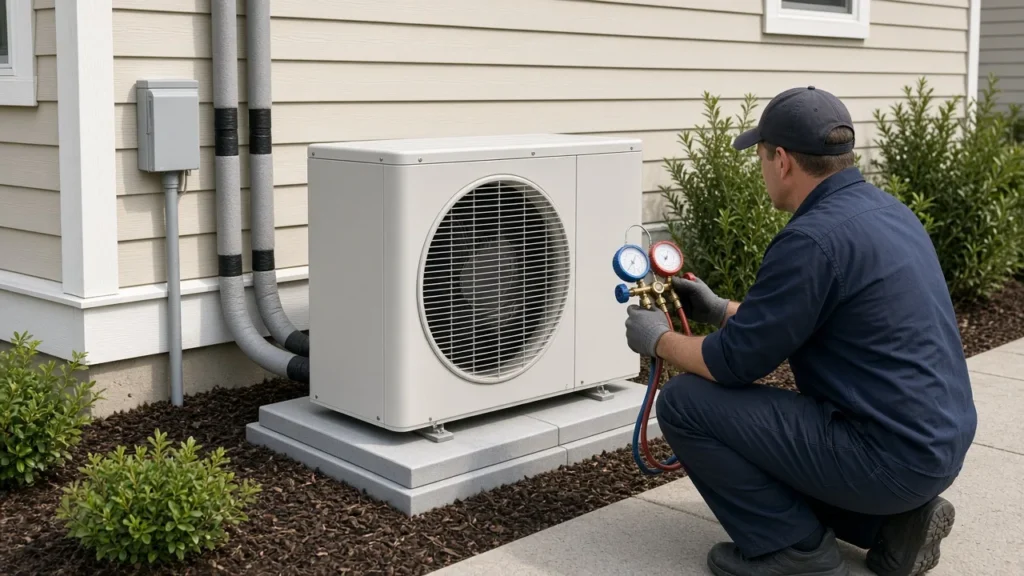
Updated October 2026. Heat pumps are getting more attention because one system can both heat and cool a home. But the price question is more complicated than “How much does a heat pump cost?” A homeowner replacing an old central AC may be looking at a very different project from someone switching from a gas furnace, adding new ductwork, or installing a cold-climate system in an older house.
The most useful way to budget is to separate the equipment from the house-specific work around it: sizing, electrical capacity, ductwork, controls, permits, and any backup heat the home may need.
Quick answer: Heat pump cost in 2026
For a typical U.S. home, professional heat pump installation often falls somewhere between about $4,200 and $8,000 for a straightforward air-source system, according to Angi’s 2026 data. This Old House reports an average central heat-pump installation of about $10,575 from its 2026 homeowner survey, with air-source replacements averaging about $8,007.
HomeGuide uses a broader range of roughly $10,000 to $25,000+ for many whole-home air-source heat-pump installations, especially once larger homes, premium equipment, air handlers, or more complex installation work are included.
That spread is not a contradiction so much as a reminder: “heat pump installation” can mean anything from swapping equipment on an existing compatible system to redesigning a large portion of a home’s heating and cooling setup.
Open the HVAC Replacement Cost Calculator →
| Heat-pump project | 2026 planning range |
|---|---|
| Typical professional installation | About $4,200–$8,000 |
| Central air-source heat pump | Often around $8,000–$10,500 average |
| Ductless mini-split | About $2,000–$17,000 depending on zones |
| Geothermal system | About $17,000–$50,000+ |
| Premium / complex whole-home project | Can exceed $20,000 |
These are national planning figures, not contractor quotes. Your actual price depends on the home, climate, capacity, efficiency level, ductwork, electrical service, and installation scope.
Heat pump cost by home size
Home size can help with rough budgeting, but square footage alone should never determine the final equipment size. HomeGuide’s current air-source pricing, which includes air-handler installation, shows these broad installed ranges. They sit above Angi’s $4,200–$8,000 range because they assume a more complete system installation rather than a straightforward swap:
| Home size | Typical capacity | Installed planning range |
|---|---|---|
| About 1,000 sq. ft. | 1.5–2 tons | $6,000–$8,500+ |
| About 1,500 sq. ft. | 2.5 tons | $8,000–$10,500+ |
| About 2,000 sq. ft. | 3 tons | $10,000–$20,000+ |
| About 2,500 sq. ft. | 3.5–4 tons | $12,000–$22,000+ |
| About 3,000 sq. ft. | 4–5 tons | $18,000–$25,000+ |
Use these numbers only as a first-pass budget. Insulation, windows, air leakage, ceiling height, orientation, climate, and duct losses can materially change the required capacity. A contractor should verify sizing with a Manual J load calculation rather than relying on square footage alone.
Why heat-pump quotes vary so much
System type
Air-source heat pumps are the most common residential option. Ductless mini-splits can be less expensive for one or two rooms but become costly when many indoor zones are added. Geothermal systems can be highly efficient, but the ground loop and excavation make installation much more expensive.
Home size and required capacity
A larger house usually needs more heating and cooling capacity. But contractors should not size a new heat pump by simply copying the old unit. ENERGY STAR recommends proper sizing using a Manual J load calculation so the equipment matches the home’s actual heating and cooling needs.
Ductwork
If the home already has well-sized, reasonably sealed ducts, the project may be relatively straightforward. If the ducts are undersized, badly leaking, or poorly balanced, the quote can increase because the contractor needs to correct airflow problems.
Electrical work
A heat pump is electric equipment. Some homes—especially older homes—may need new circuits, a disconnect, wiring changes, or even a service-panel upgrade. Those costs are easy to overlook when comparing only the equipment price.
Hidden costs that can change the final heat-pump budget
| Possible extra | Why it matters |
|---|---|
| Electrical circuit or wiring | The outdoor unit and air handler may need dedicated electrical work. |
| Panel or service upgrade | An older electrical system may not have enough capacity for the new load. |
| Duct repair or replacement | Leaky or undersized ducts can prevent the new system from delivering rated comfort and efficiency. |
| Air handler or indoor coil | A complete matched system can cost substantially more than replacing only the outdoor unit. |
| Backup heat | Cold climates or specific system designs may require electric resistance or dual-fuel backup. |
| Permits and inspections | HVAC and electrical permits vary by jurisdiction. |
| Controls and thermostat | Variable-speed, communicating, or dual-fuel systems may need compatible controls. |
| Difficult access | Attics, crawl spaces, rooftops, long refrigerant runs, and tight mechanical rooms add labor. |
Do not compare quotes until these items are either priced or explicitly marked as excluded. A lower equipment price can become the more expensive project after electrical, duct, control, or access work is added.
Climate and equipment specification
A system selected for a mild climate may not be appropriate for a colder region. Cold-climate heat pumps, variable-speed equipment, dual-fuel controls, and higher-efficiency models can cost more upfront but may perform better for the home’s actual conditions.
Air-source heat pump cost
Air-source systems are the mainstream choice for whole-home residential installations. Angi reports professional heat-pump installation around $4,237 to $7,943 in its August 2026 pricing data. This Old House reports an average air-source replacement of about $8,007 in its 2026 homeowner survey.
HomeGuide’s range is higher—roughly $10,000 to $25,000+ for many whole-home air-source projects—because its pricing includes larger homes and more extensive installations. For budgeting, it is better to expect a range rather than anchor to one national “average.”
Ductless mini-split heat pump cost
Ductless mini-splits are useful when a home has no existing ducts, when an addition needs independent conditioning, or when certain rooms need their own zones. This Old House reports about $3,250 for a single-zone mini-split in its 2026 survey, while HomeGuide shows a much broader $2,000 to $17,000 range depending on the number of zones and installation complexity.
One indoor head in a garage conversion is a very different project from a five-zone whole-house system. When comparing quotes, make sure the number of indoor units, line-set lengths, electrical work, condensate routing, and controls are all included.
Geothermal heat pump cost
Geothermal systems exchange heat with the ground rather than outdoor air. They can be highly efficient, but the underground loop makes them a major construction project. This Old House reports about $17,000 for many smaller geothermal replacements and $30,000+ for larger homes. HomeGuide places many geothermal projects around $20,000 to $50,000+.
Geothermal is not simply a “better heat pump.” It is a different project category with much higher installation cost, site requirements, and a longer payback calculation.
Replacing a gas furnace with a heat pump
If you currently have a gas furnace, the comparison is not only furnace price versus heat-pump price. A heat pump also provides cooling, so it can replace or reduce the role of both the furnace and central AC.
Angi’s 2026 guidance puts many gas-furnace-to-heat-pump conversions around $4,200 to $7,900, with about $6,000 cited as a common midpoint for straightforward projects.
But whether the conversion saves money over time depends on local electricity and gas rates, climate, existing equipment efficiency, insulation, and how the heat pump is configured. A homeowner in a mild climate may see a very different operating-cost picture from someone in a long, very cold winter.
What does “dual fuel” mean?
A dual-fuel system pairs a heat pump with a furnace. The heat pump handles heating during milder weather, while the furnace can take over when conditions or utility economics favor combustion heat.
ENERGY STAR specifically notes that homeowners with a relatively new furnace and an older central AC can consider an ENERGY STAR certified heat pump to create a dual-fuel system for a modest additional cost over replacing the AC alone.
This can be a useful middle ground when the furnace still has life left but the air conditioner is already due for replacement.
A homeowner example: same house, two very different decisions
Imagine a homeowner with a 12-year-old central AC and a 6-year-old gas furnace. The AC fails, but the furnace has been reliable.
One option is to install another central AC and keep the furnace exactly as it is. Another is to install a heat pump instead of the AC and use the existing furnace as backup heat.
The heat-pump quote may be somewhat higher, but the homeowner is not really comparing “AC versus heat pump.” They are comparing two future operating systems: one where the furnace provides all winter heat, and one where the heat pump handles much of the year while the furnace remains available when needed.
That is why a good contractor should discuss equipment operation, controls, local climate, and utility costs—not just hand over two equipment prices.
How much can a heat pump save on energy?
ENERGY STAR explains that air-source heat pumps move heat rather than creating it from fuel. Certified systems can deliver up to roughly three times more heat energy to a home than the electrical energy they consume under appropriate conditions.
That does not mean every homeowner’s utility bill will fall by the same percentage. Savings depend on what system is being replaced, climate, electricity prices, gas or oil prices, insulation, thermostat settings, and how well the equipment is sized and installed.
This Old House cites research indicating typical annual utility savings of roughly $300 to $650 for many heat-pump households, but actual results can vary materially. The strongest comparison is a home-specific estimate using your current fuel use and local utility rates.
Heat-pump tax credits and rebates in 2026
Do not assume that the federal heat-pump tax credit used in earlier years still applies to a new 2026 installation. The IRS states that the Energy Efficient Home Improvement Credit is not available for property placed in service after December 31, 2025. The Residential Clean Energy Credit also ended for expenditures made after that date, so homeowners should not automatically subtract an old federal credit from a 2026 air-source or geothermal quote.
That does not mean every incentive disappeared. State energy offices, local utilities, manufacturers, and certain regional programs may still offer rebates or financing. Ask the contractor to identify the exact program name, eligibility rules, application deadline, and whether approval must happen before installation. Treat an incentive as real only after you verify that your project and installation date qualify.
Three realistic heat-pump budget examples
Example 1: straightforward central replacement
A home with usable existing ducts, adequate electrical capacity, and a properly sized three-ton air-source system may fall in the mid-four-figure to high-four-figure range. The key is that the quote includes the indoor equipment, outdoor unit, controls, permits, refrigerant work, startup, and disposal—not only the outdoor condenser.
Example 2: older home with electrical and duct upgrades
The same basic heat pump can become a low-five-figure project if the electrical panel needs work, ducts leak or are undersized, or the air handler is difficult to access. This is why a $7,000 equipment-and-installation quote and a $13,000 complete-project quote may both be reasonable for different houses.
Example 3: cold-climate or premium variable-speed system
A homeowner in a colder climate may choose cold-climate equipment, variable capacity, upgraded controls, and backup heat. The installed cost may be higher, but the comparison should include low-temperature performance, comfort, operating cost, and what existing furnace or AC equipment the project replaces.
Repair or replace an existing heat pump?
Not every heat-pump problem justifies replacement. Angi’s 2026 repair guidance puts many maintenance repairs around $150 to $600, with some major repairs approaching or exceeding $1,000.
Replacement deserves more serious consideration when the unit is more than about 10 years old, repair costs become a large percentage of replacement cost, performance is declining, or repeated failures are adding up.
A young heat pump with one failed component and otherwise good performance is a very different decision from a 14-year-old system that has needed multiple service calls in two seasons.
What should be included in a heat-pump quote?
- Exact outdoor and indoor equipment model numbers
- System capacity and efficiency ratings
- How the contractor sized the equipment
- Air handler or indoor coil, if required
- Thermostat and control work
- Electrical circuits, disconnects, and wiring
- Ductwork modifications
- Condensate drainage
- Refrigerant line work
- Permits and inspections
- Old-equipment removal
- Startup, airflow testing, and commissioning
- Equipment and labor warranties
A low quote that excludes electrical work, duct changes, permits, or controls may not actually be cheaper once the project starts.
Questions to ask the contractor
- Did you perform or review a Manual J load calculation?
- Why did you select this capacity?
- Will my existing ductwork support the required airflow?
- Does my electrical panel need any upgrades?
- Will I need backup or auxiliary heat?
- Would dual fuel make sense in this climate?
- What happens to comfort and operating cost at very low outdoor temperatures?
- Are permits and inspections included?
- What rebates or utility incentives are currently available?
- What is covered by the labor warranty?
A five-step plan before you sign a heat-pump contract
- Start with the house, not the equipment. Gather recent utility bills, note comfort problems, and identify whether the current system is failing, inefficient, or simply old.
- Require proper sizing. Ask for a Manual J load calculation and an explanation of the selected capacity rather than accepting a like-for-like tonnage swap automatically.
- Inspect ducts and electrical capacity. Confirm whether the existing ducts, panel, circuits, disconnect, and controls can support the proposed system before comparing final prices.
- Compare complete written scopes. Put equipment model numbers, efficiency, backup heat, permits, controls, disposal, commissioning, warranties, and exclusions side by side.
- Verify incentives yourself. Confirm any utility, state, local, or manufacturer rebate before treating it as part of the net project price. Do not subtract expired federal credits from a 2026 budget.
When a heat pump may not be the best project
A heat pump is not automatically the best choice for every house. A very inexpensive recent furnace, poor ductwork, limited electrical capacity, unusually high electricity rates, or an installation requiring extensive structural or electrical work can change the economics.
The goal should not be to “buy a heat pump.” The goal is to choose a heating-and-cooling system that fits the house, climate, budget, and expected ownership period.
Related Home Cost Desk guides
- HVAC Replacement Cost in 2026
- Furnace Replacement Cost in 2026
- AC Repair Cost in 2026
- Annual Home Maintenance Cost in 2026
- Electrician Cost in 2026
Bottom line
For 2026 planning, many straightforward air-source heat-pump installations fall roughly in the mid-four-figure to low-five-figure range, while larger, premium, ductless multi-zone, or geothermal projects can cost far more. Do not choose a system from the national average alone. The best quote is the one that clearly explains sizing, electrical needs, ductwork, climate performance, controls, and the total installed scope for your home.
Home Cost Desk compares current U.S. cost or technical references and checks safety, code, efficiency, incentive, or regulatory claims against authoritative sources when available. National figures are planning ranges, not local quotes.
Editorial review: Home Cost Desk Editorial Team · Read our research methodology · Detailed sources appear below.
Sources
- Angi — Heat Pump Costs and Installation Costs, updated August 3, 2026
- Angi — Heat Pump Installation or Replacement, updated August 22, 2026
- Angi — Repair or Replace a Heat Pump, updated July 9, 2026
- This Old House — Heat Pump Cost, updated August 28, 2026
- HomeGuide — Heat Pump Cost
- ENERGY STAR — Air-Source Heat Pumps
- IRS — 2025 Form 5695 Instructions: termination of residential energy credits after December 31, 2025
National cost figures are planning estimates, not local quotes. Equipment size, climate, efficiency, electrical work, ductwork, permits, incentives, and installation complexity can materially change the final price.