Quick answer
Tampa mold remediation in 2026 commonly falls around $1,347 to $3,778 according to Angi’s Tampa-specific data, with an average near $2,548. Larger or hidden projects can cost much more. HomeGuide’s national mold-removal data commonly uses roughly $15 to $30 per square foot and shows how whole-room, attic, HVAC, or whole-house contamination can move into the high thousands or even five figures.
Tampa’s warm, humid climate makes the moisture source especially important. Remediation without moisture control is not a durable solution. Florida also regulates mold-related services. The Department of Business and Professional Regulation defines mold assessment and mold remediation involving growth greater than 10 square feet as regulated mold-related activity, subject to the state’s definitions and exemptions. Homeowners should verify current licensing before hiring for a larger project.
2026 Tampa mold remediation cost snapshot
Angi’s Tampa page reports a local normal range of $1,347–$3,778 and an average of $2,548. The page also explains that location and extent materially change the cost. Mold in an accessible bathroom wall is not the same project as contamination inside an HVAC system, attic, crawl space, or multiple finished rooms.
HomeGuide’s national data is broader and useful for large scopes. Cost per square foot can be a rough planning tool, but it should not be multiplied blindly across the entire house. Remediation is based on the actual contaminated material and containment zone, not on the home’s total square footage.
For a national comparison, see Mold Remediation Cost 2026.
Why Tampa creates a different moisture environment
National Weather Service Tampa Bay climate normals document the region’s warm conditions and pronounced wet season. That combination raises the importance of roof leaks, wind-driven rain, plumbing failures, HVAC condensate, indoor humidity, and drying time after storms.
EPA guidance emphasizes that moisture control is the key to mold control. EPA recommends keeping indoor relative humidity below 60 percent, ideally in the 30 to 50 percent range where practical, and drying wet materials within 24 to 48 hours after a leak or spill when possible.
In Tampa, that guidance has practical consequences. A small roof leak, condensate overflow, or wet drywall cavity can remain damp long enough to support growth even after the visible surface appears dry.
Florida mold licensing matters
Florida DBPR’s public guidance says mold-related services include assessment and remediation. It defines mold assessment involving more than 10 square feet of mold growth and remediation involving removal, cleaning, sanitizing, demolition, or other treatment of more than 10 square feet as regulated activity, subject to statutory definitions and exemptions.
Do not rely on a company saying “we are certified.” Ask for the Florida license number when regulated mold-related services apply and verify it through the state system. Also understand that a mold assessor and mold remediator are different roles.
For a larger project, the assessment may define the extent and remediation protocol, while the remediator performs the cleanup. That separation can improve documentation and reduce conflicts of interest.
Testing is useful when it answers a real question
Visible mold plus a known plumbing leak does not always require expensive sampling before any work can begin. EPA guidance focuses first on moisture control and cleanup. Testing can be more useful when the source is unclear, the affected area is hidden, the project is large, occupants have specific concerns, a real-estate transaction requires documentation, or an independent post-remediation assessment is needed.
Ask what decision the test will change. If the result will not affect the remediation scope, a large sampling package may not add value. On the other hand, hidden contamination or a disputed scope can justify a qualified assessment.
A mold test should support a decision, not become a substitute for fixing a known leak.
What drives Tampa remediation cost
The first driver is affected area. Ten square feet of surface growth on an accessible wall is not the same as several hundred square feet of drywall, insulation, framing, and contents.
The second driver is location. Attics, wall cavities, crawl spaces, and HVAC equipment can require more containment, access, and specialty cleaning than an open room.
The third driver is the moisture source. Roof repair, plumbing repair, exterior sealing, drainage, or HVAC condensate work may be separate from mold remediation. A quote that removes drywall but leaves the water source active is incomplete.
The fourth driver is material. Nonporous surfaces may sometimes be cleaned; porous materials such as drywall, insulation, ceiling tile, or badly deteriorated wood may need removal depending on condition and contamination.
Roof leaks and wind-driven rain
Tampa homeowners often discover mold after a roof leak, tropical system, severe thunderstorm, failed flashing, or wind-driven rain. A ceiling can look dry while insulation or framing remains damp above it.
If the moisture source is the roof, compare the remediation scope with Roof Repair Cost 2026. The roofer stops the water entry; the remediator controls contaminated material. Those are connected but distinct jobs.
Document damage before demolition when it is safe to do so. If an insurance claim may apply, ask the insurer what photos, moisture readings, or emergency-mitigation records are needed.
HVAC and condensate problems
Florida air-conditioning systems run for long periods and remove moisture as part of normal operation. Clogged condensate drains, dirty drain pans, sweating ducts, poor insulation, oversized equipment, negative pressure, or unconditioned mechanical closets can create persistent moisture.
If growth appears near supply boots, ducts, air handlers, or closets, ask whether the moisture source has been diagnosed. Do not authorize whole-house duct “mold treatment” solely because a salesperson showed a dark patch on a register.
The correct response depends on whether contamination is actually in the duct system, on nearby building materials, or simply on a surface that is getting wet from condensation. If the HVAC system itself is known or suspected to be contaminated, EPA advises against running it until it has been evaluated and addressed, because operation can spread mold through the home.
Containment and negative air
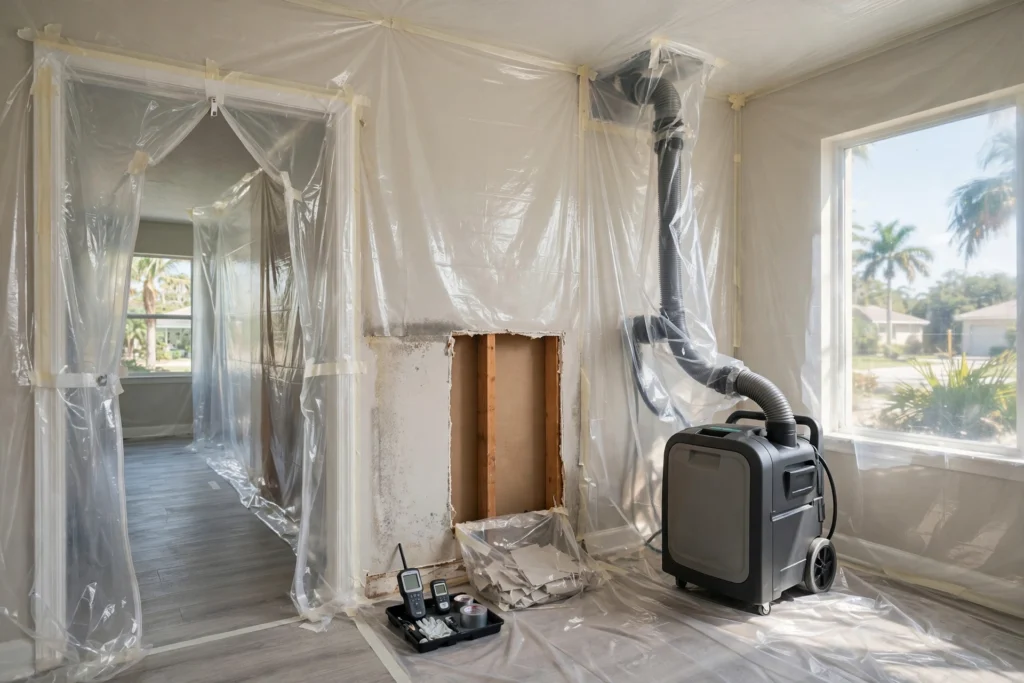
Larger remediation projects may use polyethylene containment, negative-air machines with HEPA filtration, controlled demolition, sealed debris handling, HEPA vacuuming, and detailed cleaning. The goal is to keep contaminated dust and spores from spreading into clean areas during disturbance.
The amount of containment should match the project. A small isolated area does not need the same setup as multi-room demolition. Conversely, a large project should not be opened up casually while the central HVAC system circulates through the work zone.
Ask the remediator to explain the containment boundary, pressure-control plan, debris route, PPE, and how adjacent clean areas will be protected.
Drying and moisture verification
A remediation project is not complete just because visible mold has been removed. The building should be dry enough for reconstruction. Ask what moisture readings will be taken, what target or material condition is used before closing the wall, and how the contractor documents that the moisture source has been corrected.
If dehumidifiers or air movers are used, ask what they are drying. Equipment should support a defined drying plan, not simply run for an arbitrary number of days.
In Tampa’s humid outdoor air, open-window drying is not always effective. Mechanical drying and air-conditioning can be important depending on the conditions.
Three Tampa project scenarios
Scenario 1: small bathroom area after a plumbing leak
The leak is repaired, the affected area is limited, and materials are accessible. The project may stay near the low end depending on removal, containment, and whether Florida licensing thresholds apply.
Scenario 2: attic mold after roof leakage
The roof leak is repaired, but sheathing and insulation are affected over a larger area. Access, insulation removal, cleaning, and possible roof-sheathing repair can push the project into several thousand dollars.
Scenario 3: multi-room hidden moisture
A long-running leak or HVAC problem has affected wall cavities and multiple rooms. Assessment, containment, demolition, drying, reconstruction, and independent verification can move the total well beyond Tampa’s ordinary local average.
Remediation and reconstruction are different scopes
Mold-remediation companies do not always replace drywall, trim, cabinets, insulation, flooring, or paint. Some companies provide both remediation and reconstruction; others stop when the affected area is clean and dry.
Ask the proposal to separate:
- Moisture-source repair.
- Assessment or testing.
- Containment and remediation.
- Disposal.
- Drying.
- Post-remediation verification.
- Reconstruction.
A $3,000 remediation quote and a $7,000 all-in quote may contain very similar remediation work but very different reconstruction scopes.
Crawl spaces and under-floor moisture
Some Tampa-area homes have crawl spaces or additions with under-floor areas that can trap humid air. If mold is associated with a crawl space, do not assume that spraying the joists solves the problem.
The project may also require drainage, vapor control, insulation correction, or dehumidification. Compare broader moisture work with Crawl Space Encapsulation Cost 2026 and insist that each scope is explained separately.
Mold remediation should remove or clean contaminated material; moisture-control work should reduce the conditions that allowed growth.
Insurance considerations
Coverage depends on the cause of loss and the policy. Sudden accidental water damage can be treated differently from long-term seepage, deferred maintenance, flooding, high humidity, or repeated roof leakage.
Do not assume that “mold is covered” or that “mold is never covered.” Notify the insurer promptly when the event may be claim-related and ask what documentation is required before damaged material is removed.
Emergency drying may need to begin quickly, but a clear photo record and moisture documentation can still be valuable.
How to compare Tampa remediation quotes
A strong quote should identify the affected rooms or materials, containment method, demolition limits, cleaning method, disposal, drying target, moisture-source responsibility, and verification step. Ask each bidder to price the same documented scope; a cheaper cleanup-only bid cannot be compared directly with one that also includes leak repair and rebuilding.
| Quote item | What the Tampa homeowner should confirm | Why the difference matters |
|---|---|---|
| Assessment and affected area | Rooms, materials, measured extent, and whether an independent Florida-licensed assessor is involved when required | Different demolition boundaries can produce very different prices. |
| Containment and cleanup | Work-zone barriers, air handling, removal versus cleaning, disposal, and protection of occupied rooms | A low bid may omit necessary containment or disposal. |
| Water source and drying | Who repairs a roof leak, condensate drain, or pipe; how dryness is documented before closing walls | Cleaning alone does not prevent recurrence. |
| Verification and rebuilding | Who performs any independent clearance assessment; whether drywall, insulation, finishes, and permits for separate repairs are included | Reconstruction and verification may be separate contracts. |
Bid comparison example: If one proposal covers containment and removal of damaged drywall while another also replaces the drywall and fixes the leaking condensate line, request separate line items rather than treating the totals as competing prices for identical work. Do not add a national per-square-foot mold estimate to a local all-in quote without checking for overlapping labor and disposal charges.
Ask these questions:
- Who defined the affected area and how?
- Does the project require a Florida mold assessor or remediator license?
- Is the moisture source already fixed?
- Which materials will be removed and which will be cleaned?
- How will clean areas be protected?
- Is post-remediation verification included and who performs it?
- What reconstruction is excluded?
If a contractor cannot explain why a material must be removed, ask for the reasoning before approving demolition.
Avoid fear-based mold sales
Color does not determine risk. “Black mold” is often used as a fear-based sales phrase even though many molds can appear dark. A photograph alone cannot determine species, exposure, or the correct remediation scope.
Focus on the measurable issues: how much material is affected, whether the area is still wet, whether the moisture source is fixed, what must be removed, and how the clean area will be verified.
Be cautious with companies that insist every visible spot requires whole-house fogging or major demolition without explaining the building conditions.
Homeowner action plan
- Stop the water source when it is safe to do so.
- Photograph damage and record when it was discovered.
- Dry unaffected wet materials promptly.
- Avoid disturbing a large contaminated area yourself.
- Verify Florida licensing when the project falls under regulated mold-related services.
- Get a written scope separating remediation from reconstruction.
- Keep final moisture readings, assessment documents, invoices, and repair records.
Frequently asked questions
How much does mold remediation cost in Tampa in 2026?
Angi’s Tampa data shows a normal range of about $1,347 to $3,778 and an average near $2,548. Large hidden or multi-room projects can cost much more.
Does Florida require a mold license?
Florida DBPR regulates mold assessment and remediation as defined by state law, including work involving mold growth greater than 10 square feet. Verify the current license and any applicable exemptions for the specific project.
Should I test before remediation?
Sometimes, but not automatically. Testing is most useful when it changes the scope, identifies hidden conditions, or provides independent verification.
Is fogging enough to fix mold?
Not when contaminated material and the moisture source remain. A durable project addresses water or humidity and removes or cleans affected materials as appropriate.
Bottom line
Tampa mold remediation in 2026 commonly falls around $1,347 to $3,778 in Angi’s local data, averaging about $2,548, but large, hidden, HVAC, attic, crawl-space, or whole-house projects can cost much more.
The strongest Tampa remediation project fixes the moisture source, uses appropriately licensed professionals when Florida law requires them, contains the work safely, removes only what needs removal, dries the building, and verifies conditions before reconstruction.
Sources & methodology
This guide uses Angi’s published Tampa-specific normal range ($1,347–$3,778) and average ($2,548) as local planning benchmarks, not contractor bids. HomeGuide’s national square-foot and project-scope estimates provide broader context, but are not a Tampa price survey. Florida DBPR information informs the licensing discussion; National Weather Service Tampa Bay climate normals and EPA moisture-control guidance inform the local risk and cleanup sections. Figures describe different scopes and should not be added together. Request an itemized site-specific proposal for current pricing, moisture-source repair, testing, and reconstruction.