Quick answer
Professional termite treatment can range from a few hundred dollars for a localized or perimeter treatment to several thousand dollars for whole-home fumigation. Angi’s 2026 verified-project data reports an average around $621, with most projects between about $263 and $1,033. HomeGuide gives a broader method-based range: $225 to $2,500 for many chemical or bait treatments and about $2,000 to $8,000 for whole-home tenting.
Treatment cost is only half of the homeowner’s risk. Termites can damage framing, subfloors, trim, siding, and other wood. Angi estimates termite-related wood or drywall repairs can add roughly $250 to $6,000, and structural damage can exceed that when major framing is involved.
The U.S. Environmental Protection Agency advises homeowners to identify the termite type and choose treatment accordingly. Termiticides are pesticides regulated by EPA, and many applications are best performed by trained, licensed pest management professionals.
Termite treatment cost at a glance
| Treatment or service | Planning range | Best understood as |
|---|---|---|
| Inspection | $0–$250 in many markets | Diagnosis and treatment planning |
| Localized treatment | A few hundred dollars and up | Small, accessible area |
| Liquid soil barrier | About $3–$20 per linear foot | Common for subterranean termites |
| Bait system | About $7–$12 per linear foot | Monitoring plus colony control |
| Whole-home chemical / bait program | Roughly $225–$2,500+ | Depends on perimeter and severity |
| Fumigation tenting | About $2,000–$8,000 | Severe drywood infestation |
| Structural repairs | $250–$6,000+ | Separate from treatment |
These are national planning figures. Home size, termite species, foundation type, infestation extent, access, and local licensing rules can change the total.
Start with the termite species, not the treatment brand
Subterranean and drywood termites behave differently. Subterranean termites live in soil and travel to wood, so soil treatments or bait systems are common. Drywood termites can live within dry wood and may require localized treatment or whole-structure fumigation when activity is widespread.
A company that recommends one method for every property without identifying the likely termite type is skipping an important diagnostic step. Ask what evidence supports the identification: mud tubes, frass, galleries, swarmers, damaged wood, moisture conditions, or another sign.
EPA notes that termite swarms can be mistaken for ant swarms. If the diagnosis is uncertain, the value of a professional inspection is not just finding damage; it is choosing the correct treatment category before money is spent.
Why the cheapest treatment may not be the cheapest project
A localized treatment can be appropriate when the infestation is truly limited. It can also be a false economy if activity exists in multiple hidden areas. On the other hand, tenting an entire house when a targeted solution is adequate can be unnecessary expense.
The best estimate should connect the treatment method to the inspection findings. Ask the company to show where activity was found, what areas could not be inspected, and what the treatment is expected to protect.
Then separate pest control from repair. Termites may be eliminated while damaged framing still needs evaluation and reconstruction.
Subterranean termite treatment costs
Subterranean termites are widespread in the United States and typically require treatment at the soil-to-structure interface. HomeGuide reports chemical soil treatment around $3 to $20 per linear foot, with whole-home treatment often in the hundreds to low thousands depending on the perimeter and severity.
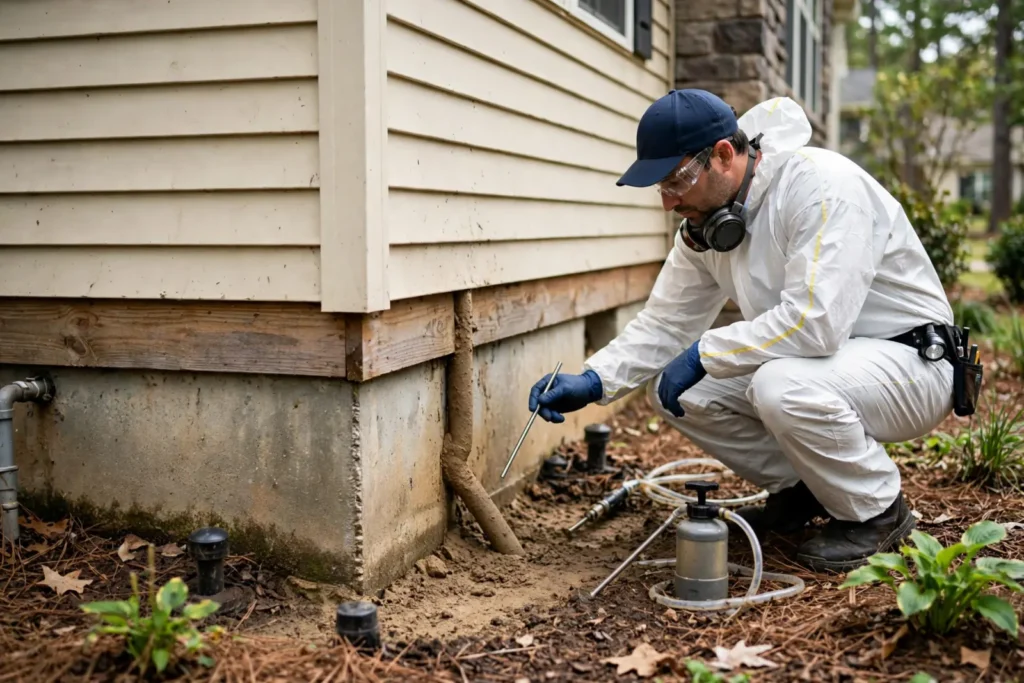
Application may involve trenching, drilling through slabs or masonry, treating soil, and sealing drill holes. The exact method depends on foundation type and the pesticide label. Because improper termiticide application can contaminate the home or nearby water, EPA stresses the importance of trained professionals and label compliance.
Homes with crawl spaces can have additional inspection and access challenges. If moisture is also present, compare the pest-control findings with our crawl space encapsulation cost guide, because persistent dampness and wood-to-soil conditions can make a property more attractive to certain termite species.
Bait systems: treatment plus monitoring
Termite bait stations are installed in the soil around the structure and checked periodically. HomeGuide reports roughly $7 to $12 per linear foot for bait systems, with many full-home programs around $1,000 to $2,500 and annual monitoring charges often a few hundred dollars.
Bait systems can reduce the need for broad liquid treatment in some situations, but they are not maintenance-free. The cost comparison should include the initial installation, the number of stations, inspection frequency, renewal charges, and what happens if active termites are found during the contract period.
Ask whether the annual fee is optional monitoring or required to keep the warranty or termite bond in force.
Fumigation and heat treatment
Whole-home tenting is usually associated with drywood termite infestations. HomeGuide reports gas fumigation around $2,000 to $8,000 for an average home and heat treatment around $2,000 to $6,000, depending on house size and local pricing.
Fumigation is a major logistical event. Occupants, pets, plants, food, medications, and other items may require specific preparation according to the fumigant label and contractor instructions. Reentry timing is also product-specific. EPA advises homeowners to follow the applicator’s instructions and the pesticide label rather than relying on a generic timetable.
Heat treatment avoids fumigant gas but still requires specialized equipment and careful temperature management. It may not be appropriate for every structure or infestation.
Treatment does not repair termite damage
Pest-control companies may stop the active infestation without repairing structural damage. A carpenter, general contractor, or structural professional may need to evaluate compromised members.
The repair scope can range from trim and isolated sheathing to floor joists, sill plates, wall studs, or roof framing. If termite activity is found near a foundation crack or moisture path, our foundation cracks guide can help distinguish cosmetic concrete cracking from conditions that deserve professional structural evaluation.
Exterior deterioration also deserves attention. Damaged siding, leaking trim, and wood near grade can create moisture conditions that complicate pest control. See our siding repair vs. replacement guide for the cost and decision framework on exterior cladding repairs.
What is a termite bond?
A termite bond or protection plan is a service agreement that may include scheduled inspections, retreatment, and sometimes limited repair coverage. The details vary widely.
HomeGuide reports termite bonds in the range of roughly $500 to $2,000, while ongoing annual monitoring or service fees can add recurring cost. Do not buy a bond based on the title alone. Read the contract for:
- inspection frequency;
- renewal price;
- retreatment terms;
- exclusions;
- whether damage repair is included;
- deductible or claim limits;
- transferability to a future buyer;
- conditions that void coverage.
A low annual fee with retreatment only is very different from a plan that includes defined damage repair coverage.
Moisture control and prevention
Termite treatment is not a substitute for building maintenance. EPA recommends reducing conditions that attract termites, including wood-to-soil contact and excess moisture.
Keep gutters and downspouts functioning, correct plumbing leaks, and avoid allowing untreated wood debris to remain against the foundation. Maintain inspection gaps where local construction practices require them. Do not pile firewood against the house.
If you are already budgeting for exterior moisture work, coordinate the sequence. Pest control may need access before a crawl space is encapsulated or before damaged trim is covered by new finishes.
Chemical safety matters
Termiticides are pesticides. EPA must register pesticide products for specific uses, and the product label is legally important. Homeowners should not ask a contractor to use a product in a way that is not on the label.
EPA warns that termiticides can be highly toxic and that many applications require professional knowledge and equipment. Ask the company for the product name and label, what areas will be treated, what occupants must do before service, and when people and pets can safely return.
Do not assume that “natural,” “green,” or “low-odor” means risk-free. The relevant question is whether the product is registered for the intended use and applied according to its label.
Inspection before a real-estate transaction
A termite or wood-destroying organism inspection used for a real-estate transaction may have different documentation requirements from a routine homeowner inspection. Some lenders or states require specific forms.
If you are buying a house, do not rely solely on a seller’s old treatment receipt. Ask whether the protection plan is transferable, when the last inspection occurred, what species was treated, and whether any structural repairs were performed.
If visible damage is present, obtain a separate repair estimate before closing. Treatment cost can be modest compared with framing repair.
How to compare termite treatment bids
Use the same inspection information when possible, then compare:
- termite species identified;
- active locations and inaccessible areas;
- treatment method;
- perimeter or square footage included;
- drilling, trenching, or tenting scope;
- product and active ingredient;
- preparation required;
- reentry instructions;
- follow-up visits;
- annual monitoring fee;
- warranty / bond terms;
- exclusions for structural repair.
A clear diagram of treatment locations is valuable, especially for liquid barrier work.
Red flags when hiring
EPA advises homeowners to choose pest-control companies carefully and confirm state licensing. Be cautious of firms that claim secret formulas, government endorsement, or an emergency collapse risk without evidence. Government agencies do not endorse individual pest-control companies or pesticide products.
High-pressure same-day discounts are another reason to slow down. Termites are important, but a homeowner usually benefits from understanding the inspection findings and comparing scopes rather than signing based on fear.
Use the licensing, insurance, quote, and contract checklist in our how to hire a home contractor guide when screening companies.
Warranty, reinspection, and renewal costs
A termite treatment is not always a one-and-done purchase. The useful life of a liquid treatment depends on the product, soil conditions, construction details, and whether the treated zone is later disturbed. Bait systems require inspection and servicing. Fumigation can eliminate a current drywood infestation but does not create a permanent barrier against future reinfestation.
That makes the warranty language financially important. Ask whether the company promises only free retreatment or also covers defined repair costs if termites return. Confirm the length of the initial warranty, the annual renewal fee, whether inspections are mandatory, and what events void coverage. Landscaping changes, additions, plumbing work, new soil against the foundation, or missed annual renewals can affect some agreements.
If the company offers a renewable plan, calculate the five-year cost rather than comparing only the first invoice. A $900 initial treatment with $250 annual inspections is a different financial commitment from a $1,500 treatment that includes several years of monitoring. Neither structure is automatically better; the value depends on what the contract actually covers.
Reinspection is particularly important after structural repairs. Replacing damaged wood can hide the old evidence, so document treated locations before reconstruction begins. Keep the treatment diagram, product information, warranty, receipts, and repair photos with the home records. Those documents can help future contractors and may also be useful during a home sale.
Budget examples: compare the same scope, not just the first invoice
Subterranean termites around a 150-foot foundation perimeter
Suppose a licensed inspector confirms subterranean termite activity and proposes treatment along 150 linear feet of accessible foundation. Applying HomeGuide’s published $3–$20 per linear foot soil-treatment range gives a simple planning calculation of $450–$3,000. At its $7–$12 per linear foot bait-system range, the comparable perimeter calculation is $1,050–$1,800 before recurring monitoring. These are illustrations using published unit ranges, not quotes or proof that either method will work at this property. Slab drilling, inaccessible sections, station counts, minimum charges, and follow-up service can change the bid.
Ask each company to mark the actual treated perimeter on a diagram and identify the termite species, foundation obstacles, monitoring schedule, and whether the quoted total includes inspection and warranty. A lower first-year bait quote can cost more over time if renewal fees are substantial; a soil-treatment quote may also exclude later inspections.
Drywood termite evidence in multiple rooms
If a qualified inspection finds activity in several separated locations, ask whether the company recommends localized treatment or whole-structure fumigation and why. HomeGuide’s $2,000–$8,000 whole-home tenting range is a planning benchmark, not an automatic recommendation. Request a written preparation checklist covering occupants, pets, plants, food and medications, the label-specific reentry process, and any separate lodging expense. The applicator—not a generic article—must give the safe reentry instructions.
Termite control plus damaged framing
Imagine that termite treatment is priced separately from repairs to a compromised sill plate or floor joist. Get the pest-control scope and the building-repair scope as two written estimates; do not assume either contractor is responsible for the other’s work. Have an appropriately qualified building professional assess load-bearing damage before enclosing or replacing members, and document treated areas before repairs conceal them. The published $250–$6,000 repair range covers varied projects and is not a structural-engineering estimate for your home.
After treatment: what to collect and verify
Before the technician leaves, request documentation specific to your home rather than relying on a verbal assurance that the infestation is solved:
- Treatment record: the inspected locations, termite type identified, areas actually treated, product name, and treatment date.
- Location diagram: soil-treatment zones, drilled areas, or bait-station positions; note any inaccessible or excluded areas.
- Safety instructions: the pesticide label or relevant written instructions, including any restrictions on entry, contact, ventilation, or subsequent work. Follow the applicator’s product-specific directions.
- Follow-up plan: the next inspection or station-service date, who schedules it, and whether it costs extra.
- Written coverage: whether the agreement promises retreatment, monitoring, or defined damage repairs, plus its expiration and renewal conditions.
- Separate building repairs: photographs and a qualified assessment of damaged framing or other materials before cosmetic finishes conceal the problem.
If fresh activity is suspected after service, contact the provider under the written follow-up terms; a homeowner should not assume that the absence of visible termites immediately proves all hidden activity has ended.
FAQ
How much does termite treatment cost in 2026?
Angi reports an average around $621 and a typical project range of roughly $263 to $1,033. HomeGuide reports $225 to $2,500 for many chemical or bait treatments and $2,000 to $8,000 for whole-home tenting.
Does homeowners insurance cover termite damage?
Standard policies often exclude damage associated with insects or long-term maintenance conditions, but policy language varies. Ask your insurer rather than assuming coverage.
Is fumigation always required for termites?
No. Treatment depends on termite species, location, and extent. Subterranean termites are commonly treated with soil barriers or baits, while widespread drywood infestations are more likely to lead to tenting.
Can I treat termites myself?
Consumer products exist, but structural termite treatment is not a good place to improvise. EPA notes that many effective applications require trained professionals, specialized equipment, and careful label compliance.
How long does termite treatment last?
It depends on the method, product, site conditions, and maintenance. Ask for the company’s inspection and renewal schedule rather than assuming a one-time treatment provides permanent protection.
Local examples: Our San Diego termite treatment cost guide covers drywood termites and tenting, and our Raleigh termite treatment cost guide covers subterranean termite baits and liquid treatments.
Bottom line
Termite treatment is a diagnosis-first project. Identify the termite species, match the method to the infestation, and separate pest-control cost from structural repair. Read the pesticide label and service contract, compare the full treatment scope, and avoid fear-based sales pressure. A $600 treatment can be a good value when it is the right treatment; a cheap but incomplete scope can leave both termites and repair bills behind.