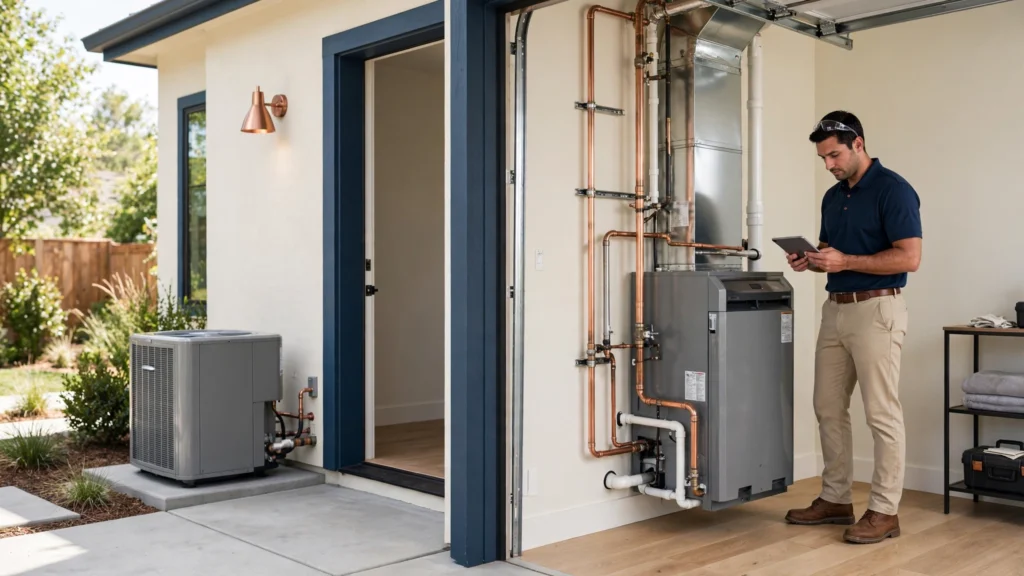
Updated October 2026. Furnace replacement is one of those home projects that rarely arrives at a convenient time. The heat stops keeping up, the technician gives you a repair number, and suddenly you are comparing a four-figure repair with a much larger replacement bill while the house is getting colder.
The useful question is not simply, “How much is a new furnace?” It is, “What will it cost to install the right furnace in this house, and does repairing the old one still make financial sense?”
Quick answer: Furnace replacement cost in 2026
For a standard U.S. furnace replacement, a practical planning range is about $3,500 to $7,500+ installed. HomeGuide reports that range for many standard-efficiency installations, while This Old House puts the broader installed range at roughly $1,600 to $10,000, depending on furnace type, size, efficiency, and installation complexity.
Open the HVAC Replacement Cost Calculator →
For homeowners asking the average cost to replace a gas furnace, current 2026 data needs one important distinction: many new furnace installations overall fall around $2,823 to $6,897, while gas-furnace replacements commonly run higher depending on size, efficiency, venting, duct modifications, and installation scope.
| Furnace type | Typical installed planning range |
|---|---|
| Electric furnace | About $2,000–$7,000 |
| Gas furnace | About $3,800–$10,000 |
| Oil furnace | About $4,000–$10,000+ |
| Standard replacement overall | About $3,500–$7,500+ |
These are national planning figures, not quotes. A straightforward replacement using existing connections and ductwork is very different from switching fuel types, resizing ducts, correcting venting, or replacing equipment in a hard-to-access attic or crawlspace.
What you are actually paying for
Homeowners sometimes compare furnace prices online and then wonder why the contractor quote is much higher. The equipment itself is only one part of the job.
A complete replacement can include:
- The furnace and installation materials
- Removal and disposal of the old furnace
- Labor and startup testing
- Gas, electrical, condensate, or venting work
- Thermostat or control changes
- Duct transitions or airflow corrections
- Permit and inspection fees
- Commissioning and safety checks
HomeGuide estimates furnace equipment and materials at roughly $2,000 to $4,000+ and installation labor around $1,500 to $3,500+ for many standard jobs. That is why a unit that looks inexpensive online can become a much larger installed project.
Gas furnace replacement cost in 2026
Gas furnaces are common in colder parts of the United States because they can deliver strong heat in low temperatures. Angi’s July 2026 gas-furnace guide puts replacement around $3,800 to $10,000, depending on furnace size, efficiency, and installation details.
That broad range is useful because “gas furnace replacement” can describe very different jobs. A like-for-like swap using sound existing ductwork and venting may stay toward the lower end. A high-efficiency furnace that needs new PVC venting, condensate drainage, electrical work, duct transitions, or combustion-air corrections can move toward the upper end.
| Gas furnace scenario | Planning idea |
|---|---|
| Straightforward like-for-like replacement | Usually lower end of the national range |
| Higher-efficiency furnace with venting changes | Mid to upper range |
| Duct, gas-line, electrical, or access corrections | Can add substantially to the base quote |
| Fuel conversion or major system redesign | Often needs a separate whole-system budget |
Gas equipment also has safety requirements that matter more than cosmetics. Gas connections, combustion air, venting, and carbon-monoxide risk all need professional attention. Angi notes that permits and inspections alone can add roughly $400 to $1,500 in some locations.
Furnace replacement cost by home size, and why size alone is not enough
HomeGuide publishes these ranges for standard installations by home size. They are useful for a first budget, but they assume a typical existing setup.
| Home size (sq ft) | Installed planning range (HomeGuide) |
|---|---|
| 1,000–1,500 | $2,000–$4,500 |
| 1,500–2,500 | $3,000–$6,500 |
| 2,500–3,500 | $4,000–$9,500 |
| 3,500+ | $5,500–$10,000+ |
Correct sizing requires a heating-load calculation
Square footage is only a budgeting shortcut. HomeGuide’s rule of thumb of 30 to 60 BTUs per square foot gives 60,000 to 120,000 BTU for a 2,000 sq ft home, a twofold range that is far too wide for choosing equipment. The U.S. Department of Energy’s gas-furnace replacement checklist calls for a room-by-room ACCA Manual J load calculation, with the furnace selected under ACCA Manual S from those results. ENERGY STAR’s bid checklist also suggests asking contractors to document the Manual J calculation. Insulation, windows, air leakage, climate and ceiling height all change the load, so a new furnace should not simply match the old furnace’s size.
Hourly rates, crew size and package pricing
HomeGuide puts furnace installation labor at about $75 to $150+ per hour, says a standard replacement takes about 4 to 8 hours (1 to 2 days for complex jobs), and lists installation labor for a standard replacement at about $1,500 to $3,500+. These figures measure different things. Many installs use more than one technician, and contractors usually price the installation as a package that includes the crew, removal, startup, commissioning and overhead. Multiplying one technician’s hourly rate by the installation hours is therefore not a reliable labor budget. Use the package labor figure (or the contractor’s itemized installation charge) for the replacement itself. Hourly rates mainly matter for added work and change orders.
When you compare quotes, check whether each of these is already inside the installation price or listed separately, and count each item only once. HomeGuide’s figures: removal and disposal of the old furnace about $50 to $200+; local permits about $50 to $300 (Angi reports permits and inspections of $400 to $1,500 in some locations); and $350 to $2,000+ for gas-line installation when converting from another fuel. HomeGuide also notes that hard-to-reach locations can add 25% to 50%.
Existing conditions that change the quote
- Ductwork: leaks, damage, undersized ducts or unbalanced supply and return airflow. The DOE checklist calls for inspecting and sealing exposed ducts and checking airflow.
- Venting: venting depends on the furnace type, the manufacturer’s installation instructions and local code. High-efficiency condensing furnaces typically need their own plastic vent and a condensate drain. A standard-efficiency replacement may use a metal vent or chimney only if the installer confirms the existing vent is the right type, size and condition for the new unit. Never assume an existing chimney or vent can be reused.
- Chimney liner: if a new direct-vent furnace leaves a gas water heater alone on an old chimney, the chimney may no longer draft properly. A liner or other venting correction may then be required (DOE checklist).
- Gas line and electrical: gas-line size, shutoffs and the furnace’s electrical circuit.
- Access: attics, crawlspaces and tight closets.
Worked example: 2,000 sq ft home, like-for-like gas replacement
Illustrative only. For a 2,000 sq ft home, HomeGuide’s standard-installation range is $3,000 to $6,500. Suppose a Manual J calculation supports a furnace similar in size to the existing one, the installer confirms the ducts and vent are suitable for the new unit, and the local permit costs $150 (within HomeGuide’s $50–$300). A quote of about $4,750 that already includes the $150 permit, along with equipment, installation labor and disposal, would be consistent with the published range. Do not add the permit, disposal or labor again on top of an all-inclusive quote. If the same home needs a chimney liner for an orphaned water heater, duct sealing, or a fuel conversion with new gas piping ($350–$2,000+ according to HomeGuide), expect those as separate line items above the standard range.
Electric furnace cost
Electric furnaces often cost less to install than gas or oil equipment. This Old House lists many electric furnace replacements around $2,000 to $7,000. The trade-off is operating cost: electric resistance heat can be expensive in regions with high electricity rates or long, cold winters.
If you are replacing an electric furnace, it is smart to request a heat-pump quote at the same time. A heat pump can provide both heating and cooling and may use substantially less electricity than electric resistance heat. The better option depends on climate, utility rates, available electrical capacity, existing ductwork, and how much cooling equipment also needs replacement.
Do 2026 federal tax credits still reduce furnace cost?
Do not assume an old rebate article still applies. The federal Energy Efficient Home Improvement Credit under Section 25C is not available for property placed in service after December 31, 2025. That means a qualifying furnace installed in 2026 does not receive the former federal 25C homeowner credit.
Local utility rebates, state programs, manufacturer promotions, or income-qualified electrification programs may still exist. Ask the contractor to identify any incentive separately and verify it with the utility or program administrator before treating it as part of the budget.
Efficiency: when is a higher-AFUE furnace worth it?
AFUE describes how much of the furnace’s fuel is converted into usable annual heat under standardized conditions. A higher rating can reduce fuel use, but the best financial choice depends on the installed price difference—not just the efficiency label.
Ask for two comparable quotes when possible: one for a code-compliant standard-efficiency option and one for a higher-efficiency option. Then compare the added installed cost with expected fuel savings, venting changes, condensate requirements, warranty, and how long you expect to remain in the home. In a mild climate, a large efficiency premium can have a slow payback; in a cold climate with expensive fuel, the economics can look very different.
Oil furnace cost
Oil furnaces tend to have higher installed costs and are more common in certain older housing markets, especially in the Northeast. HomeGuide and This Old House both place many oil-furnace installations in the upper end of furnace replacement pricing, often around $4,000 to $10,000+.
If an oil system is near the end of its life, homeowners may want quotes for both a like-for-like replacement and an alternative system. The cheaper installation is not always the cheapest long-term ownership choice.
Why two furnace quotes can be thousands of dollars apart
Furnace size
Larger furnaces generally cost more, but bigger is not automatically better. Oversized equipment can short-cycle, create uneven comfort, and waste energy. The contractor should size the system for the house rather than simply copying the old furnace label.
Efficiency
Higher-efficiency furnaces usually cost more upfront. The right choice depends on climate, fuel price, expected time in the home, and the extra installed cost of the efficiency upgrade.
Ductwork
A new furnace cannot fix undersized, leaky, or badly balanced ducts by itself. If airflow problems already exist, the contractor may recommend duct modifications. That can add cost, but ignoring the duct problem can leave you with new equipment and the same uncomfortable rooms.
Venting and combustion requirements
High-efficiency gas furnaces may need different venting and condensate drainage than older equipment. Converting from one furnace type to another can also require electrical, gas, or venting changes.
Access
A furnace in a roomy basement is usually easier to replace than one squeezed into an attic, crawlspace, closet, or other tight location. Difficult access adds labor and can affect how the new equipment is configured.
Repair or replace? The number is not the whole decision
Angi’s September 25, 2026 furnace-repair data puts the national average repair around $318, with many repairs between roughly $133 and $505. That makes repair an easy choice when the furnace is relatively young and the failure is minor.
The decision gets harder when the repair is large. Angi’s repair-versus-replace guidance uses 15 years as an important age marker and notes that repair estimates over about $2,000 can make replacement worth serious consideration.
ENERGY STAR also says homeowners should consider replacing a furnace or boiler that is more than 15 years old, especially when repairs are becoming frequent or energy bills are rising.
Furnace or boiler? A furnace heats air and pushes it through ducts. A boiler heats water or makes steam, which then circulates through radiators, baseboard or radiant tubing. The prices on this page are for forced-air furnaces. A boiler replacement brings its own costs, such as near-boiler piping, venting and the condition of the radiator or baseboard system. If your home has a boiler, see our Boston boiler replacement cost guide for an example of how those factors add up.
Three real-world furnace budget examples
Example 1: straightforward gas furnace replacement
A homeowner has a 17-year-old gas furnace in an accessible basement. The ductwork is usable, the gas line is adequate, and the new furnace can connect to an appropriate existing venting plan. This type of project may stay closer to the core gas-furnace replacement range because there are fewer secondary corrections.
Example 2: high-efficiency furnace with added scope
Another homeowner chooses a higher-efficiency furnace, but the installation also needs new venting, condensate drainage, a thermostat change, duct transitions, permit fees, and removal of the old equipment. The furnace itself may not be dramatically more expensive, yet the installed project can move thousands of dollars above a basic swap.
Example 3: repair versus replacement
Consider two families who both receive a $1,600 repair estimate. Family A has an eight-year-old gas furnace with no repair history and a replaceable failed part. Family B has a 19-year-old furnace that needed another major repair last winter and still leaves rooms uncomfortable.
The repair invoice is identical, but the financial decision is not. Family A may reasonably repair. Family B should get a replacement quote before spending the $1,600 because the repair is only one piece of a larger ownership pattern.
Signs the furnace is moving toward replacement
- It is more than about 15 years old
- Repairs are becoming frequent
- Heating bills are rising without a clear rate explanation
- Some rooms remain consistently too cold
- The furnace cycles excessively
- You hear persistent banging, screeching, or unusual mechanical noise
- Rust, corrosion, or combustion problems are present
- A major component failure is approaching the cost of replacement
Age alone does not condemn a furnace, but age plus repeated repairs, poor comfort, and rising operating cost is a very different picture from age by itself.
Carbon monoxide is not a budgeting issue
If a carbon-monoxide alarm sounds, or you suspect a combustion or venting problem, treat it as a safety issue first. Leave the home, follow your alarm manufacturer’s instructions, and contact emergency services or the appropriate gas utility as needed. Do not keep operating suspect combustion equipment just to delay a replacement bill.
A furnace replacement quote should address safe venting, combustion, gas connections, and startup testing—not just equipment price.
Should you replace the furnace and AC together?
Sometimes yes, sometimes no. If the furnace and air conditioner share a blower, controls, or matched indoor components, replacing both at once can simplify compatibility and labor. But replacing a healthy air conditioner solely because the furnace failed is not always necessary.
Ask for two written options:
- Furnace-only replacement
- Complete matched heating-and-cooling replacement
Then compare the actual installed scope rather than assuming one path is automatically better. Our HVAC replacement cost guide gives a broader whole-system benchmark.
Questions to ask before signing a furnace replacement contract
- How did you determine the furnace size?
- What is the exact model number and efficiency rating?
- Is old-equipment removal included?
- Are permits and inspections included?
- Does the price include gas, electrical, venting, and condensate work?
- Will existing ductwork be inspected for airflow problems?
- What thermostat or control changes are required?
- What is the equipment warranty?
- What is the labor warranty?
- What items could become change orders after work begins?
How to compare furnace bids without getting fooled by the lowest number
Three contractors may quote three different prices because they are not necessarily quoting the same job. One may include permits, duct transitions, thermostat, disposal, and commissioning. Another may leave several of those items out.
Put the bids side by side and compare:
| Quote item | What to verify |
|---|---|
| Equipment | Model, size, efficiency, fuel type |
| Installation | Labor, fittings, electrical, gas, venting |
| Ductwork | Included changes or explicitly excluded |
| Permits | Included or extra |
| Controls | Thermostat and compatibility |
| Removal | Old furnace and debris disposal |
| Warranty | Equipment and labor terms |
Ways to control furnace replacement cost
- Get at least two or three detailed written quotes.
- Ask for a standard-efficiency and higher-efficiency option.
- Keep the same fuel type unless conversion has a clear financial or comfort benefit.
- Confirm whether duct changes are truly required and ask the contractor to explain the airflow problem.
- Check manufacturer rebates and local utility incentives, but verify each incentive independently.
- Avoid buying more furnace capacity than the home actually needs.
- Ask whether permits, disposal, thermostat, venting, condensate work, and startup testing are included.
- Do not wait until the coldest weekend of the year if an aging furnace is already showing warning signs.
A five-step furnace replacement plan
- Document the current problem. Write down the furnace age, model number, recent repairs, comfort complaints, unusual noise, and recent heating bills.
- Get a diagnosis before shopping. If the furnace failed, ask what failed and whether the problem is isolated or part of a larger pattern. A replacement decision should not begin with equipment shopping alone.
- Request comparable written options. For an aging furnace, compare repair, like-for-like replacement, and—where practical—an alternative such as a heat pump. Make sure each quote states equipment, efficiency, sizing, permits, controls, venting, duct scope, disposal, and warranties.
- Compare total installed cost. Do not compare one contractor’s bare equipment number with another contractor’s complete installed price. Separate optional upgrades from work required for safety, code, or proper operation.
- Verify the finished system. Before final payment, confirm that the system starts and cycles correctly, airflow is reasonable, controls work, required inspections are complete, and warranty registration requirements are understood.
Safety note: If a carbon-monoxide alarm activates, there is a suspected gas leak, or combustion equipment appears unsafe, leave the area and follow emergency guidance. Do not keep operating a suspect furnace simply to postpone the replacement decision.
Explore the furnace and HVAC cost cluster
- HVAC Replacement Cost 2026
- HVAC Replacement Cost Calculator 2026
- Denver Furnace Replacement Cost 2026
- Phoenix HVAC Replacement Cost 2026
- Orlando HVAC Replacement Cost 2026
Related Home Cost Desk guides
- HVAC Replacement Cost in 2026
- AC Repair Cost in 2026
- Annual Home Maintenance Cost in 2026
- Electrician Cost in 2026
Bottom line
For 2026 budgeting, many furnace replacements land around $3,500 to $7,500+, with gas, electric, and oil systems occupying different parts of that range. The best decision is not the cheapest furnace or the cheapest repair. It is the option that gives the home safe, properly sized, reliable heat at a sensible total cost over the years you expect to keep the system.
Home Cost Desk compares current U.S. cost or technical references and checks safety, code, efficiency, incentive, or regulatory claims against authoritative sources when available. National figures are planning ranges, not local quotes.
Editorial review: Home Cost Desk Editorial Team · Read our research methodology · Detailed sources appear below.
Sources
- Angi — New Furnace Cost, updated September 8, 2026
- Angi — Gas Furnace Cost, updated July 8, 2026
- Angi — Furnace Repair Cost, updated September 25, 2026
- Angi — Repair or Replace a Furnace, updated July 9, 2026
- This Old House — Furnace Cost, updated April 3, 2026
- This Old House — Furnace Replacement, updated May 25, 2026
- HomeGuide — New Furnace Replacement Cost
- U.S. Department of Energy, Building America Solution Center — Gas Furnace Replacement checklist (Manual J and Manual S)
- ENERGY STAR — Heating and Air Conditioning Installation Bid Comparison Checklist
- IRS — Energy Efficient Home Improvement Credit (improvements through December 31, 2025)
- ENERGY STAR — When Is It Time to Replace?
- IRS — Home energy credit expirations
National cost figures are planning estimates, not contractor quotes. Local labor, furnace size, fuel type, efficiency, permits, access, ductwork, and installation scope can materially change the final price.