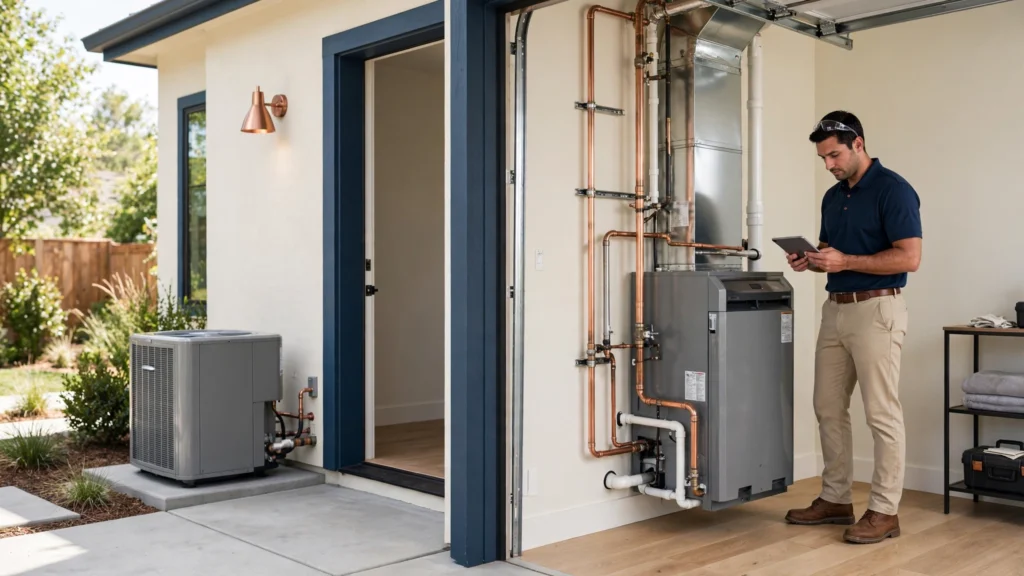
Quick answer: For the same baseline case used by the Home Cost Desk calculator—a furnace plus central-air change-out with reusable ducts—use $5,000 to $11,000 as the primary 2026 planning range, with a midpoint near $8,000. Angi’s broader 2026 furnace-and-AC replacement range is roughly $5,000 to $12,500, with an average near $7,500; complex or high-end projects can reach $22,000 or more. This Old House’s 2026 survey of 1,000 homeowners found an average installed HVAC cost of $8,209, including about $8,460 for central air. Our calculator uses a different source and scope: HomeGuide’s system-specific project bands, including $2,500–$7,500 for central air only and $5,000–$11,000 for a furnace-plus-central-air change-out with reusable ducts. These figures should not be read as competing quotes for the same job.
Open the HVAC Replacement Cost Calculator →
2026 HVAC replacement cost snapshot
| Angi broad replacement range | $5,000–$12,500 |
| Angi average | $7,500 |
| This Old House survey average | $8,209 |
| HomeGuide central air band used by our calculator | $2,500–$7,500 |
| HomeGuide furnace + central air band used by our calculator | $5,000–$11,000 |
| Complex/high-end projects | Can exceed $22,000 |
These are national planning figures, not quotes. Your price can move substantially with system type, capacity, ductwork, efficiency, labor, permits, electrical work, and local market conditions.
Before you request HVAC replacement quotes
- Write down the age and model numbers of the existing indoor and outdoor equipment.
- Note comfort problems such as hot rooms, short cycling, humidity issues or unusually high energy bills.
- Ask whether the contractor will perform or provide a load calculation instead of simply matching the old tonnage.
- Request a duct and airflow evaluation when comfort or leakage problems already exist.
- Tell each bidder you want the total installed scope, including permits, disposal, controls, electrical work and any expected duct modifications.
How much does each type of HVAC system cost?
System configuration matters. In its 2026 homeowner survey, This Old House reported the following average replacement costs:
| System type | 2026 survey average |
|---|---|
| Central air conditioner | $8,460 |
| Gas furnace | $8,533 |
| Electric furnace | $6,892 |
| Air-source heat pump | $8,007 |
| Ductless mini-split | $8,221 |
| Dual-fuel system | $7,905 |
| Packaged HVAC system | $8,188 |
| Geothermal heat pump | $17,000 |
These are survey averages rather than fixed market prices. A quote for your home may be lower or much higher depending on size, climate, efficiency target, access, duct condition, and whether other systems need modification. If you are specifically comparing air-source or ductless heat-pump options, see the Heat Pump Cost 2026 guide for heat-pump-specific pricing, sizing and installation factors.
How this lines up with our calculator: the calculator uses HomeGuide’s system-specific project bands—such as $2,500–$7,500 for central air only and $5,000–$11,000 for a furnace-plus-central-air change-out with reusable ducts. This guide also shows Angi’s broader $5,000–$12,500 overall replacement range and This Old House survey averages. They are different source scopes, not two competing quotes for the same job.
The biggest factors that change HVAC replacement cost
1. Equipment type and capacity
A basic furnace, central AC, heat pump, mini-split, dual-fuel system, and geothermal system are not equivalent projects. Capacity also matters, but bigger is not automatically better. ENERGY STAR specifically advises homeowners to have equipment sized from the actual characteristics of the home rather than by a rule of thumb.
2. Efficiency level
Higher-efficiency equipment generally costs more upfront. The relevant rating for central cooling is now SEER2. The right efficiency level depends on climate, electricity rates, expected time in the home, and the incremental price of the equipment.
3. Ductwork
Existing ducts can turn a straightforward equipment swap into a larger project. ENERGY STAR recommends that contractors evaluate duct leakage and airflow because poor ducts can reduce comfort and efficiency even when the new equipment itself is excellent. Angi notes that substantial ductwork changes can add several thousand dollars to a replacement project.
4. Electrical, gas, drain, refrigerant, and venting work
A new system may require electrical upgrades, new disconnects, condensate work, refrigerant-line changes, gas modifications, or venting changes. These items should be explicitly identified in the written scope rather than appearing as surprise change orders later.
5. Access and removal
Equipment in a tight attic, crawlspace, rooftop location, or difficult mechanical closet generally takes longer to remove and replace than equipment with clear access. Old-equipment removal and disposal should also be confirmed in the quote.
6. Location and labor market
HVAC labor, permits, climate requirements, code enforcement, and contractor availability vary across the United States. National averages are useful for budgeting, but local competitive bids are the best way to estimate your actual cost.
Why correct sizing matters more than buying the biggest unit
Oversizing can create its own problems. ENERGY STAR warns that oversized equipment may cycle too frequently, reducing comfort and potentially shortening equipment life. For heat pumps and many central systems, a contractor should calculate the home’s heating and cooling load—commonly using a Manual J calculation—rather than simply replacing the old equipment with the same nominal size.

When should you consider replacing instead of repairing?
Age alone does not force a replacement, but it changes the economics. ENERGY STAR suggests considering replacement when an air conditioner or heat pump is more than 10 years old, or when a furnace or boiler is more than 15 years old, especially if repairs are becoming frequent or energy bills are rising.
Homes heated by a hot-water or steam boiler are priced differently from forced-air systems, because the work centers on the boiler, its venting and the radiator or baseboard piping rather than ductwork. For a local example, see the Boston boiler replacement cost guide.
Before replacing, compare the repair estimate, current system condition, likely remaining life, comfort problems, efficiency, warranty status, and the cost of a properly scoped replacement. A single inexpensive repair on an otherwise healthy system can be very different from repeated failures on aging equipment.
What should a good HVAC replacement quote include?
- Exact equipment model numbers and rated capacity
- Efficiency ratings such as SEER2, EER2, HSPF2, or AFUE where applicable
- How the contractor determined system size
- Removal and disposal of existing equipment
- Duct inspection and any required duct modifications
- Electrical, gas, drain, refrigerant-line, or venting work
- Thermostat and controls (if you are upgrading it, see smart thermostat installation costs)
- Permits and inspections
- Startup, airflow, and refrigerant-charge verification
- Equipment warranty and labor warranty
- Any exclusions or allowances that could become change orders
How to compare HVAC bids without choosing on price alone
Three bids with three different prices may not describe the same job. Put the proposals side by side and compare equipment, capacity, efficiency, duct scope, electrical work, permits, controls, commissioning, warranties, and exclusions. A lower quote that omits necessary duct or electrical work may not remain the lowest quote after installation begins.
What does a complete HVAC replacement budget look like?
Homeowners often compare equipment prices when the more useful number is the complete installed project. Angi’s August 2026 cost data puts a typical HVAC replacement around $5,000 to $12,500, with an average near $7,500, while projects with new ductwork or significant upgrades can reach roughly $22,000.
| Project scope | 2026 budgeting approach | What can move the price |
|---|---|---|
| Straight equipment change-out | Often within the $5,000–$12,500 planning range | Capacity, brand, efficiency, labor and access |
| Central AC replacement | Angi lists roughly $3,900–$7,900 for the central-air equipment portion in its 2026 calculator | Coil match, refrigerant lines, electrical and permits |
| Replacement plus major ductwork | Can add several thousand dollars; Angi’s calculator uses about $3,500 as a ductwork allowance | Duct size, leakage, routing, access and number of zones |
| High-end or complex replacement | Can approach or exceed $22,000 | Premium equipment, zoning, filtration, electrical work, difficult access or major redesign |
Do not treat these figures as a menu price. Two homes with the same square footage can need different equipment because insulation, windows, air leakage, orientation, climate and duct performance all affect the heating and cooling load.
2026 refrigerant changes: what homeowners should know
Refrigerant rules are an important 2026 purchasing issue. The U.S. Environmental Protection Agency says that when a whole new residential split system is installed after January 1, 2026, it generally must use refrigerant with a global-warming-potential value below 700. Lower-GWP refrigerants such as R-32 and R-454B are therefore increasingly common in new residential equipment.
This does not mean every existing R-410A system suddenly needs replacement. EPA guidance allows homeowners to continue maintaining and repairing legacy systems, and compatible R-410A components can still be used for servicing existing equipment. The practical takeaway is to ask the contractor which refrigerant the proposed system uses, whether the indoor and outdoor components are a certified match, and whether the installer has the training and tools required for that equipment.
Do federal HVAC tax credits still apply in 2026?
Be careful with older articles that still advertise the federal Energy Efficient Home Improvement Credit for a 2026 installation. IRS guidance says the Section 25C credit is not available for property placed in service after December 31, 2025. That means a qualifying heat pump or other HVAC upgrade installed in 2026 should not be budgeted around the former 25C federal credit.
However, some households may still qualify for state-administered Home Energy Rebate programs or utility incentives, and availability varies by state, income, equipment type and program status. Before signing a contract, check your state energy office and utility rather than assuming a national rebate applies.
Hidden costs that should be identified before you sign
- Permit and inspection fees: ask whether they are included in the quoted total.
- Electrical upgrades: heat pumps, larger equipment or code corrections may require panel, breaker, disconnect or wiring work.
- Duct repairs: a high-efficiency unit cannot overcome severe leakage, undersized returns or poor airflow.
- Condensate drainage: pumps, drain lines and overflow protection may need replacement or correction.
- Refrigerant-line work: line-set condition, size and compatibility can affect scope.
- Combustion and venting changes: furnace replacements may require venting or gas-related corrections.
- Attic or crawlspace access: difficult removal and installation can increase labor.
- Thermostat and controls: communicating or variable-speed equipment may require compatible controls.
- Old-equipment disposal: confirm removal, recovery and disposal are included.
- Drywall, framing or finish repair: these are often outside an HVAC contractor’s scope.
A practical way to compare three HVAC quotes
Ask every bidder to price the same scope. Then compare the proposals line by line instead of choosing the lowest total.
- Confirm the exact indoor and outdoor model numbers and matched-system efficiency.
- Ask for the load calculation or the sizing method used to choose capacity.
- Compare duct inspection findings and any airflow corrections.
- Check whether electrical, gas, drain, refrigerant-line and venting work are included.
- Verify permits, inspections, startup testing and commissioning.
- Compare equipment warranty, labor warranty and any maintenance requirements that affect warranty coverage.
- Identify every allowance and exclusion that could become a change order.
- Ask what happens if hidden duct or electrical problems are found after work starts.
Example: why the cheapest quote may not be the cheapest project
The comparison below is a Home Cost Desk illustrative example, not a set of collected contractor bids. It shows how scope can change the meaning of the headline price.
| Scope item | Bid A | Bid B | Bid C |
|---|---|---|---|
| Headline price | $7,400 | $8,350 | $8,900 |
| Load calculation | Not stated | Included | Included |
| Duct inspection | Visual only | Included | Included + sealing allowance |
| Electrical disconnect | Reuse existing | Replace if required | New disconnect included |
| Permit | Extra | Included | Included |
| Startup/commissioning | Basic startup | Documented airflow & charge check | Documented airflow & charge check |
| Labor warranty | 1 year | 5 years | 10 years |
Bid A starts lower, but it leaves more work undefined. If permit, electrical correction or duct work is added later, the final project can approach or exceed the more complete proposals. Compare the expected final scope, not just the first total.
Frequently asked questions
How much should I budget for HVAC replacement in 2026?
For the calculator’s baseline furnace-plus-central-air change-out with reusable ducts, start with roughly $5,000 to $11,000. Broader market summaries can extend to about $12,500, and projects involving new ducts, premium equipment, electrical upgrades or difficult access can move well above that range.
Is replacing the furnace and AC together cheaper?
It can be more efficient when both systems are near the end of their useful life because some labor, controls and setup are shared. But replacing a healthy component early is not automatically economical. Compare the remaining life, compatibility and total project scope.
Should I replace ductwork at the same time?
Not automatically. Have the ducts evaluated for leakage, sizing and airflow. Reuse can be reasonable when ducts are properly sized, accessible and in good condition; major leakage or poor design may justify repairs or replacement.
Can I still repair an R-410A system in 2026?
Yes. EPA guidance allows existing systems to be maintained and repaired with compatible components. The lower-GWP requirements primarily affect new system installations rather than forcing homeowners to abandon functioning legacy equipment.
Is there still a federal heat-pump tax credit in 2026?
The former Section 25C Energy Efficient Home Improvement Credit does not apply to property placed in service after December 31, 2025. Check state and utility rebate programs separately because some incentives may still be available.
Bottom line
For 2026 budgeting, $5,000 to $12,500 is a reasonable starting range for many standard U.S. HVAC replacements, with national averages clustering around $7,500 to $8,200. Larger homes, premium systems, geothermal, major ductwork, high-efficiency equipment, difficult access, and supporting electrical or structural work can push the total well above that range.
The most useful number is not the national average—it is a written local quote based on a properly sized system and a complete scope of work.
Explore the HVAC cost cluster
- HVAC Replacement Cost Calculator 2026
- Phoenix HVAC Replacement Cost 2026
- Orlando HVAC Replacement Cost 2026
- Washington DC HVAC Replacement Cost 2026
- Miami HVAC Replacement Planning Costs 2026
- Denver Furnace Replacement Cost 2026
Related Home Cost Desk guides
- Heat Pump Cost in 2026
- Furnace Replacement Cost in 2026
- AC Repair Cost in 2026
- Window Replacement Cost in 2026
- Annual Home Maintenance Cost in 2026
- Electrician Cost in 2026
Home Cost Desk compares current U.S. cost or technical references and checks safety, code, efficiency, incentive, or regulatory claims against authoritative sources when available. National figures are planning ranges, not local quotes.
Editorial review: Home Cost Desk Editorial Team · Read our research methodology · Detailed sources appear below.
Sources and methodology
- Angi — HVAC Replacement Cost, updated August 3, 2026
- This Old House — 2026 HVAC Replacement Cost Calculator and homeowner survey
- ENERGY STAR — HVAC Quality Installation
- ENERGY STAR — When Is It Time to Replace?
- ENERGY STAR — Air-Source Heat Pump Buying Guidance
- U.S. EPA — HFC Phasedown and Residential HVAC Refrigerant Questions
- IRS — 2026 Home Energy Credit Expirations
- U.S. Department of Energy — Home Energy Rebates Programs
Updated September 2026. Cost figures are national planning estimates and survey results. They are not local contractor quotes.