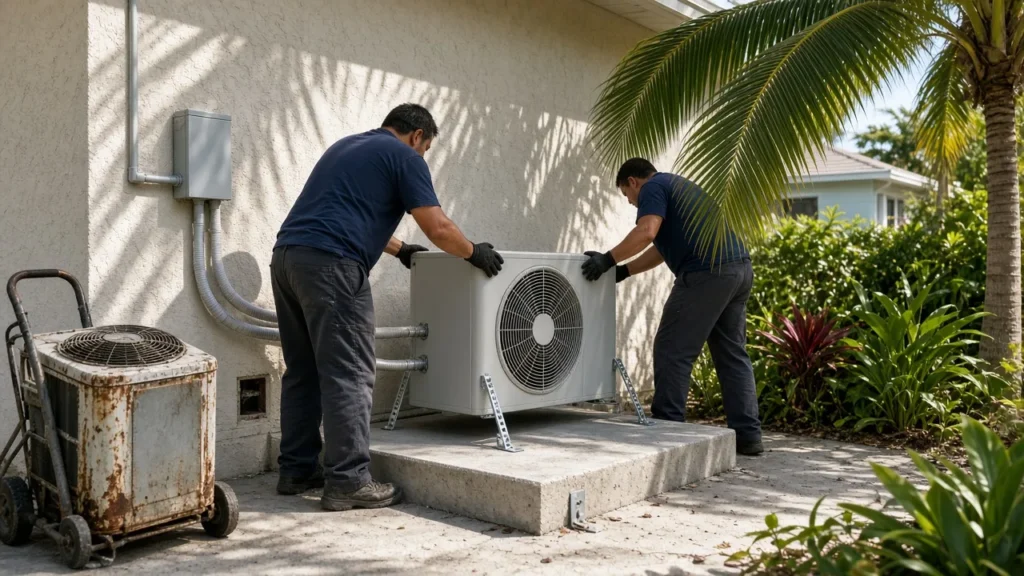
Replacing an HVAC system in Miami is different from replacing one in a mild or heating-dominated market. Cooling demand is high for most of the year, humidity control matters, coastal exposure can shorten equipment life, and mechanical permits are part of the project rather than an optional extra.
Important pricing note: Home Cost Desk does not maintain a database of Miami contractor bids. The figures below are local planning scenarios built from current national HVAC cost data, then interpreted alongside Miami-specific permitting, climate, licensing and utility-rebate information. They are not a surveyed Miami market average.
For 2026 planning, many Miami homeowners can use roughly $6,500 to $13,500 as a scenario for a straightforward central air-conditioning replacement, while projects involving major ductwork, electrical corrections, premium variable-speed equipment, difficult access, or multiple system changes can move into the $10,000 to $17,000-plus range. Home size, system capacity, efficiency, access, municipality, and scope can move the actual quote materially.
Miami HVAC replacement cost at a glance
| Project scope | 2026 Miami planning range | What usually drives the difference |
|---|---|---|
| Basic central A/C change-out | $6,500–$10,000 | Capacity, brand, efficiency, access, permit and labor |
| Higher-efficiency or variable-speed system | $9,000–$13,500+ | Premium equipment, controls, humidity performance and installation complexity |
| Replacement plus meaningful ductwork | $10,000–$17,000+ | Duct leakage, resizing, attic access, returns, zoning and insulation |
| Major redesign or multiple-system project | $15,000+ | Electrical work, new ducts, multiple zones, difficult access and structural constraints |
National 2026 HVAC replacement data provides an important baseline. Angi reports that HVAC replacement commonly falls around $5,000 to $12,500, with an average near $7,500, while projects with new ductwork and significant upgrades can reach roughly $22,000. Miami often sits above the easiest national change-out because cooling is not a short seasonal load and local homes can have humidity, duct, electrical and coastal-environment considerations that affect the scope.
Why Miami is a different HVAC market
NOAA engineering climate data for Miami shows about 4,318 annual cooling degree days using a 65°F base. That means air-conditioning demand is a dominant operating condition for much of the year. In practical terms, a Miami system is not just responsible for dropping indoor temperature; it also has to remove moisture reliably.
This is why an oversized unit can be a poor choice even when it seems safer. A system that cools the space too quickly may run shorter cycles and remove less moisture. A proper load calculation, airflow check, and duct evaluation matter more in a hot-humid climate than simply matching the tonnage printed on the old condenser.
What changes the price most in Miami?
1. System size and load calculation
Larger homes generally need more capacity, but square footage alone is not enough to size a system. Windows, insulation, air leakage, ceiling height, orientation, occupancy, duct condition and solar exposure all affect the load. Ask the contractor how capacity was selected instead of accepting a simple like-for-like tonnage replacement without explanation.
2. Duct condition in hot attics
Ductwork can turn a simple equipment replacement into a larger project. Leaky or poorly insulated ducts in a hot attic can waste cooling capacity and increase humidity problems. If rooms have persistent temperature differences, weak airflow, visible duct damage, or high bills, ask for a duct inspection before signing an equipment-only proposal.
3. Humidity-control performance
Miami homeowners should compare more than the headline efficiency number. Variable-speed and properly staged equipment can improve comfort and moisture control when correctly designed. That does not mean every home needs premium equipment, but humidity performance should be part of the discussion.
4. Coastal exposure
Homes closer to salt air may see faster corrosion of outdoor coils, cabinets and fasteners. Ask how the proposed outdoor unit is suited to the installation environment, what the manufacturer warranty covers, and whether location, clearance or corrosion-resistant options should be considered.
5. Electrical and condensate work
A replacement can uncover undersized wiring, old disconnects, damaged drain lines, poor condensate routing or missing overflow protection. These items are frequently excluded from a low headline equipment price, so they should be itemized before work starts.
Miami-Dade permits: what homeowners should know
Miami-Dade County states that permits are required for mechanical air-conditioning work. It also notes that each municipality within the county has its own building official, so the exact process depends on whether the property is in unincorporated Miami-Dade or within a city such as Miami, Miami Beach, Coral Gables or another municipality.
Miami-Dade County’s current mechanical fee sheet lists an air-conditioner exact change-out at $24.80 per ton and a $233.82 minimum mechanical permit fee. For an existing single-family home, duplex or townhome, the county’s fee schedule (Implementing Order 4-63, effective October 1, 2026) also lists a residential pilot permit type at $133.38 per system for an exact change-out of a central A/C unit including heating, plus a $25.65 non-refundable up-front fee. These are county fees for permits processed by Miami-Dade County; the City of Miami, Miami Beach, Coral Gables and other municipalities set their own fees. A project may also need additional electrical or related permits, so ask the contractor for the actual permit charge in writing.
Do not compare bids unless you know whether permits and inspections are included. A contractor who excludes permit handling may appear cheaper than one who has included the full legal scope.
Florida contractor licensing
Florida regulates air-conditioning contractors through the Department of Business and Professional Regulation. Before hiring, verify that the contractor or qualifying business is properly licensed for the work being performed. A license lookup is a simple way to confirm that the name on the proposal matches an active credential.
Also verify liability coverage and workers’ compensation status where applicable. A licensed company should be willing to provide the exact business name and license number used for the job.
FPL rebate available in 2026
Florida Power & Light currently offers an instant $200 A/C rebate for qualifying residential replacements. FPL says the new system must include both indoor and outdoor units, meet at least SEER2 15.2, and be installed by one of its Participating Independent Contractors. The rebate appears as a credit on the contractor invoice.
The important detail is contractor eligibility. Choosing a contractor first and asking about the rebate afterward can cause the homeowner to miss it. Check the FPL participating-contractor list before you sign.
Do federal HVAC tax credits still apply in 2026?
No, not under the former federal Energy Efficient Home Improvement Credit for a system placed in service in 2026. IRS guidance states that the Section 25C credit is not allowed for property placed in service after December 31, 2025. Do not let an older sales page or rebate article cause you to budget around a federal credit that no longer applies.
Utility, state, manufacturer or income-qualified programs can still exist separately, so check current programs at the time you buy.
What should a Miami HVAC quote include?
- Exact indoor and outdoor model numbers
- System capacity and the sizing method used
- SEER2 and other applicable efficiency ratings
- Thermostat and control package
- Removal and lawful disposal of old equipment
- Permit and inspection responsibility
- Electrical disconnect, breaker or wiring work
- Condensate drain, float switch and overflow protection
- Refrigerant line-set assumptions
- Duct inspection and any sealing, resizing or replacement
- Equipment pad, tie-down or mounting requirements
- Startup testing, airflow verification and commissioning
- Equipment warranty and labor warranty
- Every exclusion that could become a change order
Example Miami budgets
Example 1: straightforward 3-ton change-out
A homeowner replacing a functioning but aging central system with a similar-capacity, code-compliant system and no major duct or electrical work might budget roughly $7,000 to $9,500. The final number depends on brand, efficiency, access, municipality and included warranty.
Example 2: higher-efficiency replacement with duct corrections
If the home has leaky attic ducts, weak returns, humidity complaints and needs a more efficient variable-speed system, a realistic planning range can move toward $10,000 to $14,000 or more.
Example 3: older home with electrical and duct redesign
An older home that needs a new disconnect or circuit, significant duct replacement, access work, controls and permit coordination can move beyond $15,000. The equipment itself may not be the largest reason the quote is high.
Five-step Miami homeowner plan
- Document the existing system. Photograph the indoor and outdoor model numbers, thermostat and electrical disconnect.
- Write down comfort problems. Include humidity, hot rooms, weak airflow, noise and high bills.
- Get at least three written proposals. Require the same scope so you are not comparing equipment-only pricing with full-project pricing.
- Verify license, permit and rebate details. Confirm the Florida license, who pulls the permit and whether an FPL rebate applies before signing.
- Keep a contingency. Leave room for duct, electrical, drain or access issues discovered after the old equipment is opened up.
Questions to ask before signing
- How did you determine the required tonnage?
- Did you inspect the ducts and returns?
- How will this system manage Miami humidity?
- Are permits and inspections included?
- Is the proposed contractor eligible for the current FPL rebate?
- What electrical or condensate work is included?
- Does the outdoor unit need any special consideration for coastal exposure?
- What is the labor warranty and who performs warranty service?
- What items are specifically excluded from the price?
Miami HVAC replacement vs. national averages
National cost guides are useful for a first benchmark, but Miami homeowners should expect local conditions to matter more than the average. Year-round cooling demand, high humidity, attic duct exposure, permitting and coastal corrosion can all increase the value of a properly designed installation.
For a national comparison, see our HVAC Replacement Cost 2026 guide. For heat-pump-specific pricing, see our Heat Pump Cost 2026 guide. If your system may still be repairable, compare the decision with our AC Repair Cost 2026 guide.
Use the national HVAC replacement cost guide to separate Miami humidity, cooling-load and ductwork effects from the underlying system cost, then run the HVAC replacement cost calculator.
Bottom line
For a typical Miami homeowner in 2026, a reasonable first planning range is roughly $6,500 to $13,500 for many central A/C replacements, with complex projects moving into the $10,000 to $17,000-plus range. The best quote is not automatically the lowest one; it is the proposal that correctly sizes the system, addresses ducts and humidity, includes permits and supporting work, and clearly states what is excluded.
Sources and methodology
- Angi — HVAC Replacement Cost, updated August 2026
- Miami-Dade County — Mechanical Permits
- Miami-Dade County — Mechanical Fee Sheet
- NOAA/NCEI — Miami Engineering Weather Data
- Florida Power & Light — A/C Rebate
- Florida DBPR — Contractor License Verification
- IRS — Form 5695 Instructions and 2026 Credit Termination
Updated October 2026. Local figures are planning estimates built from current national pricing and Miami-specific regulatory, climate and utility information. Always obtain written local quotes for the actual property and scope.