2026 cost snapshot
| Item | Planning range / amount | Basis |
|---|---|---|
| Typical DC HVAC replacement | $5,445-$13,613 | Angi DC 2026 range |
| DC HVAC average | About $8,168 | Angi DC 2026 average |
| DC AC replacement | $4,597-$8,395 | Angi DC 2026 |
| DC AC average | About $6,190 | Angi DC 2026 |
| DC heat pump | $4,477-$7,349 | Angi DC 2026 |
| DC heat pump average | About $5,896 | Angi DC 2026 |
How to read these local figures: Angi’s Washington, DC HVAC replacement figures cited here are modeled estimates. Angi derives them from national project-cost data adjusted with U.S. Bureau of Economic Analysis regional price parities; they are not a survey of verified contractor quotes in Washington, DC. Use them for planning, and base your actual budget on itemized local bids.
Quick answer
Washington, DC homeowners replacing HVAC equipment in 2026 can use roughly $5,445 to $13,613 as a local planning range for many full-system projects, with an Angi average around $8,168. Cooling-only replacement averages about $6,190, with many projects from $4,597 to $8,395. Heat-pump installations average about $5,896 in Angi’s local data, with a common range around $4,477 to $7,349 before unusual duct, electrical, structural, or building-access work.
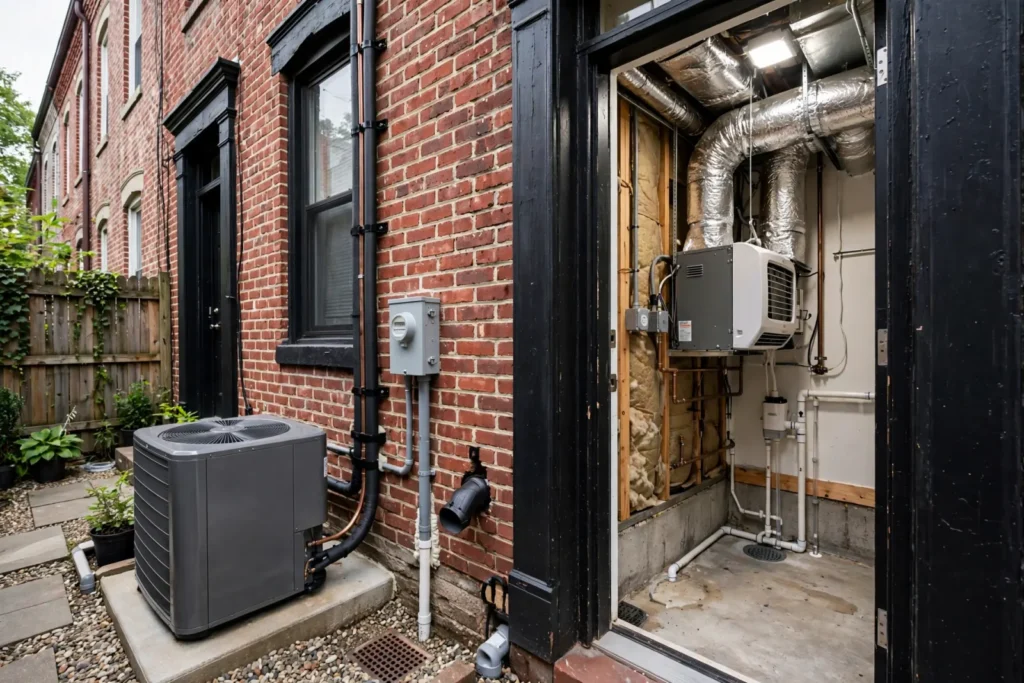
DC projects deserve a local approach because rowhouses, older duct systems, compact mechanical spaces, rooftop or rear-yard equipment, historic districts, humid summers, cold winter periods, and electrification incentives can all change the right solution. A quote should explain the complete system and permit path rather than simply naming a condenser model.
2026 Washington DC cost snapshot
Angi’s 2026 Washington, DC full-HVAC guide reports a normal range of $5,445 to $13,613 and an average of about $8,168. Its AC-only guide reports $4,597 to $8,395, averaging $6,190. Its heat-pump guide reports $4,477 to $7,349, averaging about $5,896.
Those ranges overlap because equipment type is only one cost driver. Duct replacement, electrical upgrades, difficult attic or roof access, line-set routing, permits, crane use, condensate routing, and conversion from gas heat to an all-electric heat pump can add thousands of dollars.
AC-only, furnace-and-AC, or heat pump
A cooling-only replacement keeps the existing heating system. That can make sense when the furnace or boiler is relatively new and compatible with the new indoor coil and blower. A matched furnace-and-AC project can be efficient when both systems are old and share indoor equipment or controls.
A heat pump provides both heating and cooling and is increasingly relevant in DC. Cold-climate models can carry most or all of the heating load when sized correctly. Some homes use dual-fuel systems, while others fully electrify and remove gas heat. The best configuration depends on building load, electrical capacity, ducts, utility rates, backup strategy, and incentives.
DC mechanical permits
District of Columbia Department of Buildings guidance states that installation, repair, or replacement of refrigeration and air-conditioning systems requires a mechanical permit. DOB also offers an instant mechanical permit for qualifying simple work, including installation of not more than one new air-conditioning unit up to 10 tons, when issued to a licensed contractor under the defined scope.
The contractor should identify the exact permit path before work. DCSEU rebate documentation also uses DOB permits as proof of compliant HVAC installation, so permit handling can affect both code compliance and incentive eligibility.
DCSEU rebates in the current fiscal year
As of October 2026, DCSEU’s current residential rebate application guidance covers Fiscal Year 2027, running from October 1, 2026 through September 30, 2027. The program states that qualifying electric heat pumps, heat-pump water heaters, and other products can receive rebates, with heat-pump and electrification incentives reaching into the thousands of dollars depending on equipment and whether the project switches from gas to electric.
DCSEU rebate amounts and eligibility can change, and equipment should be checked before purchase. The application guide instructs homeowners to verify the qualifying product and keep required documentation. Do not let a salesperson subtract a rebate from the contract price unless the exact equipment and installation date meet the current program rules.
Ductwork and old rowhouses
Many DC homes have ducts routed through basements, chases, attics, or additions that were never designed for modern airflow. A larger new system will not fix undersized returns, disconnected ducts, poorly balanced branches, or excessive static pressure.
If rooms are chronically hot or cold, ask for a duct and airflow assessment before approving equipment size. Use the Home Cost Desk Ductwork Replacement Cost 2026 guide to separate distribution-system cost from the equipment quote.
Sizing for humid summers and winter heating
DC summers are hot and humid, so oversizing can reduce dehumidification by causing short cooling cycles. Winter heating adds a second design condition, especially for heat pumps. The contractor should calculate the building load rather than selecting equipment from square footage alone.
For heat pumps, ask for capacity at cold outdoor temperatures, not just nominal tonnage. A unit that meets cooling load but loses too much heating capacity on cold days may require expensive resistance backup or a dual-fuel strategy.
Electrical capacity and heavy-ups
Gas-to-electric HVAC conversion can reveal an electrical-service constraint. A heat pump itself may fit the existing service, but auxiliary heat, water heating, cooking, EV charging, and future loads can change the calculation.
DOB offers an Electrical Heavy-Up Instant Permit for qualifying residential upgrades up to 200 amps, and DCSEU’s current application materials include certain electrification-service rebates for heavy-ups and circuit additions tied to gas-to-electric projects. Ask the HVAC and electrical contractors to coordinate load calculations before equipment is ordered.
Efficiency ratings and matched equipment
Compare complete matched-system ratings, not just the outdoor unit. SEER2, EER2, HSPF2, compressor staging, indoor coil, blower, and controls all affect performance. A premium variable-speed outdoor unit paired with restrictive ducts may not deliver the expected comfort or efficiency.
Ask for the AHRI matched-system reference when available. If DCSEU eligibility depends on ENERGY STAR or other efficiency tiers, verify the exact model combination before installation.
Federal credit warning for 2026
The former federal Section 25C Energy Efficient Home Improvement Credit, which previously covered certain heat pumps and other HVAC equipment, ended for property placed in service after December 31, 2025 under current law. A homeowner installing equipment in 2026 should not assume the old federal heat-pump tax credit is available.
DCSEU and other local incentives can still be meaningful, so the right 2026 strategy is to verify current District and utility programs rather than relying on an outdated federal-credit article.
Repair versus replacement
Minor controls, capacitors, contactors, drain problems, sensors, motors, or refrigerant components can often be repaired. Angi’s local 2026 data puts many DC HVAC repairs around $142 to $2,178, averaging about $381, although major compressors, coils, or difficult refrigerant problems can cost much more.
Replacement becomes more attractive when the equipment has repeated failures, major refrigerant leaks, obsolete components, severe corrosion, an expensive compressor or coil failure, or a planned electrification project. Compare the repair quote with the complete installed replacement, not the retail price of the outdoor unit.
Three DC project scenarios
Scenario 1 – straightforward AC replacement: the furnace and ducts are serviceable, electrical conditions are adequate, and the new cooling equipment is installed in the same location. This is the project most likely to sit near the AC-only local range.
Scenario 2 – full heat-pump conversion: the homeowner removes gas heating, installs a cold-climate ducted heat pump, upgrades controls and electrical circuits, and applies for DCSEU incentives. The gross project can cost more, but verified rebates may materially reduce net cost.
Scenario 3 – rowhouse with poor ducts: the existing system is oversized and rooms are uneven. The best scope includes equipment replacement plus return-air correction, duct sealing, and balancing rather than simply increasing tonnage.
How to compare Washington DC HVAC quotes
Require exact indoor and outdoor model numbers, capacity, matched efficiency, thermostat, refrigerant type, line-set plan, duct assumptions, condensate work, electrical scope, permit responsibility, DCSEU documentation support, equipment removal, commissioning, and warranties.
Use the Home Cost Desk HVAC Replacement Cost 2026 guide and Heat Pump Cost 2026 guide for national comparison, but keep DC permits, rowhouse access, electrical capacity, and current local rebates in the decision.
- Verify the contractor holds the required DC license.
- Confirm the DOB mechanical permit before installation.
- Check current DCSEU equipment eligibility before buying.
- Ask for a load calculation and cold-weather heat-pump capacity.
- Inspect duct condition and return-air capacity.
- Keep permit, rebate, model, startup, and warranty records.
Historic districts and visible equipment
Some Washington, DC properties are in historic districts or have architectural constraints that affect outdoor unit placement, line-hide routing, roof penetrations, or visible facade changes. Mechanical permitting does not automatically resolve historic-review or association requirements.
Ask the contractor to identify whether the proposed equipment location changes the visible exterior and whether another approval is needed. Planning this before ordering avoids expensive relocation after delivery.
Condensate and water-management details
High-efficiency cooling and heat pumps remove substantial moisture in DC summers. Condensate lines, traps, drain pans, float switches, and termination points should be inspected and rebuilt where needed. Poor drainage can cause ceiling or wall damage even when the HVAC equipment itself operates correctly.
If the air handler is in an attic or upper floor, ask for secondary protection and how an overflow will be detected. Condensate scope should be explicit in the contract.
Commissioning: the part homeowners rarely see
A replacement is not finished when the equipment turns on. The contractor should verify airflow, static pressure, refrigerant charge using the manufacturer’s method, thermostat configuration, temperature performance, condensate operation, and safety controls.
For heat pumps, ask the installer to configure backup heat lockouts or staging correctly. Bad control settings can erase efficiency gains even when the equipment is excellent.
Homeowner decision checklist
Before signing, compare at least two or three written proposals that describe the same scope. Normalize the bids by separating required work, condition-dependent work, optional upgrades, permit or inspection costs, and finish restoration. A low total is not a bargain when major items are simply excluded.
Photograph the existing conditions and keep model numbers, measurements, prior repair invoices, and any permit or utility records. Ask each contractor to explain the assumptions behind the proposal and what would trigger a change order. The goal is to make the price auditable before demolition or disconnection begins.
Check contractor licensing and insurance through the relevant local authority, read both equipment and labor warranties, and avoid large decisions based only on a same-day discount. A well-defined project makes it easier to compare value and reduces conflict if site conditions differ from expectations.
Mini-splits for additions and rowhouses
Ductless mini-splits can be a strong option for additions, top floors, English basements, enclosed porches, and rowhouses where extending central ducts would be destructive or inefficient. A multi-zone system avoids large duct runs but introduces multiple indoor heads, refrigerant lines, condensate drains, and exterior line-hide routes.
Do not assume a multi-zone mini-split is always cheaper than a ducted heat pump. Compare total installed cost, low-temperature capacity, head placement, condensate management, exterior appearance, service access, and the efficiency penalty that some multi-zone systems experience at part load.
Noise, neighbor proximity and outdoor-unit placement
Dense DC lots make outdoor-unit sound and placement more important than in a detached suburban setting. A condenser or heat pump close to a bedroom window, party line, rear deck, or neighbor’s patio can create complaints even when it meets basic equipment specifications.
Ask for the published sound rating and discuss vibration isolation, wall brackets, pad location, snow or leaf clearance, and service access. The quietest location is not always the easiest refrigerant-line route, so placement should be resolved before the final quote.
Maintenance plan after replacement
New equipment still needs filters, coil cleanliness, drain maintenance, and periodic professional service. Heat-pump owners should keep outdoor coils clear of leaves and debris and understand normal defrost operation in winter. Thermostat settings and backup-heat controls should not be changed blindly after commissioning.
Record the filter size, model and serial numbers, refrigerant type, permit number, rebate application, startup measurements, and labor warranty in one home file. That information shortens future service calls and helps preserve warranty rights.
Use the national HVAC replacement cost guide to separate local labor, permit and climate effects from the underlying equipment cost, then run the HVAC replacement cost calculator for a planning estimate.
Bottom line
Washington, DC HVAC replacement in 2026 averages about $8,168 in Angi’s local data, with many full-system projects between $5,445 and $13,613. AC-only replacement averages around $6,190, while local heat-pump installations average around $5,896 before unusual building or electrical work.
The strongest DC project combines correct sizing, sound ducts, clear DOB permits, realistic electrical planning, verified current DCSEU incentives, and documented commissioning. In 2026, local rebate strategy matters more than the expired federal Section 25C credit.
Frequently asked questions
How much does HVAC replacement cost in Washington, DC in 2026?
Angi reports an average around $8,168 and a common full-system range of about $5,445 to $13,613.
How much does AC replacement cost in DC?
Angi reports a local average around $6,190 and a common range of about $4,597 to $8,395.
Do I need a permit for HVAC replacement in DC?
Yes. DC DOB lists installation, repair, or replacement of refrigeration and air-conditioning systems under mechanical permitting. Some simple scopes qualify for instant permits through licensed contractors.
Are DCSEU heat-pump rebates available after October 1, 2026?
DCSEU has FY2027 residential rebate terms effective October 1, 2026 through September 30, 2027. Exact equipment and rebate amounts should be verified before purchase because program terms can change.
Is the federal heat-pump tax credit available for 2026 installations?
The Section 25C credit ended for property placed in service after December 31, 2025 under current federal law.
Should I replace ducts with the HVAC system?
Only when inspection shows leakage, damage, poor insulation, undersizing, or airflow problems that would prevent the new equipment from performing correctly.
Sources
- Angi – HVAC Replacement Cost in Washington, DC [2026 Data]
- Angi – AC Replacement Cost in Washington, DC [2026 Data]
- Angi – Heat Pump Cost in Washington, DC [2026 Data]
- DC Department of Buildings – Mechanical Permit
- DC Department of Buildings – Instant Permits
- DCSEU – Apply for Residential Rebates
- DCSEU – Residential Electric HVAC Rebates
- IRS – OBBB Energy Credit Termination FAQs